Over the years, we have watched teams spend enormous energy on the content of their meetings without ever addressing the dynamics underneath them. The agenda gets covered, the decisions get made, and yet something still feels off. People leave meetings unsatisfied without quite knowing why. Tension that surfaced in last month’s meeting shows up again in this one. The same issues keep cycling through.
What we have found, consistently, is that those teams are solving for the wrong level of the problem.
Most teams treat every meeting as a content meeting. They focus on what they need to accomplish: the task list, the project update, the decision that needs to be made. That content work is obviously critical. But it is only one dimension of what happens in a room when a team gets together. The other dimension, how the team actually operates together, is almost never addressed directly. And when it isn’t, it quietly shapes the quality of every content conversation that follows.
The Content vs. Process Meetings model makes that distinction visible so leaders can address both, intentionally and at the right time.
What Content and Process Actually Mean
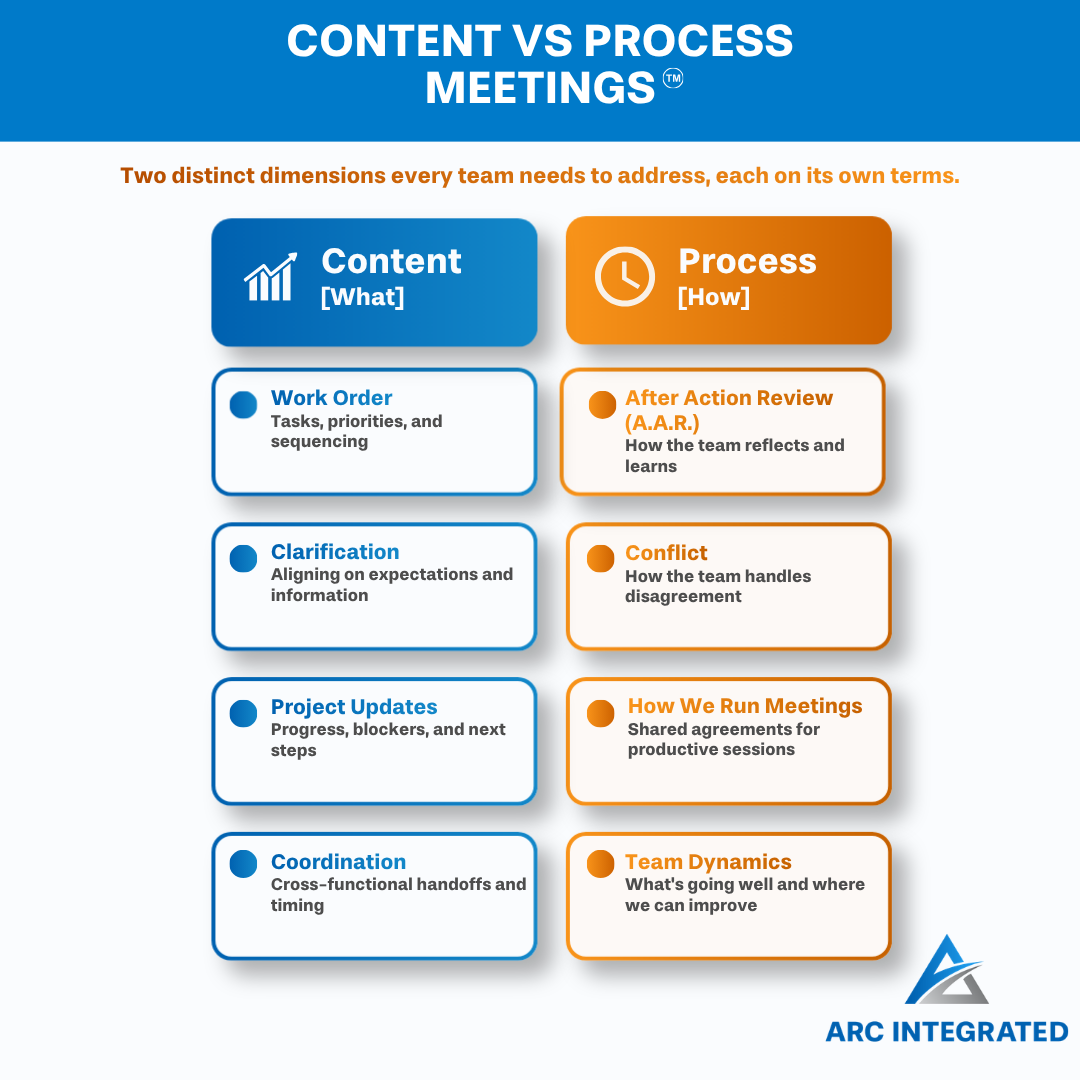
The content of a meeting is what it is about. Work order, prioritization, project updates, decisions, clarifications. These are the agenda items. They are the reason most people think meetings exist.
The process of a meeting is how the team operates within it. It includes how the team handles disagreement when it arises, what communication style norms are in place, how the group reflects and learns from what went well and what did not, and most fundamentally, how the team has agreed to run meetings themselves. Process is the meta-layer. It is the set of agreements, spoken or unspoken, that governs how people show up and engage with each other.
Most teams have a clear sense of their content and almost no explicit agreement about their process. The process exists, but it is developed by default rather than by design. And because it was never made explicit, it cannot be easily examined, challenged, or improved.
Why Process Gets Ignored
There is a practical reason most leaders avoid process conversations. They feel risky and sometimes just less important. Addressing what the team is working on is neutral territory. Addressing how the team operates together feels personal, and leaders often worry that naming process issues will come across as critical or top-down, as if they are announcing that the team is doing something wrong.
What we have seen in practice is that this avoidance is costly. Research on psychological safety shows that leader communication behaviors that encourage participation and honest dialogue are positively associated with team learning and performance (Edmondson & Lei, 2014). When process norms are never addressed, the team cannot improve them. The dynamics that are limiting effectiveness stay in place, because nobody created a legitimate space to examine them.
It is also often the process elements that drive people’s desire to stay on a team and within a company, or leave.
The Content vs. Process model gives leaders a simple structure for knowing when to have which kind of meeting, and how to facilitate the process of conversation in a way that does not feel like a verdict.
Two Kinds of Meetings, Two Different Purposes
Not every meeting needs to address both content and process. Most meetings are appropriately focused on content. But every team, at regular intervals, needs a meeting that steps back from the work itself and examines how the team is functioning.
Content meetings are the day-to-day operational rhythm. They address what the team needs to do, decide, coordinate, and communicate. A well-run content meeting follows a clear agenda, stays on time, tracks commitments, and closes with a shared understanding of next steps. The Successful Meeting Protocol we describe in detail elsewhere covers the structure for making those meetings work consistently.
Process meetings are less frequent and require a different kind of preparation. They address the agreements the team operates under. Asking questions such as –
- How do we handle conflict when it comes up?
- What are our communication norms?
- What does a good team meeting look like for us, and are we living up to it?
- Are there dynamics in how we work together that are getting in the way?
- In what ways can we hold each other accountable?
- What happens when agreements aren’t held up?
These conversations do not need to be long. They need to be intentional. The distinction between content and process is not about separating two permanent categories of work. It is about knowing which lens to apply at a given moment, so that the team can improve not just what it produces but how it operates.
What Goes on the Process Side
From our work with teams across industries, the process dimension of team functioning tends to cover four areas that shape how well a content meeting can even go.
How we run meetings is the most meta of the four, but often the most impactful. When a team has never explicitly agreed on what a good meeting looks like for them, every meeting is governed by the leader’s default approach, and the team has no shared standard to hold each other to or to evaluate against.
- After Action Review is the practice of stepping back after a project, a cycle, or a significant event and asking what worked, what did not, and what the team would do differently. Without this built into the rhythm, teams keep repeating the same patterns without learning from them. Research on team learning behaviors consistently finds that teams that engage in deliberate reflection and adjustment show measurably higher performance over time (Edmondson, 1999).
- Conflict norms address what the team does when people disagree. Most teams have no explicit agreement here, which means conflict either goes underground and resurfaces as passive friction, or escalates in ways that damage relationships. Having a shared understanding of how disagreement gets handled, and where it goes when two people cannot resolve it directly, changes the team’s willingness to name tension early. This connects directly to the Conflict Resolution Framework, which provides a clear escalation path for doing exactly that.
- Communication style norms address how people prefer to give and receive information, how direct is direct enough, how much context is needed before a decision, and what the team’s agreements are around response time, meeting participation, and shared documentation. When these are left implicit, they become a source of friction that nobody can quite name.
- How we run meetings is the most meta of the four, but often the most impactful. When a team has never explicitly agreed on what a good meeting looks like for them, every meeting is governed by the leader’s default approach, and the team has no shared standard to hold each other to or to evaluate against.
How This Connects to Team Dynamics
The Content vs. Process distinction is the foundation, but it becomes most powerful when combined with a structured approach to actually facilitating a process conversation with a team.
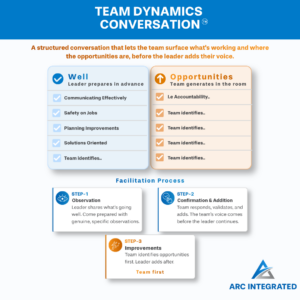
We will address that in more detail in the Team Dynamics Framework post coming in a couple on months, which covers the specific method for how a leader prepares for and facilitates a process-level conversation in a way that invites the team to drive the improvement agenda rather than receiving it from the top. The short version is that the leader comes prepared with observations about what is going well, opens space for the team to respond and add, and then invites the team to identify where the opportunities for improvement are before the leader offers their own. That sequence changes the entire dynamic of the conversation.
The Going Deeper Questions framework also belongs in this space. Those questions were designed specifically for the kind of one-to-one conversations that surface the individual-level process dynamics that do not always come up in a group setting.
What Changes When Teams Address Both Dimensions
In our experience, the teams that most consistently perform well are not the ones that have the most sophisticated content systems. They are the ones that have made explicit agreements about how they operate and that revisit those agreements regularly.
When a team has a shared understanding of how it handles conflict, how it communicates, how it runs its meetings, and how it reflects and learns, those agreements create a container that makes content conversations more productive. People feel safer raising issues. Disagreement is less threatening. Trust builds across the team not just through individual relationships but through a shared operating system that everyone has bought into.
Research on shared team cognition supports this pattern. When teams develop a more coherent, shared understanding of how their work fits together and how they function as a unit, that shared understanding is meaningfully associated with higher team performance (DeChurch & Mesmer-Magnus, 2010). The process side of the model is not soft culture work. It is the structural condition that determines how well the content side can function.
A Reflective Pause
Think about the last time your team had an explicit conversation about how it operates, not what it is working on, but how it works together. Consider whether your team has a shared, spoken agreement about how disagreement gets handled or how meetings are run. And ask yourself whether the friction that shows up repeatedly in your content meetings might actually be a process issue that content alone cannot solve.
The distinction between content and process is not complicated. What is uncommon is treating both as worth addressing intentionally.
If you are interested in learning how to apply this model inside your team or organization, book a free strategy call with us. We guarantee you will gain valuable insights into what might help take your team to the next level.