Over the years, we have seen a version of the same costly mistake repeat itself across organizations of every size. A position opens up, a job description is written in a hurry, someone is hired, and within six to twelve months the leader is frustrated because the person is not performing the way they expected. The employee is frustrated because they are not sure what success actually looks like in their role. And the organization absorbs the cost of the mismatch in lost productivity, difficult conversations, and eventually a search process that starts over.
What we have found, consistently, is that the problem did not begin at the hiring stage. It began at the job description stage, or more accurately, at the stage before the job description was written, when nobody asked the right questions about what the role actually required.
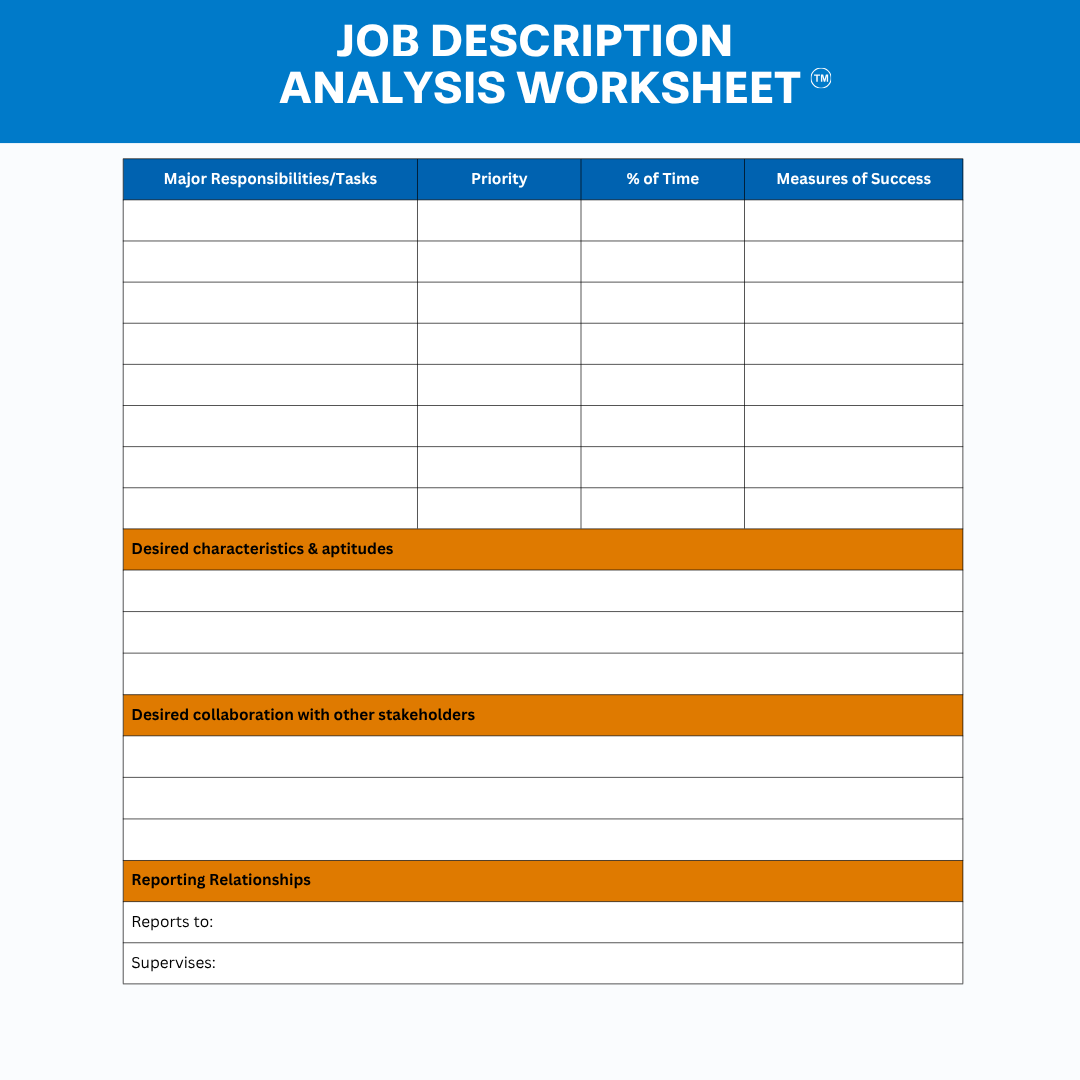
The Job Description Analysis Worksheet is a tool designed to make those questions explicit before a single word of a job posting is written. It is not a template for a job description. It is the thinking that should happen before one.
Why Job Descriptions Fail
Most job descriptions are written by copying an old version of the same role, adjusting a few bullet points, and posting it. The result is a document that describes what the previous person did rather than what the organization actually needs, one that lists tasks without saying how much time should be spent on each, one that uses words like “accountable” and “responsible” without defining what those mean in this specific context, and one that has no way of measuring whether the person in the role is succeeding.
Gallup’s research on employee engagement has consistently found that only about one in three employees strongly agrees that they know what is expected of them at work. That gap between what leaders assume employees understand and what employees actually understand begins at the job description and compounds from there. When the role is not clearly defined before someone is hired, it is almost impossible to clearly define it after, because the ambiguity becomes part of the working relationship.
Research on leader self-perception deepens the problem further. Studies consistently show that leaders’ self-ratings of their own effectiveness align only moderately with how others experience their leadership (Atwater & Yammarino, 1992). What this means in practice is that when a leader writes a job description based on their own mental model of what the role requires, that mental model is often incomplete. A structured worksheet forces leaders to make that model explicit and test it before it becomes someone else’s job.
Research on goal setting reinforces the same point from a different angle. Locke and Latham’s foundational work demonstrated that specific, measurable goals produce significantly higher performance than vague ones (Locke & Latham, 2002). A job description that does not specify what success looks like is a goal-setting failure before the role even begins.
The Job Description Analysis Worksheet was built to prevent that failure at the source.
What the Worksheet Covers
The worksheet is structured in three sections, each addressing a different dimension of role definition. Together they give a leader a complete picture of what the role requires before any hiring or onboarding conversation happens.
Section One: The Role Summary
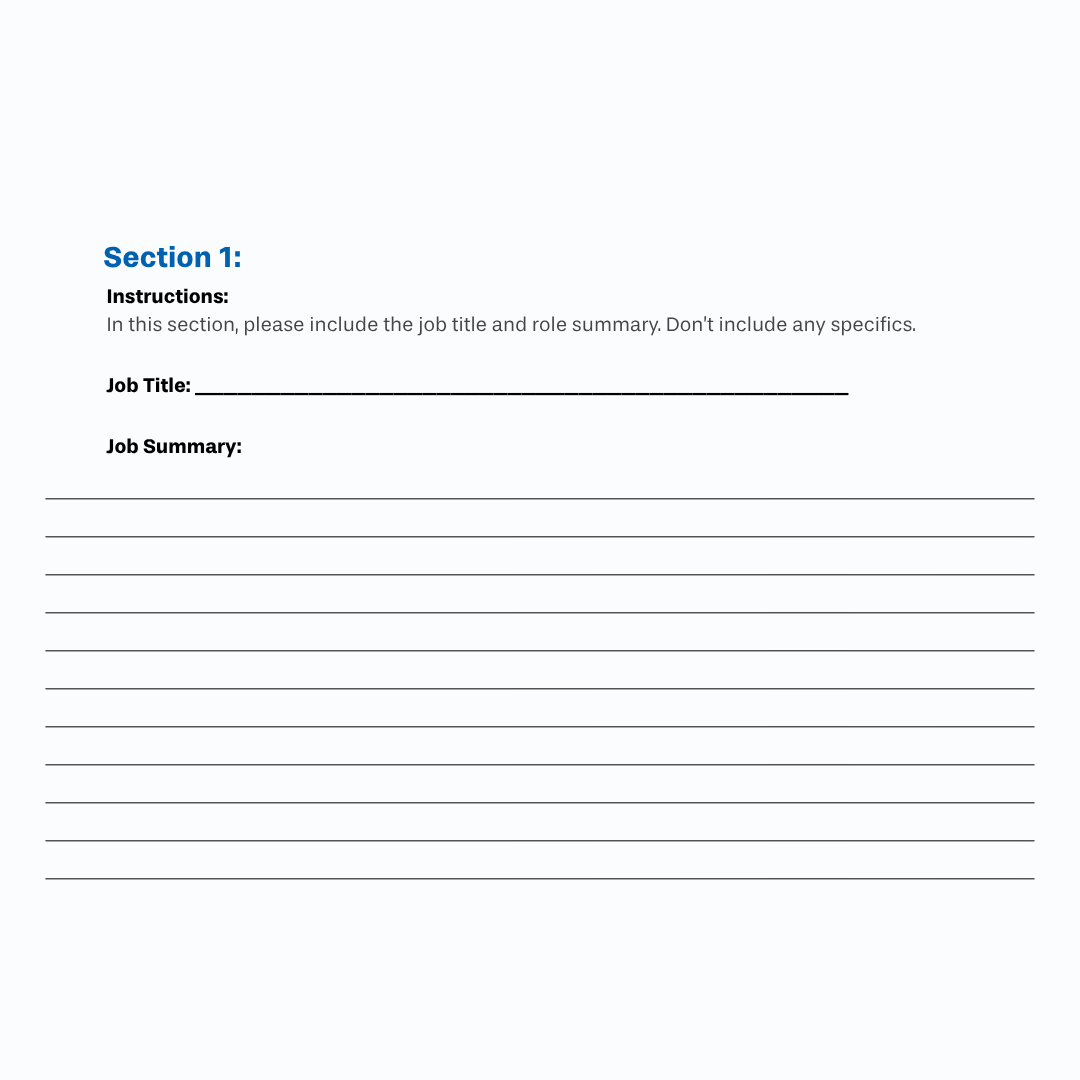
The first section establishes the foundation. It asks for the job title and a job summary that captures the essence of the role without getting into specifics. The job summary at this stage is not a marketing document. It is a clarity exercise. It forces the leader to articulate, in plain language, what this role exists to do and why it matters to the organization.
This step sounds simple. In our experience, it is often where the first gaps in clarity surface. When a leader sits down to write a two-paragraph summary of a role and struggles to get past one, that is usually a signal that the role itself has not been clearly defined internally. The worksheet surfaces that ambiguity before it becomes someone else’s problem.
Section Two: Responsibilities, Priorities, and Measures of Success
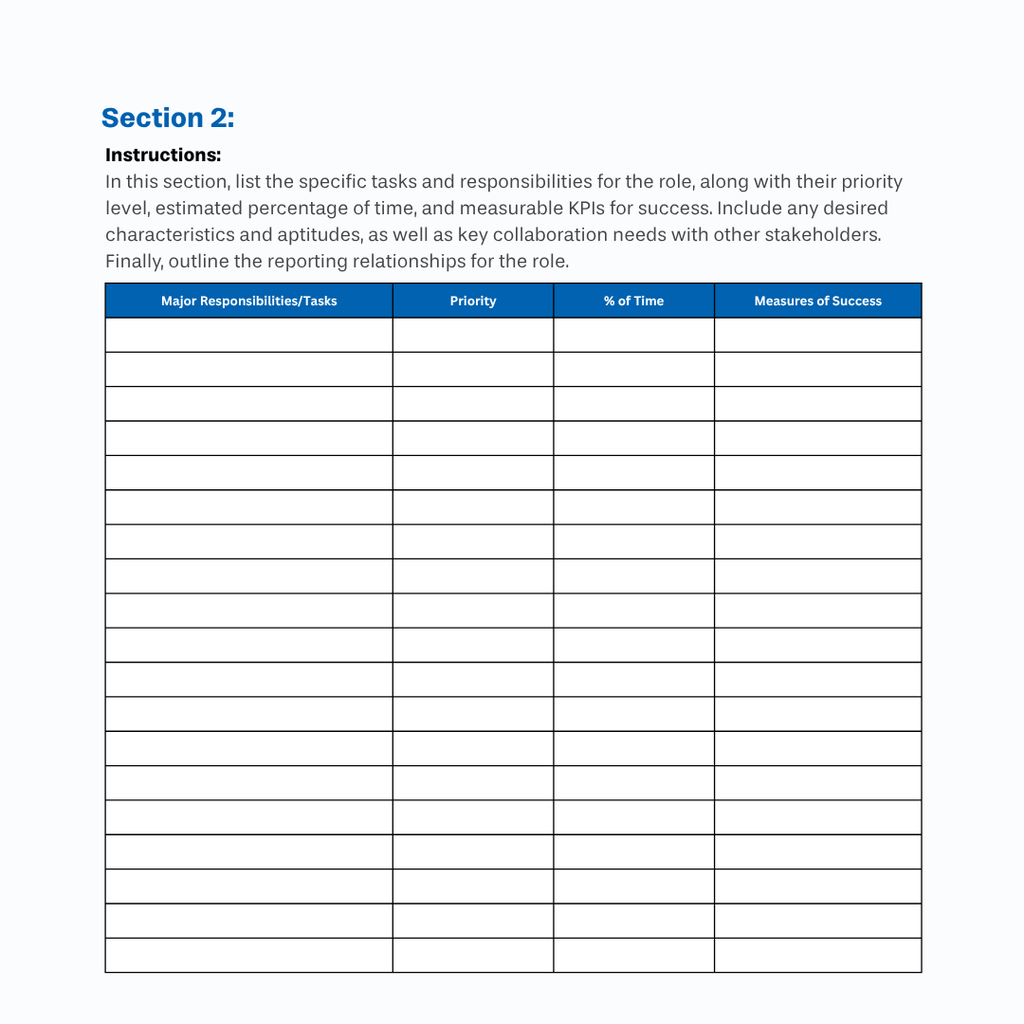
The second section is where the substantive work happens, and it is where most job description processes either skip steps or stay too vague to be useful.
Major Responsibilities and Tasks The worksheet asks leaders to list the primary duties of the role. This is familiar ground. What is less familiar, and more important, is what comes next.
Priority and Percentage of Time For each responsibility, the worksheet asks for a priority level and an estimated percentage of time the person in the role should be spending on it. This step alone surfaces misalignments that would otherwise take months to discover. When a leader realizes that the three responsibilities they listed as highest priority add up to more than one hundred percent of someone’s time, they have identified a structural problem before hiring for it. When a leader realizes that the task they listed first is actually the one they expect the person to spend the least time on, the priority list needs to be reordered.
In our experience, this is one of the most clarifying exercises a leader can do before a hire. It forces a realistic conversation about what the role actually demands rather than what would be ideal in theory.
Measures of Success For each responsibility, the worksheet asks how the organization will know if the person is doing it well. This is the step that most job descriptions skip entirely, and it is the step that matters most for ongoing performance management. A responsibility without a measure of success is an expectation without accountability. The person in the role cannot self-assess, the leader cannot give meaningful feedback, and performance reviews become subjective in ways that erode trust on both sides.
Defining success measures before hiring is also one of the clearest ways to make the Success Path visible from day one. When a new employee understands not just what they are responsible for but how the organization will measure whether they are succeeding, the upward trajectory becomes concrete rather than aspirational.
Section Three: People, Collaboration, and Reporting
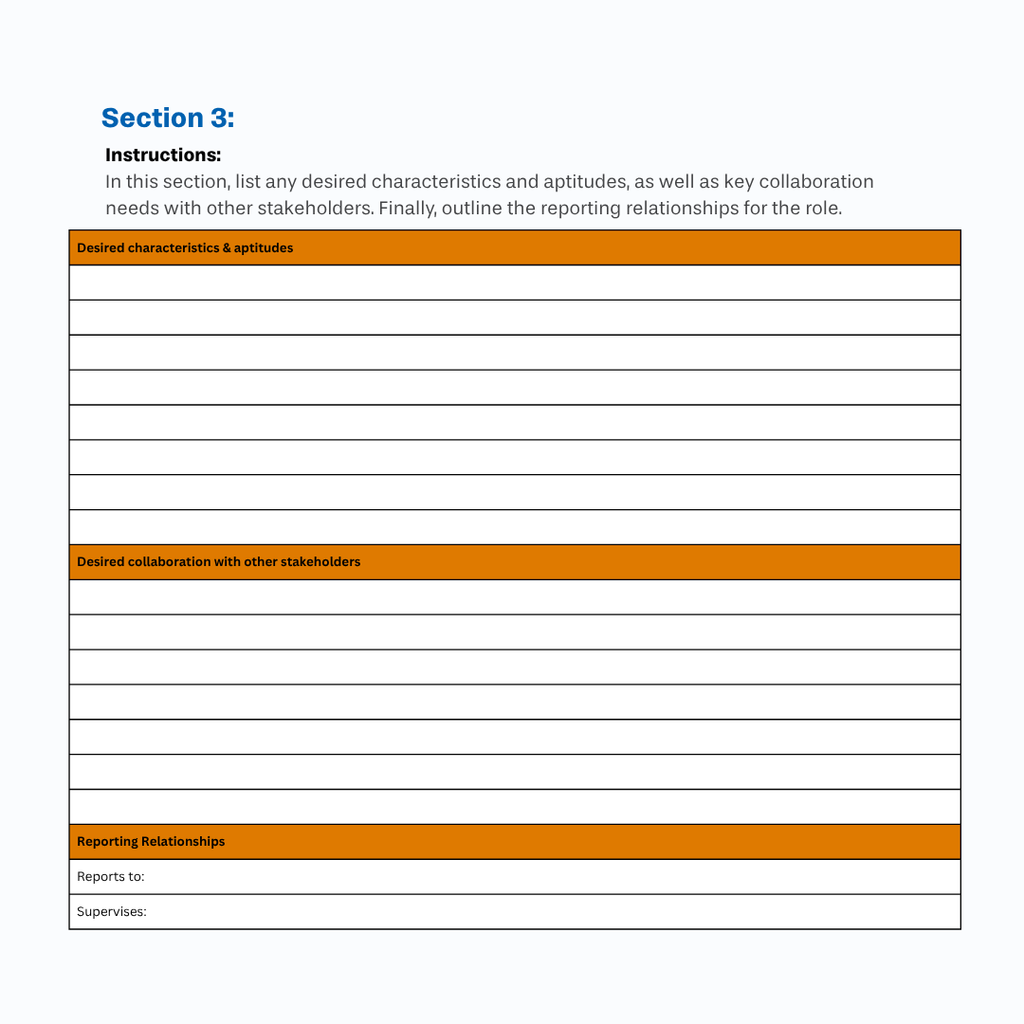
The third section shifts from what the role requires to how the person in the role fits within the broader organization. It covers three areas that are often treated as afterthoughts in a standard job description but that have an outsized impact on whether someone succeeds once they are in the role.
Desired Characteristics and Aptitudes The worksheet includes space for the leader to articulate what kind of person tends to thrive in this role, beyond technical skills. This section is about fit in a meaningful sense, not cultural fit as a vague concept, but the specific thinking styles, working preferences, and personal qualities that the role genuinely rewards. A highly autonomous role requires different aptitudes than a highly collaborative one. A role that involves frequent ambiguity requires different characteristics than one with clearly defined processes. Getting this on paper before interviewing makes the evaluation process significantly more reliable. Research comparing high-performing and average managers found that higher performers showed significantly greater alignment between how they saw themselves and how others experienced them (Church, 1997). Hiring for characteristics that match the actual demands of a role, rather than an idealized version of it, is one of the most direct ways to close that gap from the start.
Desired Collaboration with Other Stakeholders This section asks the leader to think through who this role needs to work with well, and what those working relationships need to look like. Collaboration expectations are often assumed rather than stated, which is how new hires end up surprised by the degree of cross-functional coordination their role requires, or how they end up isolated from the relationships they need to do their job effectively.
Reporting Relationships The final element establishes who the person reports to and who they supervise. This seems straightforward, but it connects directly to the broader question of accountability and authority that sits underneath every org structure. Reporting relationships on paper define structure. How those relationships actually function, who has authority to make which decisions, what accountability looks like in practice, and what leadership means at each level, is where the real organizational design work happens. These definitions deserve more attention than a job description typically gives them, and the worksheet creates the opening for that conversation.
The Real Cost of Skipping This Step
We want to be direct about what it costs when this work does not happen.
A poorly defined role produces a poorly written job description, which attracts candidates who may not be the right fit, because the posting did not accurately represent what the role requires. Those who are hired start without a clear understanding of what success looks like, which makes onboarding slower and performance management harder. When expectations are eventually communicated, they often feel like the goalposts have moved, because they were never planted clearly in the first place. And the leader, who thought they hired for one thing, realizes six months in that the role has drifted into something different because nobody defined its boundaries precisely enough.
Research on leadership effectiveness reinforces how consequential this clarity gap is. In a study of nearly 69,000 leaders, those with significant blind spots about their own effectiveness were rated approximately half as effective as those with a more accurate picture (Zenger & Folkman, 2015). The same principle applies to role definition. When leaders operate from an incomplete or unexamined model of what a role requires, the people they place into that role are working against invisible constraints from day one.
This connects to what we explore in the Responsibility Transition. One of the most important shifts a leader makes is moving from doing the work to designing the conditions for others to do it well. A well-constructed job description is one of the earliest and most concrete expressions of that shift. It is a leader saying, I have thought carefully enough about this role to define it clearly, and I am prepared to hold myself and the person I hire accountable to that definition.
Using the Worksheet in Practice
The Job Description Analysis Worksheet is designed to be completed before any job posting is written or any recruitment conversation begins. It works best when the hiring leader fills it out and then reviews it with a senior leader, HR partner, or trusted advisor who can challenge the assumptions and flag the gaps.
It is also a useful tool for existing roles, not just open positions. When a team member’s performance is unclear or a role has drifted over time, going back to the worksheet and asking the same questions about the current state of the role often reveals where the definition broke down. In that context, it becomes a clarifying conversation rather than a hiring exercise, one that resets expectations for both the leader and the person in the role.
The COR Feedback Framework is most effective when the leader has a clear observation to ground their feedback in. The Job Description Analysis Worksheet is what makes that clarity possible at the role level. When responsibilities, priorities, and success measures are defined in advance, feedback becomes traceable to something specific rather than general, which is what makes it actionable.
If you want to download our Job Description Analysis worksheet, please click in the link below.
A Reflective Pause
Think about the roles on your team right now. Consider whether each person could articulate the top three things they are responsible for and how much of their time should be going to each one. Consider whether you could describe, clearly and specifically, what success looks like in each of those areas. And ask yourself whether the expectations you have of the people you lead have been made explicit enough for them to actually meet them.
Role clarity is not a one-time exercise. It is an ongoing leadership responsibility. The Job Description Analysis Worksheet is the starting point for getting it right.
If you are interested in learning how to apply this model inside your team or organization, book a free strategy call with us. We guarantee you will gain valuable insights into what might help take your team to the next level.