Over the years, we have seen leaders spend significant time designing organizational charts and almost no time thinking about what those charts are actually meant to communicate. The boxes get drawn. The lines get connected. The hierarchy gets mapped. And then the chart gets posted on a wall or filed in a shared drive, where it serves as a reference document rather than a leadership tool.
Most org charts answer one question: who reports to whom? That is useful, but it is only a fraction of what an org chart can do when it is built with intention. The structure of an organization carries meaning about accountability, authority, decision-making, and the boundaries between roles. When that meaning is not made explicit, people fill in the gaps with their own assumptions, which is one of the quietest and most consistent sources of organizational friction we encounter.
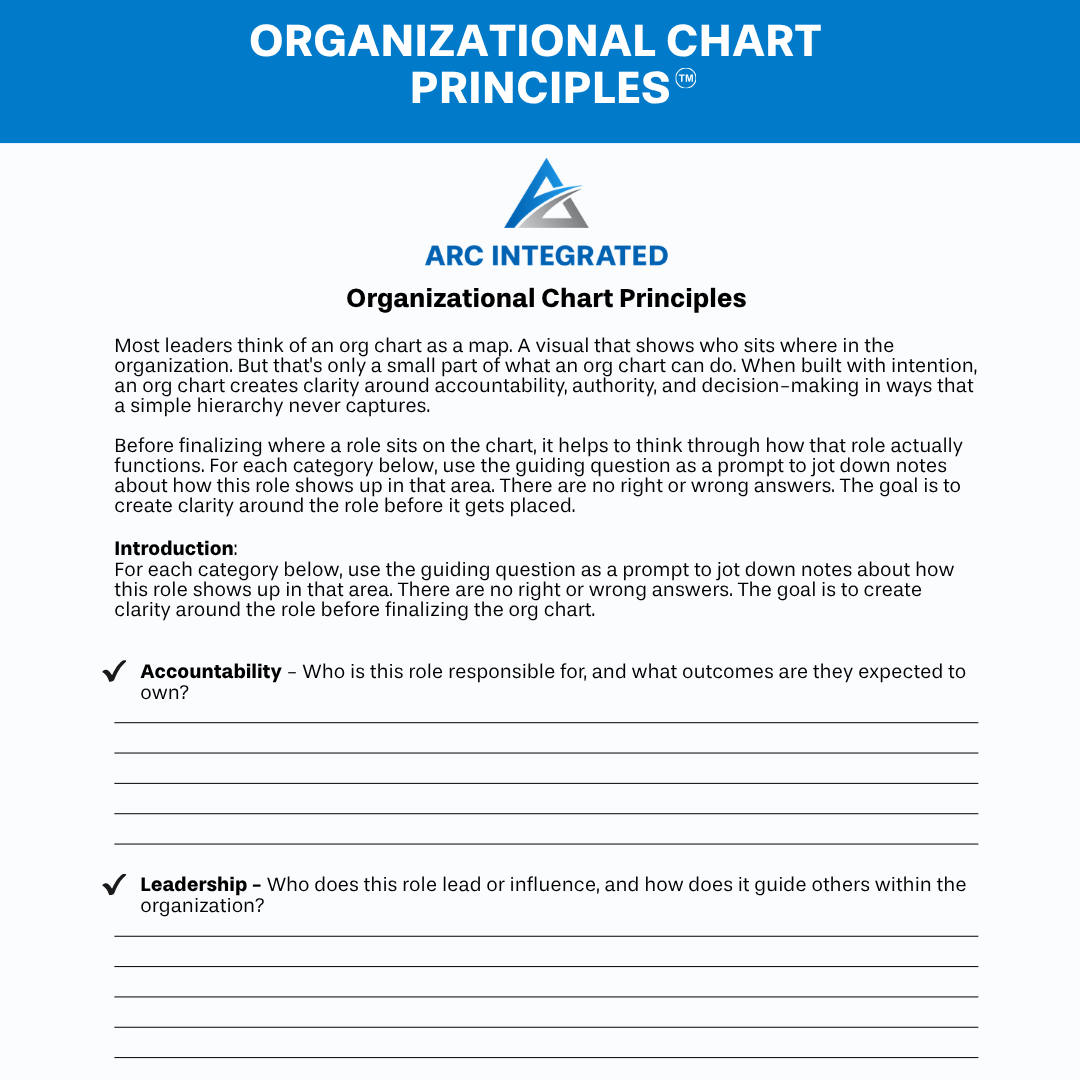
The Organizational Chart Principles worksheet was built to surface those questions before the chart is finalized, so that what gets drawn reflects how the organization actually intends to function, not just who sits where.
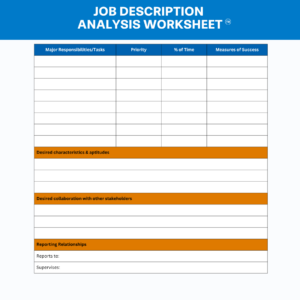
How This Connects to the Job Description Analysis Worksheet
This framework is typically taught alongside the Job Description Analysis Worksheet, and the connection between them is intentional. The worksheet helps leaders define what a role requires before hiring for it or clarifying it. The Organizational Chart Principles worksheet helps leaders define how that role relates to every other role around it.
Together, they address the two most common sources of role ambiguity in organizations. The first is internal ambiguity, where the person in the role does not know what they are responsible for or what success looks like. The worksheet addresses that. The second is relational ambiguity, where the organization has not agreed on where one role’s authority ends and another’s begins, who has the right to make which decisions, or how accountability flows through the structure. The Organizational Chart Principles worksheet addresses that.
Neither tool replaces the other. They are designed to be used in sequence, because a role that is well defined internally but poorly positioned structurally will still produce confusion, and a well-designed chart built around roles that were never clearly defined will still produce ambiguity at the individual level.
Why Most Organizational Charts Fall Short
The standard approach to building an org chart is to start with the existing structure and adjust it when something changes. A new hire gets added. A department gets reorganized. A role gets eliminated. The chart updates to reflect what happened, but the questions that should have been asked before the change often never get asked at all.
The result is an org chart that accurately reflects history without necessarily reflecting intention. It shows what is, not what should be. And when people look at that chart to understand where their authority begins and ends, or who they should involve in a given decision, or where accountability sits when something goes wrong, they often find that the chart does not tell them what they need to know.
Research on organizational role clarity consistently finds that ambiguity around authority and accountability is among the strongest predictors of stress, disengagement, and reduced performance. A 2025 study examining the psychological impact of unclear job roles found that role ambiguity leads directly to emotional exhaustion, identity confusion, and disengagement, and concludes that clear, well-communicated roles are essential to fostering a motivated, psychologically safe, and high-performing workforce (Shinde, 2025). When people are unclear about who owns what, they either over-step into each other’s territory, which creates friction, or they under-step and leave gaps, which creates execution failures. A well-designed organizational chart, built around the right questions, is one of the most direct ways a leader can prevent both.
The Six Questions That Build a Better Chart
The Org Chart Principles tool works by asking six questions about each role before it is placed on the chart. The questions are not designed to be answered perfectly. They are designed to create clarity and surface the conversations that need to happen before the structure is finalized. For each one, a leader should jot down notes about how the role actually functions in that area.
Accountability: Who Is This Role Responsible For, and What Outcomes Are They Expected to Own?
Accountability is the foundation of any org chart, and it is the category most often left undefined. Most leaders have a general sense of who is accountable for what, but that general sense tends to break down under pressure, when something goes wrong and multiple people believe the outcome was someone else’s responsibility.
This question forces specificity. It asks not just who this role is responsible to, but what outcomes they are expected to own. Outcomes, not tasks. The distinction matters because a person can complete every task on their list and still not produce the outcome the organization needed. Accountability defined at the outcome level is accountability that can be meaningfully tracked and discussed.
Leadership: Who Does This Role Lead or Influence, and How Does It Guide Others?
Leadership in an org chart context is not just about direct reports. Many roles carry significant influence without formal authority, and many formally senior roles have less actual leadership influence than their position on the chart might suggest. This question asks both dimensions: who this role formally leads, and how it guides others across the organization.
In our experience, this question often reveals informal leadership dynamics that the official chart obscures. When those dynamics are made explicit, the organization can design around them rather than working against them. Research on leadership identity shows that the people whose leadership is accepted and recognized by those around them are consistently rated as more effective, and that recognition translates directly into whose decisions carry weight in practice (Marchiondo, Myers & Kopelman, 2015). It also connects directly to what we explore in the Conscious Influence Model, where real leadership influence is earned through how someone shows up rather than assigned through a title.
Authority: What Decisions Is This Role Empowered to Make, and Over What Resources or People?
Authority is the question that most org charts leave completely unanswered, and the gap between formal authority on paper and actual authority in practice is one of the most common sources of organizational frustration.
When authority is not defined, two things tend to happen. People in senior roles make decisions that should be pushed down, because no one explicitly said otherwise. And people in more junior roles hesitate to make decisions they are actually empowered to make, because the boundary was never drawn clearly. Both patterns slow organizations down and erode the kind of autonomy that high performers need to stay engaged. Research on leader communication and employee voice finds that when people trust the boundaries of authority are clear and honest, they speak up more and escalate less (Detert & Burris, 2007).
Defining authority explicitly, for each role, before the chart is finalized, is one of the most direct ways a leader can build the kind of accountability culture described in the Conflict Resolution Framework. When people know what they are empowered to decide, direct communication becomes the natural default rather than escalation.
Decision Making: What Does This Role Handle Independently, and What Requires Escalation or Collaboration?
This question is the operational complement to the authority question. Authority defines the scope of a role’s decision-making power. This question defines the process. Which decisions can be made independently? Which ones require input from others before moving forward? Which ones need to escalate to a different level of the organization?
These boundaries are almost never drawn explicitly in a standard org chart, which means people develop their own rules of thumb over time, and those rules of thumb vary from person to person. When the rules are made explicit, meetings get shorter, fewer decisions get escalated unnecessarily, and the people who are supposed to be making decisions actually do.
Boundary Setting: Where Does This Role’s Responsibility Begin and End?
This question addresses the overlap problem. In most organizations, there are areas where two roles share responsibility for a similar outcome, and without a clear definition of where one ends and the other begins, both people either duplicate work or assume the other is handling it.
Boundary setting is not about reducing collaboration. It is about making collaboration intentional rather than accidental. When each role’s boundaries are drawn clearly, the handoffs between roles become visible, and the organization can design those handoffs rather than leaving them to chance. This connects to the Communication Map, where calibrating the right level of structure and communication to each situation is what makes coordination reliable rather than reactive.
Living with Uncertainty: How Does This Role Navigate Ambiguity and Evolving Priorities?
This is the question that distinguishes a static organizational chart from a living one. Organizations change. Priorities shift. New opportunities emerge that do not fit neatly into existing role definitions. Rather than asking how a single role handles ambiguity on its own, this question asks leaders to think comparatively, how is this role likely to evolve relative to the others around it, and what does that mean for how it should be positioned and defined today?
Some roles are likely to expand in scope as the organization grows. Others may consolidate or shift function. Thinking about that trajectory before finalizing the chart means the structure is built with some anticipation of where the organization is going, not just a snapshot of where it is. That forward-looking perspective is what makes an organizational chart genuinely useful over time rather than something that needs to be redrawn every time the organization changes direction.
What Changes When These Questions Are Asked
In our experience, the organizations that work through these six questions before finalizing their org charts produce structures that hold up much longer than those that do not. Roles are clearer. Handoffs are smoother. Accountability conversations are easier because everyone agreed in advance on what ownership means. And the chart itself becomes a useful reference rather than a document that is technically accurate but practically meaningless.
These questions also change the nature of the conversation between leaders at different levels of the organization. When a senior leader and a direct report work through the accountability, authority, and decision-making questions for the direct report’s role together, they are having a conversation that most leadership relationships never have explicitly. The result is a level of alignment that produces faster execution, less micromanagement, and more genuine autonomy for the person in the role. Research on leadership effectiveness consistently shows that leaders with a more accurate picture of how their decisions and authority are experienced by others are rated significantly more effective than those operating with blind spots (Zenger & Folkman, 2015). These six questions are one of the clearest ways to close that gap before it becomes costly.
If you want to download our worksheet of the Organizational Chart Principles, please click in the link below.
A Reflective Pause
Think about the roles in your organization right now. Consider whether the people in those roles could answer the six questions above clearly and consistently with how you would answer them. Consider where the authority boundaries are ambiguous, where accountability for a key outcome is shared in a way that effectively means nobody owns it, and where decision-making rules have been assumed rather than agreed on.
An org chart is only as useful as the thinking that went into building it. These questions are that thinking, made visible.
If you are interested in learning how to apply this model inside your team or organization, book a free strategy call with us. We guarantee you will gain valuable insights into what might help take your team to the next level.