Over the years, we have seen the same pattern play out across organizations of every size and industry. Two people have a problem with each other. Instead of talking directly, one of them talks to someone else first. That person tells a third person. A manager gets pulled in. HR gets a call. And by the time anyone addresses the actual issue, it has grown into something much harder to untangle than it ever needed to be.
The conflict itself was often manageable. What made it costly was the path it traveled before anyone tried to resolve it.
This is what we built the Conflict Resolution Framework to address. Not just how to resolve conflict when it arrives, but how an organization agrees in advance to handle it so that the default response is direct communication rather than triangulation, escalation, or unnecessary drama.
Why Most Organizations Handle Conflict Reactively
In our experience, most organizations do not have an explicit agreement about how conflict should be addressed. They have an HR department and a vague expectation that people will work things out. What that usually produces is a culture where people avoid difficult conversations until they can not avoid them anymore, and then escalate immediately to formal processes that were never designed to handle normal interpersonal friction.
The result is predictable. Managers spend significant time managing conflict that was never brought to them directly. HR becomes the destination for issues that two adults with a clear framework could have resolved themselves. And the people involved in the original disagreement rarely feel better about the outcome because the process bypassed them rather than developing their ability to work through it.
Research on organizational conflict supports what we have seen in practice. Studies consistently find that unresolved interpersonal conflict is one of the strongest predictors of employee disengagement, reduced team performance, and voluntary turnover. The cost is not just relational. It is operational.
The Conflict Resolution Framework does not eliminate conflict. It gives people a clear, culturally agreed-upon path for working through it, starting at the level closest to the problem.
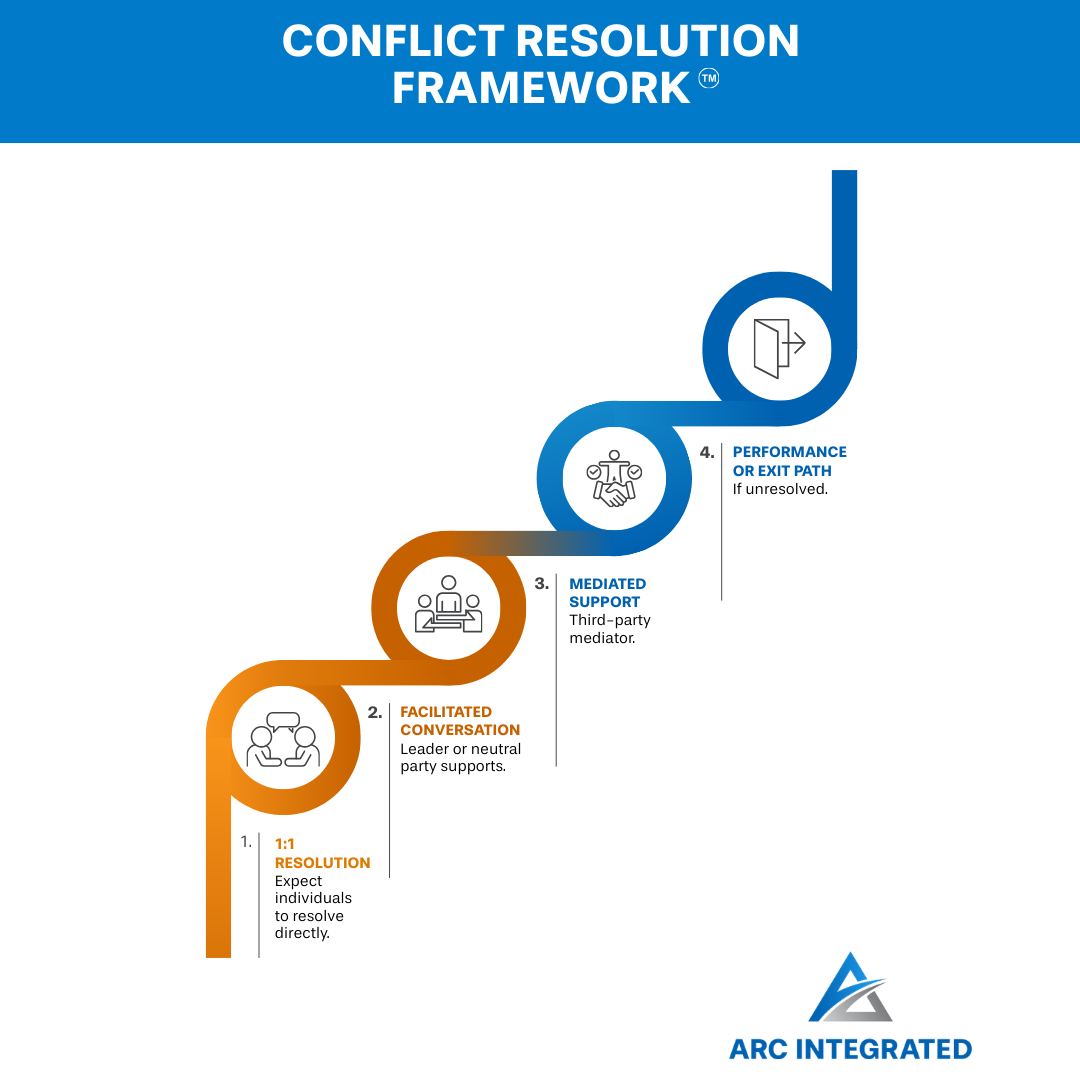
The Framework: A Four-Step Progression
The framework is a progression model. Each step represents a level of escalation, and the expectation is that teams start at the lowest level first and only move to the next step when the current one has genuinely been attempted. The structure itself sends a message: direct communication is the norm, not escalation.
Step 1: One-to-One Resolution
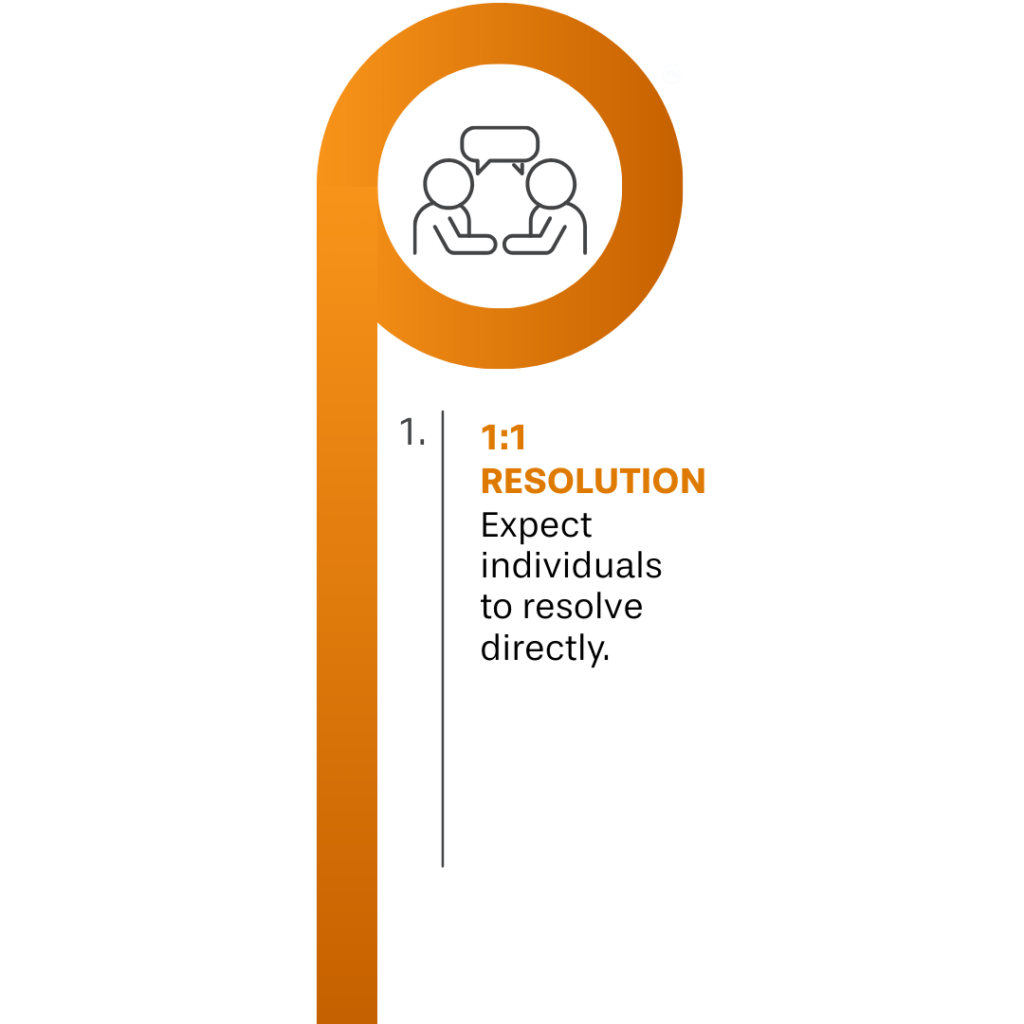
The first expectation is simple. If Person A has a problem with Person C, Person A goes directly to Person C. Not to a colleague. Not to their manager. Not to HR. Directly to the person involved.
This step matters more than it might seem, because in most organizations it is the step that gets skipped most often. People find a dozen reasons why going directly feels uncomfortable or risky, and so they go sideways instead, which is exactly how triangulation begins. In our work, we have found that most people know they should have the direct conversation. What they often lack is the cultural permission and the expectation that this is what is required of them.
When direct communication is established as the norm rather than the exception, something shifts. People start to take personal responsibility for the relationships they are part of. They stop outsourcing their discomfort to managers and colleagues who were not part of the original situation. And the conversations, while sometimes uncomfortable, tend to resolve things faster and more durably than any escalated process could.
This connects directly to what we explore in the COR Feedback Framework. When people have the tools to communicate directly and from their own experience, the one-to-one conversation becomes less intimidating and more productive. The frameworks are designed to work together.
Step 2: Facilitated Conversation
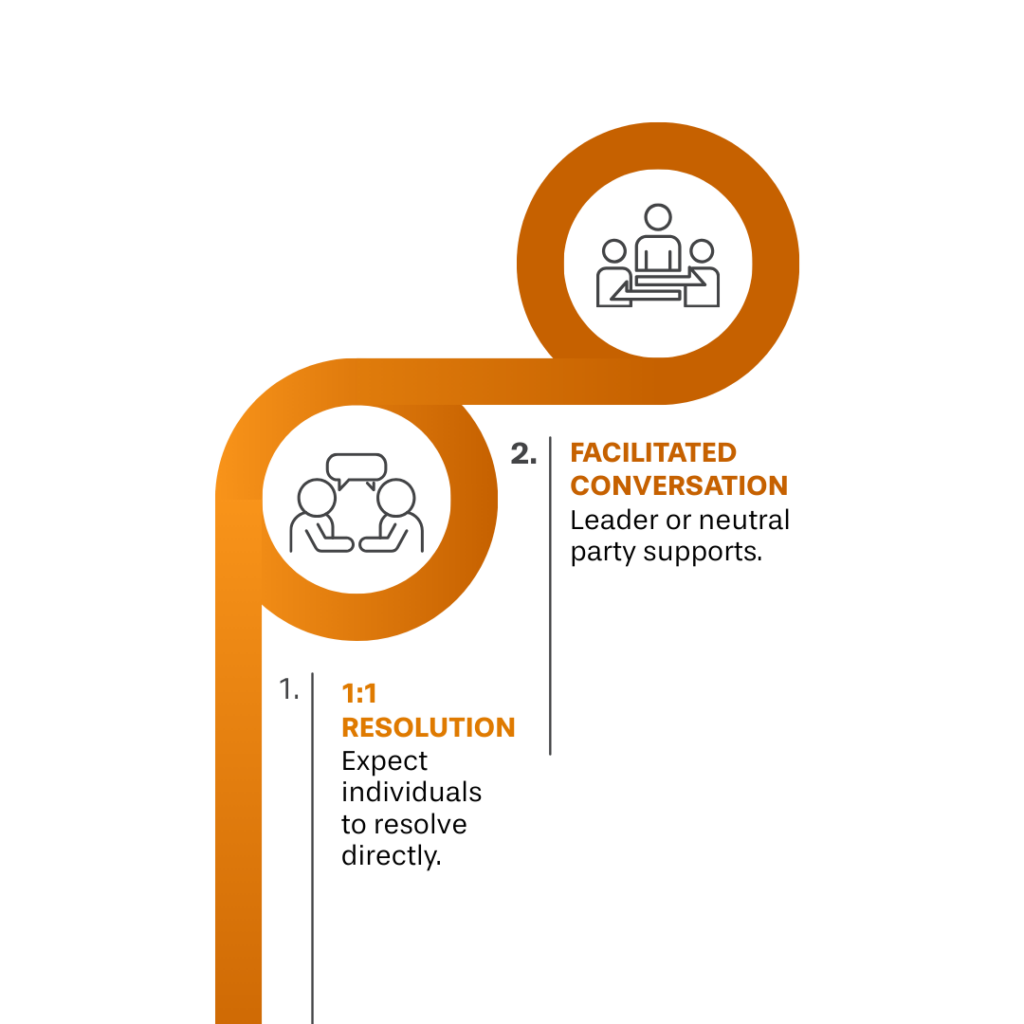
If the two individuals have genuinely attempted to resolve the issue directly and have not been able to, the next step is to bring in a neutral party to help. This might be a manager, a team lead, or a facilitator. The key distinction is what that person’s role is.
The facilitator is not there to adjudicate. They are not there to decide who was right or to take sides. Their role is to guide the conversation, keep communication productive, and make sure both people are actually heard. The goal is still resolution between the two people involved. The facilitator creates the conditions for that to happen when the two individuals have not been able to create those conditions on their own.
In our experience, this step is often all that is needed. Many conflicts that feel intractable between two people become much more workable when there is a skilled third party helping manage the process rather than the content. The issue was rarely as complex as it seemed. What was missing was the structure.
Step 3: Mediated Support
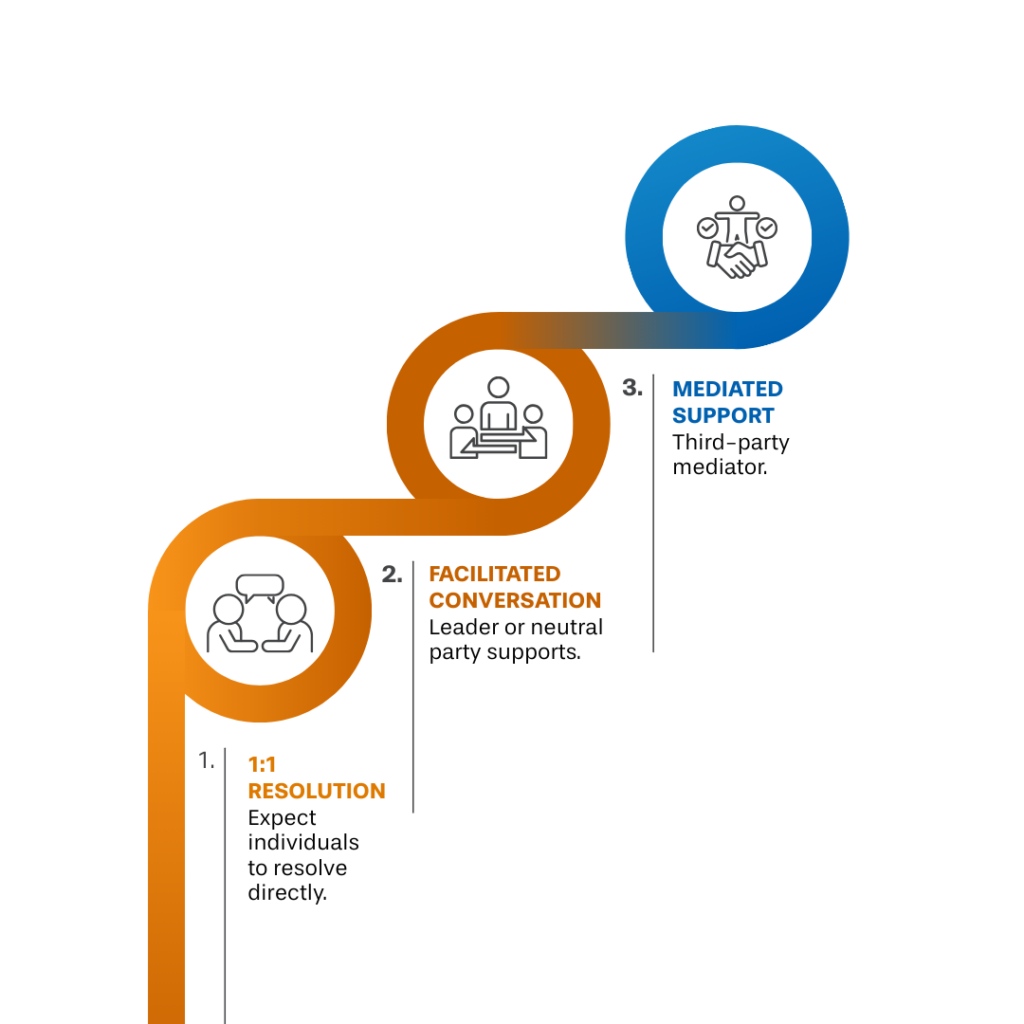
If the issue remains genuinely unresolved after a facilitated conversation, a more formal mediator becomes appropriate. This could be HR, an external mediator, or a senior leader with the standing and training to handle something at this level. At this stage the conflict requires a more structured intervention, and the organization needs to treat it as such.
What matters here is that this step is reached deliberately, not by default. Organizations that jump to this level because Steps 1 and 2 were never attempted do not get the benefit of the framework. They get a process that feels formal and adversarial when it did not have to be. The value of mediated support comes precisely from the fact that it is reserved for situations that have genuinely exhausted earlier options.
Step 4: Performance or Exit Path
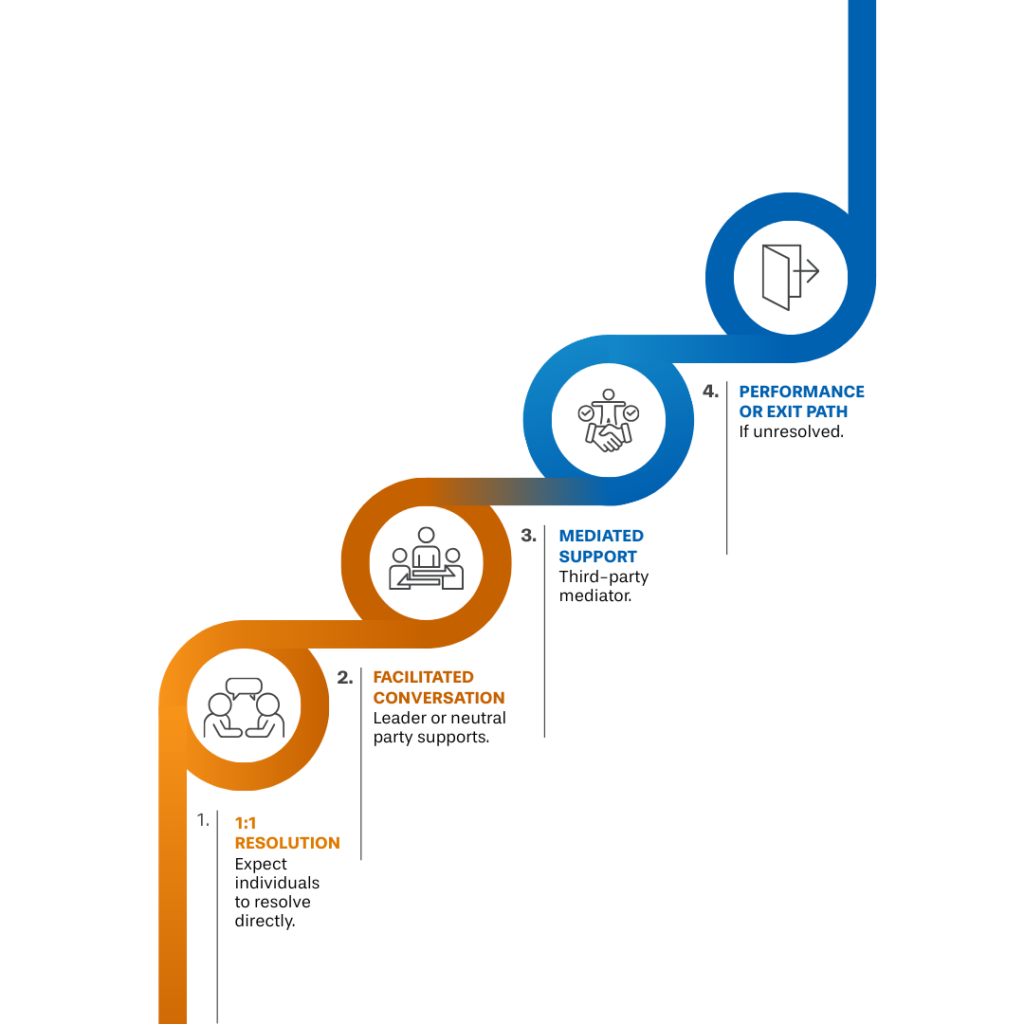
If a conflict cannot be resolved through any of the previous steps, the organization may need to take structural action. This could include a performance improvement plan, a role change, a reassignment, or in some cases an exit. The goal at this stage is protecting the health of the organization and the people within it.
Through the years, we have seen that organizations that reach this step without having moved through the earlier ones tend to experience it as more disruptive and more damaging than it needs to be, both for the individuals involved and for the teams around them. When the earlier steps are taken seriously, Step 4 is reached rarely. And when it is reached, the path there is documented, transparent, and defensible in a way that protects everyone.
How This Connects to Triangulation
This framework was designed to work directly alongside the Triangulation Model, and understanding the connection between them is important.
Triangulation describes the unhealthy pattern. Person A has a problem with Person C, but instead of going to C, they go to Person B. Person B becomes a carrier of the conflict rather than a resolver of it. The problem spreads without ever being addressed at its source, and trust erodes across multiple relationships in the process.
The Conflict Resolution Framework describes the healthy path. When Person A has a problem with Person C, the framework gives both of them a clear and culturally sanctioned route for handling it. Direct first. Facilitated if needed. Mediated if necessary. Structural only as a last resort.
The two models together answer different parts of the same question. The Triangulation Model names the problem dynamic and why it is harmful. The Conflict Resolution Framework gives people an alternative to reach for when conflict arises. One without the other is incomplete.
This Is a Culture Tool, Not Just a Conflict Tool
What we have found is that the real power of this framework is not in how it handles individual conflicts. It is in what it signals about the kind of organization you are building.
When a team agrees in advance how conflict will be addressed, they are making a collective statement about the norms they hold themselves to. They are saying that direct communication is expected, that escalation is available but not the default, and that drama is not a substitute for accountability. That agreement, made explicitly and revisited regularly, changes how people behave long before any specific conflict arises.
Research on organizational culture consistently shows that teams with clear norms around communication and conflict management report higher psychological safety, stronger collaboration, and lower turnover than teams where those norms are absent or ambiguous. The framework is not just a resolution tool. It is a culture-shaping agreement.
The conflict norms a leadership team agrees to are among the most consequential they will set, because conflict is one of the most common and most formative experiences every team goes through.
Leaders who model the first step, who go directly to the person involved rather than venting to someone else or escalating immediately, create a permission structure for everyone around them. Leaders who skip the first step and go straight to HR or a senior leader teach their teams to do the same.
A Reflective Pause
If you look honestly at how conflict is currently handled in your organization, consider whether people typically go directly to each other first or whether sideways is the default. Consider whether your team has an explicit shared agreement about how disagreement should be addressed, or whether everyone is operating on a different assumption about what is appropriate. Consider how much leadership and HR time is spent on issues that could have been resolved at Step 1 if the expectation had been clear.
The Conflict Resolution Framework is not complicated. What makes it powerful is the decision to agree on it openly, teach it consistently, and hold each other to it over time.
If you’re interested in learning how you can best apply this or other frameworks into your team, Book a Free Strategy Call with us, we guarantee you’ll gain valuable insights into what might help take your team into the next level.