Over the years, we have seen leaders invest significant time in one-to-one meetings without getting much from them. The meetings happen. The boxes get checked. Status updates are shared, blockers are noted, and everyone moves on. But the conversation never quite reaches the level where real development happens, real challenges surface, or real trust gets built.
The problem is rarely the meeting itself. It is the quality of the questions inside it.
Most one-to-one meetings stay at the surface not because leaders do not care about going deeper, but because they have not been given a set of questions designed to take them there. The Going Deeper Questions framework was built to close that gap.
What the Framework Is
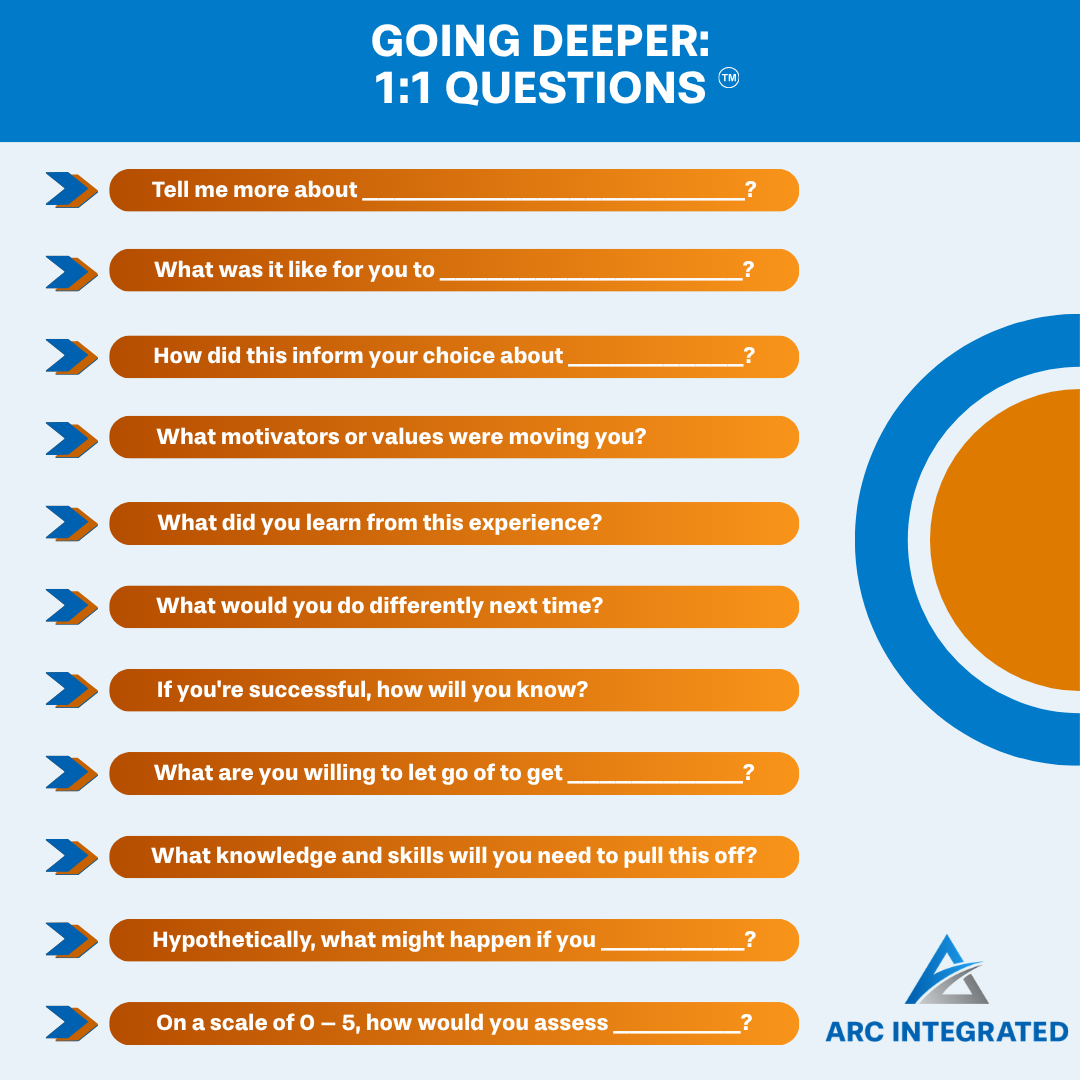
The Going Deeper Questions are a set of structured prompts a leader can use to move a one-to-one conversation from transactional to developmental. They are not a script. They are not a form to fill out. They are a toolkit that a leader pulls from when a conversation needs to go somewhere more meaningful than status updates and task lists.
What makes these questions work is that they are designed around how people actually process experience, growth, and decision-making. They invite reflection rather than reporting. They create space for the person being coached to think, not just respond. And they signal to the employee that the leader is genuinely curious about their experience, not just their output. Research on trait curiosity in workplace settings finds that curiosity-oriented inquiry is positively associated with job performance and with the kind of social functioning that builds trust over time (Mussel, 2013).
In our experience, the shift from a transactional one-to-one to a developmental one often comes down to a single question asked at the right moment. These are those questions.
The Questions
Tell Me More About…
This is perhaps the most powerful two-word phrase in a leader’s toolkit. It does not ask the employee to justify or defend. It simply creates more space. When someone shares something in a one-to-one and the leader responds with “tell me more about that,” the conversation almost always deepens immediately. The employee hears that they are being listened to, not evaluated, and that opens up honesty that status-driven questions rarely produce.
What Was It Like for You to…
This question shifts the conversation from what happened to how it was experienced. Most one-to-ones focus on events and outcomes. This question focuses on the person. It surfaces emotional context, stress, confidence levels, and meaning in a way that purely task-oriented questions cannot reach. Leaders who ask this question regularly develop a much more accurate picture of how their team members are actually doing, not just what they are producing.
How Did This Inform Your Choice About…
This question connects experience to decision-making. It invites the employee to reflect on their own reasoning process, which builds self-awareness and accountability at the same time. It is also a generous question because it assumes the employee made a thoughtful choice rather than assuming they did not. That assumption of thoughtfulness tends to produce more honest and more useful answers.
What Motivators or Values Were Moving You?
This is one of the most underused questions in leadership conversations, and one of the most valuable. Understanding what actually motivates someone is foundational to developing them well, and most leaders have only a surface-level sense of this for the people they lead. This question connects directly to what we explore in the Succession Strategy Framework, where misalignment between motivation and role is one of the most common and most avoidable causes of transition failure. Asking it regularly in one-to-ones builds the understanding that makes those bigger conversations possible.
What Did You Learn from This Experience?
Learning does not happen automatically from experience. It happens when someone reflects on experience with enough intentionality to extract a lesson. Research on reflective practice and adult learning consistently shows that awareness and structured reflection are prerequisites for real behavior change, and that lower self-awareness is associated with defensiveness and poor feedback integration over time (Schön, 1983; Kegan & Lahey, 2009). This question creates that reflective moment deliberately rather than leaving it to chance. It also signals to the employee that their growth matters to the leader, not just their performance. Over time, leaders who ask this question consistently build teams that learn faster, because the habit of reflection becomes part of how the team operates.
What Would You Do Differently Next Time?
This question is the practical complement to the previous one. It moves reflection forward rather than leaving it as an observation about the past. It is also a question that builds psychological safety, because it normalizes the idea that doing something differently next time is expected and valued, not a signal of failure. Research on psychological safety shows that leader communication behaviors encouraging participation and open dialogue are positively associated with team learning and performance (Edmondson & Lei, 2014). Questions like this one are part of how leaders build that safety one conversation at a time.
If You’re Successful, How Will You Know?
This question addresses one of the most common gaps in development conversations: the absence of a clear definition of success. Most employees are working toward goals that have never been made specific enough to be measurable. This question forces that specificity in a way that feels generative rather than evaluative. It also helps the leader and employee develop a shared language for what progress looks like, which makes subsequent conversations more focused and more useful.
What Are You Willing to Let Go of to Get…
Growth almost always requires trade-offs, and most development conversations skip over them. This question makes the trade-off explicit and invites the employee to own it. It is a question that builds real commitment rather than theoretical agreement, because someone who has thought through what they are willing to give up is far more likely to follow through than someone who has only agreed to pursue a goal.
What Knowledge and Skills Will You Need to Pull This Off?
This question turns aspiration into development planning. It is practical and forward-looking, and it positions the leader as someone who is willing to invest in the employee’s growth rather than simply expecting it to happen. It also gives the leader useful information about where to direct coaching, resources, and support. This connects to the Education Shift we describe in the Responsibility Transition, where building leadership capability deliberately rather than assuming it will develop on its own is one of the most important things a leader can do.
Hypothetically, What Might Happen If You…
This question creates psychological distance from a situation, which often unlocks thinking that directness cannot. When someone is close to a problem or a decision, they can get stuck in the immediate constraints. Framing a question as hypothetical invites them to think more freely and often surfaces solutions or perspectives that the direct version of the question would not. It is a particularly useful question when an employee seems stuck or is resisting a direction.
On a Scale of 0 to 5, How Would You Assess…
This question introduces structure and calibration into a conversation that might otherwise stay vague. Asking someone to put a number on something, whether it is their confidence in a plan, their satisfaction with a relationship, or their readiness for a next step, creates a concrete starting point for a deeper conversation. It also reveals discrepancies between how the leader and the employee see the same situation, which is often where the most useful coaching happens.
How to Use These Questions
The Going Deeper Questions are not meant to be asked all at once, and they are not a sequence that needs to be followed from start to finish. They are a toolkit. A leader might use one or two in a given meeting, chosen based on what the conversation needs in that moment.
What matters is the habit of having at least one question in a one-to-one that pushes past the surface. In our experience, even a single well-placed question from this list can shift the entire quality of a conversation and of the relationship it is building over time.
These questions also work naturally alongside the COR Feedback Framework. COR gives leaders a structure for delivering feedback grounded in direct observation. The Going Deeper Questions give leaders a way to receive information, to understand what is actually happening for the person across from them before drawing any conclusions. Used together, they create a one-to-one conversation that is both honest and generative.
What Changes When Leaders Go Deeper
Through the years, we have seen what happens in organizations where leaders take their one-to-one conversations seriously as a development tool rather than a reporting mechanism. Employees feel more known. Trust builds faster. Problems surface earlier. And the leader develops a much more accurate picture of each person’s capability, motivation, and trajectory. Research on leader communication finds that behaviors signaling openness and receptivity are significantly associated with employee voice, meaning that when leaders ask questions with genuine curiosity, people speak up more, share more, and surface issues before they compound (Detert & Burris, 2007).
The Career Path Mapping framework describes how leaders can make potential visible by showing employees the directions available to them. The Going Deeper Questions are how a leader discovers which of those directions actually fits. A map is only useful if the leader understands what the employee wants. These questions are how you find out.
One-to-ones are among the highest-leverage interactions a leader has. They are regular, private, and relational in a way that group settings rarely are. The question is not whether to have them. It is whether to use them well.
A Reflective Pause
Think about the one-to-one meetings you have had in the last month. Consider how many of them reached a level of conversation where you learned something genuinely new about how the person across from you thinks, what they want, or what they are working through. Consider whether the questions you typically ask are designed to surface information or to deepen understanding. And ask yourself which of the questions in this framework you are not currently using, and what might open up if you started.
If you’re interested in learning how you can best apply this or other frameworks into your team, Book a Free Strategy Call with us, we guarantee you’ll gain valuable insights into what might help take your team into the next level.