Most leaders believe they have a clear sense of what good performance looks like and what crosses a line. What they often don’t realize is that the leader next to them has a different sense entirely, and that gap is shaping the culture in ways neither of them intended.
This is one of the more quietly damaging dynamics we see inside organizations. Two leaders, both well-intentioned, both working with the same team, operating from different internal thresholds about what behavior is acceptable and what warrants a consequence. Neither has said that out loud. Neither may even be aware of it. But the people on the team feel it every day, because they are receiving two different messages about what is expected of them.
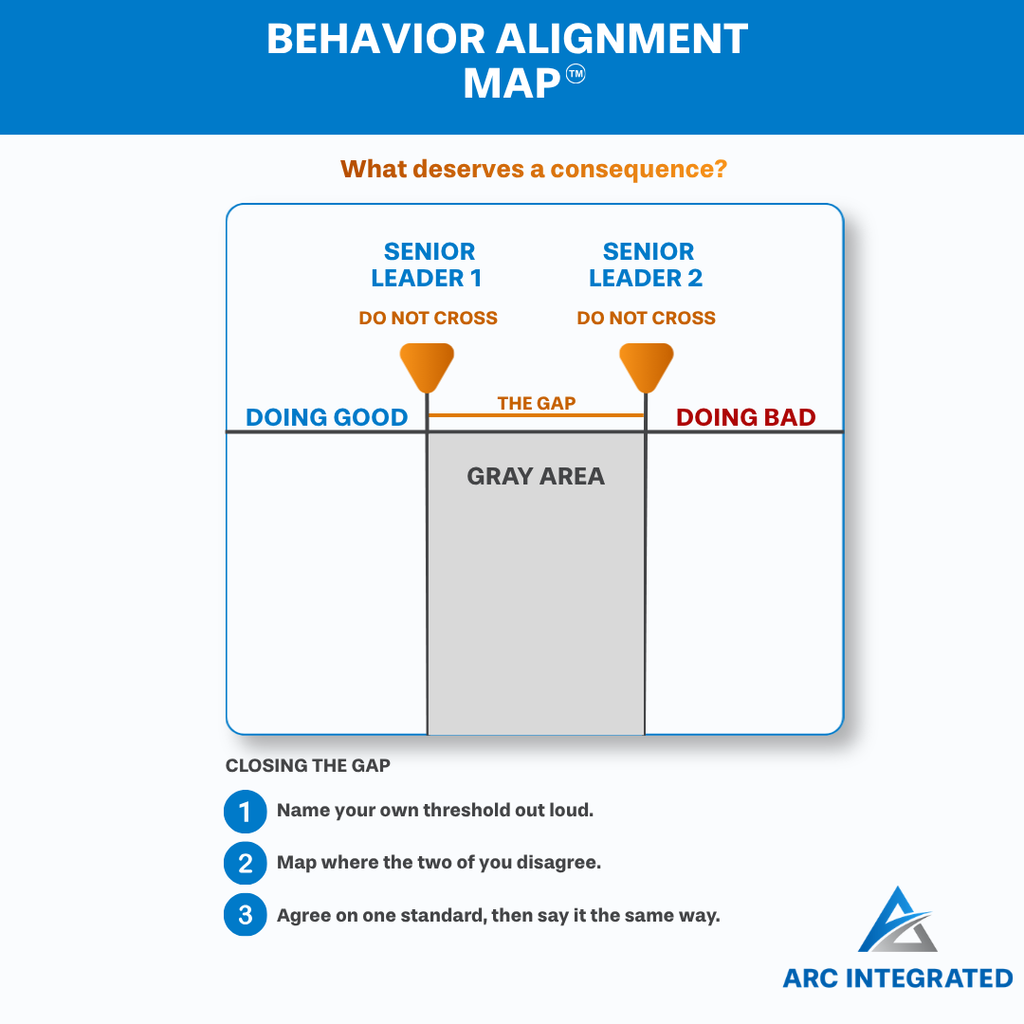
The Behavior Alignment Map is a framework for making that gap visible so leaders can close it, and for replacing the silent inconsistency with a shared, explicit standard that travels clearly through the organization.
The Problem It Solves
The core problem this framework addresses is misalignment between leaders on the threshold for consequences. When should a behavior result in a formal conversation? When does it warrant documentation? When does it cross into territory that requires immediate action, and when is it simply something to address in the normal flow of coaching?
Every leader has an answer to those questions. The trouble is that those answers were formed independently, shaped by different experiences, different assumptions about what culture means, and different tolerances for what gets named versus what gets ignored. When two leaders are operating from different thresholds and neither has made their threshold explicit, the team ends up in a gray area where the rules feel unclear, inconsistent, and sometimes arbitrary.
The downstream effects of this are significant. Performance evaluation becomes harder to do fairly because the standard shifts depending on who is doing the evaluating. Hiring and firing decisions become harder to defend because the behavioral expectations were never made explicit. Conflict between team members becomes harder to address because one leader may see a behavior as a passion response and another may see it as a conduct issue. Research on self-regulation and interpersonal functioning consistently finds that higher self-regulation among leaders is associated with lower interpersonal conflict and more stable working relationships, while its absence correlates with escalation and relational instability (Tangney, Baumeister & Boone, 2004). And over time, the team learns that the rules are subjective, which erodes trust in leadership and in the organization’s culture overall.
What the Behavior Alignment Map does is simple and important: it makes the implicit explicit. It asks leaders to put their thresholds on paper together, surface the gray areas where they disagree, and work toward a shared standard before that disagreement reaches the team.
What the Model Makes Visible
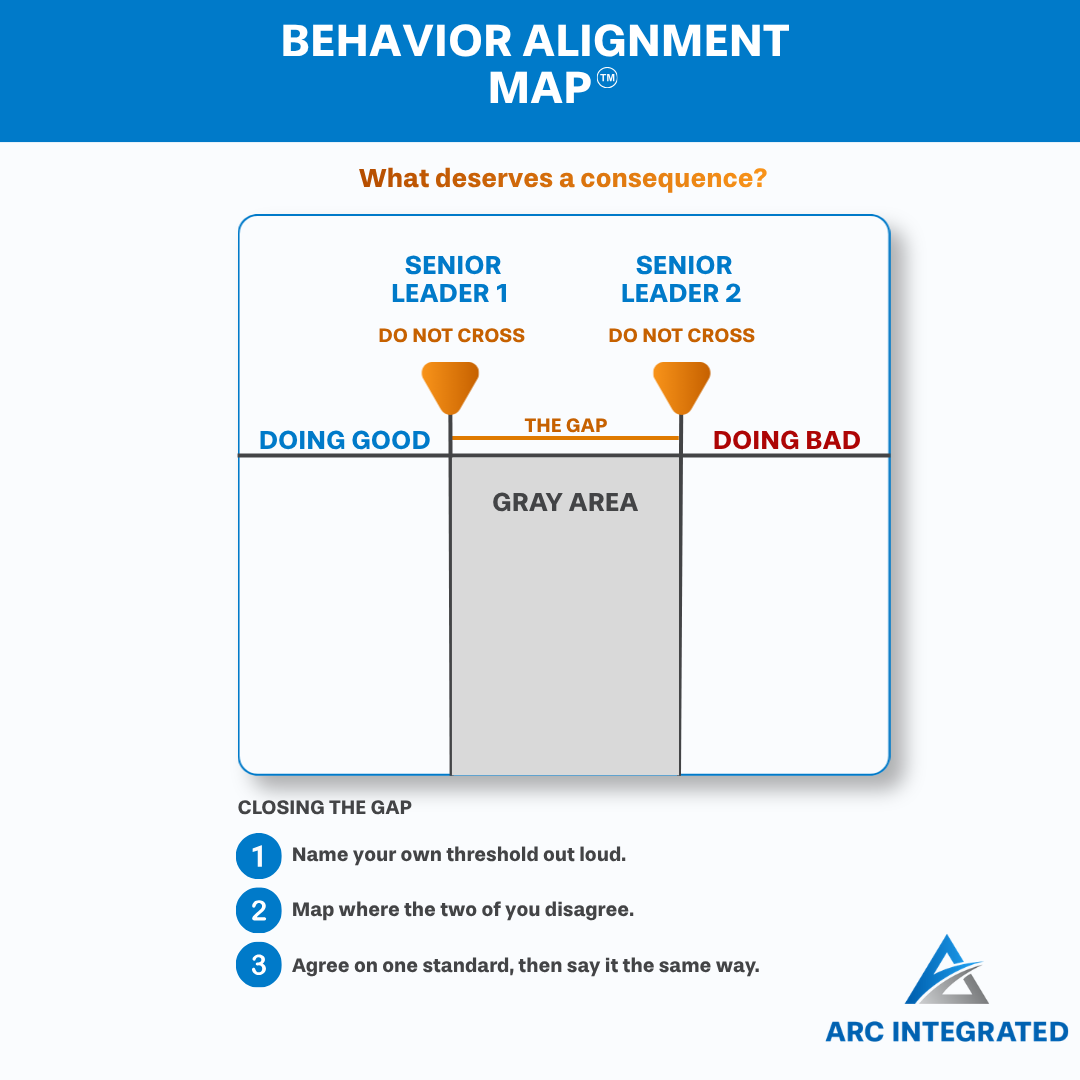
The model is drawn as a vertical structure with a horizontal line running across it. On the left column is “Doing Good.” On the right column is “Doing Bad.” Those are intentionally simple labels for what is actually a nuanced question: what does strong performance look like for this role, and what does concerning performance look like?
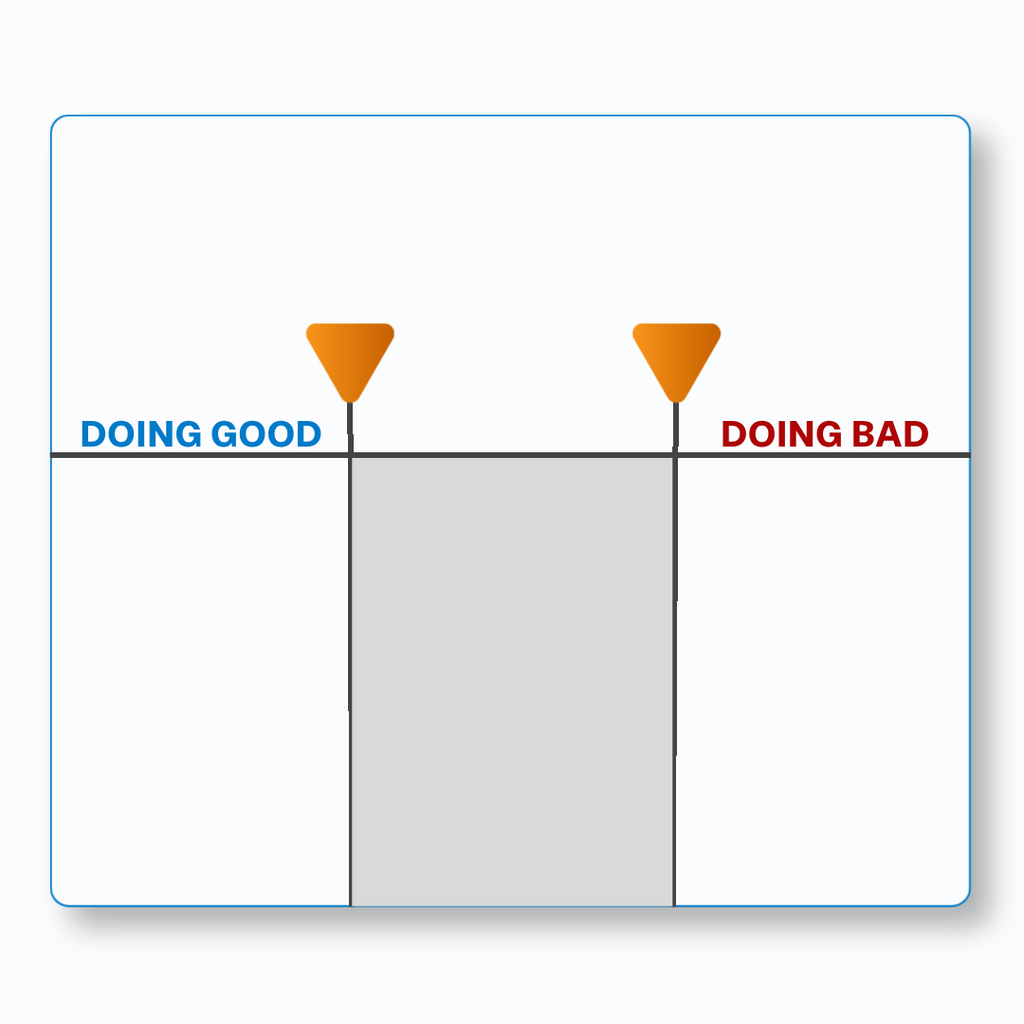
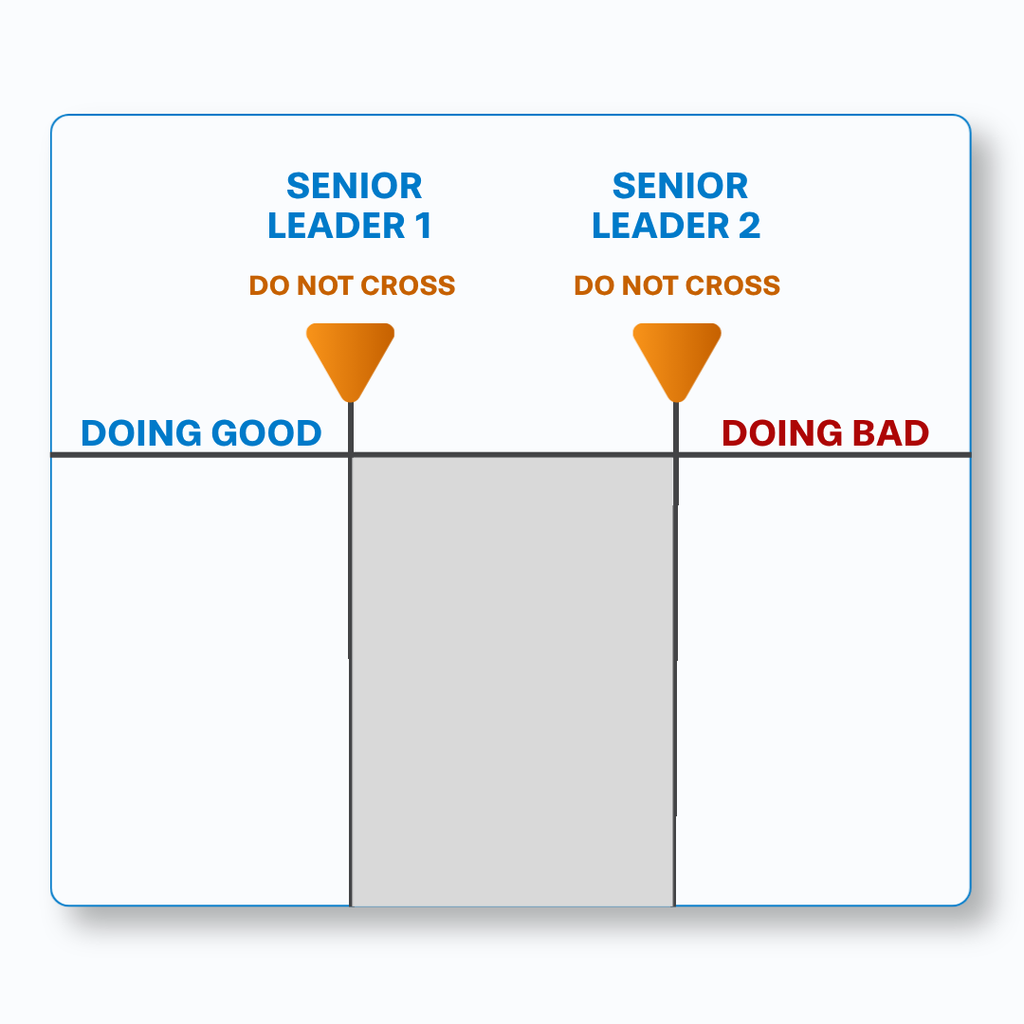
Above the line sit two leaders, each with their own position on where the threshold for consequences begins. The model shows them at different points, which is the whole point. Their disagreement is the thing being mapped.
Below the line is the gray area, represented as a winding, unclear zone between the two leaders’ positions. That gray area is where the miscommunication lives. It is not necessarily that one leader is right and the other is wrong. It is that the gap between them is traveling downward to the team without either leader intending it to, and the team is navigating the uncertainty that gap creates.
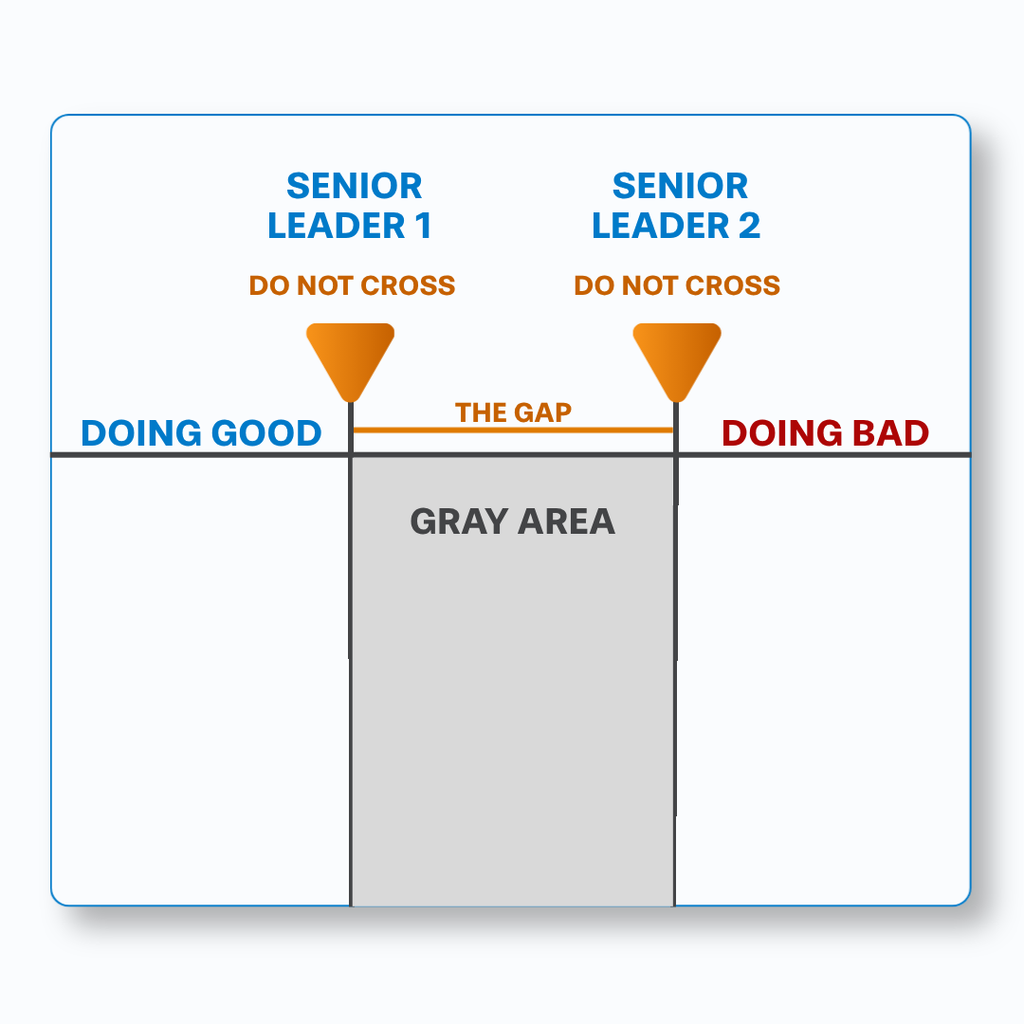
The model does not resolve the disagreement by itself. What it does is give leaders a shared visual to look at together, name where their positions differ, and begin the conversation that closes the gap.
How Other Frameworks Come Into Play
Once the gap is visible, the next question is how to have the conversation that resolves it. This is where two other Arc frameworks become directly relevant.
The COR Feedback Framework is useful here because each leader needs to make their case to the other about why they believe the threshold should sit where it does. The COR model keeps that conversation grounded in direct observation rather than opinion or hearsay. Instead of “I think employees should be able to express frustration freely,” a leader using COR would say, “In the meeting last Tuesday, I observed this specific behavior, and here is what I believe it signals about performance.” That specificity is what makes the conversation between the two leaders productive rather than circular.
The Communication Map helps leaders determine how often and in how much detail they need to be talking about this alignment question. If the misalignment is significant and the stakes are high, the Communication Map would point toward a more structured, frequent conversation until the gap is closed. As alignment develops and trust grows, the frequency and formality of those check-ins can decrease.
Neither tool replaces the alignment work itself, but both make it more likely to produce a clear, defensible outcome rather than a vague agreement that quietly erodes again once the meeting ends.
A Real Example
One of the clearest examples of this dynamic involves how leaders handle expressions of frustration or conflict in team settings. One leader sees raised voices, strong language, or visible emotional intensity as a sign of genuine engagement, people who care enough to argue for what they believe. Another leader sees the same behavior as conduct that crosses a line and reflects poorly on the team’s culture.
Both of these views are internally consistent. Neither leader is being unreasonable. But when both of them are managing the same team without having surfaced that disagreement, one employee gets coached on their behavior while another gets told to keep up the passion. The team notices. And once the team notices that the rules are applied differently depending on who is watching, trust in the consistency of leadership begins to erode.
When leaders work through the Behavior Alignment Map together, they arrive at something much more valuable than a policy: they arrive at a shared language for what is expected and what is not tolerated. That language can be communicated clearly and consistently, which is what makes a culture feel fair and predictable rather than arbitrary.
What This Signals About a Leader and an Organization
Using this framework sends a signal that a leader and an organization are committed to making things explicit rather than leaving them to interpretation. That is not a small thing. A great deal of organizational dysfunction lives in the space between what leaders assume everyone knows and what is actually being communicated clearly.
When expectations are explicit, performance evaluation becomes fairer. Hiring conversations become more honest because candidates can understand what the culture actually requires of them. Firing decisions become easier to defend because the behavioral standard was established and documented before the conversation about consequences needed to happen. Rewards and recognition become more meaningful because the criteria for earning them are clear. Research on identity clarity and behavioral consistency shows that leaders with a clearer, more integrated internal standard demonstrate lower behavioral variability and are experienced as more predictable and reliable by the people around them (Campbell et al., 1996). A shared behavioral standard functions the same way at the organizational level. It reduces the variability in how different leaders apply expectations, which is what makes the culture feel consistent rather than arbitrary.
Research on culture-shaping leadership supports this further. Organizations where leadership actively reinforces adaptive cultural norms show significantly higher performance indicators than those where culture is left to form without intentional direction (Schein, 2010). The Behavior Alignment Map is one of the most concrete tools available for doing that culture-shaping work at the standard-setting level, before misalignment has a chance to travel.
This connects to what we explore in the Conflict Resolution Framework. When behavioral expectations are aligned at the leadership level, the escalation path for addressing conflict becomes cleaner, because everyone is working from the same understanding of what the line is and what happens when it gets crossed.
An organization that has done this work is one where the culture is defined rather than assumed, and where the standards that shape daily behavior were chosen intentionally rather than inherited from whoever happened to enforce things last.
A Reflective Pause
Think about the leaders you work alongside most closely. If each of you were asked independently to describe the threshold at which a behavior warrants a formal consequence, would your answers align? Consider whether there are gray areas on your team right now where the rules feel unclear, and whether that ambiguity is something the team created or something it inherited from a disagreement at the leadership level that was never fully resolved. And ask honestly whether the expectations in your organization are explicit enough that someone new to the team could understand them from day one.
The Behavior Alignment Map is not a complicated model. What it asks of leaders is not easy, but it is specific: sit down together, map where you agree and where you don’t, and close the gap before it closes in on the people you lead.
If you are interested in learning how to apply this framework inside your leadership team or organization, book a free strategy call with us. We guarantee you will gain valuable insights into what might help take your team to the next level.