Over the years, we’ve seen leaders avoid one of the most important conversations in team leadership, not because they don’t care, but because they don’t know how to enter it without making things worse.
A team is underperforming. Communication has gotten tense. Something in the dynamic has shifted, and everyone feels it but nobody’s saying it. The leader knows a conversation needs to happen, but every time they imagine having it, it sounds like an announcement: here’s what’s wrong, here’s what needs to change. The kind of conversation that puts people on the defensive before the first sentence is finished.
So the conversation doesn’t happen. And the dynamic that was quietly limiting the team’s effectiveness, becomes the operating norm.
The Team Dynamics Framework was built for exactly this moment. It gives leaders a structured way to address what’s happening on a team directly, and to do it in a way that invites the team into the conversation rather than delivering a verdict.
The Problem with Top-Down Diagnosis
The instinct to address team dynamics by coming prepared with observations about what needs to change, totally makes sense. Leaders are paid to see problems and solve them. But when the subject is how the team operates together, leading with the leader’s assessment almost always produces the wrong outcome.
When leading with observations and conclusions first, people get defensive and feel evaluated rather than included. The conversation becomes about whether the leader’s read is accurate rather than about what the team actually wants to improve. And the leader, who genuinely wanted to help, ends up in a dynamic where they’re defending observations that the team hasn’t had any hand in generating.
What we’ve learned is that the sequence matters more than the content.
The same observations, surfaced by the team rather than delivered by the leader, land completely differently. They become ownership rather than criticism. And that shift in ownership is what makes a team dynamics conversation actually produce change.
Research on psychological safety reinforces why sequence of involvement matters. Leader communication behaviors that encourage participation and open dialogue are positively associated with team members’ willingness to speak honestly and engage constructively (Edmondson & Lei, 2014). When the leader creates the conditions for the team to surface its own observations, the conversation produces better information and more genuine commitment to change.
What the Framework Looks Like
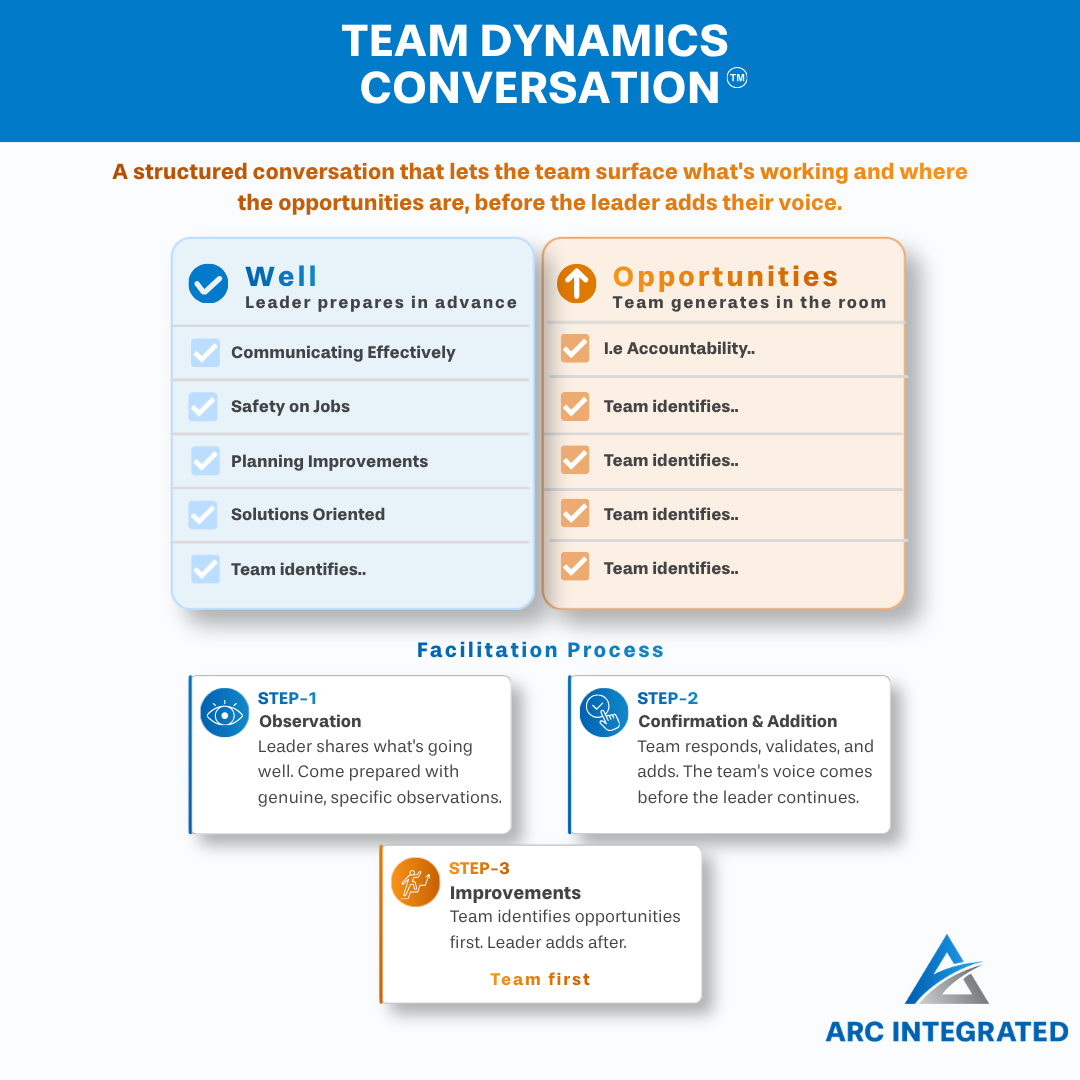
The Team Dynamics Framework is a T-chart with two columns and a three-step facilitation process below it. The visual structure is simple by design. What makes it work is how it’s used.
The left column captures what the team is already doing well. The right column captures where the team has opportunities to improve. The sequence in which those columns get filled is where the method lives.
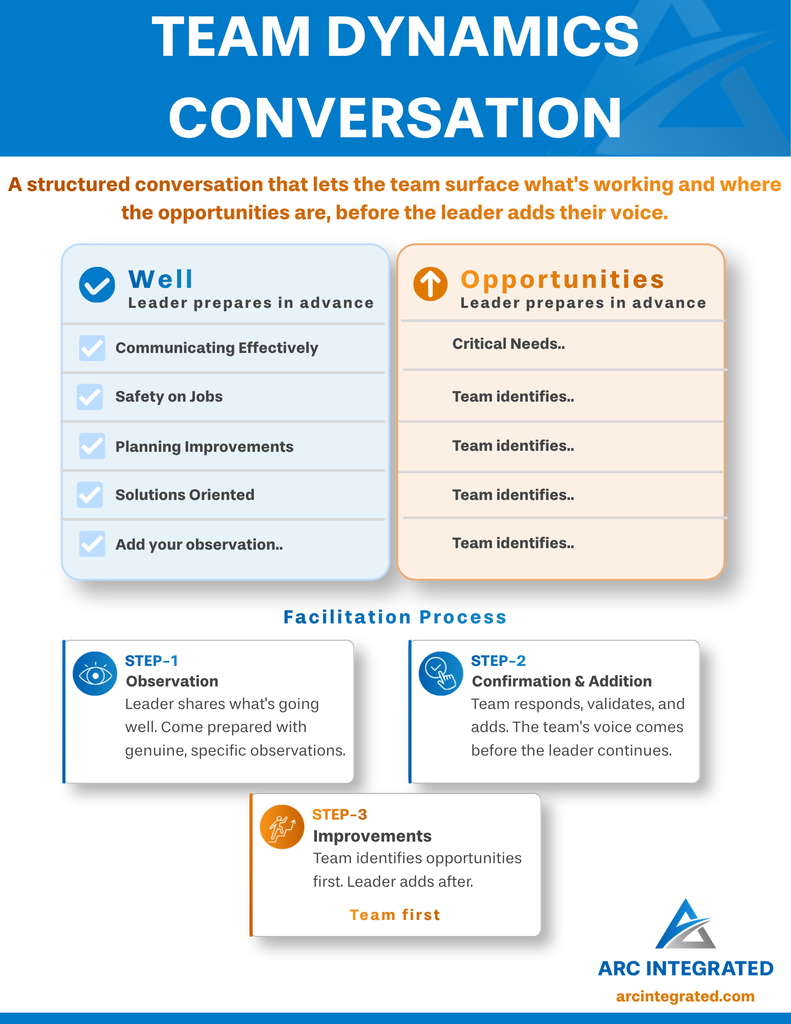
First, the leader comes prepared, before the conversation, they’ve done their own thinking. They’ve identified specific, genuine observations about what the team is doing well, what’s working, what they’ve noticed that reflects real strength. This participation signals that the leader has been paying attention, and it gives the conversation a foundation that isn’t just a list of problems.
But the right column, the opportunities side, is left open…intentionally. That side belongs to the team.
The Three-Step Facilitation Process
The framework unfolds in three steps, and the order is not negotiable. Each step creates the conditions that make the next one possible.
Step One: The Leader Shares Observations
The conversation opens with the leader sharing what’s going well. These are specific, prepared observations, not generic affirmations. The team communicating effectively. The team’s commitment to safety. The way the group approaches problems with a solutions orientation. Real things the leader has genuinely noticed.
This step does something important before the improvement conversation even begins. It establishes that the leader has been watching, that they see what the team is doing well, and that this conversation is not an intervention. It is an honest look at the full picture.
Step Two: The Team Responds, Validates, and Adds
Once the leader has shared, the floor shifts. The team is invited to respond to what was shared, to validate what resonated and add anything the leader may have missed. This is where the conversation becomes genuinely collaborative.
In our experience, this step often surfaces observations that the leader didn’t have, things that are visible from inside the team that aren’t always visible from the leader’s vantage point. And because the team is affirming and adding to a positive foundation, the energy in the room stays generative rather than defensive.
Step Three: The Team Identifies Opportunities
The third step is where the improvement conversation happens, and the sequence is critical. The team goes first. Before the leader names anything on the opportunities side, the team is asked:
Given everything we’ve just discussed about what we’re doing well, where do you see our opportunities to improve how we operate together?
When teams are asked this question after a genuine conversation about their strengths, they almost always go deeper than the leader expected. They identify friction points the leader suspected but couldn’t confirm. They take ownership of the improvement agenda in a way that makes follow-through far more likely.
Once the team has had their say, the leader adds. Not as a correction or a completion, but as a contribution. The leader may have observations the team didn’t raise. This is the appropriate moment for them. By then, the team has already established that the conversation is theirs, and the leader’s additions land as additions rather than impositions.
Research on team learning behaviors supports why this sequence produces better outcomes. Teams that engage in deliberate collective reflection, surfacing what is working and what isn’t together, show meaningfully higher performance over time than teams that receive improvement feedback passively (Edmondson, 1999).
What This Framework Is Not
It’s worth being clear about what the Team Dynamics Framework is not designed to do.
It’s not a performance management tool. This is not the conversation where the leader addresses an individual’s underperformance or a specific disciplinary issue. That conversation has its own structure, and mixing it with a team dynamics conversation collapses two very different interactions into one that serves neither well.
It’s not a one-time event. Team dynamics shift over time. The most effective leaders build a rhythm of returning to this conversation, not as a crisis response but as a regular practice. What the team is doing well changes. What the team wants to improve changes. Treating this as a recurring part of how the team operates, rather than a special session called when something has gone wrong, is what makes it part of the culture rather than an interruption to it.
And it’s not a substitute for the day-to-day feedback conversations that keep a team calibrated. The COR Feedback Framework handles those individual, observation-based conversations. The Team Dynamics Framework operates at the collective level, addressing how the team functions as a unit rather than how any individual is performing within it.
How It Connects to Content vs. Process Meetings
This framework lives inside a broader distinction we explore in the Content vs. Process Meetings model. Most team meetings address content, the work, the decisions, the updates. Process meetings address how the team operates together. The Team Dynamics Framework is a structured process meeting, one specifically designed for the moment when a team’s dynamics need direct attention.
Understanding that distinction helps leaders know when to use this tool. It’s not for every meeting. It’s for the moments when the process layer of how the team operates together has accumulated enough friction, or enough drift from what the team wants, that a deliberate conversation is warranted.
A Reflective Pause
Think about the last time you addressed how your team operates together, not what the team is working on, but how the team works. Consider whether the people on your team would feel genuinely invited into that conversation if you initiated it, or whether they’d be bracing for feedback. And ask yourself whether the dynamics currently shaping how your team functions are the result of intentional agreements, or whether they simply accumulated over time without anyone choosing them.
The Team Dynamics Framework doesn’t require a long meeting or a special offsite. It requires a leader who is willing to walk in with genuine observations, create real space for the team to speak, and let the team’s voice shape the improvement agenda before the leader adds to it. That shift in sequence changes everything about how the conversation lands.
If you’re interested in learning how to facilitate this kind of conversation inside your team or organization, book a free strategy call with us. We guarantee you will gain valuable insights into what might help take your team to the next level.