Over the years, we have heard one complaint from leaders more consistently than almost any other. Meetings. Too many of them, too long, too unfocused, and too often ending without anyone being entirely sure what was decided or who was doing what next.
It is one of the most universal frustrations in organizational life, and it is almost entirely preventable.
In our experience, the problem is rarely that people do not want meetings to be better. Most leaders and teams would welcome a shorter, more focused meeting format immediately. The challenge is that most organizations have never agreed on what a well-run meeting actually looks like. Everyone has a vague sense that something is off, but without a shared structure to point to, the default keeps winning.
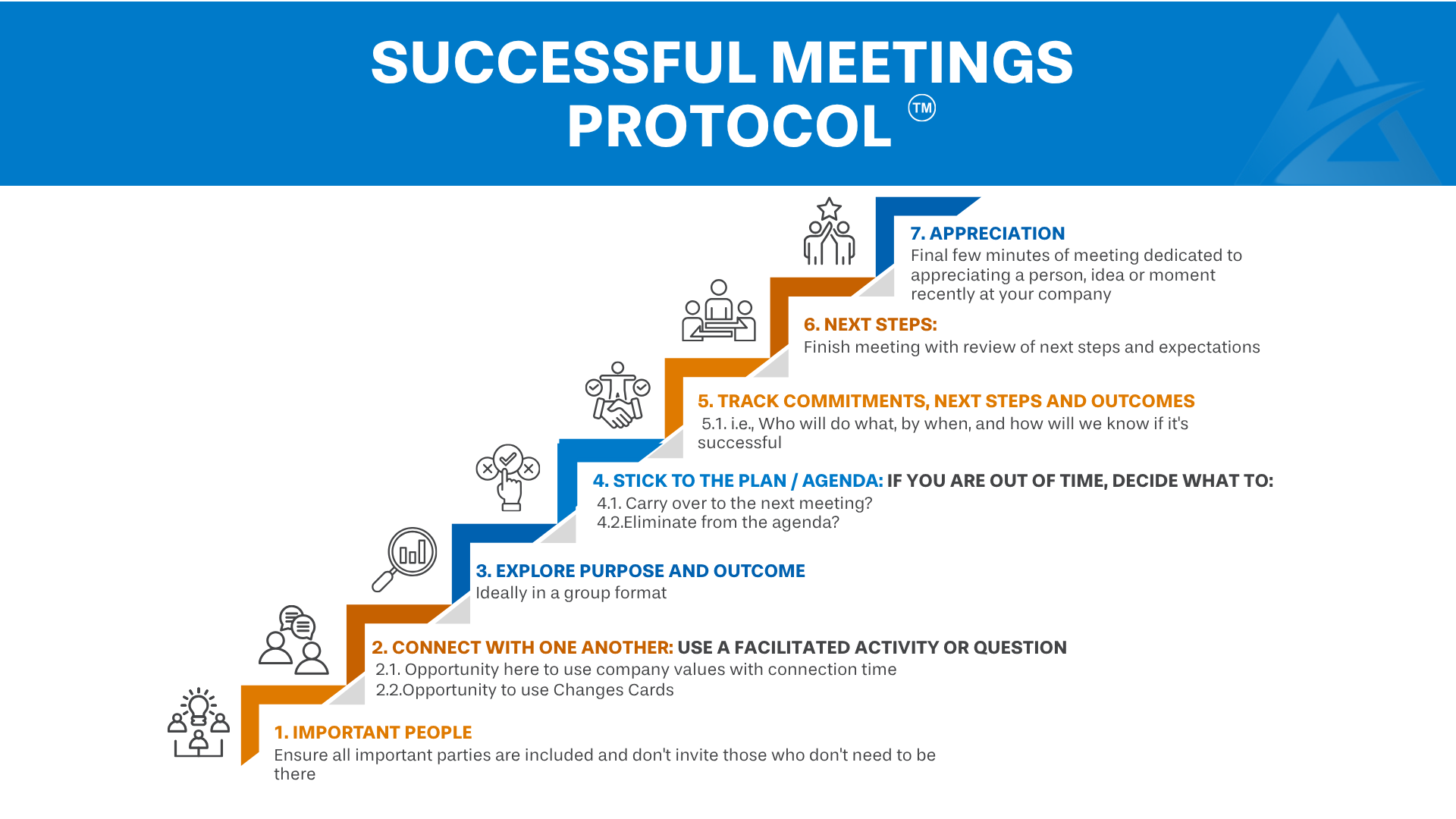
The Successful Meeting Protocol is that shared structure. It is a seven-step protocol that any leader can apply to any meeting to produce what meetings are actually for: clarity, commitment, and forward movement.
Why Most Meetings Fail
The meetings that frustrate people most are not the ones that are too long. They are the ones that feel purposeless. People sit through an hour-long discussion without a clear outcome, leave without knowing what was decided, and spend the next few days in follow-up conversations that should have happened in the room.
Research on meeting effectiveness consistently finds that a lack of clear purpose and poor agenda management are the two most common contributors to perceived meeting waste. One study found that organizations lose an estimated 31 hours per month to unproductive meetings, and that the primary drivers were unclear objectives and a failure to establish next steps (Rogelberg, Scott & Kello, 2007). Those are structural problems, and they have structural solutions.
The Successful Meeting Protocol addresses both of them directly.
The Seven Steps
Step 1: Ensure the Right People Are in the Room
The first decision about any meeting happens before it starts: who needs to be there, and who does not. This step is about being intentional on both ends. Excluding someone who needs to be part of a decision creates gaps that slow things down later. Including someone who does not need to be there costs them time and dilutes the focus of the room.
In our experience, meeting lists tend to grow by default rather than by design. People get added out of courtesy, habit, or organizational anxiety, and no one feels comfortable removing them. The Successful Meeting Protocol requires making this decision deliberately for every meeting. If someone’s presence is not necessary for the purpose of this specific meeting, they should not be there.
Step 2: Connect with One Another
Before getting into content, create a brief moment of genuine connection. This might be a facilitated question, a short activity, or simply a check-in that invites people to be present rather than just physically in the room. Company values can be woven into this naturally when the question or activity is designed to reflect them. This is also where tools like Change Cards can create meaningful connection quickly.
This step often gets skipped because it feels like it delays the real work. What we have learned is that it actually accelerates it. Meetings where people feel connected and present move faster and produce better decisions than meetings where people are mentally still at their desks. Research on psychological safety shows that the relational climate of a group shapes whether people contribute honestly, and that climate is set in the first few minutes (Edmondson & Lei, 2014).
Step 3: Explore Purpose and Outcome Together Another
Before moving into any agenda item, the group should be aligned on what the meeting is for and what a successful outcome looks like. Ideally, this happens as a group rather than being delivered top-down by the person who called the meeting. When people co-define the purpose, they are more invested in reaching it.
This step prevents the most common source of meeting frustration: people arriving with different assumptions about what the meeting is trying to accomplish. A brief shared articulation of purpose and outcome at the start takes two minutes and saves twenty.
Step 4: Stick to the Plan
Every agenda item should have a specific time allocation, and the meeting should hold to it. This is the step that requires the most discipline and delivers some of the most immediate results.
When time runs out on an agenda item and the conversation is not complete, the decision is simple: carry it over to the next meeting, or eliminate it from the agenda entirely. What is not acceptable is letting one agenda item expand and crowd out everything that follows. That pattern is how meetings become unfocused, how important items never get addressed, and how attendees learn to stop taking the agenda seriously.
Holding to time signals respect for everyone in the room and keeps the meeting moving with the kind of momentum that produces decisions rather than discussions.
Step 5: Track Commitments, Next Steps, and Outcomes
This is the step that determines whether a meeting produces anything lasting. For every decision made and every action identified, the meeting needs a clear record of who will do what, by when, and how the group will know if it was successful.
That last part matters as much as the first two. Assigning a task without defining what success looks like creates ambiguity that tends to produce either the wrong result or a follow-up conversation to clarify what was actually needed. In our experience, the absence of clear success measures is one of the most common reasons that meeting commitments do not get followed through on. This connects directly to what we explore in the Success Path, where making trajectory and expectations visible is what turns intention into consistent performance.
Step 6: Close with a Review of Next Steps and Expectations
Before the meeting ends, take two minutes to review what was decided and what everyone is walking away responsible for. This is not redundant with Step 5. Step 5 is about capturing commitments as they are made. Step 6 is about ensuring everyone leaves with the same understanding of what those commitments are.
This closing review is one of the highest-leverage two minutes in any meeting. It prevents the misalignment that produces follow-up emails, conflicting assumptions, and work that needs to be redone. It also signals a standard of accountability that, practiced consistently, becomes part of how the team operates.
Step 7: Close with Appreciation
The final few minutes of the meeting are dedicated to recognizing a person, idea, or moment from within the company recently. This step might seem like the easiest one to skip under time pressure, and it is often the one that gets skipped first. That is a mistake.
Appreciation at the close of a meeting does something that the rest of the agenda cannot: it connects the work to the people doing it. It names what is going well. It reinforces the behaviors and contributions the organization values. And it sends people out of the room with a different energy than a list of action items alone would produce. Research on team functioning consistently finds that positive relational moments within a team are associated with stronger cooperation and lower conflict (Barsade, 2002). This step is how that relational investment gets made deliberately rather than left to chance.
Why the Sequence Matters
Each of these steps works on its own, but the sequence is what makes the protocol function as a whole. Connection before content creates the psychological safety that produces honest conversation. Purpose before agenda prevents the drift that wastes time. Tracking commitments mid-meeting and reviewing them at close creates the accountability loop that makes follow-through likely rather than optional. And ending with appreciation ensures that the meeting leaves people better oriented toward the work than when they arrived.
In our work with teams across industries, we have found that the organizations that run meetings well do not have some special talent for it. They have an agreement about how meetings work, and they hold to it consistently. The Successful Meeting Protocol is that agreement made explicit.
This connects to what we explore in the Communication Map, which is built on the principle that the right structure for any communication, calibrated to what the situation actually requires, is what builds trust and clarity over time. A well-run meeting is one of the most immediate and visible ways a leader can demonstrate that principle in practice.
A Reflective Pause
Think about the last meeting you ran or attended. Consider whether the right people were in the room. Consider whether the purpose was clear to everyone at the start. Consider whether commitments were tracked and reviewed before the meeting ended, and whether the last thing that happened was something that connected people to each other rather than just to a task list.
Meetings are one of the most repeated leadership behaviors in any organization. The cost of running them poorly adds up faster than most leaders realize, and the return on running them well, in trust, in clarity, in time recovered, compounds just as quickly.
If you are interested in learning how to implement this protocol inside your team or organization, book a free strategy call with us. We guarantee you will gain valuable insights into what might help take your team to the next level.