Over the years, we have seen one of the most preventable talent problems play out repeatedly in organizations of every size. A high-performing employee starts to disengage. Their manager notices but is not sure why. When the conversation finally happens, the employee says some version of the same thing: I did not know what was possible for me here.
Not that there were no opportunities. Not that the company had failed them in some obvious way. Just that nobody had ever sat down with them and made the options visible.
That absence of a map is more costly than most leaders realize. It shapes whether strong employees stay or leave, whether they grow with intention or drift, and whether the organization builds the leadership bench it needs or keeps losing its best people to companies that had the same conversation first.
Career Path Mapping was built to make that conversation concrete.
Why the Map Matters
In our experience, most organizations fall into one of two categories when it comes to career development conversations. The first category does not have them at all. Leaders assume that strong employees know there is a future for them and will figure out the path themselves. The second category has the conversations verbally but never visually, which means the employee walks away with a vague sense of possibility but nothing concrete enough to orient their development around.
What we have learned is that people conceptualize direction much more easily when they can see a map. A verbal description of potential paths is easy to forget, easy to misinterpret, and easy to discount as generic encouragement. A visual map with distinct paths, specific milestones, and named outcomes is something a person can return to, think against, and make real decisions from.
Research on goal setting consistently shows that clarity and specificity are among the strongest predictors of sustained motivation and performance. In one of the most cited bodies of work in organizational psychology, Locke and Latham demonstrated that specific, challenging goals produce significantly higher performance than vague or general ones (Locke & Latham, 2002). A career path map is, at its core, a tool for making goals specific enough to be actionable. Without it, the employee is navigating toward a horizon that keeps moving. With it, they are choosing a direction and can see what the next stop looks like.
The Three Paths: An Example
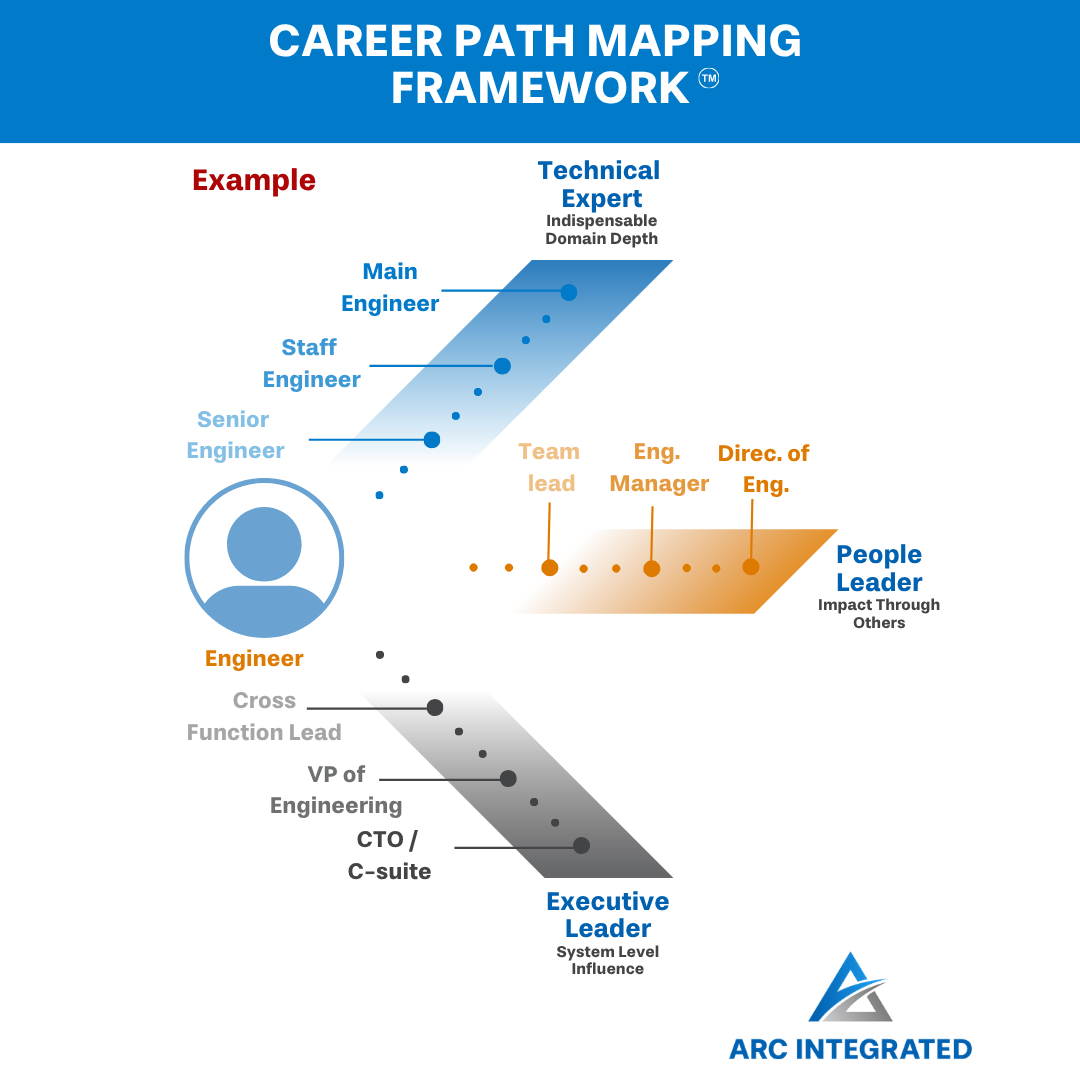
The clearest way to understand how Career Path Mapping works in practice is to walk through a real example. The framework below uses an engineer as the starting point. It is worth noting that this is just one illustration of how the model works. The specific roles, titles, and milestones will look different depending on your industry, company size, and organizational structure. What stays consistent is the logic of the model itself, which can be applied to any role in any organization.
Consider an engineer who has demonstrated strong performance and clear potential. Their leader sits down with them and lays out three distinct directions the organization can support.
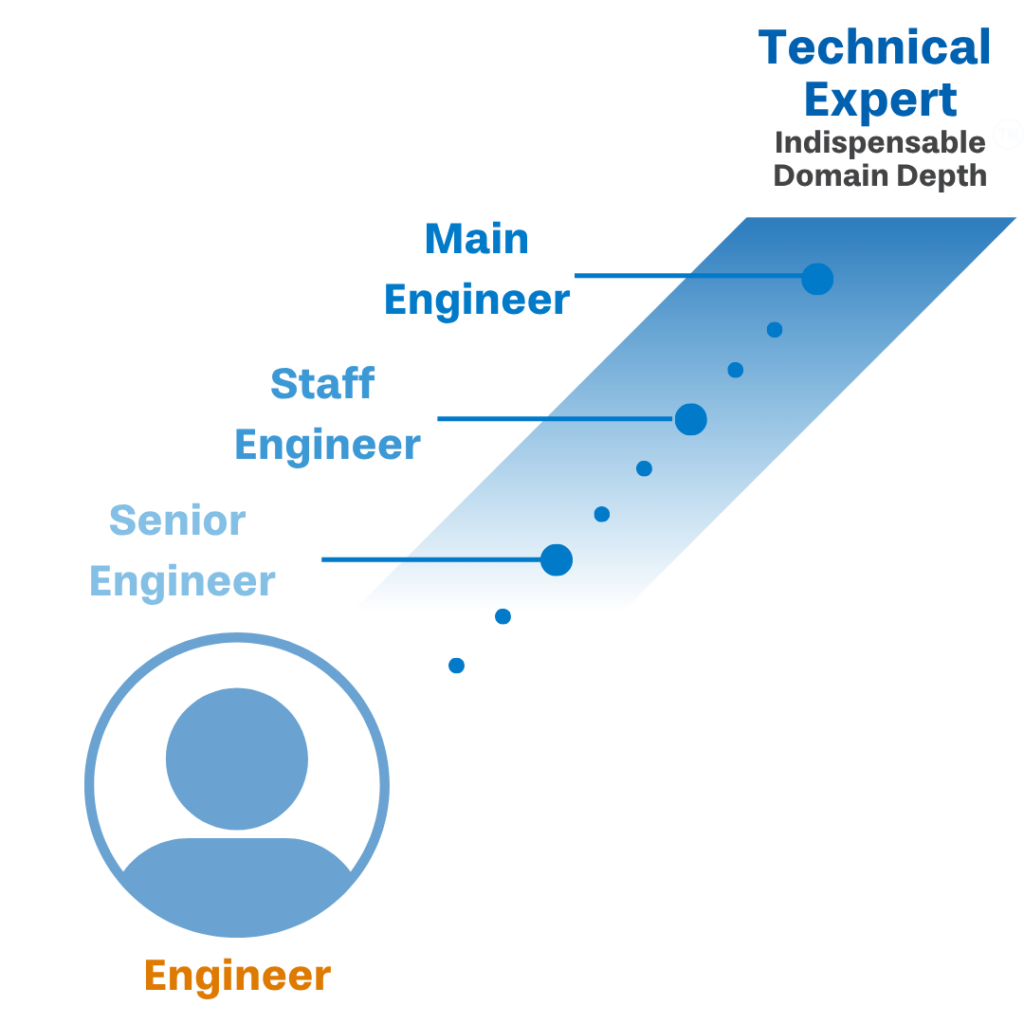
The Technical Expert Path
This path keeps the employee in deep subject matter work. The role progression on this path moves from Senior Engineer to Staff Engineer to Main Engineer, with the destination being recognized as an indispensable Technical Expert with domain depth that the organization depends on. There is no people leadership requirement on this path. The milestones are about deepening mastery, expanding specialized knowledge, and becoming the go-to authority in a particular area. For the right person, this path is not a consolation prize. It is a distinct and valued destination.
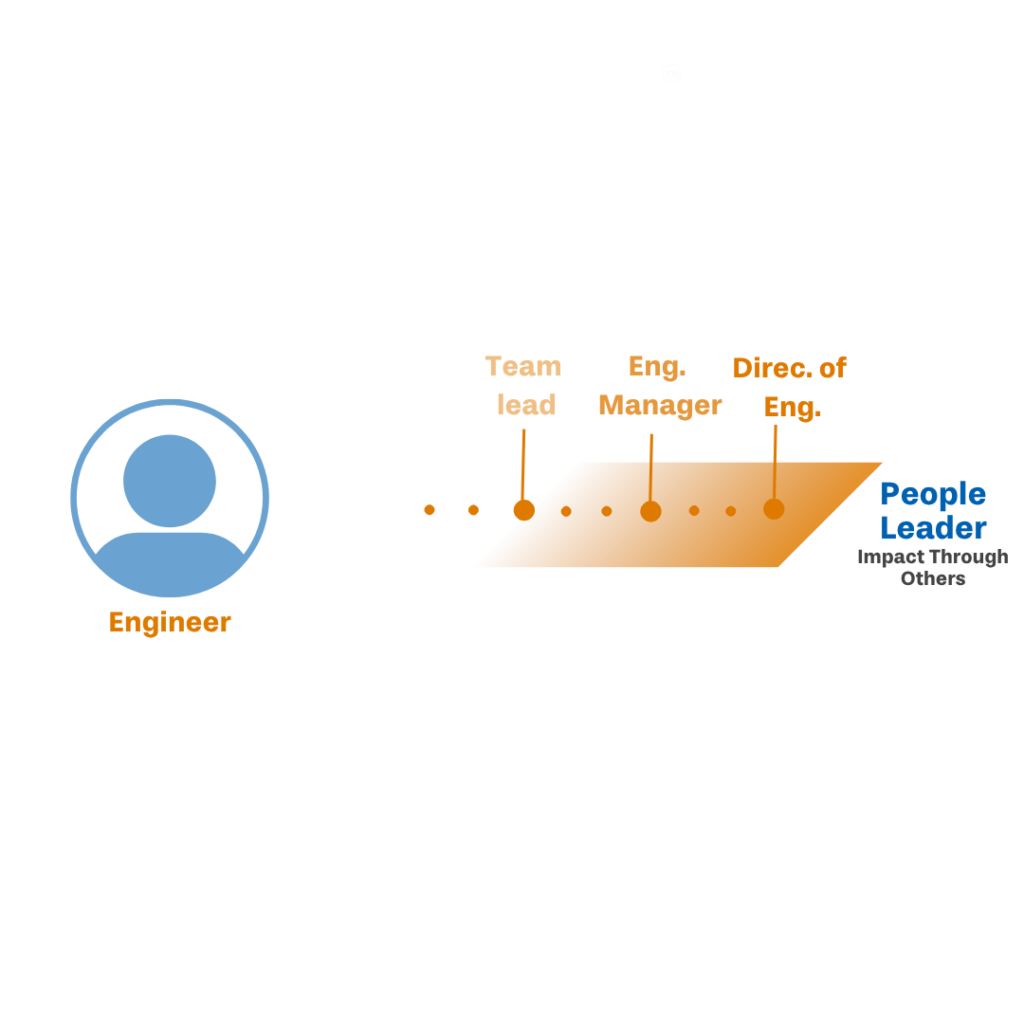
The People Leadership Path
This path moves the employee out of individual contribution and into leading others. The role progression here begins at Team Lead, moves through Engineering Manager, and scales toward Director of Engineering, with the destination being a People Leader whose impact comes through others rather than through personal output. The milestones on this path involve developing management skills, building accountability systems, learning to delegate effectively, and eventually being responsible for the performance and development of a team. This path connects directly to what we explore in the Responsibility Transition, where the shift from doer to leader is one of the most significant and most underestimated transitions a professional makes.
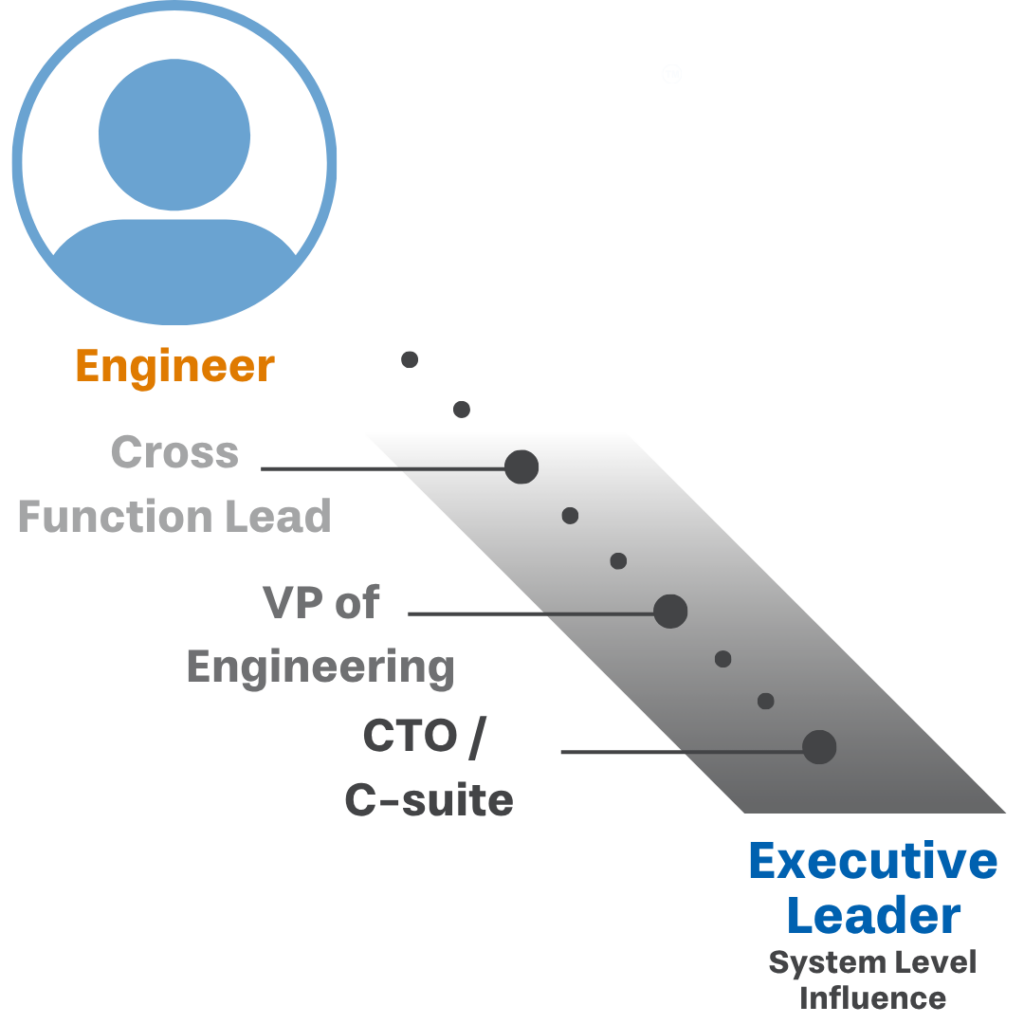
The Executive Leadership Path
This path is designed for employees whose ambition and capability point toward system-level influence. The role progression moves from Cross-Function Lead to VP of Engineering and ultimately to CTO or C-suite, with the destination being an Executive Leader whose decisions shape the organization as a whole. The milestones on this path involve moving across functions, building strategic credibility, developing a broad organizational perspective, and earning the kind of cross-functional trust that senior executive roles require.
These three paths are distinct. They require different skills, different role changes, different development investments, and different personal motivations. What they share is that they all begin at the same place: a conversation between a leader and a high-potential employee where someone finally said, here is what is possible for you here. Which direction interests you?
The Conversation This Model Makes Possible
What Career Path Mapping does is give leaders a structured way to have a conversation that most of them want to have but do not know how to start.
Without the map, the conversation tends to be vague. You have a lot of potential. We see great things for you here. Keep doing what you are doing. That version of the conversation feels encouraging in the moment and fades within a week because there is nothing concrete to hold onto.
With the map, the conversation becomes specific. These are the three directions we can genuinely support you moving. Here is what each one looks like. Here are the milestones. Here are the skills required. Given where you are right now and what you want for your future, which of these feels right to you?
That second conversation does something the first one cannot. It gives the employee real agency over their own development. The direction they choose becomes theirs, not something being done to them or promised to them in a vague way. And when the path is chosen together and made visible, both the leader and the employee can return to it, measure progress against it, and adjust it over time as circumstances change.
This connects directly to what we explore in the Succession Strategy Framework. A well-executed succession does not happen by accident. It happens because organizations identified the people with potential early enough, mapped their development intentionally, and invested in the conversations that prepared them for what was next. Career Path Mapping is often where that process begins.
What This Reveals About the Leader
In our work with organizations, we have found that the quality of career development conversations a leader is willing to have says something important about the kind of leader they are.
Leaders who avoid these conversations often do so because they are worried about making promises they cannot keep, or because they are not sure how the organization would actually support the paths they might describe. Those are real concerns. But the cost of avoiding the conversation is almost always higher than the discomfort of having it imperfectly.
Leaders who have these conversations, even imperfectly, send a message to their strongest employees that they are seen, that the organization is thinking about their future, and that development is a shared responsibility rather than something the employee has to figure out alone.
The Conscious Influence Model describes how the most effective leaders balance self-inquiry with genuine curiosity about the people they lead. Career Path Mapping is one of the most practical expressions of that curiosity. It requires a leader to actually understand what an employee wants, what motivates them, and what kind of future they are working toward. That understanding does not happen without a real conversation, and a real conversation does not happen without a map to make it concrete.
How This Is Different from the Success Path
It is worth being direct about how this model relates to the Success Path we have already written about, because the two frameworks work together but they are answering different questions.
The Success Path is consequence-based. It shows what happens depending on how someone performs. Align with expectations and the trajectory moves upward toward promotion, expanded leadership, and title change. Drift from expectations and the trajectory moves downward toward documentation and eventual exit. The Success Path is about outcomes based on performance patterns.
Career Path Mapping is directional. It is not about what happens to an employee based on how they perform. It is about where they could go if they choose to develop in a particular direction. Different tool, different conversation, different moment in the leadership relationship.
Used together, they give both the leader and the employee a complete picture. The Success Path shows what is at stake. Career Path Mapping shows what is possible.
A Reflective Pause
If you think about the high-potential employees on your team right now, consider how many of them could describe the specific paths available to them inside the organization. Consider whether the development conversations you have had with them have been specific enough to orient real decisions. And ask yourself honestly whether the employees you have lost in the last few years left because there was no future for them, or because nobody made the future visible.
Career Path Mapping does not require a perfect system or a formal HR process. It requires a leader who is willing to sit down with a strong employee and say, let me show you what I see as possible for you here. That conversation, made visual and made specific, is often all it takes to turn a high-potential employee into a committed one.
If you’re interested in learning how you can best apply this or other frameworks into your team, Book a Free Strategy Call with us, we guarantee you’ll gain valuable insights into what might help take your team into the next level.