Picture a leadership team sitting around a table. One person is convinced the organization needs to consolidate, catch its breath, and build on what’s already working. Another is just as convinced that now is the time to move quickly, expand, and push into new territory. A third is somewhere in the middle but hasn’t said so clearly. All three go back to their teams and communicate from their individual position on that spectrum. Three messages, going in three different directions, to the same employee population.
That is not a communication problem. It is an alignment problem. And the downstream effects are more costly than most leadership teams realize.
The Stability vs. Growth Spectrum is a framework for understanding why this happens and what to do about it. At its core, it is a culture question as much as a strategy question. And the work it asks of a leadership team is less about reaching agreement on every decision and more about reaching a conscious, collective position that can travel downward as one coherent message.
The Problem the Framework Solves
Individual preferences for stability or growth are not right or wrong. Some leaders are wired to consolidate. Others are energized by expansion. Both orientations have genuine value, and a leadership team that has people across the spectrum is often better positioned than one that has everyone clustered at either extreme.
The problem is not the diversity of preference. The problem is when that diversity gets communicated downward without ever being resolved into a shared position first.
When clarity breaks down at the leadership level, misalignment cascades quickly to the teams they lead. Employees start receiving signals that pull in different directions. One part of the organization is being told to stay focused and protect what’s working. Another is being told to take risks and explore what’s next. People feel the tension without anyone naming it, and over time that tension produces something that looks like resistance or confusion but is really just a reasonable response to contradictory direction.
The more common and more dangerous trigger for culture breakdown is a quiet misalignment of leadership behaviors and messages over time, and mixed messages can tip the balance and turn a culture from collaborative to corrosive.
The Model
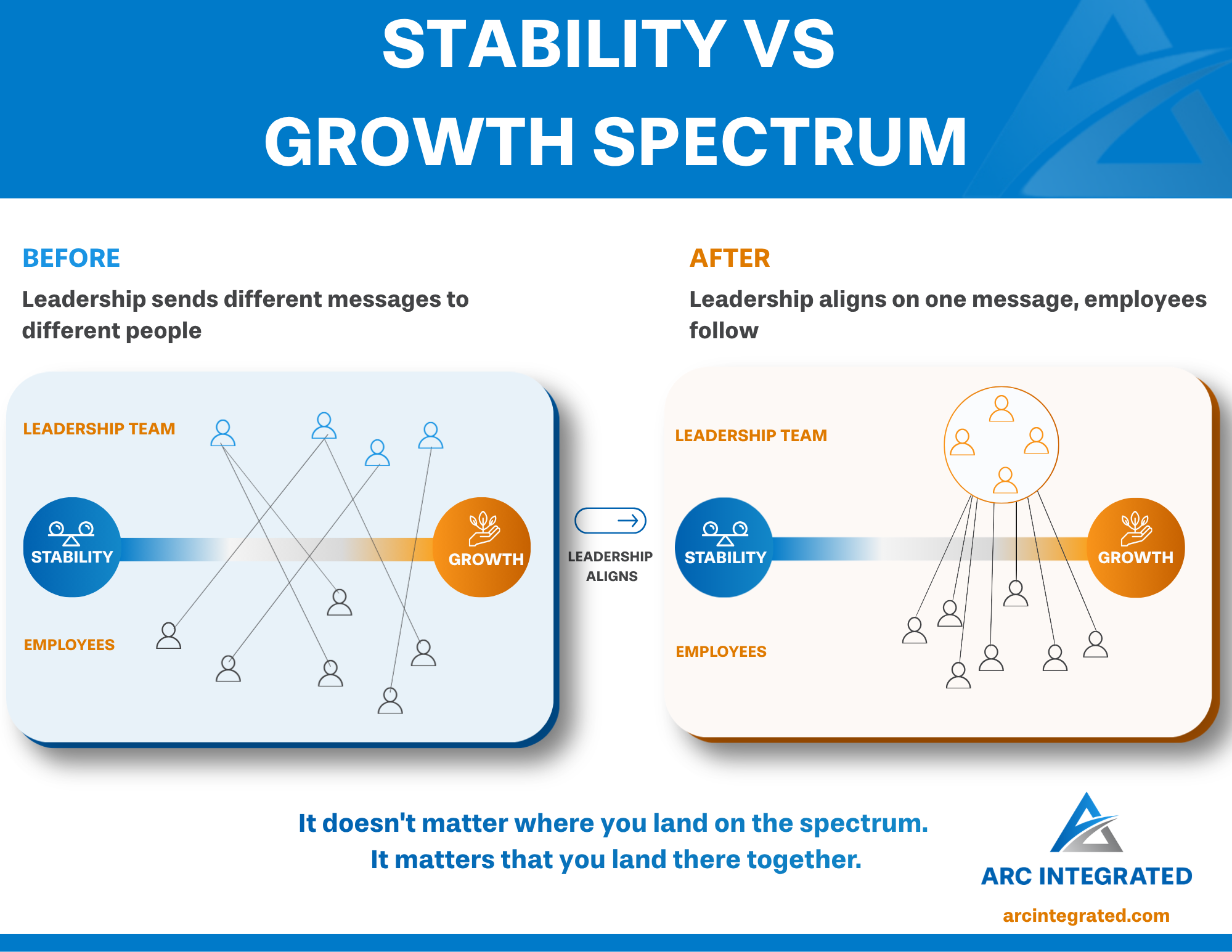
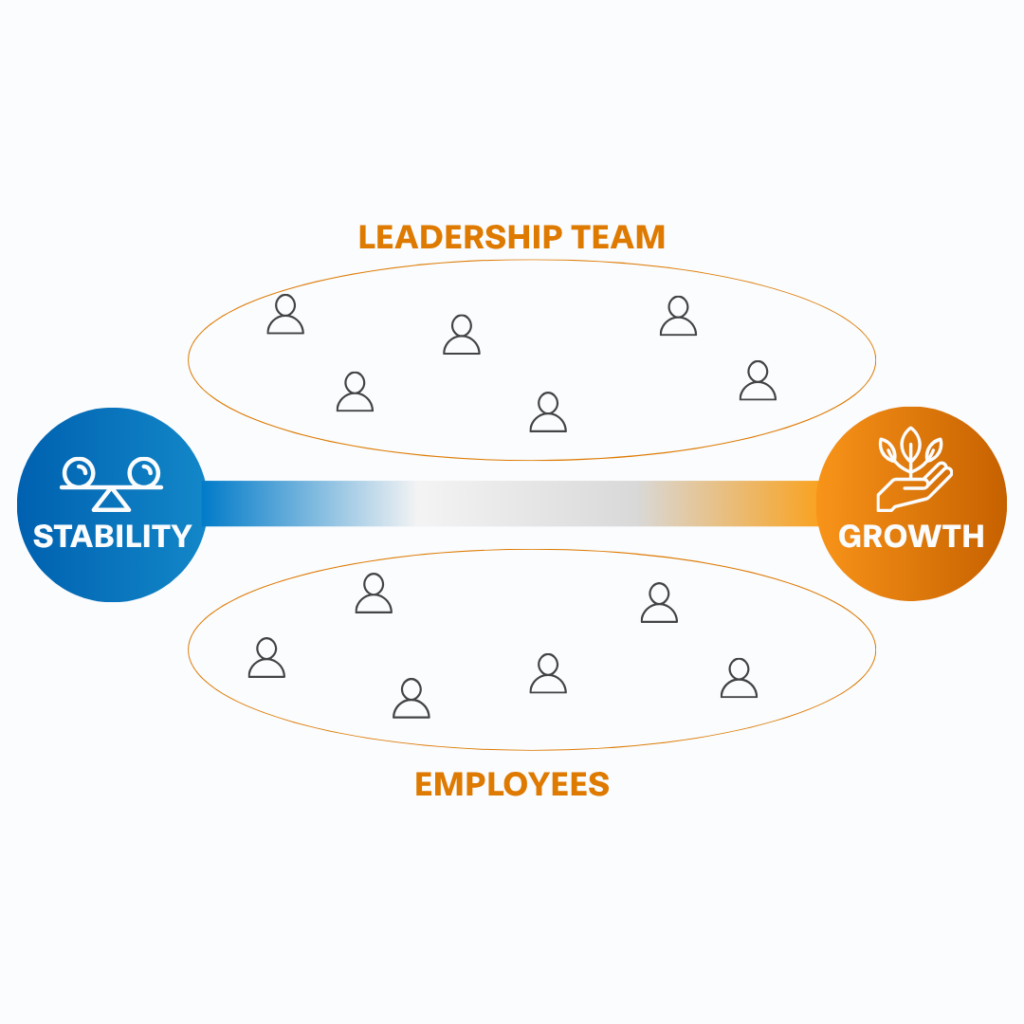
The Stability vs. Growth Spectrum is a visual model with three elements.
The first is the spectrum itself: a horizontal line with Stability on the left and Change and Growth on the right. Neither end is inherently correct. An organization that has just gone through a period of rapid expansion might genuinely need to stabilize. An organization that has been standing still too long might need to grow. The spectrum does not prescribe a destination. It creates a shared language for a conversation that most leadership teams have implicitly but rarely have explicitly.

The second element is the two levels. The leadership team sits above the spectrum line. The employee population sits below it. Individual dots scattered across both levels represent people and their natural preferences. What the model makes immediately visible is that both groups are spread across the spectrum, and that when the leadership team remains scattered, the signal that travels down to employees is fragmented rather than unified.
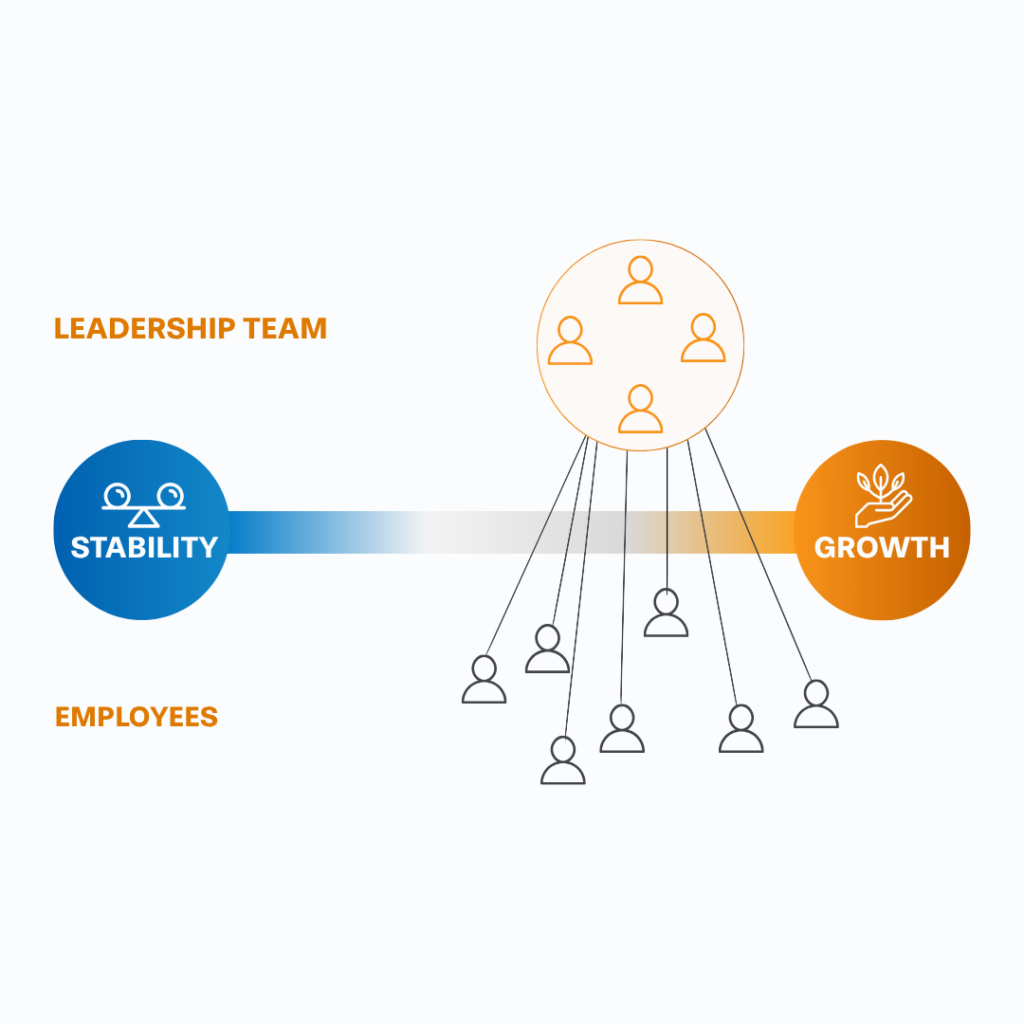
The third element is the cluster. This is the key move the framework asks of a leadership team: choosing, consciously and collectively, where to land on the spectrum together. Not based on individual preference. Not based on whoever is most persuasive in the room. Based on a deliberate decision about where the organization needs to be right now, given its current conditions, its market, its team, and its goals. Once the leadership team clusters and aligns, the message that travels to the employee population is clear. One direction. One signal. One culture.
The Cluster Does Not Need to Be in the Center
One of the most important things to understand about this model is that the right position on the spectrum is not necessarily the middle. A leadership team in the middle of a consolidation phase after rapid growth should cluster closer to the stability end. A leadership team launching into a new market should cluster closer to the growth end.
The spectrum is a tool for making a conscious choice, not a prescription for moderation.
What matters is that the choice is made together, named clearly, and communicated consistently. Research on leadership team alignment consistently shows that shared, accurate understanding among leaders is associated with higher organizational performance and stronger team coordination, and when leaders share a coherent model of where the organization is going, that clarity travels down in a way that fragmented preferences cannot (DeChurch & Mesmer-Magnus, 2010).
Rethinking the Polarity
A useful reframe we add is that the either-or framing of stability versus growth can itself be a limitation. A leadership team’s deeper work may be to find language that redefines what those terms mean for their specific context, rather than defaulting to the polarity.
A team stabilizing after rapid growth might actually be growing through consolidation. The discipline of building stronger systems, deepening team development, and reducing operational noise is not a retreat from growth. It is a different kind of it. The leader’s role includes helping the team find language for that so that moving toward stability does not feel like sacrifice or surrender.
This reframe matters because how the cluster position gets communicated is as important as where it is. A message that says “we are pulling back” will land differently than one that says “we are building the foundation our next phase of growth requires.” Both might describe the same cluster position. The language shapes whether people feel like the organization is moving forward or retreating.
This connects directly to what we explore in the Communication Map, where the way a message is calibrated and framed is as consequential as its content. The spectrum gives a leadership team a position. The Communication Map helps them think about how to carry that position into the conversations that follow.
This Is a Culture Question and a Strategic Planning Question
This framework is fundamentally a culture question, not just a strategy exercise. Where a leadership team clusters on the stability-to-growth spectrum is not simply a decision about priorities. It is a decision about what kind of organization the team is leading right now and what kind of experience they are creating for the people inside it.
The questions worth sitting with as a leadership team are direct: Where are we now on this spectrum? Where do we want to be by the end of the year? Are we aligned on that, or are we each operating from our own position without having said so? Research on leader communication confirms that consistency in how leaders communicate direction is one of the strongest drivers of psychological safety in teams, and when employees receive a coherent signal from leadership about where the organization is headed, they feel steadier and more willing to engage honestly with the work (Edmondson & Lei, 2014).
This framework lives naturally inside a strategic planning conversation. It is one of the core questions strategic planning is designed to answer: given who we are, what we have, and what the market is doing right now, where do we want to go and how do we want to exist as we get there? The spectrum makes that question visual and concrete in a way that is hard to sidestep.
It also connects to what we explore in the Conscious Influence Model. Leaders who have not resolved their own internal position on the stability-to-growth question are more likely to communicate from that unresolved place rather than from a collective one. Getting clear internally before communicating outward is not just a personal leadership discipline. At the team level, it is a structural prerequisite for sending a coherent message.
What Changes When a Leadership Team Aligns
When a leadership team does the work of clustering deliberately, several things shift. The message going to employees becomes coherent. The decisions different leaders make independently become more consistent because they are drawing from the same shared position. The friction that comes from people feeling pulled in different directions begins to settle. And the leadership team itself has a clearer anchor point when new decisions come up, because they have already agreed on the direction they are moving.
None of this requires everyone to feel the same way about stability and growth. People will still have individual preferences. What changes is that those preferences are held internally rather than communicated downward as competing signals. The team has made a collective decision, and that collective decision is what travels.
A Reflective Pause
Think about your leadership team right now. If you asked each member independently where they believe the organization should land on the stability-to-growth spectrum, would the answers be consistent? Consider whether there are places where different parts of your organization are receiving different messages about direction, and whether that fragmentation might be a reflection of the leadership team’s own unresolved position rather than anything the employees are doing wrong. And ask honestly whether your team has made this decision consciously together or whether it has simply accumulated from individual preferences without anyone choosing it.
The spectrum is not a complicated model. The work of actually clustering as a team, naming the position, and carrying it consistently into every communication and decision is what makes it powerful.
If you are interested in exploring where your leadership team sits on the stability-to-growth spectrum and what alignment might look like in your organization, book a free strategy call with us. We guarantee you will gain valuable insights into what might help take your team to the next level.