The Success Path: A Clear Model for Performance, Promotion, and Retention
Organizations often talk about success as if it is obvious. Work hard, perform well, get promoted. But over the years, we have noticed something different playing out in practice.
Most employees understand that effort matters. What they are often missing is clarity about their trajectory. Where they stand, where they are headed, and what the signals along the way actually mean. That absence of clarity is not a small thing. It shapes how people perform, how long they stay, and whether they trust the organization they work for.
The Success Path Model makes visible what is often implicit inside organizations: performance always moves in a direction. It is never neutral. Over time, patterns either compound toward expanded responsibility and success, or toward exit. This model helps leaders and teams see that direction earlier, before small signals become structural outcomes.
What Is the Success Path Model?
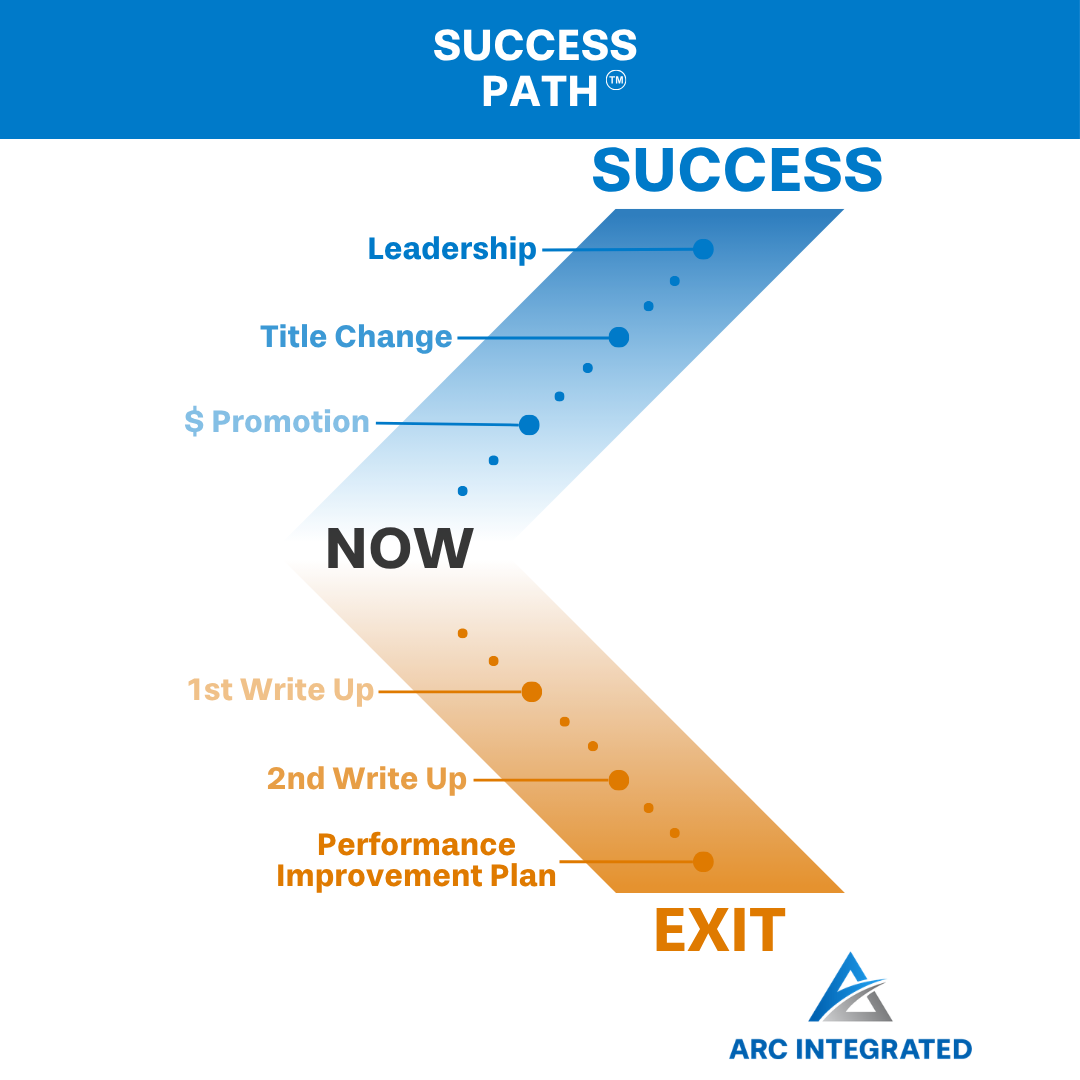
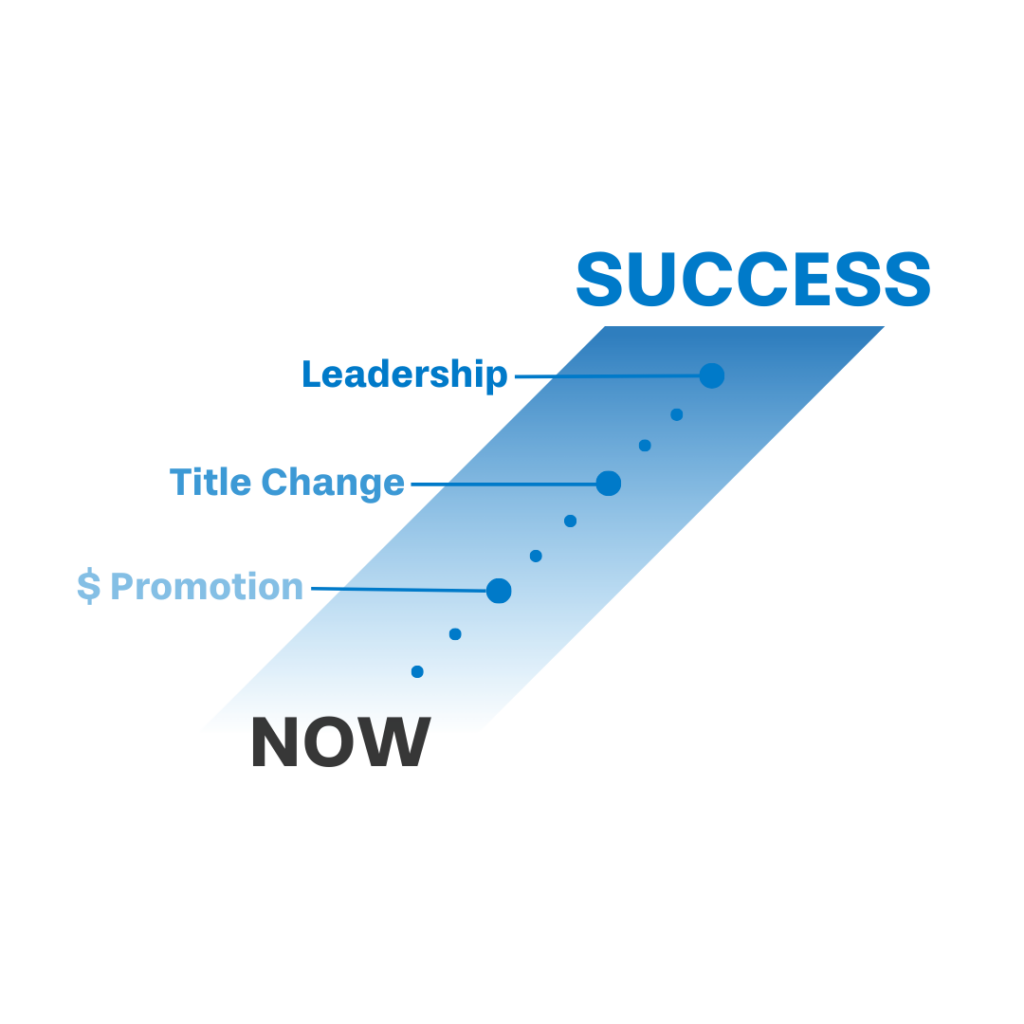
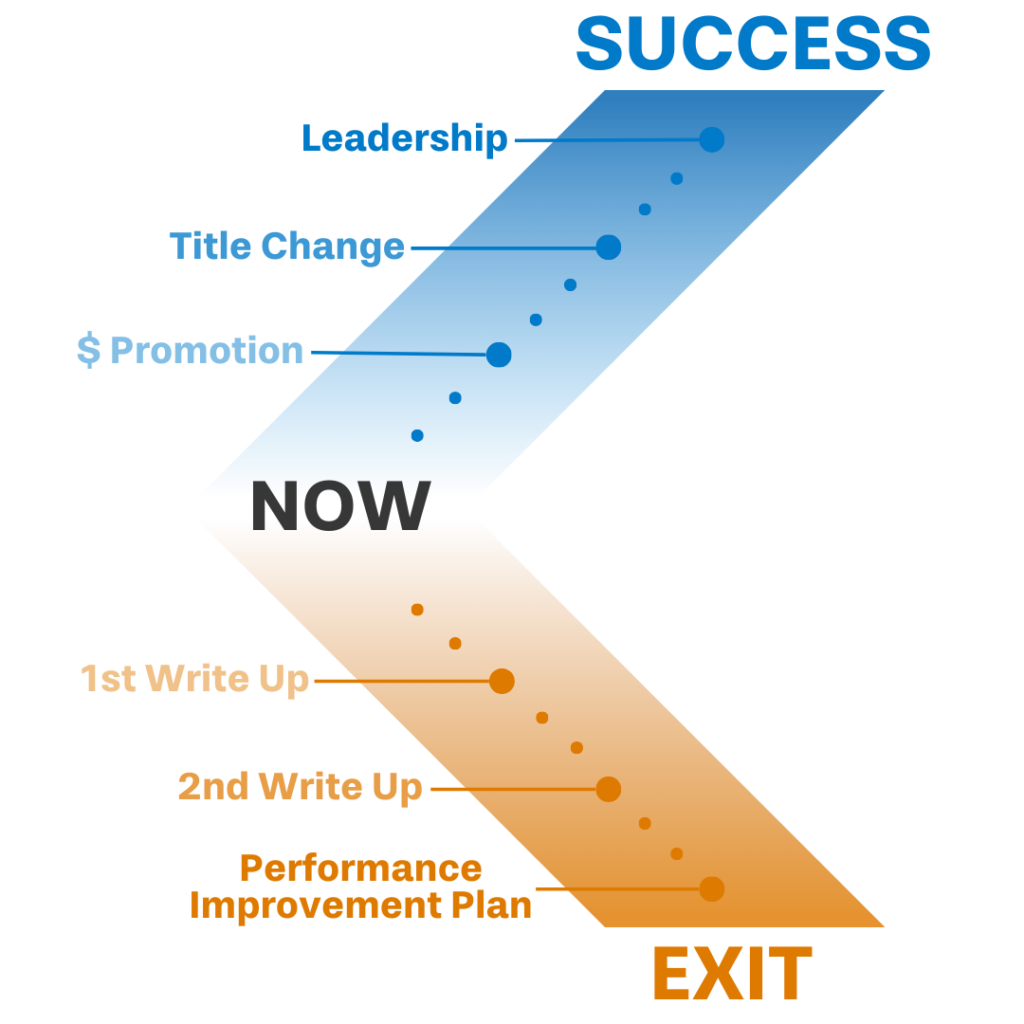
The Success Path is a visual representation of performance trajectory over time. At the center is now. The present moment of contribution. From here, two pathways extend.
Our model has placeholders in both directions that can serve as a guide but that will ultimately be different from one company to the other.

The upward path reflects compounding alignment, the kind that leads to promotion, title change, and expanded leadership.
The downward path reflects compounding misalignment, the kind that leads to a first write-up, then a second, then a performance improvement plan, then exit.

The model is not about punishment or reward. It is about pattern recognition. Some organizations have both directions clearly mapped out. Others have vague agreements in place that leave everyone guessing. The difference is whether trajectory is visible and intentional, or reactive and ambiguous.
Success Is a Direction, Not an Event
One of the most common misunderstandings about performance is treating it as episodic. A strong quarter. A missed deadline. A difficult conversation. But performance is rarely defined by single moments. It’s defined by trajectory. Small behaviors, repeated consistently, create a signal. Over time, that signal clarifies direction.
The research on this is consistent. Studies on self-regulation show that leaders with stronger self-discipline demonstrate what researchers describe as greater behavioral reliability and sustained effort over time. In one longitudinal study, self-discipline correlated with performance outcomes at nearly twice the rate of raw cognitive ability (Duckworth & Seligman, 2005). In other words, the person who shows up consistently and integrates feedback over time tends to outperform the person who is simply talented. This is what the upward path is built on.
On the upward path, we typically see increasing ownership, growing clarity, expanding influence, reliable follow-through, and proactive communication. On the downward path, patterns tend to include repeated missed expectations, avoidance of feedback, defensive responses, reduced reliability, and narrowing influence.
The difference between these paths is not talent. It is alignment and responsiveness to feedback.
Why the Success Path Model Matters for Leaders
For leaders, this model operates at two levels simultaneously. At the team level, it shapes how expectations are communicated, how feedback is delivered, how accountability is structured, and how early signals are addressed. At the organizational level, the cumulative effect becomes cultural. Is promotion predictable and fair? Is performance management consistent? Is feedback normalized or avoided? Is exit sudden, or preceded by visible signals?
The Success Path model helps organizations avoid two costly extremes. The first is ambiguity, where people do not know where they stand. The second is shock, where consequences appear sudden but were structurally building for months. Research on leader communication shows that employees in organizations where expectations are clearly communicated report significantly higher job satisfaction, with studies finding a positive correlation between perceived communication quality and satisfaction (Mikkelson, York & Arritola, 2015). When trajectory is visible, performance management becomes developmental rather than punitive. When it’s not, even well-intentioned leaders end up in conversations that feel unfair to everyone in the room.
The Upward Path: How Success Compounds
The upward side of the model is not random advancement. It reflects sustained patterns that organizations learn to recognize and reward. Our model is based on examples that will vary from one organization to the other.
Promotion and title change are not rewards for effort alone. They are signals that someone has demonstrated readiness for expanded scope. In our experience, movement upward consistently reflects five reinforcing dynamics. Individuals understand what good looks like in their role. Reliability becomes predictable over time. Feedback is integrated rather than resisted. Responsibility grows beyond minimum requirements. And peers begin to trust and rely on that person’s input, even without a title that formally grants authority.
That last point matters more than most organizations acknowledge. Research on leadership identity shows that people whose leadership claims are accepted by those around them are consistently rated as more effective, and that those ratings translate into concrete decision outcomes (Marchiondo, Myers & Kopelman, 2015). Influence, in other words, is not assigned. It is earned incrementally through the accumulation of these patterns.
These dynamics do not appear overnight. They compound. Over time, organizations extend responsibility because trust has increased, and trust has increased because the patterns were there to see.
The Downward Path: How Misalignment Compounds
The downward path is also rarely sudden, even when it feels that way.
A formal write-up typically follows a series of signals that were either not addressed or not heard clearly enough to produce a change in direction. Expectations were not clarified or not met. Feedback was delivered but not integrated. Patterns of inconsistency built up over time. Trust quietly eroded.
When misalignment continues, structure increases. A first formal documentation. A second. A performance improvement plan. Eventually, exit. Again, there may be more steps is the trajectory, it will depend on the company.
The structure itself is not the problem. In fact, clarity can be stabilizing for everyone involved, including the person receiving it. The challenge is when feedback is delayed or softened to the point that the first formal signal feels surprising. In our work, most exits are not caused by one major failure. They are caused by repeated unaddressed drift. Small things that were noticed but not named, named but not clearly, or clearly named but never followed through on.
Research on leadership derailment supports this pattern. Studies consistently identify the inability to build and maintain relationships, and the failure to adapt and learn from feedback, as the two most common drivers of leadership failure. These are not dramatic collapses. They are slow deteriorations that become visible only when the gap between where someone is and where they need to be has grown too wide to bridge quickly.
Feedback as the Pivot Point
The Success Path hinges on one central mechanism, and it is the same one we return to across many of the frameworks we teach: feedback.
Feedback determines whether small issues correct upward or compound downward. When feedback is early, specific, behavior-based, and predictable, trajectory becomes adjustable. When it is avoided, vague, personal, or inconsistent, trajectory becomes opaque until it hardens into something that is much harder to shift.
Studies on leader communication bear this out. Research finds that leader behaviors supporting open communication are significantly associated with employee voice (Detert & Burris, 2007). When people trust that feedback is honest and grounded in what the leader actually witnessed, they speak up sooner. They name friction before it compounds. They treat the conversation as useful rather than as a verdict.
This is where the Success Path connects directly to the COR Feedback Model. COR was built to make feedback traceable to direct observation, which is exactly what makes it trustworthy enough to act on. It also connects to the Responsibility Transition, where leaders who successfully shift from task dominance to scalable influence build feedback loops into the system. Without those loops, trajectory remains invisible until it is too late to easily change it.
Feedback does not create success or failure. It reveals direction early enough to influence it.
What Changes When the Path Is Visible
When organizations use the Success Path intentionally, several shifts tend to follow. Performance conversations become less personal and more structural. Promotion criteria become clearer and more consistently applied. Documentation feels less punitive and more predictable. Leaders intervene earlier, which means they intervene more gently. And employees begin to understand that direction is shaped daily, not annually during a review cycle.
Importantly, this model is not about pressure. It is about orientation. Research on awareness and self-regulation consistently shows that people perform better when they have an accurate picture of where they stand and what is shaping their trajectory. In one large study done by Harvard Business Review with nearly 69,000 leaders, those with significant blind spots about their own performance were rated approximately half as effective as those with more accurate self-perception (Zenger & Folkman, 2015). Visibility, it turns out, is not just useful for leaders. It is protective for the people they lead.
A Reflective Pause
If you consider your current team or organization, think about how visible the path to promotion actually is. Consider whether early signals are being addressed or postponed. Ask whether feedback feels developmental or episodic. And look honestly at where ambiguity might be allowing drift that nobody has yet named.
The Success Path reminds us that performance always moves somewhere. The question is not whether a path exists. It is whether it is visible early enough to influence.
How the Success Path Aligns with Other Arc Models
The Success Path is not a standalone concept. It integrates with several structural dynamics across the Arc framework.
The Communication Map reflects the same logic: structure and communication frequency increase when misalignment grows, and decrease as trust and competence rise. The Responsibility Transition shows how expanded responsibility reflects upward trajectory, and how stalled delegation often signals drift that has not yet been named. And the 10x Learning Experience speaks directly to why the upward path requires more than information. The model is built around optimizing for different learning styles in the room, balancing hands-on experience with evidence-based frameworks so that development actually translates into changed behavior. When employees are given the right kind of learning environment alongside a visible path, they are more likely to take ownership of their own trajectory rather than waiting to be managed toward it.
Across all of these models, one pattern holds. Autonomy increases when clarity increases. When both the leader and the employee understand where the path leads and what choices are shaping it, the employee stops being a passive recipient of performance management and starts being an active driver of their own outcomes. That shift, from managed to self-directed, is what the Success Path is ultimately designed to produce.
The Success Path makes that coexistence explicit so leaders can act on it before the window closes.
If you are interested in learning how to apply this model for yourself or across your leadership team, book a free strategy call with us. We guarantee you will gain valuable insights into what might help take your team to the next level.