Over the years, we have seen organizations handle leadership transitions in one of two ways. The first is intentional. The outgoing leader and the incoming leader work together over months, sometimes years, to transfer not just a title but the knowledge, relationships, and judgment that made the role function. The second is reactive. A leader announces their departure, someone gets promoted, and the organization spends the next year absorbing the cost of everything that was never transferred.
The gap between those two outcomes is not talent. It’s structure.
Leadership succession is one of the highest-stakes transitions an organization goes through, and it is one of the least structured. Founders step back without a clear plan. Senior leaders retire and take institutional knowledge with them that nobody thought to document. Successors are chosen based on competence without anyone checking whether the role actually aligns with what they want for their lives. And the transition, when it happens, is treated as a moment rather than a process.
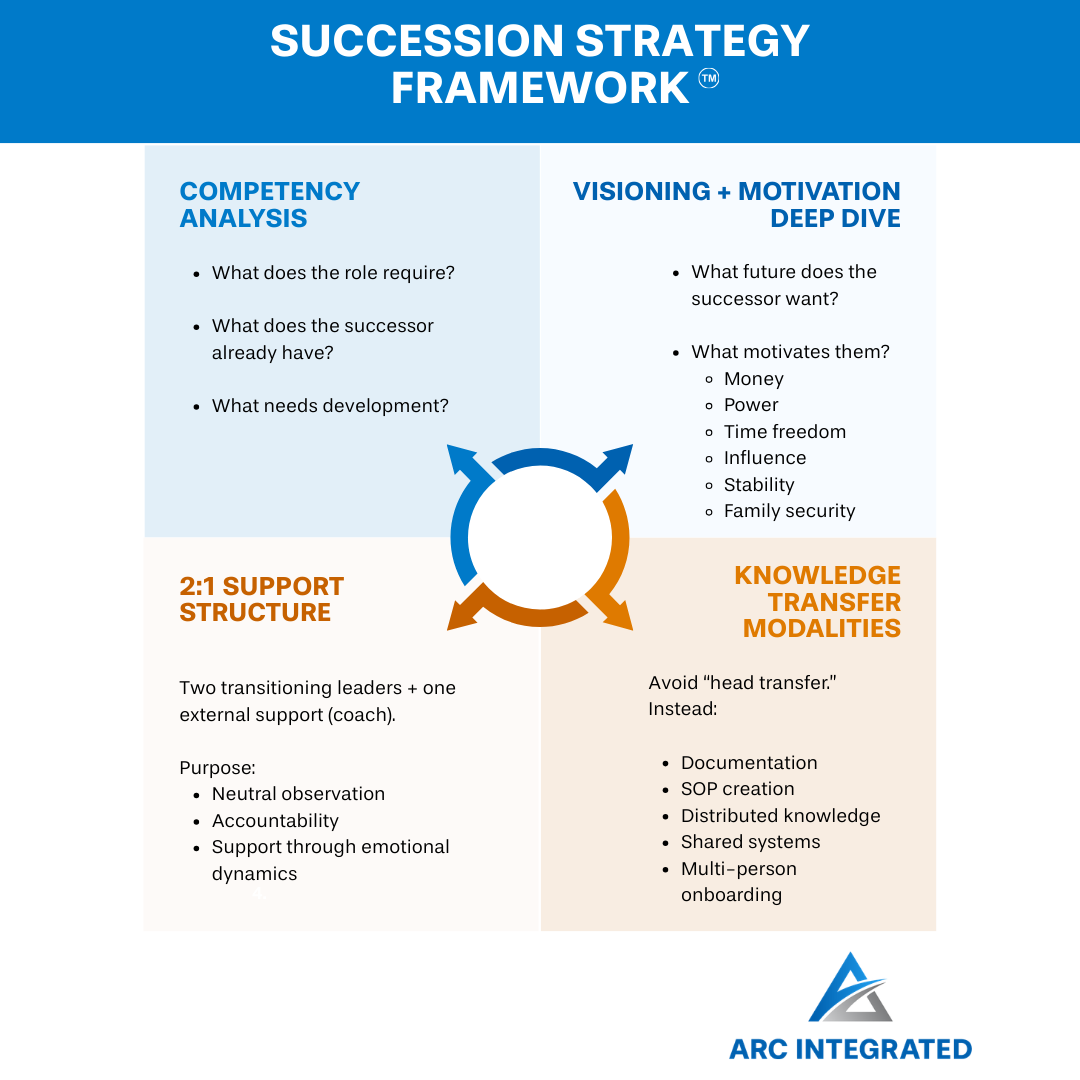
The Succession Strategy Framework was built to change that.
Why Most Successions Fall Short
In our experience working with organizations across industries and ownership structures, succession planning tends to fail in one of three predictable ways.
The first is assuming the successor is ready. Capability is evaluated based on current performance, not on the specific demands of the role being transitioned into. The person who was excellent in one position gets placed into a fundamentally different one without a clear map of what the new role actually requires.
The second is transferring knowledge informally. The outgoing leader answers questions as they come up, maybe sits in on a few meetings with the successor, and trusts that the important things will find their way across. What actually happens is that decades of judgment, relationships, and institutional context stay inside one person’s head and walk out the door with them.
The third is misalignment between the role and the person. Even when someone is capable of stepping into a leadership role, if the role does not match what they actually want from their career and their life, the succession tends to be short-lived. We have seen this pattern often enough to say with confidence that motivation misalignment is one of the most common and most avoidable causes of succession failure.
Research on leadership transitions supports this. Studies on executive derailment consistently find that poor transitions account for a significant portion of leadership failures in the first eighteen months of a new role, and that the failures are rarely about raw capability. They are about preparation, alignment, and the quality of support during the transition itself.
The Succession Strategy Framework addresses all three failure points deliberately.
The Four Components of a Strong Succession Process
The framework is built around four elements that, when addressed together, create the conditions for a transition that actually holds. None of them are complicated in isolation. The discipline is in taking all four seriously rather than treating any of them as optional.
Competency Analysis
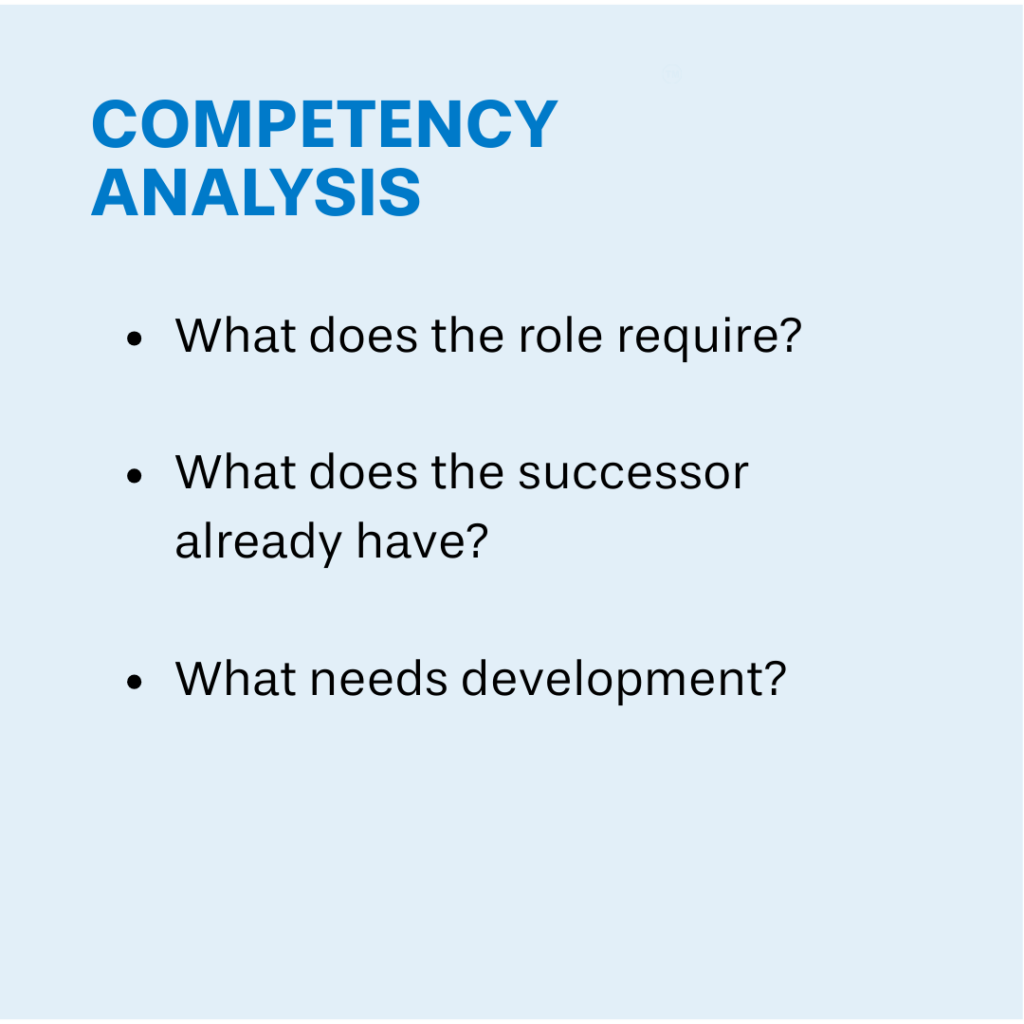
The first step is understanding what the role actually requires and how the successor currently measures against those requirements. This sounds straightforward, but in our experience it is rarely done with the specificity that makes it useful.
A competency analysis for succession is not a general performance review. It is a targeted conversation about the specific capabilities the position demands, which of those the successor already demonstrates, and which ones represent genuine development gaps that need to be addressed before or during the transition. That last category is the most important one. The gaps that are identified and planned for rarely derail a transition. The gaps that are assumed away almost always do.
This conversation is often the beginning of an ongoing dialogue between the outgoing and incoming leader, one that continues throughout the transition period and shapes how time and development resources are invested. When done well, it also gives the successor a clear picture of what they are walking into rather than discovering it one surprise at a time.
Visioning and Motivation Deep Dive
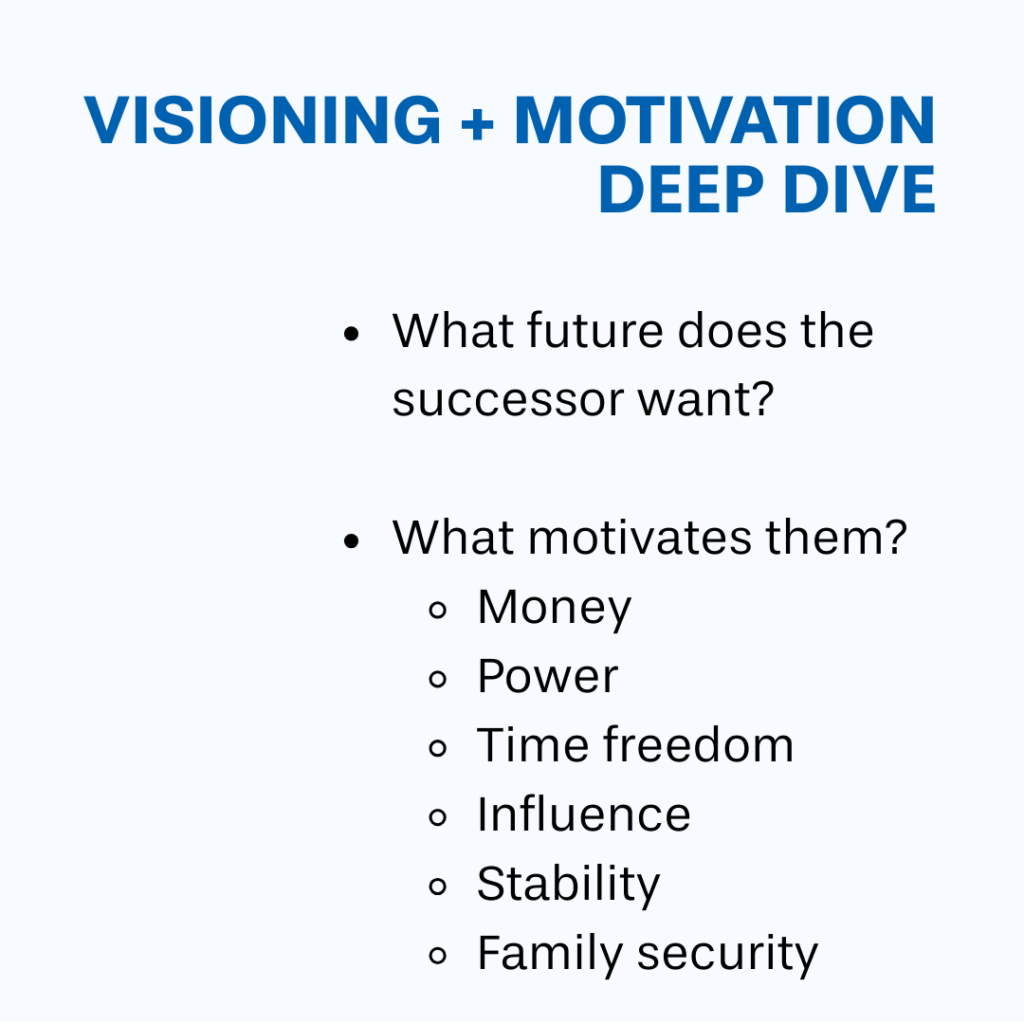
The second component is the one most organizations skip entirely, and it may be the most consequential.
Before a succession can succeed in any durable sense, there has to be genuine alignment between what the role demands and what the successor actually wants from their professional life. Financial reward, influence, work-life balance, responsibility, status, flexibility, family considerations. These motivations vary enormously from person to person, and they are rarely surfaced in a formal succession conversation. The assumption is that if someone is offered a leadership role, of course they want it. What we have learned is that this assumption is often wrong, or at least incomplete.
A successor who takes a role primarily because they felt expected to, or because declining felt like a missed opportunity, is not positioned for the kind of sustained commitment that a leadership transition requires. The role may be the right fit on paper while being the wrong fit for where that person is in their life. When motivation and role align, people lead with energy and ownership. When they do not, the transition produces a technically capable leader who is quietly looking for the exit.
The visioning conversation is not a formality. It is an honest exploration of what the successor wants their future to look like and whether this role is genuinely part of that picture. It protects the organization and the individual at the same time.
Two-to-One Support Structure
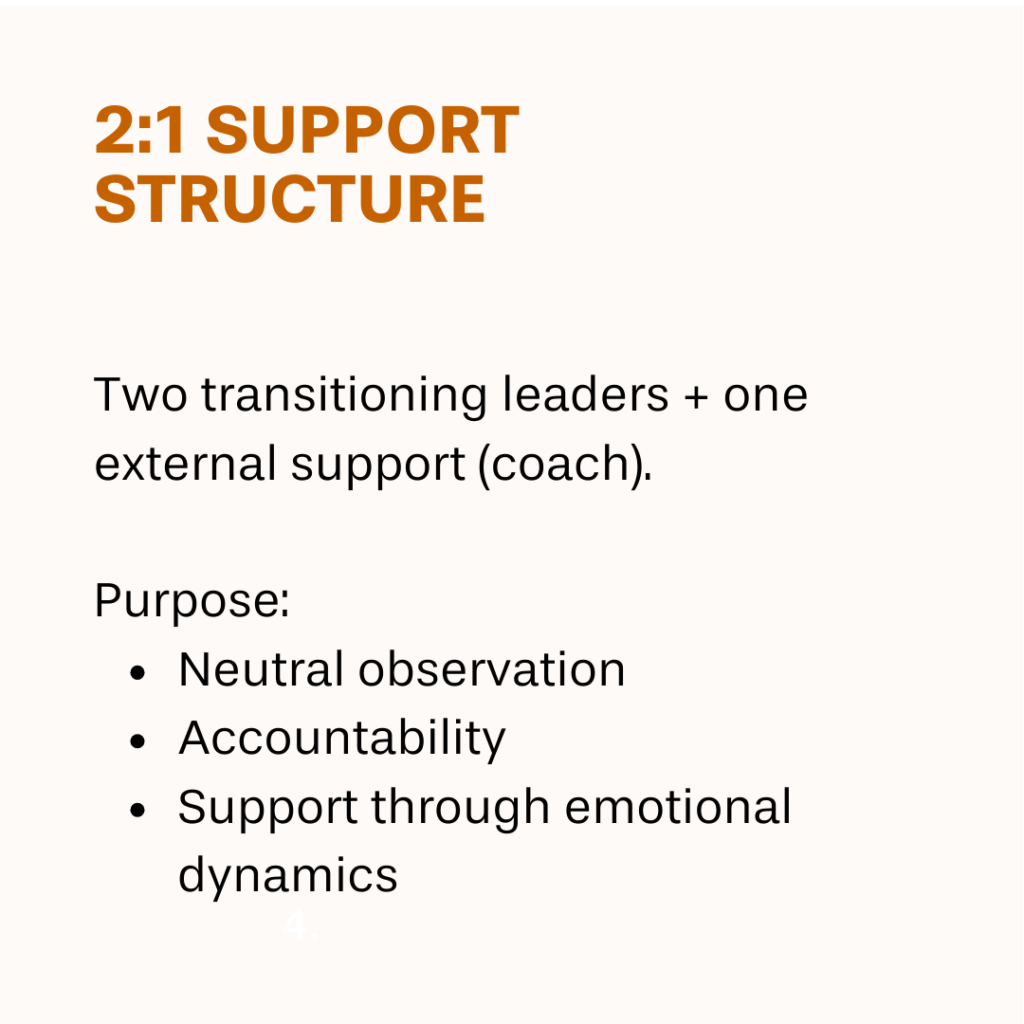
The third component addresses something that most succession plans overlook entirely: the relationship between the outgoing and incoming leader is itself a system that needs support.
In the two-to-one model, a coach or advisor works with both the leader stepping out and the leader stepping in simultaneously. The external perspective this creates is not about arbitrating between them or managing the relationship. It is about seeing what neither of them can see clearly from inside the transition. Blind spots on both sides, dynamics that are developing between them, assumptions that are going unexamined, conversations that need to happen but are being avoided.
Transitions between leaders are almost always more emotionally complex than they appear on the surface. The outgoing leader is navigating identity and legacy. The incoming leader is navigating credibility and confidence. Both are managing the relationship between them while also managing the expectations of everyone else in the organization. An external advisor who understands all of this and can hold both of them accountable creates a kind of stability that the transition would otherwise lack.
In our experience, this is often the element that makes the difference between a transition that holds and one that quietly unravels in the first year.
Knowledge Transfer Modalities
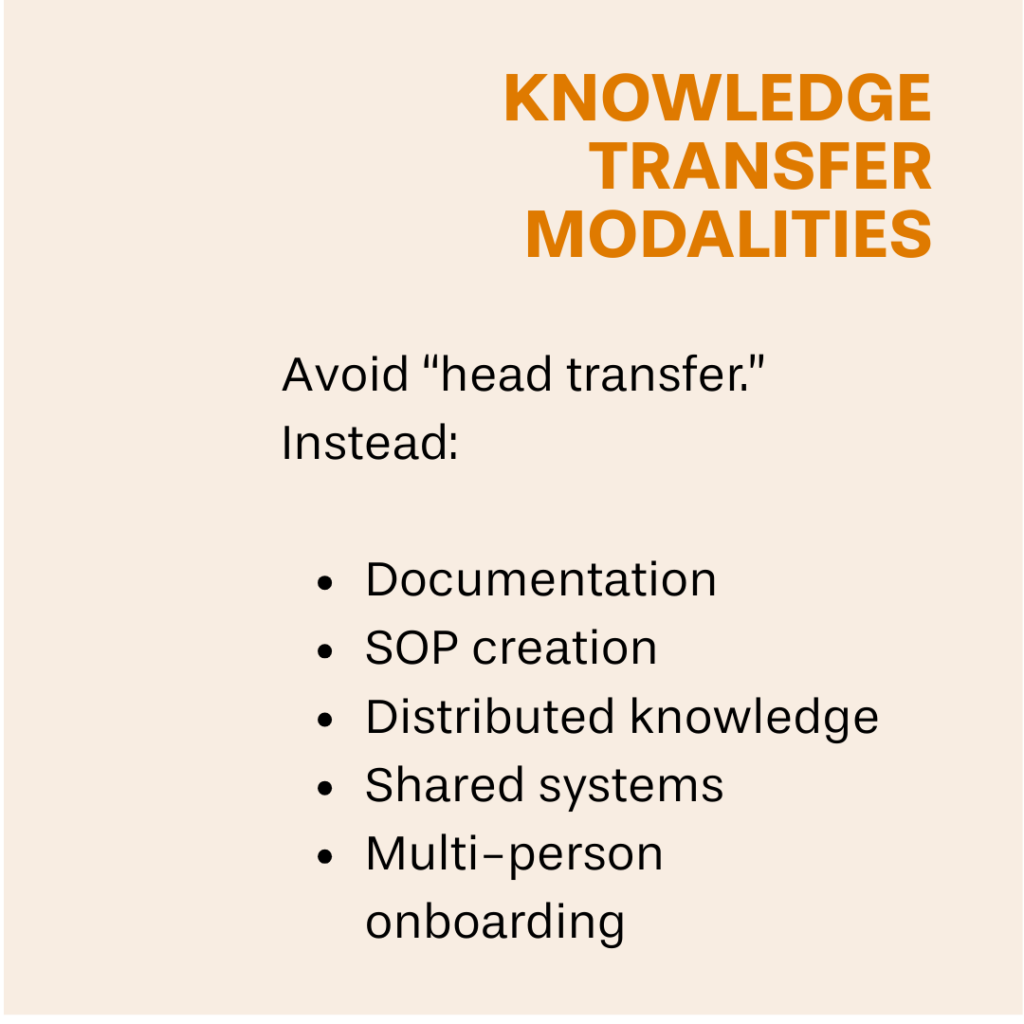
The fourth component is where most of the practical work happens, and where most organizations are the least intentional.
Knowledge transfer is not a conversation. One leader telling their successor everything they know over a series of lunches is not a knowledge transfer strategy. It is a starting point at best, and it leaves the most valuable organizational knowledge exactly where it has always been: inside one person’s head, where it will eventually become unavailable.
The goal of deliberate knowledge transfer is to make institutional knowledge organizational rather than personal. That means documentation. It means standard operating procedures. It means shared systems and databases. It means involving additional team members in the process so that critical knowledge is distributed across the organization rather than relocated from one person to another. When a successor eventually transitions out of the role themselves, the organization should not be starting over.
This work takes longer than most organizations expect and more intention than most outgoing leaders naturally bring to it. People who have been doing something for decades often struggle to articulate what they know because so much of it has become automatic. Part of the successor’s role during this phase is to ask the questions that surface what the outgoing leader did not know they knew.
The Timeline Reality
We want to be direct about something that often surprises organizations when they begin this work. A genuine succession process takes time, often measured in years rather than months. The organizations that do this well typically begin the conversation long before a transition feels imminent.
That timeline is not bureaucratic overhead. It is the natural duration of what needs to happen. Competency gaps need time to be developed. Motivation alignment needs time to be explored honestly. The two-to-one support relationship needs time to build the trust that makes it useful. Knowledge transfer, done properly, is not a sprint.
The organizations that handle succession well are the ones that treat it as a long game, a form of strategic investment in the future stability of the organization rather than a logistical problem to be solved when someone announces their departure.
This connects directly to what we explore in the Responsibility Transition, which describes how individual leaders move from task execution toward system-level influence. Succession planning is the organizational version of that same shift. The organization itself is transitioning from dependence on one leader’s knowledge and judgment toward something more distributed and durable.
Succession as a Culture Signal
What we have found is that how an organization handles succession says something important about how it thinks about leadership more broadly. Organizations that plan succession intentionally are organizations that take leadership development seriously at every level. They are not just managing a transition. They are demonstrating that leadership is something the organization invests in and thinks about continuously, not something that gets addressed when it becomes urgent.
A well-executed succession either builds confidence across the organization that leadership is thoughtful and the future is stable, or it creates anxiety that the organization is less prepared than it appeared. That signal travels further than most leaders expect.
Leaders who engage with this framework are not just planning for their own transition. They are modeling the kind of intentional, forward-looking leadership that makes organizations genuinely resilient.
A Reflective Pause
If you look at your organization honestly, consider whether you have a clear succession plan for your most critical leadership roles. Consider whether the people most likely to step into those roles have been told that, have been developed toward it, and have been asked whether it is actually what they want. Consider how much of the knowledge that runs your organization lives inside individual people rather than inside organizational systems.
Succession is not a contingency plan. It is a leadership responsibility. The time to begin is well before the transition feels necessary.
If you’re interested in learning how you can best apply this or other frameworks into your team, Book a Free Strategy Call with us, we guarantee you’ll gain valuable insights into what might help take your team into the next level.