Responsibility Transition: How Leaders Shift from Task Management to Scalable Leadership
Over the years, we have seen one of the most predictable inflection points in leadership development play out in organizations of every size and industry. We call it the Responsibility Transition.
Most high-performing professionals are promoted because they are strong subject matter experts. They are reliable, technically deep, and they solve problems. But once they step into leadership roles, the expectations shift. The skills that created success at one level no longer create success at the next. This is not a personal failure. It is a structural transition, and it tends to catch even talented people off guard because no one made it explicit before they got there.
The Responsibility Transition makes visible what is often unspoken: leadership effectiveness over time requires a gradual shift from personal task execution and subject matter expertise toward system-level influence.
What Is the Responsibility Transition?
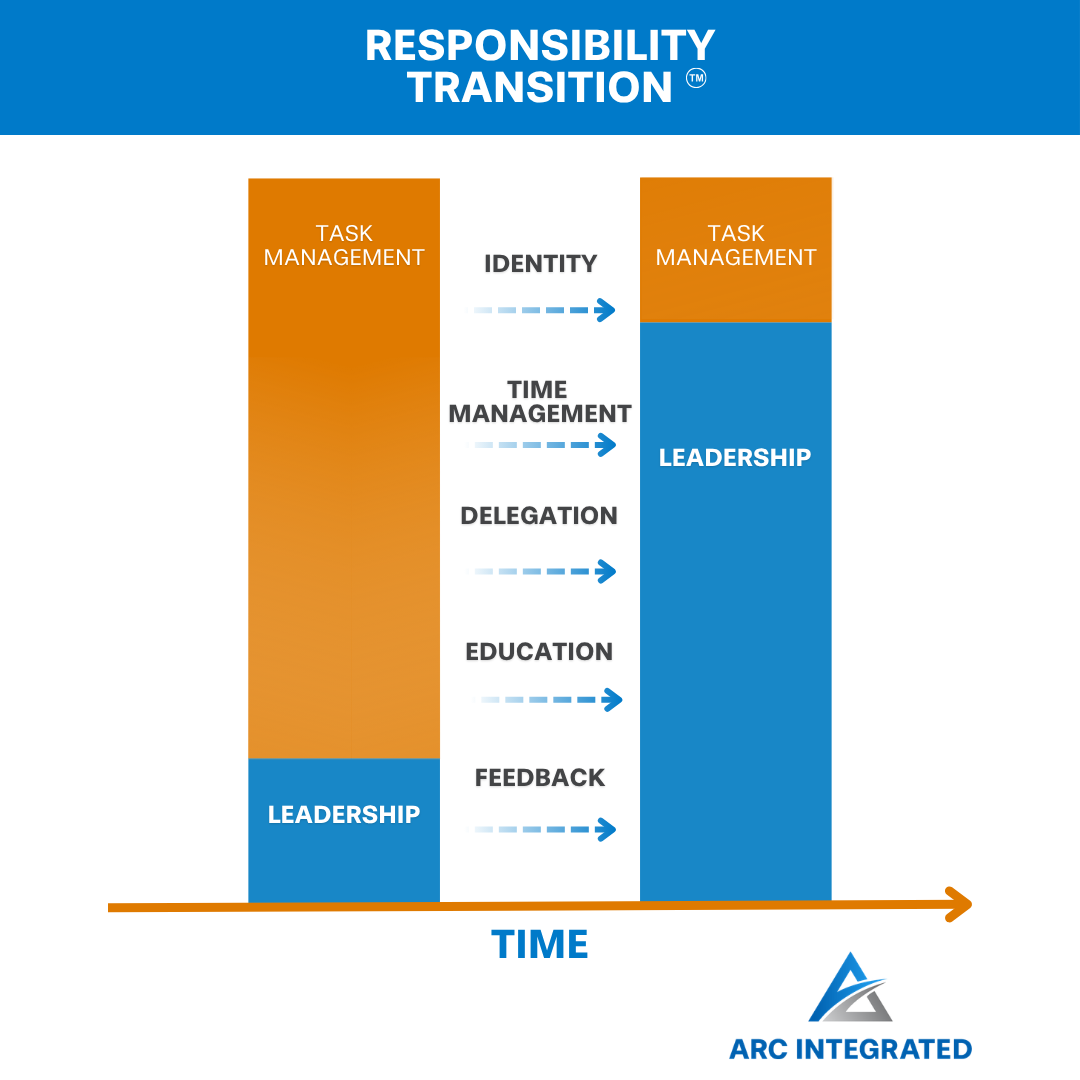
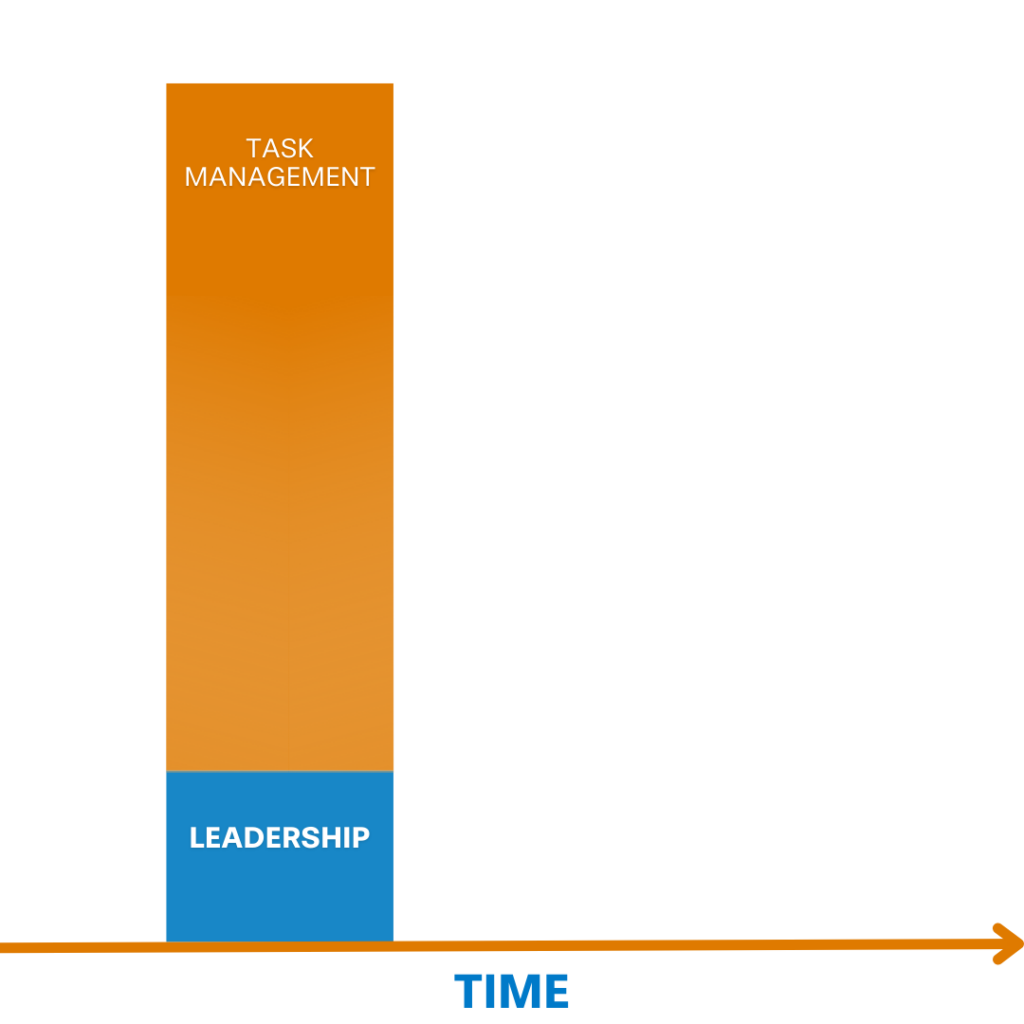
At the beginning of any role, most responsibility sits in task management and subject matter expertise. You complete deliverables, manage deadlines, own execution, and you are valued for the technical depth you bring.
As time progresses and the professional is required to move into a leadership position, five shifts are necessary to successfully complete that process. Those shifts involve identity development, time reallocation, delegation, intentional self-education, and the ability to both give and receive feedback.
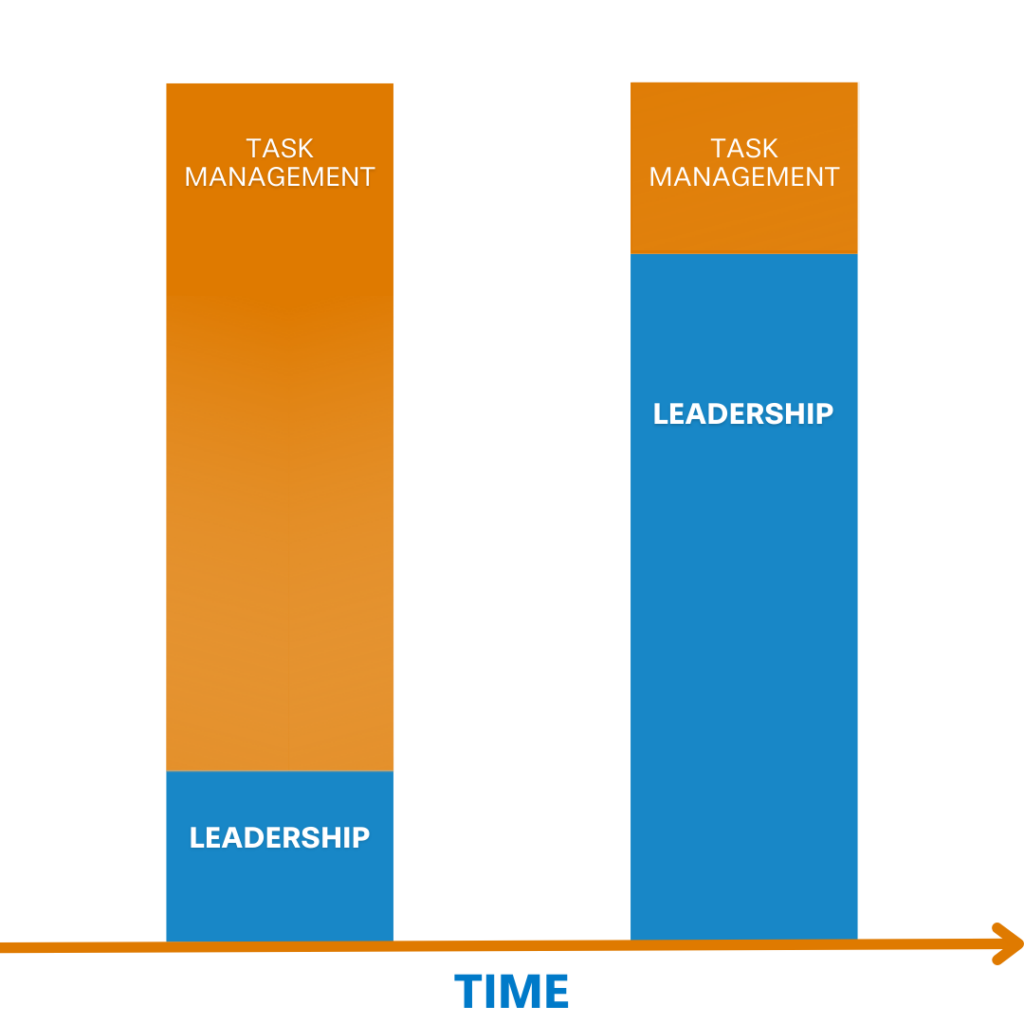
Subject matter expertise does not disappear in this process, but it can no longer dominate. What we have learned is that without these shifts, leaders become bottlenecks instead of multipliers.
Why This Transition Is Difficult
This shift is rarely made intentionally. In our work with organizations across industries, we consistently see the same five patterns show up.
Leaders are promoted for their ability to execute, so they continue to over-execute even after the promotion. Delegation feels risky because competence has been their safety net for their entire career. Time stays reactive because operational demands feel urgent and measurable in a way that leadership development does not. And the development itself gets postponed because technical work feels more concrete and controllable than the messy, harder-to-quantify work of growing other people.
Research on leadership derailment suggests that difficulty transitioning from technical expertise to people leadership is one of the most common causes of stalled advancement (Lombardo, M. M., & Eichinger, R. W.). Leaders who cannot redistribute responsibility often experience burnout, reduced team engagement, and limited scalability. We have seen this enough times to say with confidence that the transition rarely gets easier by waiting. It gets more entrenched.
Our Responsibility Transition model was created to make this predictable friction visible before it becomes costly.
The Five Shifts Required to Transition from Technical Expert to Leader
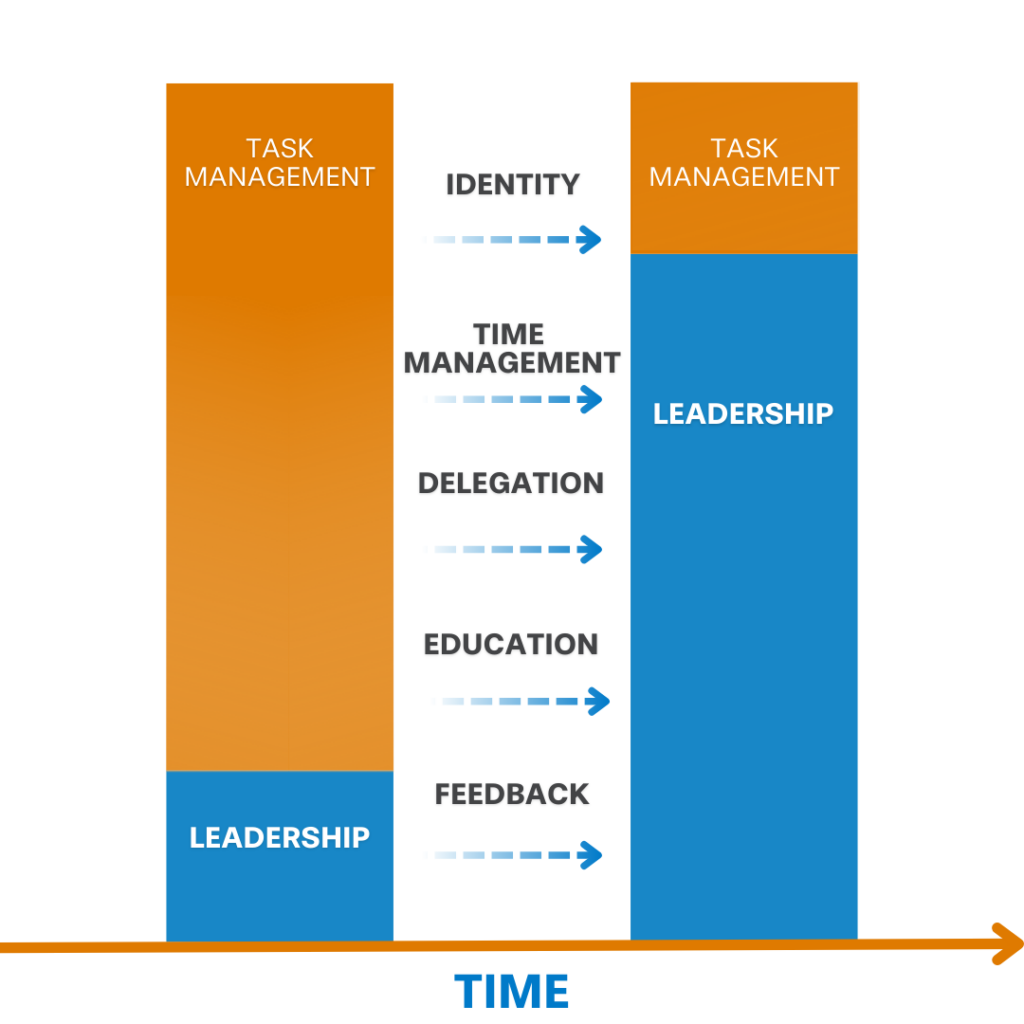
These five shifts are not a description of what leadership work looks like on the other side. They are the requirements necessary to get there. They form the bridge between technical expertise and scalable leadership, and when even one of them is underdeveloped, the entire transition tends to slow down.
Identity Shift: From Doer to Leader
The first shift is internal, and in our experience it is often the most subtle and the most powerful. Leadership development begins with identity. A leader must gradually move from “I am valuable because I produce” toward “I am valuable because I create conditions for others to produce.”
If identity stays anchored in personal production, delegation feels like loss. Leaders step back into execution at the first sign of risk because that is the terrain where they feel competent and safe. When identity expands to include influence and development, delegation becomes a strategy rather than a threat. The work does not change overnight, but the relationship to it does.
Research on leadership identity development supports this. Longitudinal studies show that increases in leader identity strength are associated with meaningful increases in leader role enactment over time, even after controlling for prior behavior (The Leadership Quarterly). How leaders see themselves shapes how they lead, more than most people expect.
Time Management Shift: From Reactive to Intentional
Once identity begins to shift, time allocation has to follow. Early-stage leaders spend most of their time solving immediate problems and responding to requests. In our experience, even seasoned leaders fall back into this pattern under pressure, because reactive work always feels urgent and visible in a way that strategic work does not.
Scalable leadership requires reallocating time toward coaching conversations, strategic thinking, cross-functional alignment, and structured feedback. Time signals priority. If leadership work is not scheduled, it remains aspirational. We often hear leaders say that development matters, but their calendars tell a different story.
The fix is structural rather than motivational. Block recurring development conversations. Protect time for strategic thinking before execution fills it. Reduce the reflexive quick answers that feel helpful in the moment but quietly train your team to stay dependent.
Delegation Shift: From Control to Capability-Building
Delegation is often misunderstood as task redistribution. In practice it is a developmental act, and it is one that strong subject matter experts tend to struggle with because they can perform the tasks quickly and precisely. In the short term, doing it themselves feels efficient. It probably is efficient, in the short term.
But in our experience, leaders who avoid delegation create invisible dependency. The team learns that the leader is the real decision-maker, and ownership stalls at the top. Effective delegation means setting clear expectations, defining what success looks like, building in feedback loops, and extending autonomy gradually as competence and trust grow. When done well it increases ownership and reduces dependency. When avoided it concentrates risk in one person and limits how far a team can go.
This connects directly to what we explore in the Communication Map. Structure increases when seriousness is high, then decreases as competence and trust grow. Delegation follows the same logic.
Education Shift: Building Leadership Capability Deliberately
Most professionals are promoted because they are technically strong, not because they have been trained to manage conflict, give effective feedback, regulate emotional responses, influence across systems, or lead strategic alignment. These are distinct skill sets, and the assumption that strong performers will figure them out along the way is one of the more expensive assumptions organizations make.
In our experience, leaders who operate on that assumption tend to plateau. Leadership competence has to be built deliberately, through executive coaching, structured programs, applied reflection, mentorship, or some combination of those. Subject matter expertise does not automatically translate to people leadership, and the leaders who grow fastest are usually the ones who stop expecting it to and start investing in what the new role actually requires.
Research on adult learning reinforces why this matters. Our 10x Learning Experience model is built around the reality that learning sticks when it is designed around how adults actually absorb and apply new behaviors, not just exposed to content and left to integrate it alone.
Feedback Shift: Learning to Give It, Receive It, or Both
The Responsibility Transition breaks down quickly when feedback is avoided, and in our experience, the direction it gets avoided varies by person. Some leaders struggle to give feedback directly. They soften it, delay it, or skip it entirely because the discomfort of the conversation feels greater than the cost of staying quiet. Others struggle to receive it. They become defensive, dismiss the input, or accept it on the surface without actually integrating it. And some leaders struggle with both.
Neither challenge is a character flaw. Both are patterns that develop over years of being rewarded for technical performance rather than for the quality of their communication. Research published in Personnel Psychology found that most organizations implement feedback processes without connecting them to structured development, which means leaders are often left to navigate these dynamics without a clear path forward (London & Smither, 1995).
A useful place to start is simply asking yourself: do I need to work on giving feedback, receiving it, or both? That honest answer shapes where the real development work is.
The COR Feedback Framework was designed specifically for this moment. It gives leaders a structure for feedback that is grounded in direct observation rather than secondhand information, which is what makes feedback feel safe to receive and productive to act on. Leaders who scale influence normalize feedback as part of the system, specific, behavior-based, and predictable. When that happens, responsibility can genuinely redistribute, because the system begins to self-correct without the leader carrying everything personally.
The Long-Term Impact of the Responsibility Transition
When leaders successfully move from task dominance to leadership distribution, teams operate with greater autonomy, decision-making speeds up, learning loops strengthen, strategic focus increases, and organizational resilience improves. These are not soft outcomes. They are the structural difference between a leader who is essential to every decision and a leader who has built something that works beyond their direct involvement.
Importantly, subject matter expertise does not disappear on the other side of this transition. It becomes contextual rather than central. Leaders step into execution when it is genuinely needed, but they no longer define themselves by it.
That is the structural difference between management and scalable leadership.
A Reflective Pause
If you look honestly at your current leadership role, consider where most of your time actually goes. Consider whether your identity is still anchored in execution, where delegation might be a developmental opportunity rather than a risk, and what capabilities you are intentionally building in others.
Responsibility Transition is not a one-time event. It is a gradual redistribution that happens over time. Clarity makes it visible. Intention makes it sustainable.
If You Are Seeing This Pattern in Your Organization
If you are navigating this transition personally or seeing it play out across your leadership team, you are not alone. What we have found is that making this shift explicit changes everything. Leaders stop feeling like they are failing and start recognizing that they are simply in transition, which is a very different problem with a very different solution.
If you are interested in learning how to apply this model for yourself or inside your organization, book a free strategy call with us. We guarantee you will gain valuable insights into what might help take your team to the next level.