Over the years, we’ve seen there’s a moment most leaders have experienced. You sit down to give feedback, you pull out the model you were taught, maybe SBI, maybe SAR, you walk through your notes, and the person in front of you looks… confused. Or defensive. Or politely checked out.
You did everything right, you followed the framework, and yet somehow the conversation still felt off.
The problem might not be you. It might be the model itself.
Why Most Feedback Models Fall Short
Frameworks like SBI (Situation, Behavior, Impact) and SAR (Situation, Action, Result) were designed to bring structure to a conversation that often lacks it. That intention is right. But in practice, these models have a quiet flaw baked into their design.
They usually don’t tell you where the information has to come from.
So what happens in organizations is predictable. A leader sits down to give feedback, and instead of drawing from what they personally witnessed, they draw from what someone else told them. “I heard the meeting didn’t go well.” “Someone mentioned there was tension.” “Emily said the conversation felt off.”
That is not feedback. That is communication triangulation wearing a framework’s clothing.
In our experience working with leaders across healthcare, construction, hospitality, manufacturing, and dozens of other industries, this pattern shows up everywhere and it causes real damage. It looks responsible on the surface. You are following a model and you’re having the conversation. But the source of the feedback is a rumor, and the person receiving it knows it, even if they can’t name it in the moment. In our work on the Conscious Influence Model, we talk about how the most effective leaders are the ones who stay deeply curious rather than reactive, and how that curiosity has to be directed at what is actually true, not what has been filtered through other people.
Our research makes this even clearer. Studies on leader self-perception consistently show that leaders’ self-ratings and others’ ratings correlate only in a proportion, which means leaders are regularly operating on an incomplete picture of their own impact. When you add secondhand information into the feedback loop, you compound that gap. You are not just working from a partial picture of yourself, you are also working from a partial picture of someone else.
The COR Feedback Framework was built to fix this.
Introducing COR: Context, Observation, Result
COR gives leaders a structure for feedback that is clean, direct, and grounded in what they actually know. It’s not a reinvention of feedback. It’s a refinement, one that closes the loophole that other models leave open.
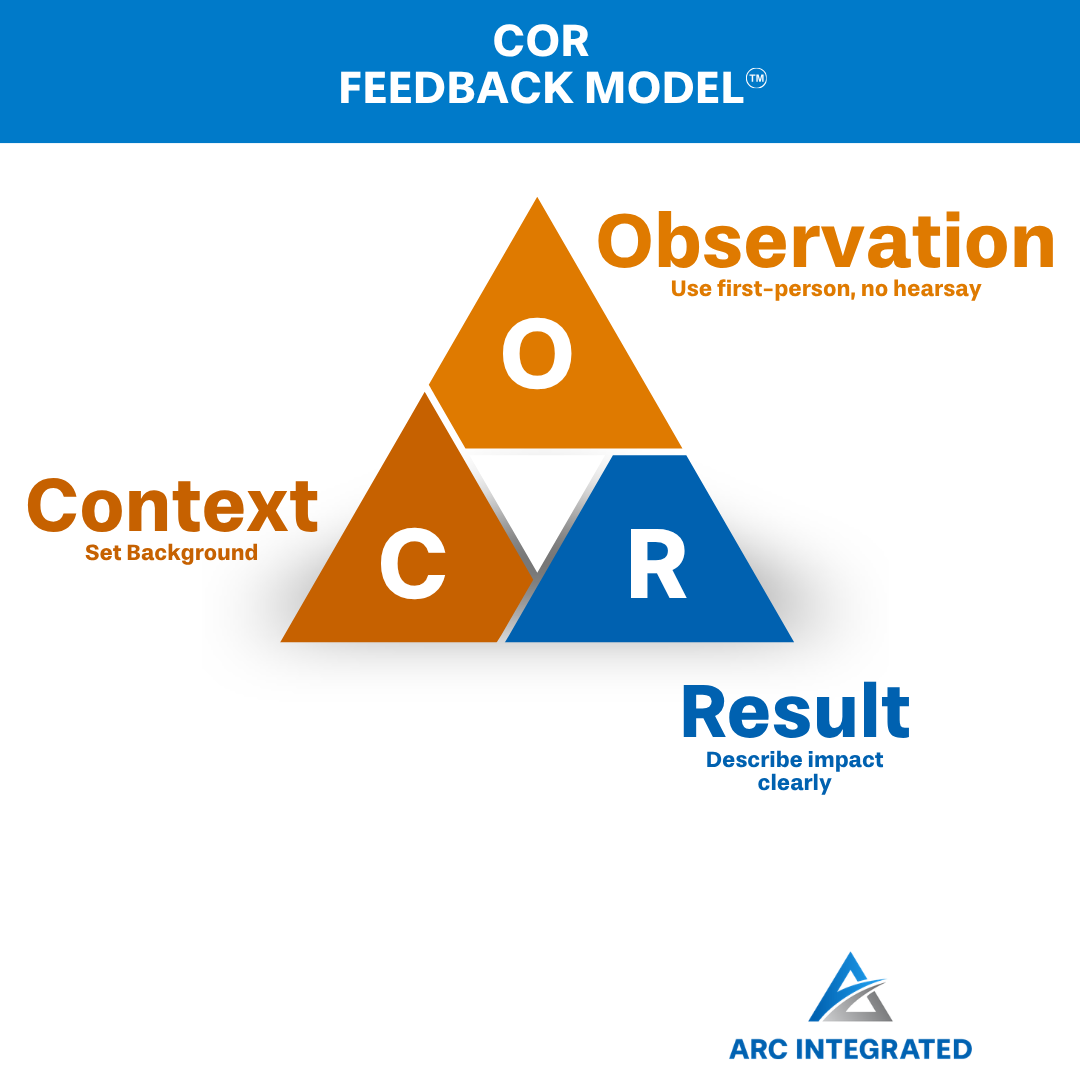
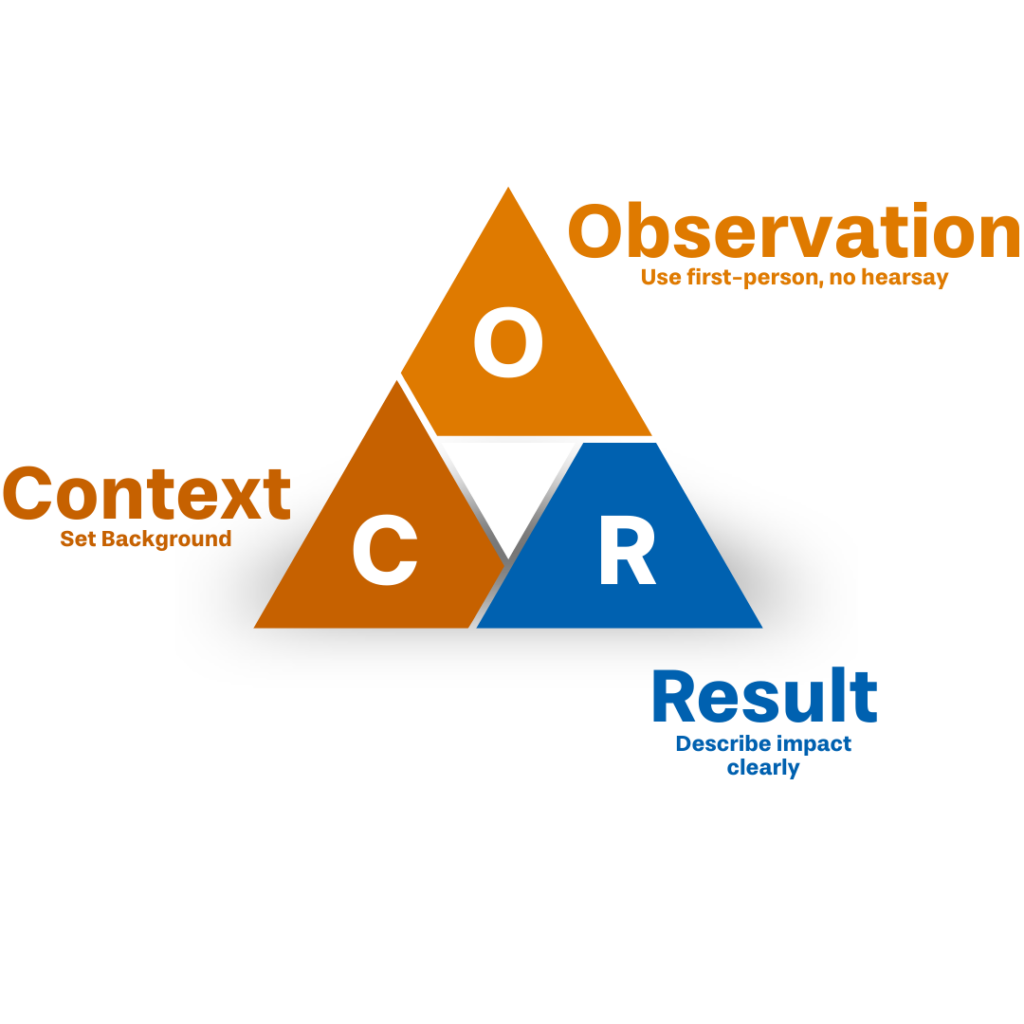
The three elements are simple: Context, Observation, and Result.
What makes COR different is not the structure. It’s the discipline each element requires.
Context: Wider Than a Situation
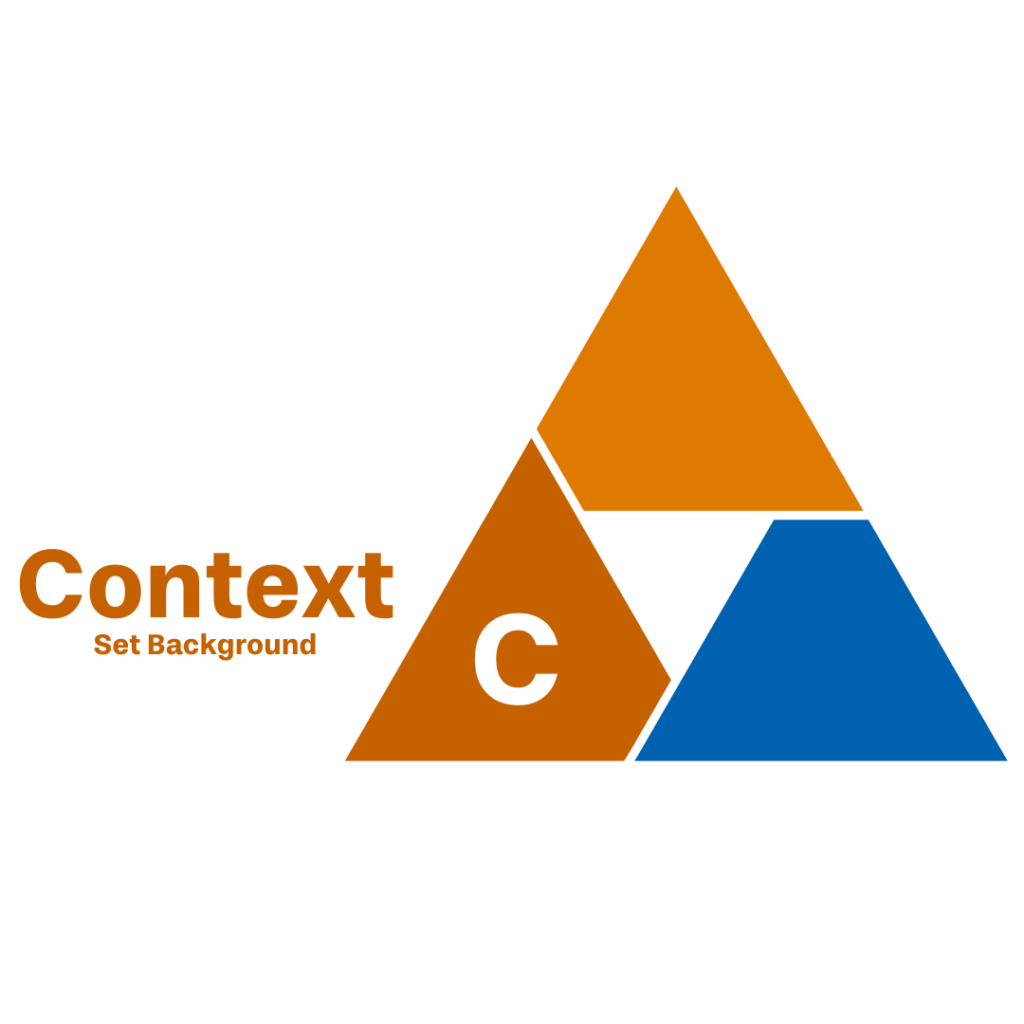
Most feedback models open with a Situation. “In last Tuesday’s meeting…” “During the project debrief…” The idea is to anchor the feedback in a specific moment so the conversation does not feel abstract.
That is a reasonable instinct. But a situation, by definition, is narrow. It implies a single event in isolation, stripped of the relationship, history, and expectations that give it meaning.
Context is broader. Context allows you to bring in the background that makes the observation make sense. That includes the role someone is playing, the agreements already in place, the environment they are operating in, the expectations set in earlier conversations. When you frame feedback with context instead of situation, the person receiving it understands not just the what, but the why this matters.
The difference sounds like this. Instead of saying, “In yesterday’s meeting, you took over the discussion,” you might say, “We talked a few weeks ago about Emily stepping into more of the design lead role, and the goal was to create space for her to take ownership of those conversations.” That second version does not just describe a moment. It creates a frame. The person receiving the feedback immediately understands the larger picture they are being placed inside.
We have learned through years of coaching that when feedback lands poorly, it’s almost never about the content. It is about the missing frame. People become defensive not because they disagree with the observation but because they don’t understand the context in which they are being asked to receive it. Context is the part that makes the conversation feel fair rather than ambushing.
Context sets the listener up to hear what comes next without confusion and without defense.
Observation: The Most Important Shift

If there’s one place the COR framework draws a hard line, it’s here.
An observation must be first-person. It must come from something you personally saw, heard, or experienced. Not something you were told or inferred. Not even something a colleague mentioned in passing. If you were not there, it does not count as an observation.
This sounds obvious, but it’s surprisingly hard to practice.
In most organizations, the information that reaches a leader is filtered. Someone tells them about a conversation. A colleague flags an interaction. A manager hears through the team that something went sideways. And because the leader cares and wants to address it, they bring it into a feedback conversation as if it were their own.
The result is feedback that the person on the receiving end cannot trust, because the source is invisible. They cannot respond to it cleanly. They cannot learn from it clearly. And they begin to wonder who said what, and to whom, and why it ended up here. That is the triangulation spiral, and it starts with a single moment of using someone else’s experience as your own.
COR cuts this off at the source. When you commit to observation, you are committing to only speaking from what you directly know. “I reviewed the email exchange between you and Emily and saw that you clarified the next steps clearly.” That is an observation. “I heard the call went really well” is not.
The research on communication and leadership bears this out directly. Studies show that leaders whose communication is experienced as precise and supportive correlate with follower satisfaction and perceived leader performance. Precision is not just a courtesy. It is a performance variable. And in our experience, nothing makes feedback feel imprecise faster than the receiver knowing it was not based on something the leader actually witnessed.
This shift does something important beyond the individual conversation. It changes the culture. When leaders consistently speak only from what they have directly witnessed, people stop wondering who is feeding information up the chain. The gossip network loses its power because the leadership communication system is not using it. This connects directly to what we explore in the Communication Map, which is built on the same principle: that the right kind of communication, calibrated to what is actually happening rather than what is being assumed, is what builds trust and autonomy over time. Feedback is one of the most practical places where culture gets built or broken.
Research also tells us that leader communication behaviors that signal openness and receptivity are positively associated with employee voice. In plain terms, when people trust that their leader is speaking from what is real, they speak up more themselves. The feedback culture you build as a leader is shaped by the quality of information you are willing to bring into it.
Result: Connecting the Observation to What It Produced

The third element of COR will feel familiar. Result is essentially the same as Impact in SBI, the consequence, the outcome, the effect the observed behavior had on the team, the project, or the person.
What changes in COR is that Result is now grounded in a real observation. Because you have already committed to speaking from what you personally witnessed, the Result you describe carries weight. It is not a speculative impact. It is a genuine one.
“Because of that email exchange, I now have a clear picture of next steps.” Or, “That moment created confusion for the rest of the team, and I want to talk through it.” The Result lands differently when the Observation that precedes it is solid.
This is also where you connect the feedback to what it means going forward. Result is not just about what happened. It’s about why it matters, to the team, to the work, to the relationship. Done well, it closes the loop between behavior and consequence in a way that feels clear rather than punitive.
Through the years, we have seen that leaders who consistently close this loop, who connect what they observed to what it produced, are the ones whose feedback actually changes behavior. The people they lead know that the feedback is traceable and real. They can learn from it because they understand exactly what it was attached to.
Putting COR Together
A full COR conversation does not have to be long. In practice, it sounds something like this.
“We talked a few weeks ago about having Emily take more of a lead role in developing the design models, and the intention was to build a real collaboration between the two of you. I went back and reviewed the email thread from last week, and I could see that you both mapped out the direction clearly and agreed on who was doing what next. That made a real difference. I came into the project review with a clear picture, and so did the rest of the team.”
That’s it. Three elements, one paragraph, completely traceable to a direct experience.
Compare that to what a triangulated version of the same feedback might sound like. “Emily mentioned the project is going well and that the collaboration has been good.” That version sounds like positive feedback. But the source is invisible, the leader is not actually present in the conversation, and the person receiving it has no idea what specifically is being affirmed or how to repeat it. It is hollow in a way that feels warm on the surface.
COR feedback is not just more precise. It’s more respectful. It treats the person receiving it as someone worth speaking to directly.
Why COR Belongs in Your Leadership Practice
Most feedback models teach leaders how to structure a sentence. COR teaches leaders how to earn the right to say it.
That is a meaningful distinction. When you commit to observation, you are committing to being present, paying attention, and doing the work of actually knowing what is happening on your team before you walk into a feedback conversation. That level of intentionality shows, and people feel it.
In our work across organizations ranging from small owner-operated businesses to companies with 2,500 or more employees, we have seen that one of the most consistent pain points leaders report is people accountability and performance. It shows up across industries, roles, and team sizes. Leaders want to hold people accountable but are not sure how to do it in a way that feels clear and fair. COR solves a significant part of that problem because it grounds accountability conversations in something real. You are not managing someone based on a story you heard. You are responding to something you personally witnessed.
It also signals something about the kind of culture you are building. Leaders who use COR consistently are leaders who do not traffic in secondhand information. They do not accept triangulated updates and then redistribute them as feedback. They go to the source. They look at the email thread. They sit in the meeting. They review the output. And then they speak from what they actually know. The way you deliver feedback either builds direct, accountable communication loops or it quietly feeds the kind of triangulated culture that erodes trust over time. The choice happens in a single conversation, repeated across dozens of them.
A Note on the Triangle
The visual for COR is intentionally a triangle. When you see the triangle, think of it as a container for honest communication. Everything inside it should be something you can stand behind because you were there.
COR is also designed to work inside a learning culture. In our research, giving and receiving feedback ranked among the top five topics leaders most want to develop, with 30% of leaders specifically naming it as a priority and 70% naming behavior change influence as their number one concern. Those two things are not separate. The way leaders give feedback is one of the most direct levers they have for influencing behavior. If you are thinking about how to introduce COR to a team or use it in a coaching context, our 10x Learning Experience model offers a structure for helping people absorb and apply new behaviors in a way that actually sticks rather than fading after the first session.
If you want to explore how COR connects to the way we think about influence, communication, and building accountable teams, those frameworks are part of the same system and they are designed to work together.
If you’re interested in learning how you can best apply this or other frameworks into your team, Book a Free Strategy Call with us, we guarantee you’ll gain valuable insights into what might help take your team into the next level.