Most organizations today are not suffering from a lack of activity. They are suffering from misaligned interventions.
Surveys are launched. Interviews are scheduled. 360s are deployed. Conferences are organized. And after all of it, engagement remains flat, problems remain unsolved, and leaders still lack the clarity they were hoping for.
In our experience working across industries and organization sizes, this is one of the most frustrating patterns leaders encounter. They invested in the intervention, people participated, there was momentum (at least for a while), and then nothing much changed. The assumption that follows is usually that the people were the problem, that leadership did not follow through, or that the culture is just resistant. But in most cases, we have found the real issue is simpler and more fixable than that. The issue is intervention design.
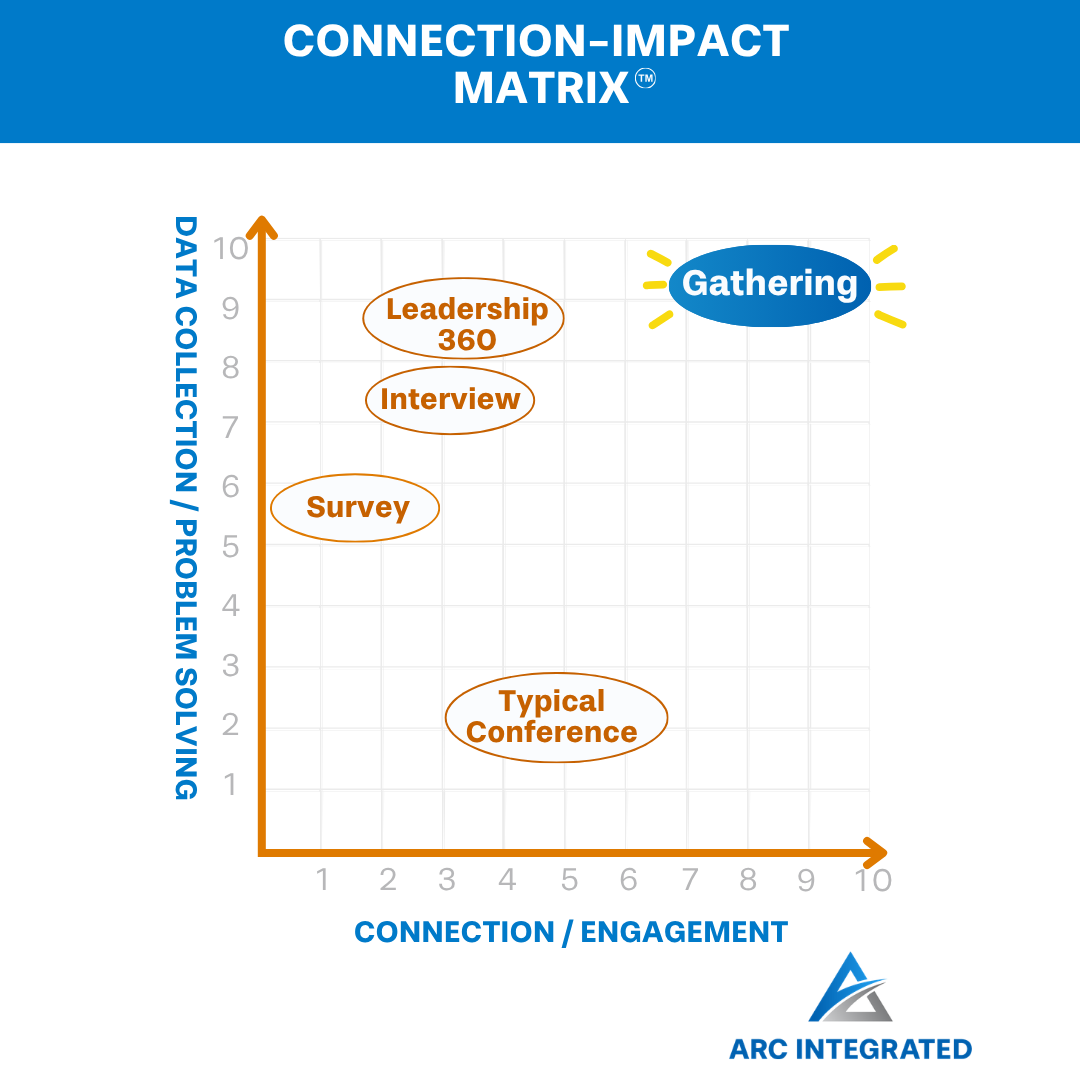
The Connection-Impact Matrix exists to challenge a misconception that quietly drives a lot of this frustration: not all engagement tools are created equal, and very few of them simultaneously increase real connection and solve real problems. Most tools do one or the other. Some do neither. Understanding the difference is not an academic exercise. It is one of the most practical things a leader or organization can do before investing time, money, and credibility in the next initiative.
Why the Gap Between Effort and Outcome Is So Common
The data on this is striking. According to Gallup’s research in 2025, only 21% of employees worldwide are engaged at work, and the cost of active disengagement is estimated at roughly $8.8 trillion annually across the global economy. At the same time, McKinsey research has consistently found that approximately 70% of change initiatives fail, with leaders citing lack of alignment and poor communication as the most common barriers to execution.
These two findings are connected. Organizations are not failing to try. They are trying with tools that were not built to produce the outcomes they are hoping for. A survey can tell you that engagement is low. It cannot create the conditions that raise it. A conference can energize a room. It rarely leaves behind the structural clarity needed to sustain that energy. Through the years, we have seen well-resourced, well-intentioned organizations invest heavily in interventions that produce a lot of data and very little movement, or produce a lot of energy and very little insight.
The Connection-Impact Matrix exists to expose that trade-off clearly, so leaders can make a more informed choice before they start.
Understanding the Two Axes
The model evaluates interventions on two axes, and understanding what each one actually measures matters more than it might seem.
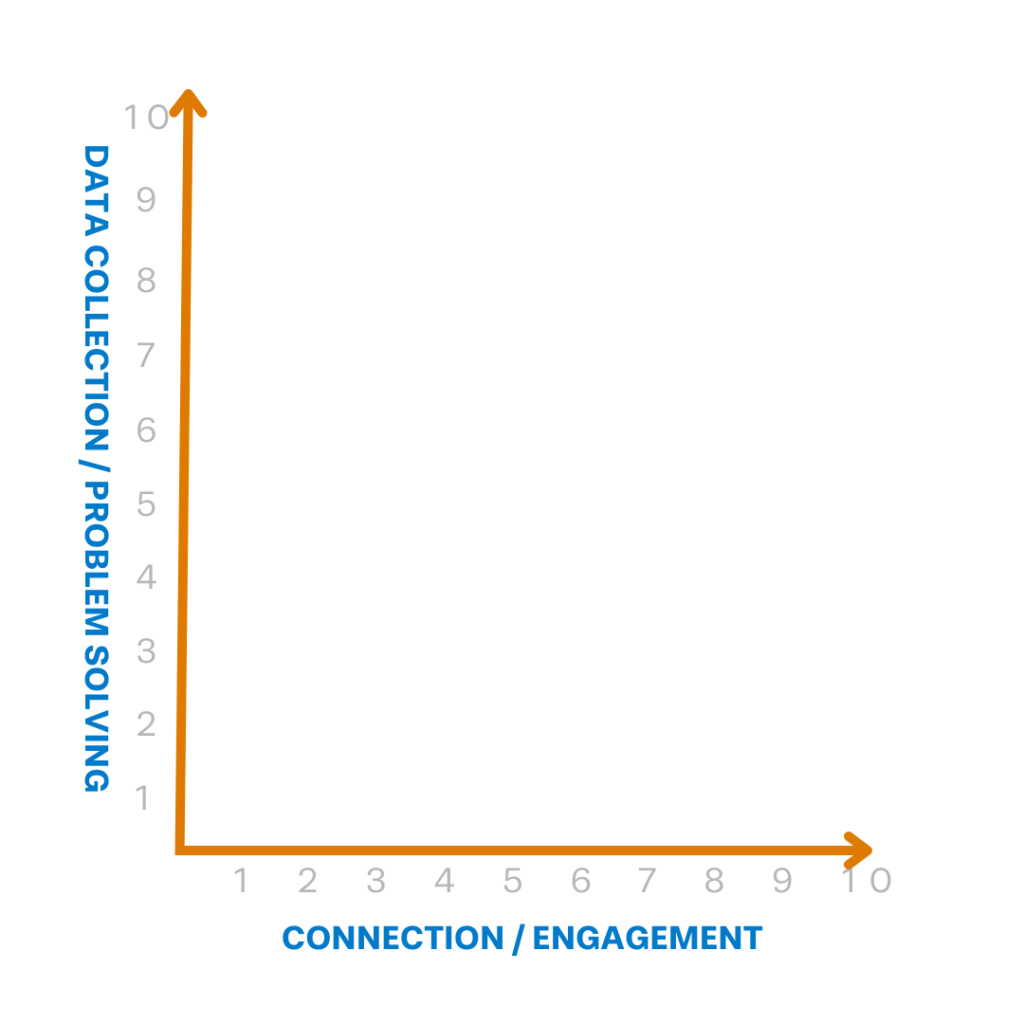
The first axis is connection and engagement. This is not about whether people showed up or whether the event was enjoyable. It measures emotional investment, depth of participation, relational trust, the energy in the room, and most importantly, the degree to which people feel ownership over the outcomes. Research on psychological safety, which is the environment where people feel safe to contribute honestly, shows that leader communication behaviors supporting open and inclusive dialogue correlate with psychological safety across team-based studies. Connection, in other words, is not just a feeling. It is a structural outcome that either gets created or does not, depending on how the intervention is designed.
The second axis is data collection and problem solving. This measures the quality of insight generated, how specifically issues are uncovered, how clearly root causes are identified, and whether actionable solutions actually emerge. Many organizations confuse data collection with problem solving, but they are distinct. Collecting data without the collective sensemaking process that turns it into shared understanding does not move organizations forward. It just adds to the archive.
Where Common Interventions Actually Land
When you plot standard organizational tools against these two axes, the picture becomes useful very quickly.
Surveys score low on connection and moderate on data collection. They are efficient and scalable. They provide quantitative snapshots that can be useful for tracking trends over time. But they lack emotional nuance, they do not create shared ownership, and they almost never generate forward movement on their own. They are data tools. Using them as engagement tools is where the misalignment starts.
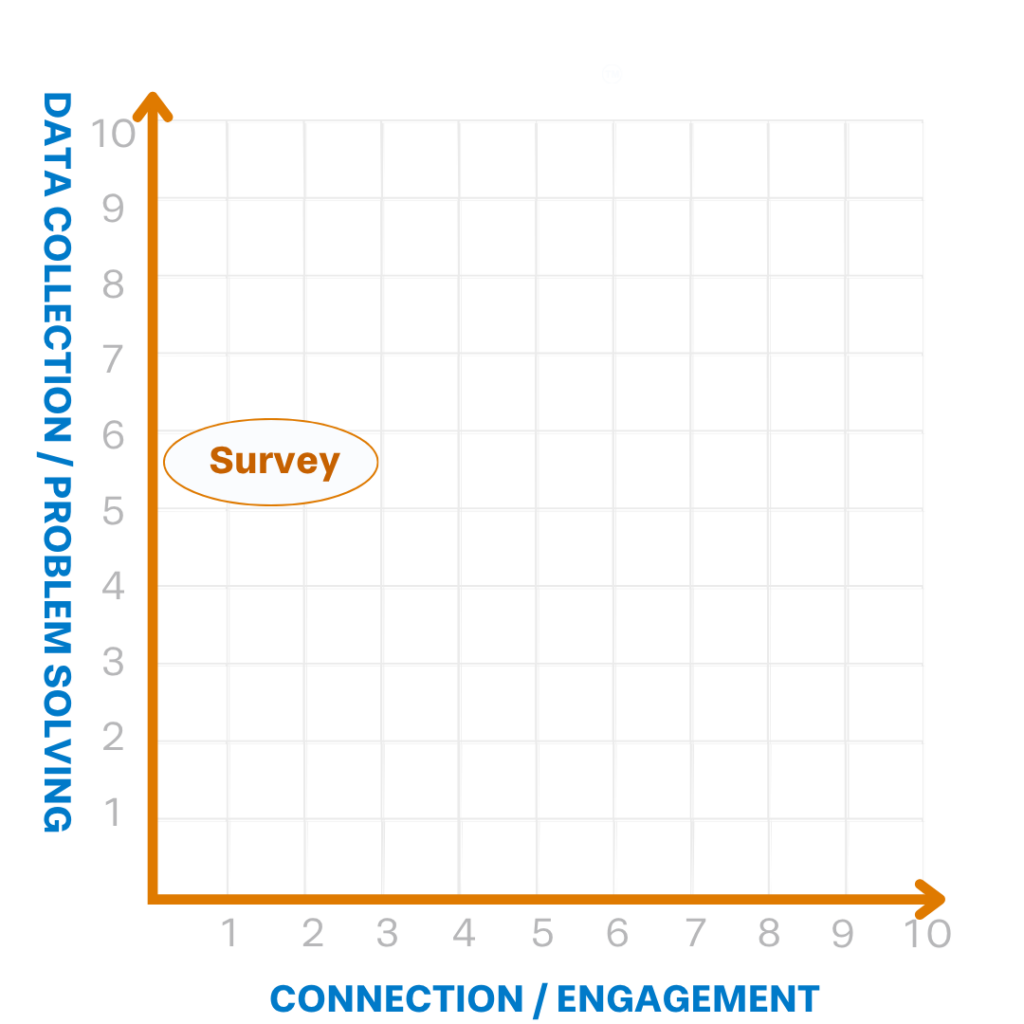
✅ Connection: Very Low
✅ Data Depth: Moderate
Interviews score moderate on connection and high on data depth. They create relational context and surface perspective that surveys cannot reach. But they are not scalable, the insights they generate are filtered through the interviewer, and they do not build collective alignment. They are strong for discovery. They are not designed to create organizational cohesion.
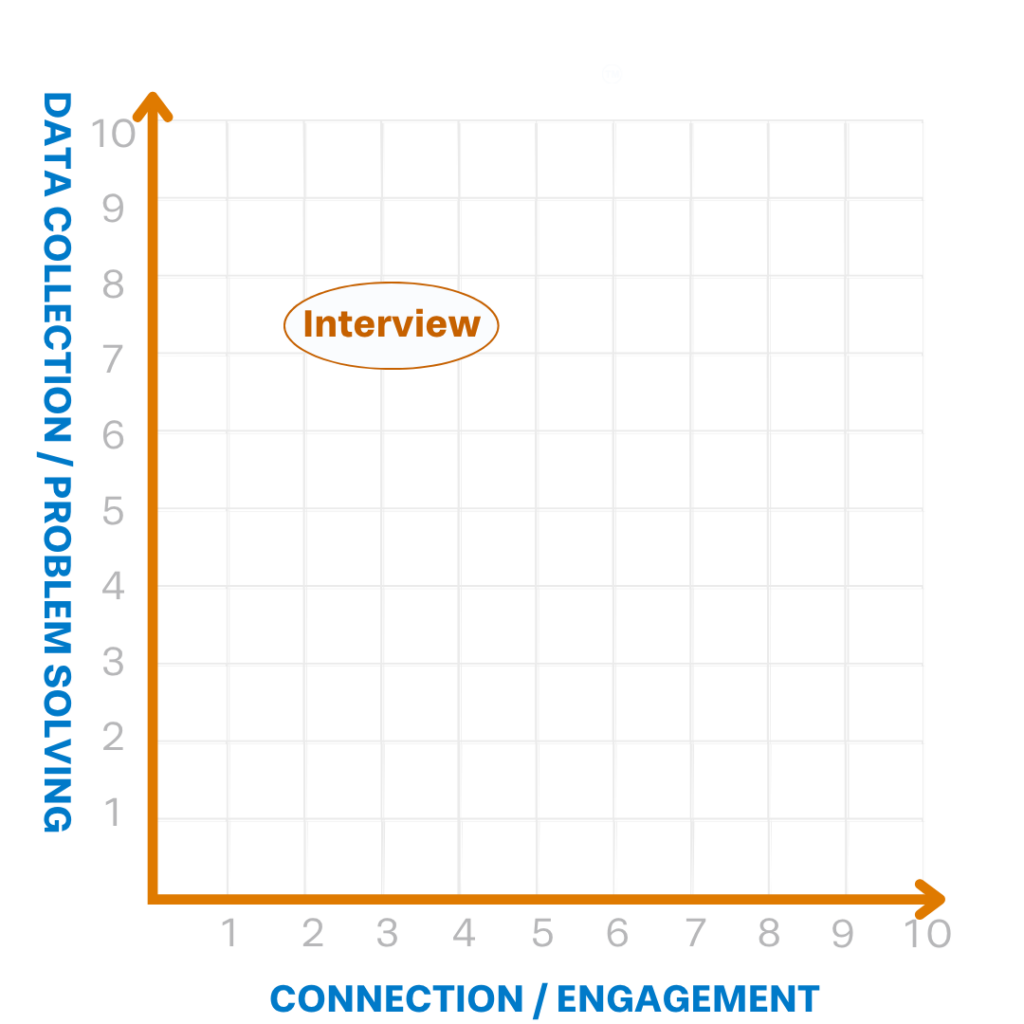
✅ Connection: Moderate
✅ Data Depth: High
Leadership 360 assessments score moderate on connection and high on individual-level data. They generate structured feedback that can be genuinely useful for a leader’s development. But engagement is limited to the participants directly involved, and the focus is on individual growth rather than system-level problem solving. They are effective development tools. They are not transformation tools, and expecting them to function as one is a common and costly mistake.
✅ Connection: Moderate
✅ Data Depth: High (individual-focused)
Typical conferences score moderate on connection and low on problem solving. We have seen this pattern so many times that we now consider it one of the most expensive ways to create short-term energy without long-term impact. Conferences can activate people temporarily. They can reconnect a dispersed team and reinforce a shared sense of direction. But they rarely collect structured data, they tend to prioritize inspiration over implementation, and whatever engagement they generate fades quickly without systemic follow-through. They feel powerful because they often are, in the moment. The question is what remains two weeks later.
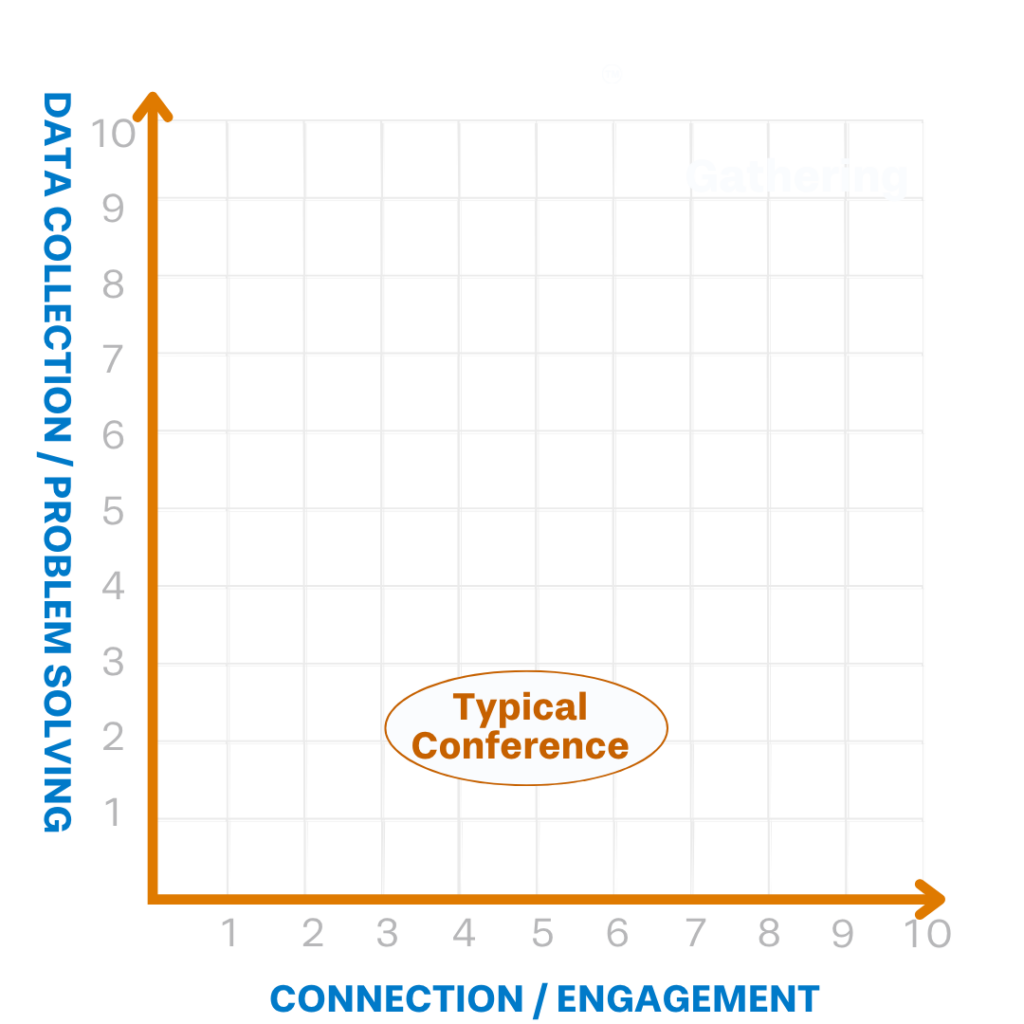
✅ Connection: Moderate (often surface-level)
✅ Problem Solving: Low
The Unique Design of Gathering
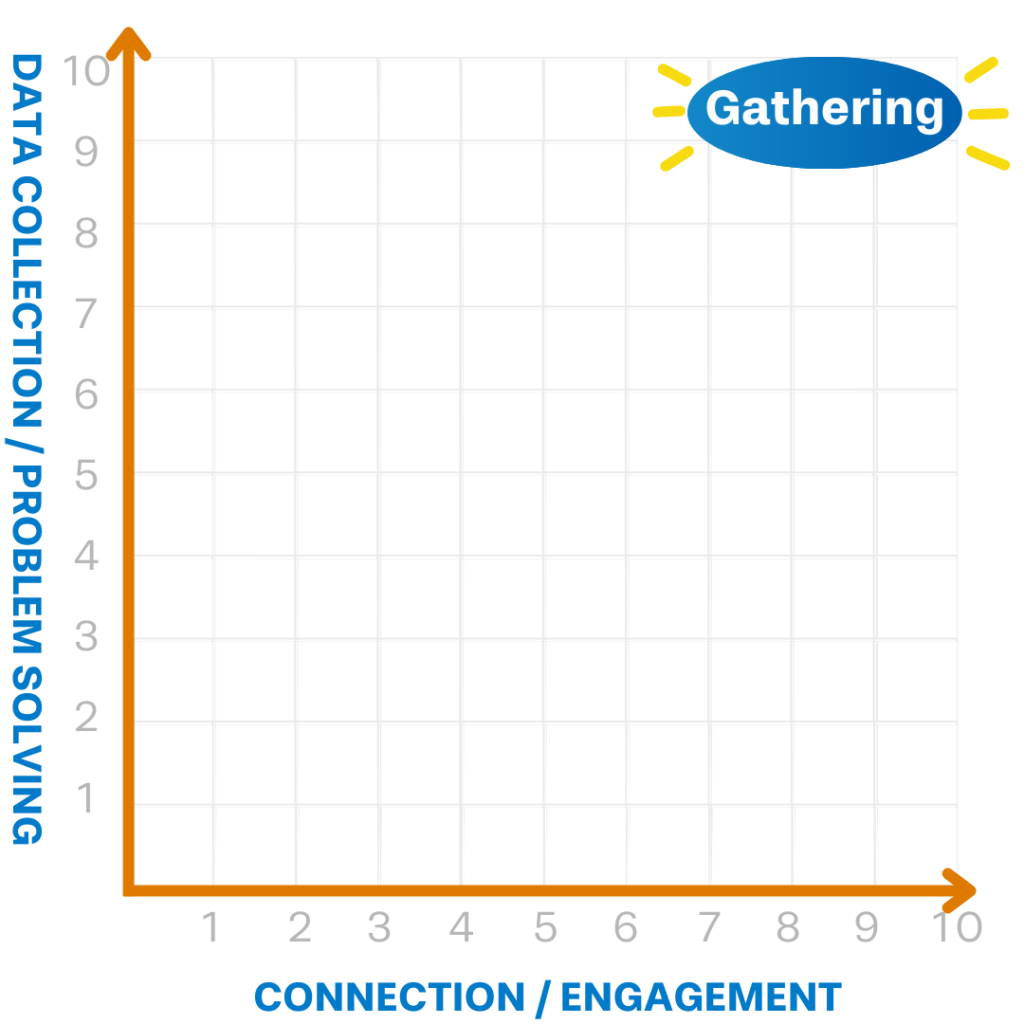
When designed intentionally, Gathering sits in a fundamentally different position on the map. It scores high on both axes simultaneously, which is rarer than it sounds.
What makes this possible is integration. A well-designed Gathering brings structured inquiry together with facilitated dialogue, real-time sensemaking, and shared ownership of what emerges. It is not a meeting made bigger. It is not a conference with better breakout sessions. It is a facilitated environment where people experience genuine connection, data surfaces organically through the quality of conversation, themes are synthesized in the room rather than weeks later in a report, and leaders and teams co-create direction together rather than having it handed down.
The research on team cognition helps explain why this matters. Studies show that accurate shared understanding, the kind where a team has a genuine and aligned read on what is actually happening, correlates highly with team performance, and that teams with stronger shared models of how work fits together show even stronger coordination behaviors. Gathering creates those shared models in real time. The other tools generate inputs that someone else eventually synthesizes into a shared model, if they get around to it, and if the report is read, and if people trust the process enough to act on it.
We have learned that the interventions which actually shift culture are the ones where people arrive as participants and leave as co-owners. That shift from participant to owner is what Gathering is specifically designed to produce.
What We Are Not Saying
It is worth being direct about what this framework is not arguing.
Surveys are not bad. Interviews are not useless. 360s are not ineffective. Conferences do not need to be eliminated. Each of these tools was designed with a real purpose in mind, and each one can be genuinely valuable when it is matched to the right goal.
The problem arises when organizations expect a low-connection tool to produce high-engagement results, or expect an energizing experience to solve complex systemic problems. The Connection-Impact Matrix does not rank these interventions by quality. It maps them by design. The misalignment is not in the tools. It is in the expectations placed on them.
This connects to something we explore in the Communication Map, which makes a similar argument about how communication itself needs to be calibrated to what a situation actually requires. The same principle applies here. The right intervention for the goal you care about is not always the most familiar one or the least expensive one. It is the one whose design actually matches what you are trying to create.
The Question of Investment
Gathering typically requires more investment than a survey, and that is a real consideration. But in our experience, the more important question is not what’s cheapest, It’s what is most effective for the specific outcome you are trying to reach.
When disengagement costs organizations trillions globally, and when 70% of change initiatives fall short, the real risk is not overspending on a high-quality intervention. The real risk is underspending on the right one and then absorbing the cost of the misalignment, in turnover, in failed initiatives, in leaders who are working hard but not making progress, and in teams that were surveyed and interviewed and conferenced but never actually heard.
Choosing the right intervention is one of those decisions that shapes whether people feel like active participants in the direction of the organization or like respondents in someone else’s process.
The Strategic Question Before Your Next Initiative
Before launching your next initiative, the most useful question is not which tool is most available or most familiar. It’s this: are we prioritizing connection, are we prioritizing problem solving, or are we unintentionally sacrificing one for the other?
If your aim is both, the evidence and the experience accumulated across decades of working with leaders point clearly in one direction. Gathering is not just another option on a menu of interventions. It is a fundamentally different design. And in a world where engagement and alignment are among the most consequential competitive advantages an organization can have, design matters more than ever.
If you’re interested in learning how you can best apply this or on a gathering experience that organically gathers data while connecting your team, Book a Free Strategy Call with us, we guarantee you’ll gain valuable insights into what might help take your team into the next level.