Watch the Interview
Listen to the Episode
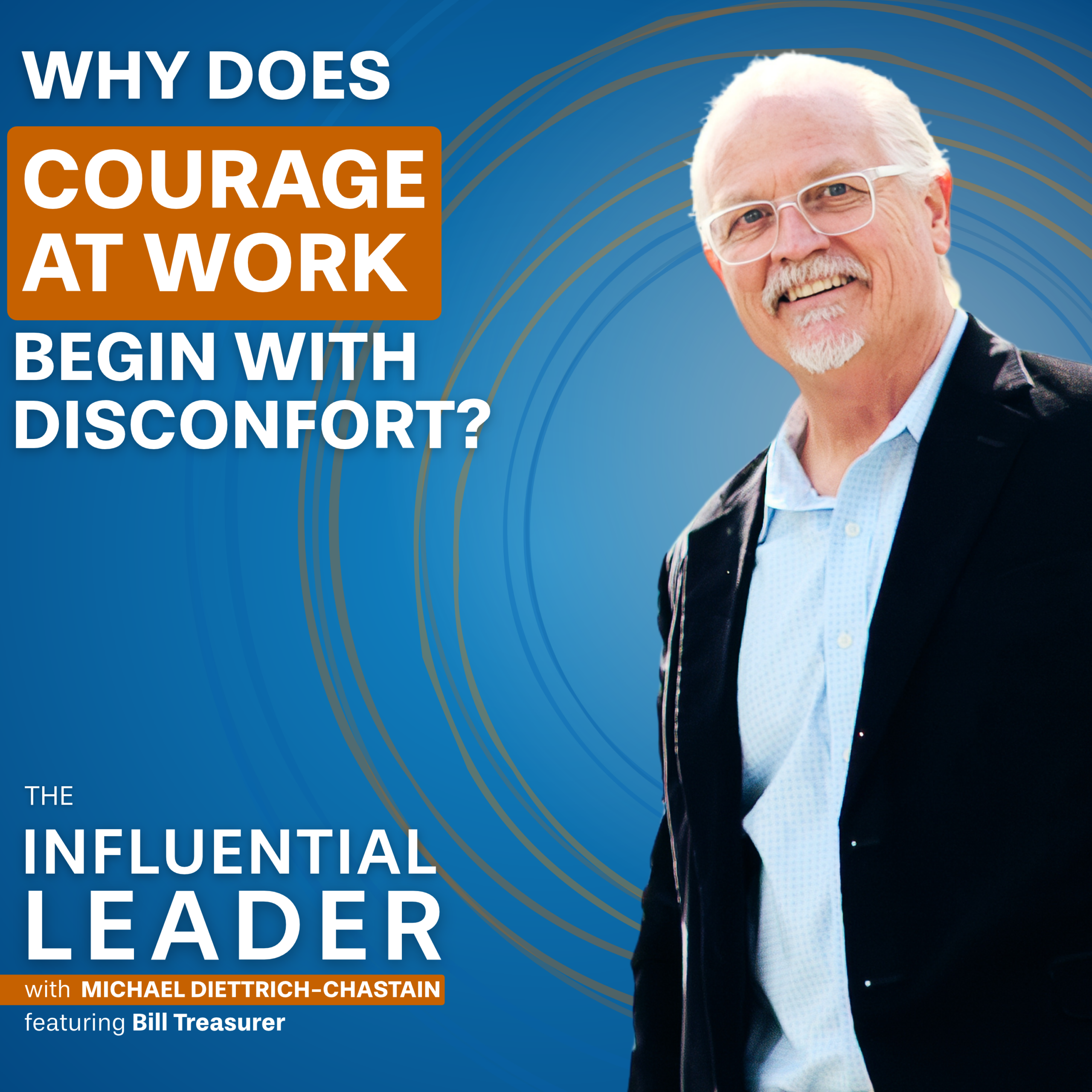
Bill Treasurer was afraid of heights even while diving from more than 100 feet. In this conversation with Michael, he explains how practicing at gradually greater heights shaped his approach to courage at work. They explore how leaders can create safety before challenging people, receive difficult feedback without becoming defensive, ask more questions than they make statements, and address conflict before avoidance becomes costly. Bill also reflects on authenticity, family, succession, and a question from his mentor that still brings him back to his own motives. The episode closes with practical lessons from six of his books and a reminder to pause before reacting.
Chapters:
- 00:00:00 Courage at Work and Bridging Differences
- 00:07:00 Bill’s Fear of Heights and High Diving
- 00:14:00 What Is Your Courage For?
- 00:21:00 Psychological Safety and Receiving Feedback
- 00:28:00 Authenticity, Family, and Work Identity
- 00:35:00 How to Build Leadership Training That Works
- 00:42:00 Ask More Questions and Address Conflict Debt
- 00:49:00 Succession Planning at Giant Leap Consulting
- 00:56:00 Finding Purpose Beyond Work and Asking Why
- 01:03:00 Practical Lessons From Bill’s Six Books
- 01:10:00 The Beautiful Beat and Starting the Day Well
Quotable Moments
- “I could still be afraid and still do the thing that I was afraid of, and that’s what courage is.”
- “Too many leaders make themselves the hero of their own story.”
- “Get curious about questions if you’re a leader.”
- “Problems don’t get better with time. They get worse with time.”
- “Take a beat before solving something to really understand something.”
About the Guest
Bill Treasurer is the founder of Giant Leap Consulting, a courage-building company. For over three decades, Bill has worked with leaders from organizations that include NASA, Saks Fifth Avenue, The Home Depot, eBay, Walsh Construction, UBS Bank, Southern Company, and the U.S. Department of Veterans Affairs.
Links and Resources:
- Giant Leap Consulting Website
- Courage Building Website
- Right Risk
- Courage Goes to Work
- Leaders Open Doors
- A Leadership Kick in the Ass
- The Leadership Killer
- Leadership Two Words at a Time
- Bill Treasurer’s Coaching Q Cards
- Margie Warrell
- StoryBrand by Donald Miller
- Radical Candor Framework
- The Good Fight by Liane Davey
- Conflict Debt by Liane Davey
- The One Minute Manager by Ken Blanchard and Spencer Johnson
- Arc Integrated Website
- Strategy Call Page
- Podcast Page
- Michael Diettrich-Chastain in Linkedin
- Michael Diettrich-Chastain in Instagram
- Michael Diettrich-Chastain in Facebook
- Arc Integrated in Linkedin
Transcript
Click here to show transcript
Bill: [00:00:00] We’ve all stood at that edge of a high dive, whatever it is. So now my job is instead of taking giant leaps like I used to, it’s to help other people take giant leaps, and that’s how it connects to courage.
Michael: Today I got to sit down with my dear friend and mentor, Bill Treasurer, who is an absolute expert on all things courage.
Michael: Bill has been teaching how to be courageous to leaders, teams, and organizations for many decades at this point, and he’s a real expert in his space. We cover a lot of ground in this episode, but to highlight a few things that were standout moments to me, uh, we certainly talk a lot about courage, but we also talked about how to monitor our ratio of telling versus asking as leaders.
Michael: He gives us some great tips there. Talk about the concept of conflict debt and the risk that it poses. Bill shares with us a question that his mentor asked him many years ago and why perhaps all of us should be asking this question of ourselves. And then at the end of this episode, we do a lightning round with all [00:01:00] seven, yes seven, of Bill’s books, and we take an action from each of the seven that’s very tactical, so, uh, lot of good tools and strategies towards the end here.
Michael: And then lastly, just a shout-out and thank you to our friends at Amplified Media in Asheville, North Carolina, who hosted this in-person podcast and will be hosting many episodes in the future. So thank you so much to them. And with that, let’s get into it. Welcome to the Influential Leader Podcast. This is Michael Dietrich-Jastane, and today I have a dear friend with me, Bill Treasurer.
Michael: Bill is the founder of Giant Leap Consulting, a courage-building company that’s worked with leaders at organizations like NASA, Saks Fifth Avenue, The Home Depot, and the US Department of Veteran Affairs. He’s the author of six books, which we’ll talk about today including the international bestseller Courage Goes to Work, and previously he served as Accenture’s first full-time internal executive coach.
Michael: He lives in Asheville, North Carolina, with his wife Shannon and three adult children. Welcome, [00:02:00] my friend.
Bill: Dude. It’s great to be with you. Thanks for having me.
Michael: Oh, it’s great to be with you too, man. I’m excited to dive in. I know there’s a lot of ground we’ll cover. Courage. Mm. Your career has been spent on courage.
Michael: Mm. And before we started, we were talking about this idea of it’s a polarizing world out there right now. It sure is. You know, you and I work with leaders all the time, and they’re managing conflict, they’re managing differing views, they’re managing tension about just all the polarizing nature that exists out there.
Bill: Mm.
Michael: So the first thing I’m curious about is what’s the relationship between courage and managing the polarity in the world-
Bill: Yeah …
Michael: that you see for leaders?
Bill: The, the connection point probably is discomfort. Mm. The, the idea of moving towards the thing that for you is foreign, different, not what you’re used to.
Bill: Mm. Not comfortable.
Michael: Yeah.
Bill: And to be willing to engage with that and move out of what you know and the, the safe shores of your knowledge into the experience of somebody else. And to [00:03:00] do that means that it might, for you, feel disruptive to what you came from. Yeah. Uh, and yet it’s the only way to build bridges is to move towards the, quote-unquote, other.
Michael: Yeah.
Bill: And learn the experience of, and then it becomes less threatening to you in the process. But it takes the engagement of you moving into discomfort. Makes
Michael: me curious about, you know, I know you and I have both been with leaders that are very convicted to their truth, quote-unquote. Yeah, right. Their way, right?
Michael: Yeah. So in, in the face of someone that’s got a lot of conviction on the right way to do things- Right … you know, what’s a, what’s an idea you have around, around how they might lean away from their, quote-unquote, cap- capital T truth-
Bill: Yeah …
Michael: and be courageous to, to move elsewhere? What would you say to that kind of person?
Bill: Yeah. It, it is such the challenge- Yeah … is, is the, uh, the conviction that we have and, and that we’re right, uh, about whatever we’re holding onto. W- you know, one of the things that we often [00:04:00] do in our leadership workshops, as you know-
Michael: Yeah …
Bill: sometimes we’ll start off with some illusion slides where you’re looking at it, and some people in the room are seeing one thing, and some people are seeing the other thing.
Bill: Mm. And you’re both right, and you’re both wrong. Yeah. And so we sort of marinate the heads first- Yeah … to be able to recognize the world isn’t always as you see it. Sometimes it’s also carrying another viewpoint that is also legitimate. So we do some marination first. Uh, one of the things that I think is useful is to…
Bill: And this is another thing we do directly in the workshops- Mm … is we’ll give them a series of small questions where they’re not introducing themselves to the group. Mm. We pair them up and have them introduce the other person by asking them questions. So where they ask these interesting questions of one another, have the experience of that person, and then you have to kinda honor them by introducing them to the group yourself.
Michael: Yeah.
Bill: And that gets you out of yourself. That’s the thing, is to get out of yourself, get out of your conviction, get out of your [00:05:00] adherence and adhesed, uh, ness to rightness- Yeah … that I’m right, and experience the, the world point, the worldview of the other person.
Michael: Love it. Love it. Yeah, those… I love those examples.
Michael: It’s like the little reps, right? The little reps. Those little reps of moving away from our own, our own rightness.
Bill: Yeah. You know, and we see it all the time in work- working with construction companies.
Michael: Oh, yeah. Sure.
Bill: You know, you have people that come up the management ranks. They probably came out of a construction management program at a college.
Bill: Maybe they went on to graduate school. Maybe they have an engineering’s degree. And then you’re working with people in the field who are a little bit more rough cut, and they came up out of an apprentice program, maybe in a union, maybe not in a union, but definitely in the field. And many of them didn’t go to college.
Bill: And there can be some antagonism that grows up between those two ranks. Mm-hmm. “Oh, these college kids always trying to tell us what to do. They don’t know. They didn’t grow up out here like we did.” And then these guys being, “Why are you so resistant? We have some new practices that can actually help you,” right?
Bill: Yeah. And it’s getting them to be able to recognize they need each other [00:06:00] in order to build great work together. Mm-hmm. Uh, and so it’s of value to them to get to learn the experience of one another so that they get disarmed and start to join hands and link arms and say, “Okay, let’s make it about the project and not about our two world viewpoints.”
Michael: Yeah, yeah. Yeah, totally. Totally, yeah. How do we build bridges between each other, right? Right. Yeah, yeah. Well, we’re gonna, we’re gonna talk a lot about courage. Before we go too much further into that, I wanna ask you a couple questions about you. So your bio is very impressive. We’ve got a stack of your books here, which we’re gonna talk about.
Michael: I’m really excited to dive into the le- few lessons from each of those. If we were to zoom out and say, outside of the bio, the professional bio, what are two to three things that we would wanna know about who Bill is to really understand, uh, you as a human being?
Bill: Hmm. Two or three things. One is there for I’m like Dorothy.
Michael: [00:07:00] Dorothy?
Bill: Yeah. In The
Michael: Wizard of Oz.
Bill: Oh, oh, Dorothy. Yeah, yeah, yeah. Right. There is no place like home.
Michael: Okay.
Bill: I travel and I’m on the road so much, and I have been for 25 years- Yeah … that the premium time home to me is so central. Uh, like on my birthday this year, like I, I’ve got everything I need. I’m at the point in life where what are you gonna give me that’s gonna like make me feel warm and fuzzy?
Michael: Right.
Bill: What I ask for is a barbecue with my family. Yeah. That’s all I want. I want, you know, to be around the, you know, the, my core family because they’re all flying the coop and they’re all got their own full lives and such. But that just… That moment for me is so grounding, it’s so connecting, it’s so important.
Bill: And I love being a dad. Yeah. And I love being a husband. I mean, those things are really s- they’re, they become more valuable as time goes on. That’s one thing. Mm-hmm. And then the other is there is As, as much as I am, like, sort of now on in years, I still like the spirit of adventure and I still like to get in [00:08:00] a kayak or white- go white water kayaking- Yeah
Bill: go for a hike or do… explore a place I’ve never explored. I just like newness and novelty. So those two things I think are unique.
Michael: Yeah, yeah. Well, you, you have another, uh, special uniqueness about you which I’m always surprised by. And for those of you that are watching this on the video, I’m looking at Bill’s book called Right Risk, and on the cover of this book is a picture of Bill on fire jumping off a platform into a little pool of water.
Michael: And how high is this right here? So that high dive,
Bill: if you call it that, is only maybe 30 feet.
Michael: Oh, it’s only 30 feet. Yeah. And you’re only on fire. Man, that’s crazy. So tell me… Te- walk us through, like, that’s pa- that’s part of your history. Tell us a little bit about, about that and how it, you know, was a, maybe a, a segue into your work in courage.
Bill: Yeah, it definitely connects to courage. Of course. And it rewinds back to that I’m kind of a big fraidy cat.
Michael: Okay.
Bill: And I had a [00:09:00] pretty profound fear. And I would say that it’s, it’s contemporary. I still have this fear of heights. Okay. Like, I g- if we go up to a big giant tall building a- and you’re looking over the edge with some excitement, it’s like I’m, like, probably pressed up against the building because I don’t like heights.
Bill: And yet I became a springboard diver. Uh- Mm … and I was a, a really good springboard diver on the one meter. I was a one meter specialist. That’s the low board, right?. Okay. And then colleges started to dangle scholarships in front of me and say, “Hey, we, we also have high board.” Mm. “So if you wanna get a s- scholarship, tell us about your high board list of dives.”
Bill: And I didn’t have a high board list of dives. Okay. So I had a coach who would take me down to a place where they had a diving board built on a hydraulic lift. So now he could take that one meter diving board and make it one and a half meters. Ooh. A- and, like, literally, quite literally pushing me outside of my o- my…
Bill: into my discomfort zone.
Michael: Mm.
Bill: So now I’m really uncomfortable because I… it’s no longer one meters. I’m at one and a half meters. I have no spatial awareness. I have to get used to this thing that is so [00:10:00] foreign to me. And then after 300 dives maybe I get used to it. And what does he do? Yeah. He lifts it to two meters.
Bill: Yep. And now I’m back out into discomfort. And so this process of modulating- Mm … between comfort and discomfort, intentionally pushing me out into discomfort, not for his good, but for my good and for the acquisition of new skills and new competencies. And once I get to that place, allow me to settle in with those competencies i- in terms of the dive.
Bill: But when I get a little too confident, a little overconfident, then he’s gonna ra- ratchet it back up, right? And so through, through this process, I got a three-meter list of dives, and I got a full scholarship to college.
Michael: Mm.
Bill: I wouldn’t have been able to afford college had it not been for that.
Michael: Wow.
Bill: But then after college, I continued that process of still going up greater levels of heights, and eventually I became a member of the US High Diving team.
Bill: Uh-huh. Diving from heights that scale to over 100 feet. Wow. Traveling at speeds in excess of 50 miles an hour. Wow. Into a teeny [00:11:00] pool that looked like a teacup from way up there. So I literally used to take giant leaps for a living. Yeah. And it was so… I, I mean, it changed my life, right? Mm-hmm. Because it took this fear, this debilitating fear, which I still have.
Bill: Mm. But it sort of subdued it. It put me in control of it. It allowed me to figure out how to navigate this thing that was somewhat debilitating and master it so that I could still be afraid and still do the thing that I was afraid of, and that’s what courage is.
Michael: Yeah.
Bill: And so I found my own courage in that process, and I thought I…
Bill: There’s so many things I don’t know about, but I have been at the edge of a risk 1,500 times. I have stood on that platform that other people metaphorically stand on when they’re getting ready to start their own business, when they’re getting ready to put their hand up and say, “I’ll take that management role.”
Bill: Mm-hmm. Uh, when they’re getting ready to, uh, ask for a raise. We’ve all stood at that edge of a high dive, whatever it is. So now my job is instead of taking giant leaps like I used to, it’s to help other [00:12:00] people take giant leaps, and that’s how it connects to courage.
Michael: Yeah. Love it, love it. Really appreciate the c- the thing you mentioned about modulating.
Michael: You know, there’s a little bit up, and then we practice. A little bit more up, and then we practice. Yeah. It connects to something that I know you talk about, which is courage as a, as a daily practice.
Bill: Mm.
Michael: And so for leaders that are listening and wanna figure out how do they institute daily practice to build courage, what would you say?
Bill: Yeah. Little leaps- Uh-huh … before big leaps.
Michael: Yeah.
Bill: No diver will dive one time from 100 feet without jumping 100 times from one foot. So incrementalism matters a lot.
Michael: Yeah.
Bill: And I would also say having a big gulp goal. Gulp?
Michael: Yeah. Oh,
Bill: okay. So it’s like, “Oh, that’s a high dive.”
Michael: Yeah.
Bill: And you can find that, by the way.
Bill: Uh, asking yourself, “Where am I playing it too safe?” Mm. And maybe I’m the only one who knows the answer to that question. What is it that I want? And once you figure that out, what I want, where I’m playing it too safe, now you can say, “All right, [00:13:00] that’s the destination point. That’s where I’m trying to get to.
Bill: That is outside of my comfort zone. But in order to get there, I don’t have to take that jump today. What’s the little preparations that I can do along the way? Who are the people who have had that experience that I can talk to? Is there… Can I use…” You’ve done this, Michael. Can I use AI to put together a plan for me that’s incremental so that u- ultimately I get to the destination point of the big high dive, the giant leap, but I’m doing it in little ways to get to the big way?
Michael: Yeah, yeah. Love it. Love it.
Bill: Like, I, I call it little C courage before big C courage.
Michael: Yeah, little practices along the way. I really like the, the notion though that not just the little practices, but there’s something that’s really intimidating that’s out in front of you that you maybe don’t even know how you’re gonna accomplish it yet.
Bill: Yeah.
Michael: But that the… It sounds like there’s a certain level of, uh, trust or faith that if you do the reps, eventually you’ll build the courage to do the big thing. Is
Bill: that right? Yeah. The, the big thing matters. You know, you could, uh… A good question that a colleague of mine, Margie Warrell, [00:14:00] Margie Warrell, she has also written books on courage.
Bill: Okay. I res- I respect her.
Michael: Yeah.
Bill: And she asked, “Courage for the sake of what?”
Michael: Yeah.
Bill: Courage for the sake of what? What is the thing that you’re trying to get to that- Yeah … the activation of your courage is going to be important to be able to get to that destination? So yeah, incrementalism matters, the little leap before the big leap, but towards what end?
Bill: What, what are you gonna… It’s really important mojo. Courage is a, a fuel. It is a, like a vitamin, but you need to direct it towards something important, not just use it kinda willy-nilly.
Michael: Yeah.
Bill: Yeah, yeah.
Michael: Yeah. Okay. Okay, good. Good. Let’s, uh, let’s segue a little bit. So, you know, we’re talking about practices obviously for leaders that will help them be more effective, help their teams be more effective.
Michael: Mm. ‘Cause it sounds like not only… And I’m, I’m filling in the blanks a little bit here, but this is a, a tool or a philosophy that leaders could be challenging their team members to also do.
Bill: Oh, yeah. Is
Michael: that fair?
Bill: Yeah.
Michael: Yeah, yeah.
Bill: And I think it’s sometimes helpful to… There’s a couple of people who’ve put a good [00:15:00] button on this idea of courage in terms of definitions.
Bill: Mm. And one of them is Aristotle. Okay. He said that courage is a virtue. Yeah. Right. And he says it’s not just one of the virtues. He says it’s the first virtue because it makes all the other virtues possible.
Michael: Oh, nice. Yeah. That’s a- C.S. Lewis,
Bill: C.S. Lewis said that courage is not just one of the virtues, it’s all of the virtues taken to the testing point.
Michael: Yeah.
Bill: And so outside of work, courage has always been like the premier virtue. Mm. And my, my whole contemplation and much of my research and my writing has been focused on, well, if courage is a virtue outside of work, and it’s like the number one virtue, what about work? And where I’ve landed is it’s the number one virtue of business and leadership.
Bill: Mm. That if you want to be a leader, you have to occasionally nudge people out into discomfort because leaders bring improvement and, and by its nature, that means change.
Michael: Yeah.
Bill: And change is often turbulent, and so we’ve gotta be willing to push people out into their [00:16:00] discomfort zone-
Michael: Yeah, yeah …
Bill: in order for them to be able to activate their courage.
Michael: Yeah, yeah. That makes sense. There’s an interesting, uh, maybe it’s a paradox, maybe not, but we… You know, you and I talk a lot about the, the notion of psychological safety and, you know, if you’re listening to this, you may have heard that term before as a leader. You probably have. And there’s a lot, as, as we know, a lot of research that connects the dots between if a group is psychologically safe, then they’re gonna be high performers.
Michael: The other… So another skill that I’ve seen you use in real time many, many times in our work together, in our collaborations, is that you’re funny. You’re a funny guy. Lose at everything. I mean, you… That’s right. And you u- you use this in a really, uh, great way to teach, and you also have a talent in that you interweave, uh, self-deprecation a good bit that is also, I think, serves well to get audiences engaged and teams engaged.
Michael: So the, the question is, how does, how do those things connect to courage?
Bill: Yeah. [00:17:00] Thank… Well, thank you. I appreciate it. You’re welcome. Yeah.
Michael: Of
Bill: course. Um, yeah, the idea of psychological safety, it, it is interesting. So I wrote the book, Courage Goes to Work, I think it was in 2008. Psychological safety wasn’t yet a term.
Bill: Mm. But I have a whole chapter that’s literally called Create Safety. That’s the title of the chapter, because it’s the same idea of that creating psychological safety, because people are much more willing to extend themselves and do hard, challenging, and scary things to the extent that they feel they’re going to be safe- Mm
Bill: while they do that. Yeah. The, the idea is of psychological safety. There’s a term called the psychological, the, the psychological protective frame. You’ll be willing to do th- things that are scary if you feel protected, that you can do it and you’re not going to be actually harmed by doing it. So you as a leader need to be able to create that safe area where people are willing to extend themselves.
Bill: I think humor is, is really essential to it because it is disarming, and too many leaders, [00:18:00] you’ve seen them, I’ve seen them- Maybe occasionally we do it ourselves.
Michael: Sure.
Bill: But w- too many leaders make themselves the hero of their own story. Mm. They’ll tell you some story and then how they were the white knight and came in and said the special thing that changed the situation.
Bill: Right. It’s like, “I tell you, that situation was going south until I put my foot down, and I changed it by saying the special thing.”
Michael: Yeah.
Bill: That’s being the hero of your own story.
Michael: Yeah.
Bill: You’re gonna win people over much more as a leader if you come in and say, “You see that hole over there, that you can all see it’s so blatant that the hole is there?
Bill: I fell in that hole.” Yeah, yeah. “Now here’s how it hurt me, and man, what a humiliating experience that was.” Mm. And make fun of yourself about how when you were in the hole. Yeah. Now people f- get the sense that, oh, this guy’s real. This guy, he’s been in holes, and I know I’ve been in holes too, and I didn’t wanna fess that up in front of the group.
Bill: But look, he’s fessing that up in front of the group. So I think it’s important to not be the hero of your own story. Mm. To create a space where you tell them something that you’ve done wrong. Mm. The mistakes that you made, [00:19:00] but what you learned from it. Yeah. And humor can go a long way with all of that.
Michael: Yeah. L- uh, it reminds me, this is a, a bit of a s- a sidebar, but there’s a marketing expert named Don Miller. Has a company- Familiar
Bill: with him … StoryBrand, right? Yeah, StoryBrand.
Michael: Yeah, so he often also talks about the same principle when we’re thinking about getting customers. Like you as the, as the seller of the thing, the service, the product, it’s you can’t be the hero.
Michael: And the parallel I’ve heard him use is you have to be like the Yoda. Yeah. And your customer is Luke. And what, that’s kinda what I hear you saying as the leader. It’s like you don’t wanna be Luke as the leader. You wanna be Yoda, and you’re helping to create the hero in the employee. Absolutely. Is that a fair comparison?
Bill: Yes, and you know, part of the hero’s journey-
Michael: Yeah …
Bill: is that you did d- get banishment, right? Mm. And you did go away from the safe s- shores. You have been there. You were, you are where they are about to go, these, this group of people.
Michael: Yeah.
Bill: And you understand what it feels like to be ostracized, to feel a sense of being alone.
Bill: Sure. To, to, uh, having to, [00:20:00] uh, rely on letting go and whatever guidance comes your way and it’s not you anymore. Mm-hmm. And then you come out and you experience… You have to fight the dragons, too, right? Yeah. And, and this trials and tribulations of the hero’s journey. Yeah. But then you come out with the boon, which- Mm
Bill: which is the reward that you get, and bring it back to the group and say, “H- this is what you have. If you leave your safe shores, here’s the, the reward that you get-”
Michael: Mm-hmm … “
Bill: too.” So yeah, I love the idea of the hero’s journey and connecting to that.
Michael: Yeah, yeah. You know, we’re talking about two things which seem maybe at face value a tension between them, right?
Michael: We’re talking about building psychological safety, which is people being comfortable and being, being themselves. Mm. And then on the other side we’re saying, or I think, I think I hear you saying, that we gotta challenge people.
Bill: Mm-hmm.
Michael: We gotta push them toward discomfort.
Bill: Yeah.
Michael: I guess my question back is which one comes first, the challenge into discomfort or creating the safe space that allows for that?
Bill: I think that [00:21:00] maybe chicken and egg a little bit- Sure, yeah … but I think that the creation of the, uh, the safety is important and premier first. Mm-hmm. Uh, it almost is a little bit of the radical candor idea. Mm. Let, let’s drop some caring in first. Let me show them that I’m on their side, that they can trust me, I’m not here to harm them, I’m here to help them.
Bill: Mm. And that they know that. Then it gives me latitude to be able to push because they’ll know I’m not pushing them because I’m some jerky leader and all about myself and getting my needs met, but I’m actually pushing them for their own good and the enlargement of their capabilities and confidence ultimately.
Bill: So it’s creating that psychological safety first. Uh, yeah, an example that I would share is that a lot of times leaders are like Uh, l- listen, I want you to– You can give me feedback too. Any, any, when you gotta tell me something. And then the first person that, that finally gives that feedback to the leader’s like, “Well, why are you telling me that?”
Bill: But y- and they get all defensive- Yeah … and they get all sensitive. Yeah. Because it’s one thing to tell people that you’re creating psychological safety, but what that [00:22:00] leader hasn’t done is giving them the coaching on how to do it.
Michael: Yeah.
Bill: So here’s what I– Michael, I want you to be able to disagree with me.
Bill: Mm-hmm. I want– In fact, I need it. I need for you to give me feedback that’s gonna help me to be a better leader. But Michael, here’s the best way to do that and get a good response out of me.
Michael: Mm-hmm.
Bill: Don’t do it when you know I’m getting ready to go to the board meeting. Yeah. Don’t do it when you see I got 50 things on my inbox.
Bill: That’s not the day- Yep … to be doing it. B- and please give me a little forewarning. Tell me you wanna talk to me on Thursday- Yeah … but it’s Tuesday, and just tell me you got something important. Yeah. And don’t do it in front of a group of people. I’d prefer it if it was just you and I. Now I’ve given you coaching.
Bill: Mm-hmm. Now I’ve given you– So that when you’re like, “Hey Bill, I got some…” Remember we talked about that whenever I’m gonna give you feedback, I got some feedback to give you. I’m like, okay- Nice … now I’m marinated. Now I’m like ready- Yeah … for it.
Michael: Yeah. So th- this is great. So this feels very tactical. Like this is something that p- someone that’s listening, a leader that’s listening could take this and do it right away.
Bill: Absolutely.
Michael: So let’s take it a step further. So I, I like how you framed the response, [00:23:00] like what not to do, right? Not– Don’t be immediately defensive. Don’t discount the feedback right away. Right. So if you were to say to a leader listening, what is the– a good response that they could give or a couple responses that they could give to that difficult feedback that they might get from their employee?
Michael: Yeah. What, what’s a good response?
Bill: Well, uh, th- you know, the first one I would say, and is two very important words- Yep. Yeah … is expression of gratitude. Yeah. Good. I mean, the person’s giving you this feedback. It’s ultimately a gift of feedback, right? Yeah. E- even though your ears may first get defensive or start to shift away why, why you think it’s not true.
Bill: But the first words out of your mouth should be, “Thank you. Thank you.” And could be the acknowledgement of the courage. “Thank you.” Yeah. ‘Cause I imagine what you just told me probably took a little courage for you to say it. Good. And to be honest with you, it’s taking a little courage for me to hear it.
Bill: Mm-hmm. Um, but I wanna first thank you. That would be the, the first thing. Excellent. And then I would say instead of, uh, you know, the– I think sometimes the obvious choice becomes explaining yourself. “But I only did that because of this [00:24:00] thing that you didn’t see.” I, I would leave that at bay. Uh, is leave the explanation for the behavior that you just got feedback, and instead get more curious about it.
Bill: “You know, I’d like to learn a little bit more. I’m not saying this to doubt you. I, I believe the feedback that you just shared with me. I’d like to learn a little bit more. Can you give me a good instance of when that’s happened, uh, so that I can sort of get t-tangible and sort of wrestle?” Right. So they, they do that.
Bill: They give you the input. And then say, then I would invite them into, “Listen, if it happens again-” Would… Is there a clue that, that we can establish so that while it’s happening, you can give me, like, the high sign so that I can sort of- Mm … catch myself? Or if you see me do it again, would… Can we have this agreement between the two of us that you will immediately come to me afterwards and, and just point out that, “Remember we talked about that thing?
Bill: That kind of was an instance when you did it again.” So you kinda have to deputize the person-
Michael: Mm …
Bill: for the future afterwards.
Michael: Yeah. That’s good. That’s good. All, all really good strategic t- tactics to apply. And so we’re, you [00:25:00] know, we’re talking about a lot of, a lot of ways- Wait, wait,
Bill: Michael.
Michael: Yeah.
Bill: Is this all a setup ’cause you have to give me some feedback?
Bill: Did I- I mean-
Michael: Phil, I, I’m not sure if this is the right time, but I wonder if you’d be open to hearing something. So yeah, we’re talking about different ways to engage, and these are very intentional, right? Planned out ways. And then there’s the notion of authenticity. Mm. Right? Which you touched on a bit, right?
Michael: Being a little self-deprecating, you know, telling stories of when, you know, maybe there was a fumble or a mistake or mistakes, right? So how, how do leaders live more, um, authentically and maybe more comfortable in their own skin?
Bill: Yeah. It takes… It does take a, a certain courage to live with authenticity.
Bill: The last chapter of my book, Right Risk, begins with, “Bill Treasurer is a fake.” And that, that last chapter goes into the ways that I, that there was a portrayal of Bill the business guy, that would talk in a very business-like voice where- Right … and, and that over [00:26:00] time I recognized that, that, that’s in its own way it’s kind of a lie.
Bill: You’re not being who you actually are. You’re being somebody else to please other people typically. And now there’s always a certain calibration ’cause when you’re a leader, you are in a leadership role. Right. A role has expectations of professionalism. And professionalism, the professional Bill is different than Bill at home having a cookout- Mm
Bill: in the backyard. Sure. And, and so it’s not that you have to have cookout Bill at work, but you do have to be able to be comfortable with who you are. Some of that comfort comes over time. Some of it comes with… L- If… I’ll give you a very tangible example. I… Maybe I can show your camera. I, today I’m in my- Hi
Bill: I’m in my Nike- Look at those. Huh?
Michael: Yeah. My Nike shoes there.
Bill: Yeah, look at those- But it- … kicks. You… It took me until I was 50 years old to be able to wear those sneaker shoes.
Michael: Uh-huh.
Bill: Like Cole Haan, uh-
Michael: Yeah, [00:27:00] yeah …
Bill: because I always felt like I had to be in wingtips. Wing- wingtips are so uncomfortable, particularly like walking at the airport- Oh, agreed.
Bill: I make you hurry, right? And it took me until I was like 50 years old to be like, “Do my clients really care?” And by the way, I’m 50 years old. Like, we’re all gonna die someday. I don’t wanna be uncomfortable in front of a group anymore. You get to the… I don’t know if I can say it in your podcast.
Michael: You c- Yeah, you
Bill: can.
Bill: You get to the F it stage.
Michael: Yeah, yeah,
Bill: yeah. Like F it, man. I mean- Yeah … if they can’t deal with the fact that I’m wearing sneaker shoes, on them. I’m wearing them from now on. There you go. But it took me that long in life-
Michael: Sure …
Bill: to get to a place to be comfortable being a little bit more myself.
Michael: Yeah, yeah.
Michael: Love it, love it. Thanks for sharing. And if you’re not watching this on video, you should rewind and go check out Bill’s shoes. Wonderful. Well, let’s segue out of that. Oh. Yeah, go ahead. Something
Bill: else. My, my, my most recent one on that.
Michael: Yeah. Okay. And two new tats. Ah. So two new… So Bill has two tats, one on each arm.
Michael: You wanna tell us about
Bill: them? Yeah. I wanted to get these for years and years, but it again, took comfort in my own skin. Yeah. Being like, “Okay, [00:28:00] there’s some clients are gonna see tattoos or whatever. They’re gonna make a judgment.” I already had tattoos on my back.
Michael: Yeah.
Bill: But I had never… And then I was like, “You know what?
Bill: Okay, I’m 64.”
Michael: Yeah.
Bill: F it.
Michael: There you go.
Bill: I’m putting my tats and they mean something. Amor fati means that embrace your fate, love your fate. It’s your fate.
Michael: Yeah.
Bill: And then memento mori is remember, life is short. You’re gonna die. Everyone’s gonna die, so- Yeah … you know, get a big bite out of this big apple before we kick.
Bill: So I just… That’s another expression-
Michael: Yeah …
Bill: of More of the cookout Bill being in a professional environment.
Michael: Yeah, yeah. The cookout Bill, I love it. Oh,
Bill: yeah, my, my kids. Yeah. You know, they used to talk about business Bill. Yeah. And they would, they would do business Bill voice. They’d be like, “Oh, dad’s being business Bill, business Bill.”
Bill: And then they would mock me, like talk like business Bill. Your s- your son is here off camera and he’s cracking up, so I, I think this is a true statement.
Michael: Awesome. We’re gonna, we’re gonna get into some feedback that we got from other people that know you- Oh … uh, which I’ll s- I’ll tell, tell you [00:29:00] about in a second.
Michael: But I wanna ask a question about ta- tell me this tattoo again. What does it say?
Bill: Memento Mori.
Michael: Yeah.
Bill: Yeah.
Michael: And it means, uh-
Bill: Life is short. Life is short. You’re, you’re gonna die, right? We all are. That we’re- Yeah … the m- mori mean- meaning like, like, uh, rigor mortis, right? Yeah. We’re, we’re gonna be gone. Yes. Yeah.
Bill: So live with gusto now, because this is it. You get one time around the carousel. Mm-hmm. Live it big. Yeah. Uh, etch your mark on the tree of humanity. I was here. Yeah. And… Oh, but always recognize that in this moment, value this moment because it is so precious because it… Life is fast, it is fleeting, and then you’re gone for infinity, so-
Michael: Yeah
Bill: be here now.
Michael: Yeah. Yeah. So the, the curiosity I have is you, you, I know have seen this, I’ve seen it too, the, the leader that their entire identity is work, and it’s real important to them, but that’s, you know, that’s all they have.
Bill: Mm-hmm.
Michael: And so it’s a big contrast to what you’re describing. And so if we had a room full of those people with us right now- Mm
Michael: uh, what would you tell them [00:30:00] to inspire them to-
Bill: Mm …
Michael: give them something to do differently or think differently? I know you’ve run into this personality before, yeah? Yeah.
Bill: Sure.
Michael: Yeah, yeah. Yeah. What, what comes to mind?
Bill: Ah. I have a, a story about a guy that I was coaching in Atlanta. Mm. Really good guy.
Michael: Yeah.
Bill: And he was out of balance i- in the form of overworking.
Michael: Mm-hmm.
Bill: And he had a picture on his wall in his office, and there… It was written… You could tell it was drawn by a, a young person, and it turned out that he had three girls-
Michael: Aw …
Bill: uh, and a wife.
Michael: Yeah.
Bill: And in the picture, three girls, uh, and stick figures- Okay
Bill: and the little dog and the sun up in the sky and some mountain scenery and such. And he goes, “Oh, yeah, I love that picture.” I’m like, “That’s, that’s really neat.” I’m like… He’s like, “Yeah, my, my little daughter drew that picture.” I’m like, “Oh, that’s cool, but Kevin, where are you in the picture?” And he goes, “Oh, well, look at the…
Bill: There’s an airplane up there. You can see my hand. It’s waving goodbye.” And that, he kept that in his office to remind him of what really matters. Wow. Right? Like, [00:31:00] the, it’s the family in the picture that matters. Yeah. And I, I gotta start spending more time with my family. He took a client to East Life- Eakes East Lake Golf Club.
Michael: Okay.
Bill: Entertaining three clients playing golf. He died. Oh. It, to me, learning… Having worked with him as a coach- Yeah … on the integration of work-life integration- Mm … and it… And unfortunately the work or the overwork got the best of him because he didn’t take care of himself and he didn’t pay enough attention.
Bill: So that-
Michael: Wow
Bill: Drop that, I know it’s a bummer of a story, Rick- No, it’s power- But it’s a forewarning. It’s a forewarning that this is real,
Michael: right? Yeah.
Bill: That family in the picture mattered more than traveling to the next client engagement. Yeah. And, you know, you, we see it. You and I do see it. People… And I have to struggle with it.
Bill: There’s decisions.
Michael: Same, same here. Yeah.
Bill: You, you have to make hard choices. You have to make- Mm. You have to have clients that are willing to make, come to decisions with you about changes that you’re willing to make. Yeah. ‘Cause you’re no longer wanting to m- miss the cookout ’cause it matters.
Michael: Yeah, [00:32:00] man. Yeah.
Michael: Yeah, it, it is. It’s powerful, and we do see it, and I, I struggle with it, too. And the reason I wanted to ask you this is, is one, it’s common, right? But two, there, it’s certainly connected to courage. Mm. You know, the notion of someone’s identity so wrapped up in their work. They’re passionate about it. That’s all, that’s all they’re doing.
Michael: I think what you’re describing, to move away from the full commitment to work and to i- truly integrate into what else matters more-
Bill: Yeah …
Michael: takes a big, big leap, a big, big courageous, uh, leap of faith. And so seems like there’s a tie.
Bill: Yeah. It, there is a tie, and I don’t want to suggest, nor I know you would feel the same way.
Bill: And I’m not saying it’s easy. Right. I’m not saying it’s simple. It’s simple. I am saying it’s important. Yeah. I have a guy, and you know him, that I’ve been coaching for a good number of years, and he’s worked with his company for, I don’t know, 25 years. And he, he hadn’t taken a vacation to Europe with his wife ever until this year.
Bill: Wow. And he really had a lot [00:33:00] of guilt about going. He was very afraid about going. And then he came back, and it was like 14 days.
Michael: Oh, wow. Cool.
Bill: And he’s like, he learned that the world didn’t fall apart at work for him to go. Yeah. Yeah. And after three days or so, he was able to settle in and really enjoy the company of his wife and being present in Europe.
Michael: Whoa.
Bill: And it kinda taught him, right? But think of 15 years without a, a vacation like that.
Michael: Yeah.
Bill: I mean, he’d never went taken one to Europe ever.
Michael: Yeah.
Bill: Um, so it’s unfortunately you have to wait that long to get that lesson.
Michael: Well, it’s a good… It’s another good example of, of a possible rep too, right? Like a, a test, you know.
Michael: He’s not taken off three months, but what if… And this is maybe an invitation for anybody listening that feels a resonance around this overwork. Mm. Like, what if there was just a test and take off 10 days? Will the world fall apart? Probably not.
Bill: Probably not.
Michael: Right? Right? So that, I think that’s, and it’s a good example of dipping our toes in.
Bill: Right.
Michael: Yeah, yeah. Cool. Well, switching gears a little bit, one of the, one of the things that we do on this show is we send out five questions [00:34:00] to people that you know, that you’ve identified that we could reach out to, or so you know this is coming. And they’re essentially questions about you and your work and your leadership and your special sauce, your, your special strengths that you’ve brought to the world.
Michael: So I’ve got a handful of questions that we, that we gathered from this feedback, and so- I’m
Bill: nervous, Mike.
Michael: Oh, they’re gonna- Nervous … they’re so good. You’re gonna love it. So one of the questions is related to someone that you did a training program with for a number of years, and it was a company leader that said 22 participants from your program Got promotions.
Michael: And, you know, I don’t know if this person was saying as a result of your program, but certainly at least nudging to the fact that it was very impactful and that these participants have, have moved up into the organization. M- uh, it’s a, it’s all a setup for a question about training.
Bill: Yeah.
Michael: So you and I do a lot of training programs together.
Michael: We’re, we’re even doing some collaboratively.
Bill: Yeah.
Michael: And so my [00:35:00] question for you is what makes an exceptional leadership development training program?
Bill: It’s a good question, and, uh, that’s cool about the 24- Yeah … 22 people getting bumped. Isn’t that great? That’s great. I will say that, uh, you know, in all fairness, those programs, when they’re leadership programs, they’re probably high posts, so they’re probably, uh, you know, already demonstrating a certain degree of competency and leadership appetite that makes them self-select into a group that might bubble up anyway.
Michael: Yeah.
Bill: The… What makes an exceptional leadership development pr- program, a couple of things come to mind, Michael. First is a, an upfront needs analysis. Mm-hmm. You and I can come in and do a program tomorrow, and it’d be a good program, right? Just off the shelf delivering stuff that we already have. But if you can get the voices involved, particularly the people that you’re going to be working with, disarm them towards you, learn more about their company, their outcomes, the, the gaps you’re trying to close, and you’re building it with them, not doing it to them.
Bill: That upfront needs analysis for stakeholder engagement is so important. Uh, the other element that it’s one thing to have the group experience where [00:36:00] they’re all going through the same standard and the same content at the same time, having the same breakouts, and that’s good- Mm-hmm … because it showcases what the organization wants them to live into and live up to by way of being a leader.
Bill: But if you really wanna make that program transformational is in between the months that you’re doing your workshops, one-on-one leadership coaching. Because the group experience is great, but every individual in that program is going through their own plight. They have their own improvement points.
Bill: They have their own gaps that they’re trying to close.
Michael: Yeah.
Bill: So adding a coaching element to the program is important. Mm. So those two things in particular can make it transformational, and then it should have some memorability factor. Mm. Uh, whether it’s dinners the night before your workshops with the senior executive groups in an informal way, whether it’s doing a strategic action teams where they can now apply what they’re learning in the program in small groups together, whether it’s bringing in a memorable outside speaker, whether it’s a Major League Baseball coach or- Mm
Bill: somebody who’s been on the top of Mount Everest, which you know we have both. [00:37:00]
Michael: Yeah.
Bill: Or doing s- uh, a capstone event where they’re going through like whitewater rafting together or climbing a rock face together and having to belay and support each other. So it’s making it memorable too
Bill: Love it.
Bill: Love it, man. Awesome.
Michael: You ever wondered what your leadership style really says about you? Are you leading in a way that drives engagement, builds trust, and maximizes your influence? Well, we’ve got a resource for you. You can take our Leadership Influence Quiz, which is a quick three-minute assessment that gives you a personalized insight and roadmap and actionable strategies to improve your leadership effectiveness and ability to actually change behavior The best part is that you’re gonna get immediate feedback with recommendations you can use right away to
Bill: elevate your leadership game.
Bill: Just go to leadershiinfluencepodcast.com to get your free report today.
Michael: So I want to ask a follow-up question to this. And maybe it’s the similar answer, but part of the reason I was curious about this is because I think a lot of our clients are curious [00:38:00] about this question: how do we build a really good leadership training program?
Michael: So to the leaders that are– want to take this question a step further, what do you see leaders getting wrong when they go to either build out their own leadership training program or they hire consultants to, to do something? What are some mistakes that are, that are typically made that you would caution them against?
Bill: Yeah. There are some companies early in the process that think, “Well, we’ll just do this ourselves.”
Michael: Okay.
Bill: Like, think of a construction company. Yeah. They build bridges. They build buildings. They build highways. They do water treatment plants. They have leaders, but they d- leadership development isn’t their core competency.
Bill: Their competency is building things. And so to try to do it yourself without a Sherpa from the outside who this is their competency, this is their expectise- Mm-hmm … uh, expertise to help you, trying to do it on your own, I think it’s a futile effort and eventually you’ll come to the conclusion, “Well, we need to bring in somebody from the outside.”
Bill: Uh, [00:39:00] the second mistake I think is when you do bring in somebody from the outside is just yielding to that- Mm … and being like, “Let’s just use their template,” or, “Let’s just send our people to their site to do their program,” and they get dipped in the vat of that company’s program. Uh, that’s way different than you and I do it, right?
Bill: Mm. You and I do more bespoke, more customized, more truly built around the culture and the value system of the client that we’re working with because we respect that client’s culture- Yeah … versus saying, “We have the expert answer and we’re going to impose it on you.” Mm-hmm. So if you’re a leader and you’re now bringing in a consulting firm, just yielding to the consulting firm and looking for a- an easy button template, that’s a mistake, too.
Michael: Mm-hmm. Mm-hmm. Yeah. Excellent. Excellent. Totally agree, of course with all those, have seen those mistakes. Awesome. Well, thank, thank you for that and, and I’m guessing that’s helpful for those that are also struggling with this question.
Bill: Yeah. But one more.
Michael: Yeah, yeah. Please. Please.
Bill: Y- d- you know, there is a certain degree of you get what you pay for.
Michael: Yeah. [00:40:00] Right.
Bill: I’ve had, I have to admit, uh, we’re, that’s telling your podcast, and so don’t tell the rest of the world. You know, we get called by government entities- Sure … sometimes and the first question out of their mouth- Yeah … now, they have not told us what’s going on, what’s driving the need for leadership development, how many people they have, how long a program they want, where the venue will be.
Bill: Yeah. You know, they know none of that. Their first question is How much for a leadership development program?
Michael: Yeah, yeah.
Bill: Which is they’re saying, “How cheap can we get a leadership program for?” Yeah. You get what you pay for when it comes to developing your leader. Are you willing to invest-
Michael: Yeah …
Bill: in your people and for the payoffs like promotions, right?
Bill: Like high retention. Right. Like better output, like a psychologically safe environment. Think of all the benefits that you get, but your first question is, “How cheap can we get it?”
Michael: Yeah.
Bill: It’s the wrong question.
Michael: It is the wrong– Well, and it also– I think it also speaks to the notion that there’s probably not clarity on the organization’s part of the cost that they’re in the face of.
Michael: True. Right? So there’s, [00:41:00] you know, if, if they’re bleeding money because of retention issues, employee engagement issues, conflict issues, communication issues, rework issues, right? There’s, there is a tangible cost to all these things. Sure thing. And it’s kind of funny ’cause, you know, we could, we could figure out those costs, right?
Michael: Through our inquiry and if we determine, okay, they’re spending $500,000 a year, they’re bleeding $500,000 a year and, and this program is gonna cost, you know, $100,000 a year. That’s a pretty nice trade. You know, I’ll give you five bucks if you, if you give me a dollar, I’ll give you five bucks back. Yeah.
Michael: That’s- Exactly … that’s pretty nice. So yeah, it’s, it’s, it’s an interesting dynamic. Awesome. Well, again, back to the feedback we got from those that we reached out to. Mm-hmm. Another compliment to you is that people mentioned that you’re a great connector, and I’ve felt that from you for years, that you’re really good at connecting with people.
Michael: So the question again is, you know, from a, from a leader’s perspective, what would you suggest to leaders that [00:42:00] want to more effectively connect to those that they’re leading, and why is that important? You touched on this a little bit earlier, but I just wondered if you had anything to add to it.
Bill: I appreciate somebody saying that.
Bill: I don’t… I think that some of it, in my case, might have been personality type and such that is part of my nature that I actually like people. Yeah. And I, I’m very interested in people. And, uh, when I’m engaging with somebody, I truly want to know their story and what’s cooking for them, and th- their background.
Bill: Even simple things like, “Where are you from?” And I get… They’re… That’s jazzing for me. I like to really connect with people. I, I didn’t realize until later in, in life that maybe not everybody is good at that. And they’re… For me, what’s, what that’s done is it’s build really trustful relationships. Yeah. And those, those trustful relationships in business have been everything.
Bill: For one, they’ve been so gratifying for me to have those trustful relationships that I’ve built with. And I value those things, and I never want to break any of [00:43:00] that trust. And I think that my business, in a way, has been able to capitalize on those, uh, you know, deep relationships built through connection because I care about people, and I care about the person that I’m engaging with, and I want to know more about them.
Bill: It’s super helpful for coaching. Of course. And I’m… Or it’s, you know, that’s… Because the whole thing with coaching is questioning and learning more about that person. And if I was a leader who maybe it wasn’t my natural skill-
Michael: Yeah …
Bill: I think to monitor your I to we ratio or your telling to question ratio, and ask more questions than saying statements.
Bill: Be much more interested in learning about the other person’s answers to questions than you giving them the answer to your question that you’re asking them. So it’s- Sure. You know, that, that’s one thing. And what you’re looking for is commonality of experience on, on some level, but you’re also kind of looking for the uniqueness of that person.
Bill: I’ve, you know, [00:44:00] through coaching, I’m sure you’ve found this too, when you peel back the onion through questioning, ’cause like the, the very first coaching session is always the intake and is the background. I want to understand this person’s journey. I want to understand their home life. I want to understand what formed them.
Bill: Who are they based on where they came from? And when you learn that stuff, you cannot help not becoming empathetic for them. Mm-hmm. You, you become s- even if they’re like a, a person you, you felt was wrapped tight, once you learn more about where they came from, then you start to become so much less judgmental about them- Mm
Bill: and more empathetic for them. I think everybody- Yeah … every single human I’ve ever talked to, if especially in coaching, is freaking interesting. If you just keep peeling back the onion far enough, you’re gonna find something that is so unique and interesting about that person.
Michael: Yeah, 100%, I agree. Just to underscore something you said as a, as a tactical practice, you know, if anybody’s listening that, that is wondering, is building deeper connections with those that I’m leading worthwhile?
Michael: The challenge I would give, and this is, [00:45:00] this is your invitation, that your tell to questions ratio, to track that is very tactical. And so that if I could tie into that, it would be track that for a couple weeks, your ratio, and if you can increase your questions to telling, then to also track what results are you seeing?
Michael: ‘Cause my, my guess is, you know, again, for those that are maybe doubtful of this, the value of this approach, is that they will likely see the benefit if they toggle that ratio, right? Yeah. More questions, less telling, so.
Bill: I, I will say, too, take an interest in questions. I think they’re… You know, when we start asking questions, it’s like, “Did you do this?”
Michael: Yeah. “
Bill: Did you like that?” Yeah, yeah. And so we’re asking these dichotomous- … dragon questions that are yes or no answers, right? Yeah, yeah. So you know, and you yourself have, you know, change cards, right?
Michael: Yeah. Some of them are question based. That’s it.
Bill: I have my cue cards, which are coaching questions.
Michael: Yeah.
Bill: Get curious about questions if you’re a leader.
Bill: Yeah. Like, what are good questions that can unlock a person? What are questions where I can peel [00:46:00] back that onion, learn more? The… And, and they should not just be answered through yes or no. Yeah. They should be more about tell me why, or let me understand this experience a little bit more. You mentioned this.
Bill: Can you go into that a little bit more? So you’re, you’re trying to dilate the person right in front of you.
Michael: Yeah, absolutely. Absolutely. It’s a great segue. So one of the, one of the questions we ask to the, those that we surveyed about you, we ask them, “What’s a question that Bill asks that you’ve heard that’s either valuable or that he asks others or helps others answer?”
Michael: And one of the themes that came through is, is this question: What is the cost of not doing the thing I’ve been avoiding? A couple people mentioned that’s a good question that you ask. What is the thing… What is the cost of not doing the thing I’ve been avoiding? Tell us about why you ask that question- Hmm
Michael: and what does it mean to you.
Bill: I don’t know when I started answering, uh, asking that question. I will say that I have a friend, her name is Leanne Davey. She specializes in conflict. She’s fantastic as a person, and her and her husband, Craig, are two of my favorite people. Hmm. [00:47:00] Um, but she talks about a concept called conflict debt.
Michael: Okay.
Bill: And it, and that is that avoidance has a cost. Problems don’t get better with time. They get worse with time, and it’s much better to address an issue early on in the early stages ver- versus let it grow and, and now it’s uncon- It’s left the lab, and we can’t get it back. And so it’s being clear about what is the avoidance costing me?
Bill: And it could be courage. Like- Hmm … or, you know In what ways has this, this staying safe in my comfort zone had a cost? Now what am I… What is it that I’m not confronting? What is it that I’m avoiding that’s causing me to stay in my comfort zone? Mm-hmm. And what is the price of that, right? So- Yeah … so avoidance comes with a price, for sure.
Michael: Yeah, I love that term conflict debt. Mm. Yeah. What’s that person’s name again, just for folks that wanna check her out?
Bill: Liane Davey. She- Davey … one of her books is called “The Good Fight,” and she’s a conflict avoidance kinda person. That’s- [00:48:00] Yeah … why she wrote the book.
Michael: Sure.
Bill: And she’s got great ideas, useful, practical ideas in there.
Bill: Yeah. But conflict debt is one of them. Yeah. Very
Michael: cool. “The
Bill: Good Fight.” Great.
Michael: Well, and we’ll, we’ll put a note of that in the show notes so people can check it out. That’s a great resource. One more Bill-ism- Mm-hmm … that we got from, uh, our little research on you. Someone gave us this quote, which is, “Be ubiqui- ubiquitous,” “but be worthy.”
Michael: What does that mean to you? Tell us about that.
Bill: Yeah. I… It’s something I learned myself. When I was at Accenture, I felt like I was kinda confined and I was in a little box, and I’d go to my cubicle and I’d work on a spreadsheet or I’d toss a PowerPoint to somebody else, and it felt so confining. And luckily, I got plucked into a position where I worked with a very senior person, a, a managing partner, w- the best leader to this day that I’ve ever actually personally experienced, a guy named Heinz Brannon.
Bill: And he brought me into these situations where I was now– I was, like, enlarging the landscape that I was, I was now getting to work with finance. I was now getting to [00:49:00] work with the marketing and communications team. I was now having to understand operations. I was now at the table honestly taking notes at first for the senior executive meetings, hearing the perspectives and viewpoints and what they hash out, and the prioritization and differing goals and such.
Bill: And it g- it taught me that you’re going to be more valuable to an organization to the extent that you can enlarge the landscape that you’re working with, become more enterprise-wide. It’s okay to be a s- a specialist. You do have to have your own special discipline as a practiced professional, but you also need to learn the hinterlands of your organization.
Bill: You need to understand the entirety of the enterprise and the different levers that are being pushed and pulled in order to make profitability. And being ubiquitous means to get involved as much as you can to the extent that you can add value. If you– If… Don’t get involved just for involvement’s sake, but be involved to make a contribution.
Bill: So be ubiquitous, but you better be making a [00:50:00] contribution in a meaningful way, too.
Michael: Love it. Very good. Very good. All right. Well, we’re gonna start heading home. We’re gonna start landing the plane here. But I’ve got a handful of personal curiosities- Oh … that, um, that are personal questions for you and, uh, I think these questions may be interesting to others as well, so I thought we’d throw them in.
Michael: True thing. And, you know, you and I have a, have a friendship. We’ve been buddies here for, I don’t know, 10 plus years. Yeah. And so, you know, I’m, I’m curious about a handful of these personal things. We can cut any of this out if you want. But the first question is, you have a transition of your own coming up.
Bill: Yes.
Michael: Yeah, yeah.
Bill: I do.
Michael: And so I’m curious, in the next few years, how are you building courage to take on this upcoming transition? And, and speak to that however you’d like, but I’m- Sure … I’m guessing this will be relevant for a lot of listeners as well.
Bill: Yeah. You know, I’ve had my business… It turns 24 a month from now-
Michael: Yeah
Bill: which rounds us into our 25th year. [00:51:00] I’ve been in this industry for 35 years. I am, I’m 64. I just turned 64. And we, in our work, a lot of times leadership development, in some form or fashion, is going to be connected to succession planning. Mm-hmm. It’s connected to how are we beefing up the next generation of people, preparing them, doing the baton passing so that they…
Bill: We leave this organization in better position than we found it in a low-risk way by building up the capabilities of this group of people. And it would be inauthentic for me to be in the area of leadership development and not also s- be thinking about my own succession and what does that look like. I built a business I’m very proud of.
Bill: I’m very proud of the relationships with the, my clients, and I love them. They have taught me so much.
Michael: Yeah.
Bill: And we have co-created some wonderful things together, and that has made the business valuable, and I don’t wanna just shut the lights off to the business. There is value to be [00:52:00] transferred over, capitalized on, uh, and it’s a good steward of my own business to be thinking of my succession.
Bill: And so in this year, s- it’s, you get the same bill. From 65 to 67, there will be… Because of this thing that we talked about, this memento mori.
Michael: Yeah, yeah.
Bill: Hey, man, I know life is short, right? I know that the conveyor belt ends for everyone, and I know that it has, as much as I love the business, it has taken a sacrifice, too.
Bill: You know, all the grueling traveling. Yeah. The winged shoes that I wore for 50 years. I’m gonna start wearing sneakers all the time. And so, uh, so from 65 to 67, uh, there will be a, a pulling back. And then at 67, a more significant… I’m not sure that I’ll retain any clients, possibly a handful of coaching clients in 67, by choice, right?
Bill: Mm-hmm. And so I’m being thoughtful about my own progression, and part of that is, is our involvement.
Michael: Sure.
Bill: You know, the good news is we have worked [00:53:00] together for, or known each other for 10 years, and in the last, you know, almost two years have been planning a thoughtful transition where, uh, you’re coming into client situations.
Bill: We’re slowly, uh, b- doing some baton passing where the clients fully trust you, that we’re doing many things together so that they- Right … are involved with this baton passing. They see the partnership. A few years from now, it’ll be you and your team in the room and me l- much less involved. Right. But right now, still full involvement.
Bill: Right. So, so this is… Uh, does it take me going into my discomfort zone? Sure.
Michael: Yeah.
Bill: You know, I worry about the hard stop, right? Like I get to 67, 68 and I hard stop, and then like a month later I’m like, “Oh, wait, wait, I’m really bored,”
Michael: right? “Oh, where’s the money coming from? It’s…
Bill: Uh, hey Michael, you mind if I, uh…”
Bill: You know, like I hope that doesn’t happen, but I also, you know, the fragility of life, I, I do wanna, I want… There’s some stuff I wanna do outside of Giant Leap Consulting.
Michael: Yeah, totally. Well, I wanna, I wanna ask a follow-up question to that. And yeah, th- thank you. Super grateful for our partnership [00:54:00] and this, this baton passing, and I know you and, you and I are gonna share more about that in the months ahead, so super excited about it.
Bill: Yeah.
Michael: For those that are listening and are also in this transition period of moving into a retirement or just a re, you know, re-identifying into whatever’s next, how are you imagining that part? Like how are you, how are you thinking about what identity will be in the next couple years? And I say that ’cause I, I know you well.
Michael: Like I know how pat- you’ve spoke to it very, you know, passionately about how important work is to you and making an impact and making a difference, and so it’s big p- part of your identity. Yeah. Um, how are you thinking about that identity shift in the next few years?
Bill: I, I’m sure that there will be one.
Michael: Yeah.
Bill: I am There’s things that I wanna do. Yeah. Like I, I don’t read as much as I used to.
Michael: Yeah.
Bill: And there’s some specific types of books that I haven’t read in a long time that I, I would like to. I wanna get more involved in, honestly, things that are a little bit more theological in nature. Mm. Uh, books that used to resonate with me a lot that I’ve sort of put on the shelf for a long time.
Bill: Possibly going back to school, uh, [00:55:00] maybe. Uh, if I would, it probably would be along the theological path.
Michael: Mm-hmm.
Bill: Be- working out more faithfully. Now, I’ve been a lot more faithful, as you know, in the last year. But I, you know, I’m an ex-athlete and then- Yeah … I was dormant for a long time. Sure. So I definitely want to be able to amp up my physicality.
Bill: I love traveling. Mm. Talk about a way to de-otherize people. Mm. Go and learn the culture of other people, and suddenly they become much less threatening. And I love to travel, so there’s some… Maybe I do both. Maybe I take- Yeah … like a semester at sea or something. Then I’m gonna pick- I have talked about with my wife and daughter to, of maybe getting an around the world trip.
Bill: Oh. Like, so if I- Cool … you know, at the point that I actually do sort of retire retire-
Michael: Right …
Bill: to, that would be the crescendo moment to let’s go around the world. Yeah, yeah. Around the world trip. So there’s stuff I got stacked in front of me that- Excellent … I think will occupy my time. Good. Uh, and if not, the honey-do list.
Michael: Yes. The honey-do list. I’m taking notes here. I think that the whole notion of stacking things in front of [00:56:00] you and having a, a, a guidepost, a light post to point to, that feels like a real actionable principle for those that are in the midst of making a retirement or transition into something else. Like, that feels like a very tactical thing that, you know, anybody who’s in that space could think about doing for themselves.
Bill: Yeah, for sure. And I think about… I remember I told you about this guy, Heinz Brandon, who I love. His wife once told me when he was getting ready to retire, she was a little bit worried about what is he going to do with his power. Mm. She meant by that by his influence, by his contribution, the fact that he, he has a need to be contributing to things.
Bill: And what he did was he got situated on some boards. Hmm. And some of them are nonprofit boards. Sure. There were some for-profit boards as well. But as an outlet for his curiosity, the– his love of business, and I could see myself having some involvement with probably nonprofit boards.
Michael: Excellent. Yeah, outlets.
Michael: Gosh, so important. You– we, we, we read about these, uh, these studies, right? [00:57:00] About, you know, moving into retirement, and people lose identity and lose a, an outlet, a light post, a guide post, and serious health consequences. Yeah. Yeah. And I think for people like you and I that are so passionate about, about what we’re doing, and for others that are listening that are really wrapped into their work as a piece of identity, that’s– that feels like a critical thing.
Bill: Totally, and because you can go in the other direction. Yeah. Like I know these two guys that I work with.
Michael: Yeah.
Bill: Uh, they’re clients. I respect them both. Sure. But their claws are like on the bus- You– They’re like having to- Some other people are like trying to pull their ankles to get them clawed out from the business, but like- Yeah.
Bill: “Ah, don’t let me get out of here.” And they’re both are in their 70s.
Michael: Yeah,
Bill: yeah. Like, you know, they’re– I don’t want to be that.
Michael: Yeah, right, right. Well, let’s– So let’s look the other direction. Let’s look back for a second. I, I, I got a, a question for you related to a retrospective approach. So today, uh, I’m 45.
Michael: It’s my birthday today.
Bill: Happy
Michael: to you. Happy to you. And thank you. And, and it’s so great to h-have you here, and this is actually the first in-person [00:58:00] podcast, so this is, uh, this is, uh, marking the calendar, a celebratory day. I
Bill: love it.
Michael: So my question is, when you think back about, about 20 years ago And you asked the question, if you could talk to yourself, 20th Bill at, at 45, 46 was sitting right here-
Bill: Hmm
Michael: what would you tell him?
Bill: That’s a good question. First of all, happy birthday. Thanks, buddy. Man, I love being the first in-person podcast. Oh, I love it too. It’s an honor. It’s a good commemoration.
Michael: Yeah, no doubt.
Bill: Yeah, what would I tell myself, you know, so back, say, 20 years ago? I would… The first thing I’d probably be like, “It’s gonna work out.”
Michael: It’s gonna work out. Okay.
Bill: You know? Like, it, it’s gonna be okay. You’re carrying a lot of anxiety, and you bite your nails a lot. I didn’t stop biting my nails till last year, Michael.
Michael: Okay. Okay.
Bill: And-
Michael: Well, I’m glad you stopped.
Bill: Me too, ’cause I looked ridiculous. Like you and I know each other. The, uh… But I think that I g- uh, that nail biting was partly [00:59:00] reflective of, you could call it conscientiousness.
Bill: Hmm. You know, it was… Some of it was positive worrying- Okay … purposeful worrying. Um, but, but much of it was anxiety. And to just recognize that it’s going to be… It’s going to figure its way out, and to trust the process, trust your inner guidance, whatever inner wisdom that you have, call it the, the grand universe, whatever, the thing that lives in all of us.
Bill: To get in tap with that, get grounded with your family, be a good husband. Right? Like, like the things from 20 years ago, I would probably say you did the right thing. You s- you started- Yeah … this business for the right reasons, the right intentions. You know, whatever this is is gonna take care of you. So put yourself into the confidence of that and carry less of the anxiety.
Michael: Is there, again, if younger Bill were sitting here, is there a question you would encourage him to ask either of himself or of others?
Bill: I would ask him to ask I guess I would have him [01:00:00] to, “Hey, Bill,” what I would say is, you know, much more frequently be trying to connect with, “Why are you doing this?”
Michael: Mm. “
Bill: Why are you really doing this?”
Michael: Mm. “
Bill: What is it you’re trying to impact? What is it you’re trying to make better? What are you trying to resolve in yourself by doing this?” Like, s- try to, to s- explore that question more often.
Michael: Love that. Yeah, that’s good. The why.
Bill: Mm,
Michael: yeah. In the spirit of questions, I don’t know if I’ve shared this with you yet, but the…
Michael: You know, this, this podcast is, was built on a question that I hear all the time and a hypothesis around what the answer to that question is. And so question I hear, and I, and I’m guessing you’d agree with this, is that leaders wanna know ultimately how do I influence and maybe change the behaviors of those that I’m leading, right?
Michael: Which I think of it as the meta question. They wanna have people more accountable. They wanna delegate more. They wanna communicate better, improve emotional intelligence. Ultimately, that’s about how do we get people to change? So my [01:01:00] hypothesis is the best path to change is through the questions we ask ourselves and the questions we’re asking others.
Michael: Mm. That that’s actually their biggest superpower. What’s your reaction to that hypothesis?
Bill: I think it’s a good hypothesis, right? And the, and a little bit of that is, is it, it’s either Maya Andre- Angelou or it’s Gandhi, would be the change we w- wish to see in the world, right? Sure. And so some of it’s gotta be us, right?
Bill: Yeah. Yeah. The questions we ask ourself, as you point out, and a g- you know, a good question to… Because I think a leader can get, transmit their own anxiousness through, they can transmit their own frustration for not getting the thing that they want. They can… They, you know, leadership can be a little self-centered about me getting my result and you’re the resource to help me get, you know, that.
Bill: Mm. Can be exploitative because of that. And so I think a leader has to stay in touch with what’s going on, M- Mr. Leader, Mr.- Mm … Mrs. Leader, that’s, that’s making you wanna move in that direction. Is the, is it a positive intention? Is it a pure intention? Yeah. Or is it some selfishness [01:02:00] thing, right? Mm. And a question that, uh, a mentor used to ask me, God rest his soul, a guy named O.K.
Bill: Sheffield. When I would come to him with whatever frustration early on in a business and anger that I had or resentment towards somebody or whatever, he would ask me… He’d listen patiently, and then eventually he’d go How’s Bill with Bill?
Michael: Ooh, yeah.
Bill: How’s Bill with Bill? And usually if I was antsy at other people, it’s ’cause I was antsy with myself.
Bill: There was something unresolved, s- unacknowledged, some disappointment in myself that I wasn’t getting clear about. Yeah. And by saying, “How’s Bill with Bill?” it, it turned the focus of all those people that were doing the wrong thing-
Michael: Mm …
Bill: away from that and onto me. It’s like, what do I gotta do?
Michael: Yeah. You know?
Michael: Right. I think that’s the first domino, right? Yes. Like, that’s, that’s why I say questions of self and others is that ultimately what blocks us from getting what we want, right, out of others really starts with how’s Bill with Bill? For sure. How’s Michael with Michael? Yeah. Yeah. Yeah, man. Awesome. Awesome.
Michael: Well, we’re gonna move [01:03:00] into some rapid fire here, which I, I think is gonna be fun. So for those that are watching, there’s a stack of all Bill’s books here. It’s very high. He’s got a lot of books. And a thought we could do, Bill, is I’m gonna pull each of ’em. I’ll read the title, and if you could tell us, you know, this rapid fire tips, like what would a leader do if they were to take one action from this, each of these books maybe in, in 30 seconds or less.
Michael: Mm. Give us the gold. Are you up for it? Yeah. Okay. So first, first one’s up. Right Risked: 10 Powerful Principles for Taking Giant Leaps With Your Life. And this is, if you haven’t seen, you should all get this book if it’s if only for the cover, watching Bill on fire dive into a pool. Yeah. What should they do here?
Michael: What’s the action?
Bill: You know, I, I like the action. It, it’s got 10 powerful principles for taking giant leaps with your life. And the first principle is find your golden silence. We want to move towards action as a leader, [01:04:00] gotta start solving the thing and get the result and I gotta get the m- m- move with this frenetic pace.
Bill: But the place where you really should start is composure and some degree of self-awareness, and the idea of start with silence and figure out what it is you’re trying to get to and what it is that you want ultimately to achieve. So I think that principle is the first principle, is like get, get connected with your golden
Michael: wisdom.
Michael: Love it. Okay. Cool. And we’ll, in the show notes we’ll put the answer to this question as well as a link to all your books so people can check ’em out.
Bill: Great.
Michael: Next we’ve got Courage Goes to Work. This is the 10th anniversary edition. How to Build Backbones, Boost Performance, and Get Results. What’s the 30-second action on that?
Bill: 30-second action is that not all courage is the same. So you can look at courage from three different, uh, lenses. The courage to try things you haven’t done before. For you, your first attempt. We call it try courage. The second kind of courage is the courage it takes to get disarmed, get emotionally available, and trust others, empower [01:05:00] others.
Bill: So trust courage. Which is different than the third kind of courage, which is courage of voice and assertiveness. Me saying my point of view and having some backbone to be able to do it. So I would say for any leader is to instead of thinking about, “Oh, this is a giant courageous thing,” what’s one thing you could try that you haven’t tried before?
Bill: In what way can you get to a higher degree of trust with the people around you by esta- by empowering them? Maybe delegate one thing to somebody that you have built trust with. And then what’s a point of view that you’ve been holding back on, biting your tongue ’cause you’re afraid that it will offend other people, and how could you deliver that message in a way that might resonate and have some e- other ears in the room saying, “Yeah, I feel the same way.”
Bill: Nice. Can you tell us the three, three kinds of courage again? Try, trust, and tell. Try, trust, tell. Trying new things, trusting others, asserting a point of view. Tell courage.
Michael: Amazing. All right. Next we’ve got Leaders Open Doors: A Radically Simple Leadership Approach to Lift People, Profits, and Performance.
Bill: Mm.
Bill: That book was inspired by my son.
Michael: [01:06:00] Oh.
Bill: Who’s right here. Right. When he was five years old he got- Ooh … to be class leader for the day. Yes. My wife said to make a big deal of it, and I did. I was like, “Come here, Ian. You get to be class leader. What’d you get to do?” And he said I got to open doors for people. Aw.
Bill: And I was like, “Wow, that is what leaders do. Hmm.” Amazing. Within a week I started writing a book- Amazing …
Michael: on
Bill: that. And I think that the idea of leaders open doors… One, one idea that’s important is in that book, because it was inspired by a five-year-old- Yeah … I kept it simple. I decided to decomplexify my thinking- Mm
Bill: and just say things that were truthful and simple. And I think leaders sometimes are trying to prove how smart they are to other people and use big intellectual words- … and talk with people. And, well, you know, they’re, they’re… And it, it’s much more important for you to… You gotta resonate with people. Yeah.
Bill: You gotta speak real, speak truth, speak simple. Ducks and bunnies are gonna resonate with people. Right. So that book decomplexified leadership. And remember, be a, a leader who’s… It’s harder to take [01:07:00] complex ideas and make them simple- Oh, yeah … than to take simple ideas and complexify
Michael: them. I mean, yeah. Very well said.
Michael: Very well said. All right. Next we’ve got Leadership Kick in the Ass: How to Learn from Rough Landings, Blunders, and Missteps.
Bill: Yeah. So much of what we learn as a leader is through our missteps, right?
Michael: Mm-hmm.
Bill: That book is about the comeback. That book is about… You know, I like the… Clint Hurdle in the forward of the book said he’s learned that there’s two kinds of leaders: those who have been humbled, and those who are about to be.
Michael: Oh, nice.
Bill: Every leader worth their salt is going to have a crash landing at some point. And that is the moment when… You know, we gain humility through humiliation. And so allow yourself to work through that process, and you don’t have to be the king. Sometimes you can experience that humiliating moment, and it can transform your career for the better if you take the learnings- Yeah
Bill: that come from those moments. And there’s all sorts of comeback stories in there.
Michael: That’s awesome. Yeah. It reminds me of the self-deprecation we were talking about earlier and the value of telling those stories.
Bill: Totally.
Michael: Yeah. Okay, great. [01:08:00] Next we’ve got The Leadership Killer: Reclaiming Humility in an Age of Arrogance.
Bill: Authored with my Navy SEAL buddy.
Michael: Ah, Jon Havlik. Jon “Coach” Havlik. Yeah.
Bill: We’re friends for 35 years. He became a captain in the SEALs. Uh, served on all the SEAL teams, including the cataclysm ones. Uh. And what we proclaim in that book, and I think it’s true, is that leaders do a lot of damage when they make leadership about themself, their own acquisition of power, their own ego fortification.
Michael: Yeah.
Bill: And, and that’s the killer. Hubris- Mm … is the killer.
Michael: Yeah, yeah.
Bill: And that it will do a lot of damage, and ultimately it will damage the leader because they won’t have loyalty when people aren’t l- uh, when the leader’s not looking. People won’t- That’s good … give the hearts and minds. So that book, the central lesson for a leader is watch your ego.
Michael: Yeah.
Bill: You know, is your ego growing and swelling, or are you… Is it right sized for the role that you’re in?
Michael: Yeah, yeah. It reminds me of our… what we were talking about earlier as well around, you know, don’t be the, don’t be the hero, be the guide. Right. Right? [01:09:00] Yeah, yeah. The Yoda. Be the Yoda, yeah. Okay. Last one, my friend, is Leadership Two Words at a Time: Simple Truths for Leading Complicated People.
Bill: Another book with the, the simplicity piece. I think that l- leadership itself can feel like a burden. It can feel like there’s so many things I gotta get right, and we start judging ourself towards all sorts of different barometers, and I never quite live up to how I am relationally, how I am with EQ, how I am with psychological safety, how I am with my teams, how I am with results, how am I…
Bill: We hold ourself to these barometers and feeling dwarfed by the idea of leadership. And what that book is saying is push all that aside. If you can do three things very well: you’ve gotta lead yourself, two words; you gotta lead others, two words; and you gotta lead the work, two words. Mm-hmm. And every concept in the book breaks down something complex and just gives it a two-word header so that it’s more manageable and it doesn’t weigh you down, it frees you up.
Michael: Yeah. Yeah. Excellent. All right. Well, hey, just for fun, let’s imagine there’s another one. I’m gonna put it on the top of the stack here. Yes. And we, we won’t hold you to [01:10:00] this. Okay. But if you had to answer the question right now, what would the next book be?
Bill: Hmm.
Michael: And again, no, no pressure, but if you, but if you had to answer, what would, what would it be about?
Bill: I’d be like, “Leave me alone.” “Why do I have to write another one?” I have thought about a book. I’m always a- afraid, too, to say it.
Michael: Yeah.
Bill: Yeah. ‘Cause there’s the li- you know, there’s like the bird’ll fly away. Put, put it out there. Yeah. Yeah. Um, but I’ve thought for an… probably the last 10 years I’ve thought about a book that I would call The Beautiful Beat.
Bill: Okay. And The Beautiful Beat is the idea of so much of the trouble that we get into, whether in relationships or in leadership roles, is that we pounce too fast, that we react- Hmm … to something too quickly, that we don’t have the intentional find your golden silence mom- moment. Yeah. We don’t have proportionality.
Bill: We act out of anxiety and reaction. And the beautiful beat is just take a beat.
Michael: Yeah.
Bill: Take a beat before you get involved in this situation. T- take a beat before solving something to really understand something. Take a beat when you’re so sure the other person is wrong ’cause they’ve done something that frustrated you.
Bill: [01:11:00] Take a beat to learn more. Take a beat sometimes. Sometimes a beat is to take two weeks. Sometimes a beat is to just go and wash your hands under cold water in the bathroom. But take a moment to get perspective and proportionality before you act on something. Yeah. And that beautiful beat moment will change everything.
Michael: Yeah. Agreed. Agreed. Yeah. Pause. Pause and notice.
Bill: Yeah.
Michael: Yeah. Well, Bill, this is, this is awesome, man. I, I know we could talk for quite a while yet, but as we put a, a, a bow on this, there’s a couple of questions we ask to every guest, and the first one is- Knowing the time that we’re in, this is kinda coming full circle back to where we started, but knowing the time that we’re in, in any way you wanna take that, what should leaders be doing now more than ever that might be different because of all the change we’re experiencing?
Bill: I’m gonna go back to the inner wisdom piece. I, I love, you know, I’m a, a admirer of, an acquaintance of, maybe a friend of Ken Blanchard, who wrote The One Minute Manager and 75 [01:12:00] other books, right? A, a truly a guru and a legend in, in our community, right? And he asks a really critical question I think is so worth answering as a leader is, how do you start your day?
Michael: Okay.
Bill: How do you start your day?
Michael: Okay.
Bill: And I think starting your day with a quiet moment of reflection, maybe reading something that’s important to you, m- whether it’s something spiritual or otherwise. But starting a moment with some peace and centeredness before you go into the full fury of the day that’s getting ready to interrupt you, so that at the very least you are coming at the world from a place of centeredness instead of frenetic-ness.
Michael: Yeah.
Bill: So I, I think how do you start your day is a good, you know-
Michael: Totally agree. Totally agree. Yeah. There’s a quote that… There’s a course we teach around influential leadership. One of the quotes in there is, “Serenity precedes strategy.”
Bill: Great.
Michael: Yeah, yeah. Perfect. Totally agree with that. Yeah, and it sound, you know, it sounds like something we could all easily dismiss, right?
Michael: Because there’s so much to [01:13:00] be done. But that ta- just like you said, take a beat.
Bill: Take a beat. Right? The beautiful beat. I mean- Yeah … you probably have seen it. I’ve seen it. Yeah. You know, have you ever started the day and it’s like, “Oh, crap, I’m behind,” and like- Of course … you’re like, “Honey, I can’t talk,” and you’re like, grab the burrito and you’re- Oh, yeah
Bill: you’re out the door and you… And that day goes a lot different than the day where you plant your feet- Yep … your hands around your, your kneecaps.
Michael: Yeah.
Bill: You’re starting probably with your eyes closed. Yeah. You’re taking a few deep breaths. You’re considering some spiritual literature. Mm. You’re thinking about what I want to get done today.
Bill: Benjamin Franklin used to start his day by thinking, “What good in the world shall I do today?”
Michael: Ooh, that is a great
Bill: question. And he would end the d- the day by saying, “What good in the world have I done today?” Amazing. Those
Michael: little
Bill: moments of processing are super important.
Michael: Super good. Super good. Next question is, for the next guest, not sure who that’s gonna be yet based on the order of recording, but what’s a question that you think we should ask the next guest about this show?
Michael: And you have a sense of what this show is about. What’s a question we should ask the next
Bill: guest? You’re asking, asking good questions already, right? Like, these are thoughtful, useful questions [01:14:00] for a leader to be able to apply and such. Mm-hmm. I would ask the leader It might be interesting to, to, you know, who are some leaders that impacted you for better or for worse?
Bill: Ooh, yeah. And sometimes they’re the same person.
Michael: Yeah.
Bill: Yeah.
Michael: Yeah. I’m taking a note of that. That’s a really good question. What leaders have impacted you? It’s like- For be- for better or for worse, yeah … ‘
Bill: cause I think that a lot of people will recite things that they learned in a book that somebody said, but I think the actual experience of having worked for human beings-
Michael: Yeah
Bill: who sometimes get it wrong-
Michael: Yeah …
Bill: and occasionally get it right, is, uh, way more valuable than some academician remotely telling you the experience of some CEO that you have no connection with and you never will. Absolutely. Versus somebody that you actually experience.
Michael: Yeah, yeah. Agreed. Agreed Well, this has been super fun.
Michael: I hope you’ve had a good time.
Bill: You know, dude, I wanna encourage you on your path, right? Yeah. Like, I love how [01:15:00] engaged you are with leadership and people- Oh, thanks … and, uh, furthering businesses, and being on the, on the journey of trying to remind people of the goodness inside of them and to bring that goodness into the workplace.
Bill: Yeah. And you live it yourself- No … as you go through your own life struggles- Sure … and such. And so I, I, uh, dig being… I dig creating stuff too. You’re extremely creative person- Oh, thank
Michael: you …
Bill: as well. Yeah. And so I dig being on the journey with you, man. Yeah. And thank you for having me.
Michael: Oh, thank you, Bill. This is awesome.
Michael: Looking forward to what we may co-create down the road. And for folks that wanna find you, whether it’s social or website or any, any direction you wanna give to folks that wanna connect?
Bill: Yeah, sure. Giantleapconsulting.com. Okay.
Michael: All right.
Bill: And then, you know, might be easier to remember couragebuilding.com.
Bill: That’ll take you there too. Okay, cool. Excellent. Excellent.
Michael: Leaders, if you’re listening to this, you’re probably asking some common questions, questions like, how do you retain top talent? How do you improve engagement? How do you build a culture that people are actually attracted [01:16:00] to and want to stay in?
Michael: And you’re not alone in this. Most leaders are asking similar questions. There’s a lot of pressure around this. The good news is, is that there are clear solutions around how to do these things well and what to avoid. So for that reason, we are offering a free strategy call. This is a no-strings-attached conversation where we take a deep dive into your business, your culture, your employee challenges, and ultimately identify opportunities that you can take and immediately apply into your business to see results.
Michael: In addition to that, I’m also happy to share some of the lessons I’ve learned over the course of a decade plus working with all sorts of businesses, from family-owned companies to Fortune 100 organizations, and share some of the strategies that I’ve seen be really effective in moving the needle on employee engagement, attraction to talent, and ultimately how to create a peak-performing workplace.
Michael: If that sounds interesting to you, [01:17:00] just go to leadershipstrategycall.com/podcast to book your free call today. Look forward to talking with you soon. Thanks so much. All right. Well, that’s it for this episode of the Influential Leader Podcast. And the invitation maybe as you’re closing this up is if you are thinking about a leader that would value being more courageous or is interested in figuring out how to be more courageous, share this with them.
Michael: And, uh, I hope you all take that invite for yourselves as well. Be courageous, be compassionate, be good to each other, and we’ll see you next time. Thanks, everybody