Watch the Interview
Listen to the Episode
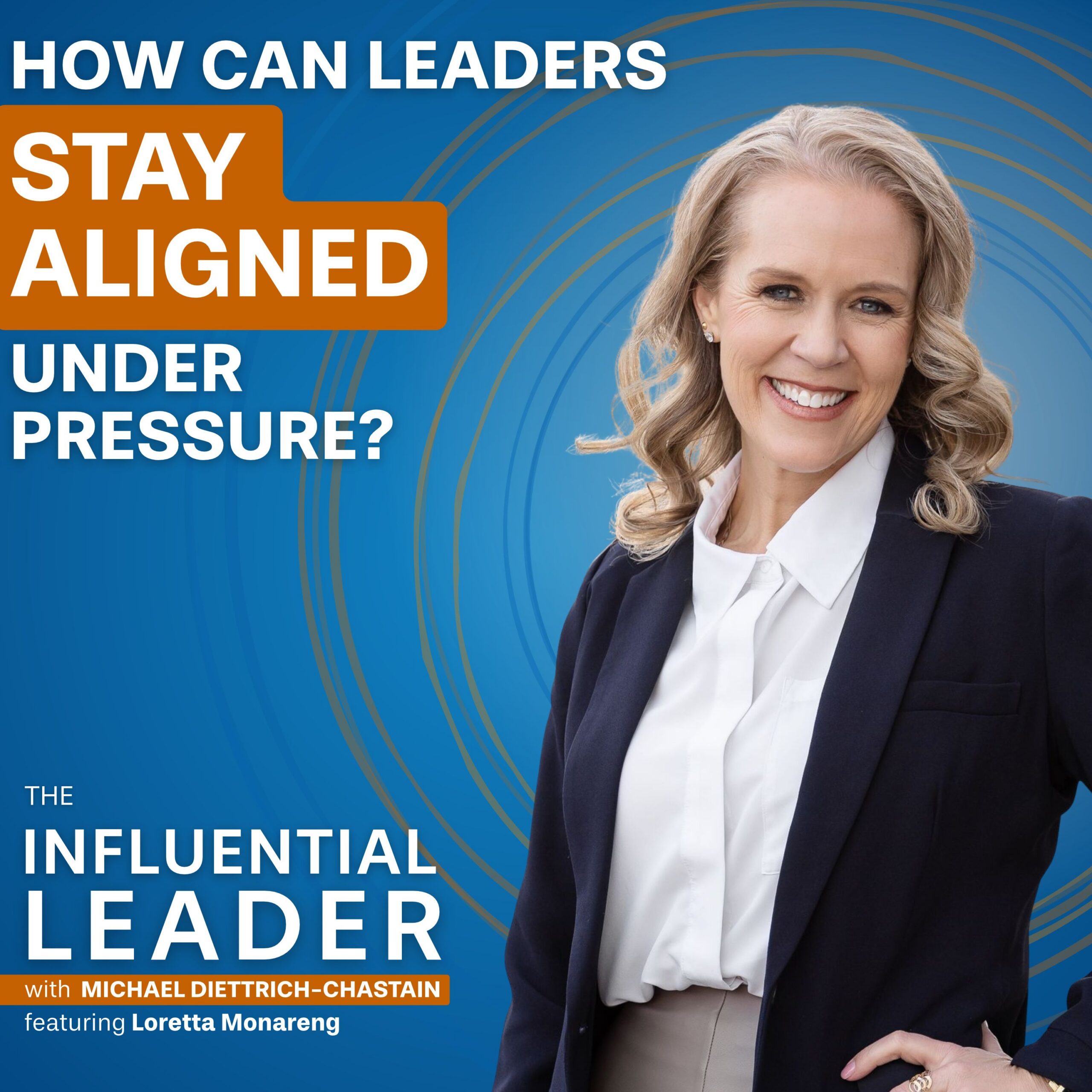
Loretta Monareng joins Michael to explore what it means to stay aligned when leadership gets difficult. She shares how she appeared successful on the outside while struggling internally, and how that experience shaped her approach to leading under pressure. Together, they discuss why a leader’s internal state affects the people around them, how safety and challenge can support growth, and why developing who we are matters alongside building skills. Loretta also offers a different way to think about work and family balance, invites leaders to look beyond their own departments, and challenges the familiar belief that there is never enough time. As the conversation turns to AI, she makes the case for investing in human qualities such as empathy, discernment, and connection. Her closing invitation is to question the stories we tell ourselves and create more belonging under pressure.
Chapters:
- (00:00:00) Introduction: Staying Aligned Under Pressure
- (00:06:00) Upgrading the Human Side of Leadership
- (00:12:00) Work, Family, Boundaries, and Grace
- (00:19:00) Enterprise Thinking, Safety, and Challenge
- (00:24:00) The Story Behind the RAY SHIELD Framework
- (00:30:00) Vertical vs. Horizontal Leadership Development
- (00:36:00) The Myth of Not Having Enough Time
- (00:39:00) AI and the Human Cost of Change
- (00:43:00) The Human Qualities Leaders Need for the Future
- (00:47:00) Belonging, Curiosity, and the Stories We Tell Ourselves
Quotable Moments
- “Even though I was really successful on the outside, inside I was struggling.”
- “When we have challenges but no safety, we have anxiety.”
- “Genuine laughter is a signal that there’s trust amongst a team.”
- “The primary tip is to create belonging within yourself so you can create environments of belonging with your team.”
- “Question the stories that we tell ourselves. Let’s question those stories and not assume that they are facts.”
About the Guest
Loretta Monareng is the Founder and CEO of Monareng & Co., creator of the RAY SHIELD™ Alignment Operating System, and author of the forthcoming book Aligned Under Pressure (expected Nov 2026). Over the past two decades, she has helped leaders across the globe create the human conditions that enable people and organizations to transform under pressure. Her work has helped individuals and teams move from anxiety to calm, from self-doubt to confidence, from mistrust to trust, from self-protection to shared contribution, and from reactive to creative leadership.
-CTA: monareng.co
Links and Resources:
- Monareng & Co.
- Aligned Under Pressure by Loretta Monareng (forthcoming book)
- RAY SHIELD Alignment Operating System
- Leader Under Pressure Assessment
- Founder Leadership Team Alignment Assessment
- Corporate Leadership Team Alignment Assessment
- The Aligned Organization Field Guide
- DiSC Assessment
- Big Rocks Exercise — FranklinCovey Video
- XCHANGE Approach
- Loretta Monareng on LinkedIn
- Arc Integrated Website
- Strategy Call Page
- Podcast Page
- Michael Diettrich-Chastain in Linkedin
- Michael Diettrich-Chastain in Instagram
- Michael Diettrich-Chastain in Facebook
- Arc Integrated in Linkedin
Transcript
Click here to show transcript
Loretta: [00:00:00] Even though I was really successful on the outside, inside I was struggling. Around 2020, when my job was extremely challenging, there was just so much going on with the pandemic, and I became very conscious that, okay, my nervous system is not okay
Michael: Today on the Influential Leader podcast, I got to sit down with my friend Loretta Montering. We cover a lot of ground in this chat, but one of the things I appreciated most is her emphasis around alignment, which she unpacks in, in a significant way, and we talk about that topic quite a bit. There’s a number of other things that stood out to me in our conversation, including why the constraint of time is actually a myth.
Michael: Certainly a common, question or a common constraint that exists. I don’t have enough time. We all feel it She also talks about how to develop an enterprise mindset as a leader and why it’s so important. We talk about what is vertical capacity building versus horizontal capacity building in leadership.[00:01:00]
Michael: She shares how our human qualities as leaders are perhaps more important now than ever in the face of AI and all the tech challenges we’re up against. And then lastly, as I mentioned, how to increase alignment as a leader and why it should be a sincere focus. And with that, please welcome Loretta Monarang to this episode of the “Influential Leader” podcast.
Michael: Enjoy. Welcome to the “Influential Leader” podcast. I’m your host, Michael Dietrich Chastain, and today we have with us my dear friend, Loretta Monarang. Loretta is the founder and CEO of Monarang and Co., creator of the Ray Shield alignment operating system, author of the forthcoming book, “Aligned Under Pressure.”
Michael: She has over two decades of experience helping leaders across the globe, creating human conditions that enable people and organizations to transform under pressure. Loretta, welcome.
Loretta: Thank you. Yeah. So great to be [00:02:00] here, Michael.
Michael: Yeah. It’s great to be here with you. I’m excited to, to jump in. you and I have known each other for, gosh, I don’t know, six years maybe?
Michael: Yeah. Does that sound right?
Loretta: Sure, yeah.
Michael: Cl- close
Loretta: to that? It’s, it’s been since around 2020, yeah.
Michael: Yeah, yeah.
Loretta: Pan- pandemic days with Exchange, right?
Michael: Yeah, I think so. I think that’s right. and we’ve had all sorts of conversations about leadership and conscious leadership and convening and event organization But we’ve never had a conversation like this, and I’m super excited to pick your brain because you have a, a ton of really interesting experience, wide-ranging with leaders from big brands, and excited to dig into your, to your expertise and your wisdom. And before we do that, though, I thought we could start a little personal with a handful of personal questions just to get to know you and so our audience can get to know you a little, a little bit better.
Michael: Would that be okay?
Loretta: Yeah. Let’s jump in- Yeah. Awesome … to the real Loretta.
Michael: That’s it. That’s it. So the [00:03:00] real Loretta, if you were to say these are three things to know about you as a human being that are not- Hmm … on the bio that I just read, what three things-
Loretta: Mm-hmm … come to mind? Three things about me, is th- that I love to laugh.
Michael: Yeah.
Loretta: And I have a immense love for deep conversations as well.
Michael: Mm-hmm. Mm-hmm.
Loretta: I love to laugh and to dance and to play. You always find me doing those things, but you’ll also always find me being the one having the deep conversation with somebody.
Michael: Uh-huh.
Loretta: Yep. and I love– I’m an activator.
Loretta: Okay. I love to take something from idea to reality. Hmm. So I’m really good at activation, and that really energizes me.
Michael: tell me more about that. When you say [00:04:00] activation, what does that mean?
Loretta: Like I’m a fire starter. I’m an initiator. I… let’s not just sit around and talk about it. Let’s, let’s make it happen type of girl.
Michael: Yeah. Yeah. Love it. Love it, love it. I have, I’ve seen that in action. what– There’s a, here’s a curiosity. With, with that activation can sometimes, and I’m not saying you do this, but can sometimes be disruptive. And my curiosity is, would you also call yourself a disruptor?
Loretta: Yes. Yeah. Yeah. And I, and I can be very spontaneous.
Loretta: I can be quick to make decisions and then regret them. quick to act on, on things and then regret it later. I’m a D on the DiSC, so bias for action and, and bold and say what I… Some- And, and I’ve tried to actually become more thoughtful. Becoming a coach has really helped me develop a lot more S, or presence and, and [00:05:00] thoughtfulness about what I say, and do, and more listening.
Loretta: But under pressure, I go back to that D and I go right– I, I do m- even more activation and even more directness and so sometimes it, it ends up with some negative consequences.
Michael: Sure. Well, and, and it’s certainly strength, right? Like this, this bias towards action and, and the, the strength of like balancing challenge and curiosity, which I’m excited.
Michael: There’s a number of questions I have related to that. before we go there into kind of the, the depths of leadership, you are writing a book and you just expressed that you have some passion for the world, and I’m curious about how– like how was this book inspired? What passion is behind the book that’s driving you to take on such a big task?
Michael: Writing a book is a huge undertaking, as many listeners know. what’s the passion that drives it?
Loretta: there’s a couple of things. The possibility for the [00:06:00] individual, right? So the book, it’s called “Aligned Under Pressure,” and it’s h- to help organizations stay aligned, especially as they going th- as they’re going through massive amount of change.
Loretta: it’s about upgrading the human operating system, right? So with all this upgrading that we’re doing to our technology and to structures and to processes and systems, the humans are kind of expected just to go along with it or just to adapt or, traditional change management is great, but it’s a lot of– it’s limited in that it’s a lot about just changing behaviors.
Loretta: I’m talking about upgrading the human operating system from the inside out. And, so the possibility– I’m passionate about the possibility, of that and the implications of that for people and what it means for, or an individual might be going from living every day,from fear or protection or from an [00:07:00] intention of basically survival, to living every day, from a place of wholeness, a place of delight, a place of energy and creativity.
Loretta: and that shift is huge, going from anxiety to calm and self-protection to shared contribution. It’s a huge benefit to an individual. And then from an organizational standpoint, huge benefit to the future growth of any company and the, the success of all those investments that we’re making in technology, in large part, I think, depend on, on, on the, on whether we’re upgrading our human operating system in parallel with those investments.
Michael: I totally agree, and see the, the benefit of this approach. And I’m also hearing, like in the back of my mind, I’m hearing some of the leaders that I’ve worked with, and I’m sure this, what I’m about to say will resonate with you too. It’s like, can hear some leaders hearing that and saying, “That’s a massive undertaking,” right?
Michael: To up- to upgrade the human operating system. [00:08:00] And so it makes me won- like with that voice in the back of my head makes me wonder- Yeah … like, what would, what would be a, whether it’s a small tip or a small strategy that listeners, leaders that are listening are asking themselves, “Well, how do we do that?”
Michael: Yeah. What would be one, one thing that comes to mind?
Loretta: Well, we look to nature. We look to fractals in nature.
Michael: Okay.
Loretta: And-
Michael: Yeah …
Loretta: we look to replicating patterns, basically. Mm-hmm. And so if we look to, if we think, if we buy into the idea that an indiv- that an individual leader’s internal state or their nervous system And how aligned they are with their values, identity, nervous system, and actions.
Loretta: and how they relate to themself. Is that, if that’s contagious and if that is how it, the world, the team then experiences them-
Michael: …
Loretta: that energy can be contagious for bad or for good, right? So that- Hmm … that vertical capacity building, [00:09:00] that’s what I’m talking about, is that leader becoming aligned within.
Loretta: Mm-hmm. And I believe it’s contagious based on my experiences. Yeah. So- Right … if a, if we can, if the more leaders that we can get doing the work to get that true alignment and come home to themselves then creates the conditions for the team to, also have the opportunity to f- create more alignment amongst themselves relationally.
Loretta: and then it can grow from there into, embedding that, those vertical capacity builders in the RAY shield system that the book go- talks ab- through.
Michael: Oh, yeah. Yeah.
Loretta: Those, those vertical capacity builders then can get embedded in the things that we reward, in our incentive systems- Mm-hmm … in our- Mm-hmm
Loretta: our, our performance processes, our selection processes, in, in those institutional governance things that we have to protect- Okay … and, and protect those capacities and help them to sustain.
Michael: Yeah.
Loretta: So I [00:10:00] guess the short answer is the one little thing we can start with is individual leaders just getting still and honest enough with themselves, self-aware enough- Yeah.
Loretta: Uh-huh … to recognize the parts of themself that maybe aren’t in alignment, that maybe are fragmented, that maybe are those parts of themselves that are living in survival or in, or being motivated from a place of fear. Mm-hmm. And, and, and start to lead those places in themselves from that place that knows who they really are, and that place- Yeah
Loretta: that is aligned, and then bring, integrate that themselves. Yeah. Starts with just stillness. Starts with getting still enough to take a pause and get, honest. So shield, RAY shield, stillness and H, the S and the H are the first- Yeah … the first steps in the model.
Michael: So what I heard you say, and, and I’m gonna paraphrase a little bit, but that leaders have this massive ripple effect.
Michael: And what I love about what you mentioned is that it’s for better or for worse, right? The ripple effect that they have is gonna create [00:11:00] conditions in one way or in the other, and that it starts with alignment. It makes a ton of sense. And that, in my mind, where my mind goes is alignment can be practiced everywhere.
Michael: not just at work, but in all of our relationships, with our family, right? And it’s, it’s, I’m gonna make a segue here over to a question about family. So you, as, as I understand it, you have a big family. You’re very family-oriented. They’re very, very important to you. and you’ve had a really exceptional career and are having a really exceptional career.
Michael: So my curiosity is how, how have you been able to balance such a, embracing of your family and such embracing of your career with such success in both areas? And I, and I ask that again with leaders in the back of my mind asking themselves the same question, and I’m sure you’ve heard it before too.
Michael: How do we balance it all? So any, any thoughts on that strategy?
Loretta: By balance, we [00:12:00] sometimes think of a scale and we think of 50/50
Loretta: I stopped thinking about it that way, especially recently. so I’m thinking about it, more in terms of it’s not just about like, am I spending the right amount of time with my family or, equal amount of time with my work as my family. I think when people think about work-life balance, it tends to go into a time management framework.
Loretta: And, even with my partner, so my husband, the s- he’s a big part of why I’ve been so successful in managing both because of our shared commitment to our family. And, what’s the– and the reality, sometimes it’s 30/70 and sometimes it’s 70/30, but it’s one eternal, it’s one eternal round. It’s him and I as one working together for our family and our shared goals and our shared values.
Loretta: And sometimes it looks [00:13:00] like, me at the office till eight o’clock at night, and sometimes it looks like, me taking a, demotion. I took some– I traded a title and pay at, at, at one job, and left a director and executive title for a senior manager, title and pay, but in exchange for time, because at that time in my life and in our family’s dynamics, I needed more time than I needed money.
Loretta: And so it’s being willing to look at things, I guess, non-linear, non-hierarchical. For us, more looking at things more holistically and dynamically and looking at, the partnership with ourselves, with each other, and focusing on what matters most. And sometimes that bedtime, that little– even if I don’t see my kids all day, but I have 10 minutes of loving snuggles and kisses and prayers at night with [00:14:00] them, they feel nourished.
Loretta: And we can have those– and we can have talks together, that, that fuel them and fuel me where it doesn’t necessarily m- then, then, then I’m able to go do what I do best and they’re able to go do what they do best, and doesn’t necessarily require me, You know, physically always being with them
Michael: It’s a great example of alignment.
Michael: Like how- Mm … I hear you emphasizing the alignment between you and your partner, and that that- Uh-huh … is like the, the first domino you could say, I guess. Yeah … so that, that’s a beautiful example to what you were just describing.
Loretta: Thank you.
Michael: Yeah. Yeah, for sure. For sure. Well, so switching gears a little bit, there’s a fun question I wanna ask you.
Michael: Did you wanna s- add something?
Loretta: I’ll just add one more thing.
Michael: Please.
Loretta: it’s also been about grace, a lot of grace-
Loretta: all around between like my husband giving each other, and us, m- my kids giving me grace, me giving them [00:15:00] grace, and, also team. sometimes extended family has helped. Sometimes care- we’ve had beautiful caretakers.
Loretta: even, a housekeeper s- at times, you know, might be the w- like the one that just keeps it all flowing. So looking at it from a holistic team level, and- Yeah … and not necessarily putting expectations on ourself that we need to do it all on- Mm … or we need to be… al- also boundaries.
Loretta: I don’t, I don’t– I’m not the one at the PTA, right? I’m not gonna be the parent. I’m gonna say no to certain things and be okay with that and have grace with that. So just like at times I’ve really leaned in, to… And other times I’ll say no to, my boss and say, “Can’t make the meeting. I’ve got a kid, kid’s in a play.
Loretta: I don’t wanna miss the play.” So it’s about boundaries. It’s about team and pulling in, the whole community to help us and it’s about that, that partnership and grace, a lot of grace.
Michael: Yeah, I [00:16:00] think I appreciate the, all, all the addition. I think a lot of those principles are so transferable to effective team performance, right?
Michael: In the workplace, right? Things like boundaries and grace and alignment, right? So these are great principles, whether they’re happening
Loretta: in- And delegation
Michael: Yeah. Right, right, right. Yeah. Wonderf-
Loretta: We do, we do a lot of proxy too. Like not everybody has to be in the room at work- Uh-huh … Sure
Loretta: same thing, like s- my da- my husband will go to the parent-teacher conference on our- Yeah … behalf. I don’t necessarily always have to be at everything. He can go, Yeah … can represent and, and the same thing. We can put a representative of the team in the meeting. We don’t all have to be- Mm-hmm … in the room all the time.
Michael: Yeah. That’s great. That’s great. Well, shifting gears a little bit, there’s a fun question I wanna ask you next, and one of the things we do on this show is, is at, with every guest we’ll ask, and you’ll, we’ll ask you this as well, of course, “What’s a question we should ask the next guest?”
Michael: So the question, and you’ll have a chance to answer that at the end here, but the question from the [00:17:00] last guest, which is really fun, is this: What is a creative idea that has come to fruition for you and it made you very happy?
Loretta: Oh. So
Michael: a creative idea that you’ve had that’s come to life and it made you very happy. Anything come to mind?
Loretta: okay, look, m- moving back home to South Africa was a really huge creative idea that came to fruition, and I’ve been really, really delighting in it. we’ve been here about a year now, and it, it, it all spawned from, what if?
Loretta: a conversation, a walk on the beach with my husband saying, “What if we really did this?” And coming back to that activation, I was like, “Okay, well, if we’re really gonna do this, let’s turn it from just a creative idea to like, let’s make this happen.” And, it’s been,a massive creative project.
Michael: Yeah.
Michael: What, I mean, what a- Yeah … [00:18:00] what a leap of bravery too. That’s so, so wonderful. So wonderful. Yeah. I’m, I’m glad, I’m so glad it’s working out well, and I’m, and insp- and inspire- and in- ah, I am inspired by the, the bravery that it takes to make such a big move, so yeah, congratulations.
Loretta: Thanks.
Michael: Yeah. It’s cool.
Michael: Yeah. That’s cool. Well, so you have a lot of strengths, Loretta, and we, a- as, if you’re the first… If you’re listening to this for the first time, one of the other unique things about this show is that we go to our guests and ask them to nominate a handful of people that know them so that we can do research, and you nominated a number of people, Loretta, which is great, and they gave us a number of pieces of insight about you, about your strengths.
Michael: In addition to being brave and creative, we’ve got a number of other things that I wanna ask you about. And so I’m gonna read you a quote that came from this research, and then follow it up with a question. So here’s one of the quotes that we gathered, says, “Loretta has the ability to see the invisible architecture behind visible [00:19:00] organizational problems, and then create a framework that helps people realign that architecture.
Michael: She ha- she is a sense maker and asks powerful questions that can bring transformational change.” I’ve found that to be true about you as well in the time we’ve known each other. So here’s the, here’s the curiosity, though.
Loretta: Wow.
Michael: How can leaders see the forest through the trees, so to speak? Right? How can they develop the skill of seeing patterns that will drive system change?
Michael: I think this is a, and I’m sure you’ve seen this too, like leaders can sometimes get too fixated on a thing rather than have this zoomed out perspective and see, what are the patterns? What are the root causes? You have that at, as a skill set. How do we develop that?
Loretta: my mind goes to having an enterprise mindset.
Michael: Okay. Yeah. Say, say more about that. That’s great.
Loretta: So sitting in HR,I functionally had the [00:20:00] advantage of looking at the whole organization.
Loretta: And so a department leader doesn’t necessarily sit in that kind of bird’s-eye view that I d- had in HR, but that doesn’t mean they can’t have an enterprise mindset.
Loretta: So no matter where you sit on an org chart, I would invite us, invite you, listener- Mm-hmm … to have an enterprise mindset- Hmm … and look at the whole organization, and look at the shared interests of the organization, or look at what, how, what– Be mindful of how what you’re doing and your priorities in your department affect other departments.
Michael: Yeah.
Loretta: and having, having that, understanding interdependencies and, understanding… You’ll start to see More coherence, more collective, energy- Mm-hmm … when you look at the organism or the organization [00:21:00] as one- Yeah … body instead of just your, day-to-day subset of that.
Michael: Yeah, agree, agreed. Yeah, that’s, that’s so good.
Michael: Enterprise mindset. Love that. That’s a wonderful, a wonderful invitation. we touched… I want to ask you another question about something we touched on previously, and it– and I’m gonna read you another quote, which I think highlights the strength that you have. So another person said in our, in our research, said that, “Loretta genuinely cares about people and leads with compassion, yet she’s resilient, hardworking, and never afraid to step up when something needs to be done.
Michael: The balance of warmth and strength is one of her greatest qualities.” So my curiosity here is, how can leaders develop this heightened sense of both compassion and challenge or directness and be able to hold both equally, right? ‘Cause they’re both really important. how do we do that?
Loretta: well, I think it’s [00:22:00] a myth that they’re actually, have an inverse relationship per se. safety and challenge, right? I think that was your question is how do we have both, right? So when we have both, that’s when we have growth. Think about it, right? So when we have challenge but no safety, we have anxiety.
Loretta: When we have challenge– or when we have safety but no challenge, we might have, like, apathy or just comfort, but no growth. And I think they work hand in hand ’cause we all want to grow. I– If we do our best and we thrive as, as living beings, just like the plants, like, we wanna be growing. and so I think those are the two ingredients that we need to grow is that s- challenge and that safety.
Loretta: And if you think about it, like, yeah, empathy without honesty is maybe just stagnation. It can feel good, but we’re just kinda stagnant. And then [00:23:00] challenge without empathy is fear. So I really think the two go hand in hand. We need both. even,going back to this Ray Shields model for alignment under pr- or how to stay aligned under pressure, it has both those ingredients.
Loretta: The H is for honesty and voice, and the E in, in the acronym of the shield is empathy. and empathy creates that psychological safety and that connection, and then that honesty creates that truth, that trust, that productive challenge, creative tension. And so long as you have both, or the– Having both helps to go to that growth and go to that alignment, those conditions for alignment that I talked about earlier.
Michael: Yeah. May- maybe this is a good time to go into that model. Is there, is there more you wanna share about the Ray Shields model? You wanna walk us through all of it real quick?
Loretta: So for, for much of my career, I was in, a s- a, a [00:24:00] state of, constantly trying to achieve and make myself useful and, I didn’t necessarily– I wasn’t always conscious of it, but for years I had, actually a, a really strained and fragmented nervous system.
Loretta: Sure. so even though I was really successful on the outside, inside I was struggling. it wasn’t until actually around the time I met you, Okay … around 2020, when my job was extremely challenging, the George Floyd incident, there was- Hmm … just so much going on with the pandemic and,I became very conscious that, okay, my nervous system is not okay.
Loretta: And I was in a really challenging work environment and challenging, conditions at,with my work team. Mm-hmm. and my husband would tell me every day before I went to work, “Put your Ray Shield on. Don’t forget to put your Ray Shield on.” And it was just a way of- Huh
Loretta: like making sure that I, protected my sense of self-love and I, I- Oh, wow … didn’t allow all of this going on to, [00:25:00] turn inward and, like-
Michael: …
Loretta: collapse on myself. because I found, he f- he’s found that I was starting to come home just, like I was losing my sense of self. and- Mm-hmm … so put your Ray Shield on and,what it, and it, it, so it, it became a way to protect self-love is how it started.
Loretta: It’s now- Hmm … turned into an entire, operating system for alignment- Okay … for individuals and for organizations on how to stay aligned. And- … the ray is radiant as yourself, and that radiance- Okay … is what emerges when you don’t have anything to defend, anything to prove, anything to hide-
Michael: anything to protect. You are then- Sure … left with your radiant, truest, authentic self. and then the shield is, are the capacity enablers to protect that radiant self or to create the conditions in the environment- Hmm … that allow for others to be their radiant self.
Michael: Oh, that’s great. [00:26:00] Okay.
Loretta: Okay?
Michael: Yeah.
Loretta: And it’s an acronym.
Loretta: Yeah. Stillness in presence, and that creates the capacity for regulation and for calm. it l- it reminds us to take that sacred pause,to notice, what’s happening within our nervous system and to get our- Okay … our prefrontal cortex back online. If we notice we’re get- starting to get hijacked by our amygdala- Sure
Loretta: it’s that s- like taking a breath, taking that pause, get regulated, get calm.
Michael: Mm-hmm.
Loretta: and then Honesty in voice, stands f- it’s what creates the capacity for truth,for trusting, productive, challenging conversations.
Loretta: It’s like what protects us against, we’re all in the room nodding like, “Yeah, we agree,” and then going and having the, the water cooler conversation being like, “What the heck was-
Michael: Right
Loretta: w- was that all about?”
Michael: Yeah.
Loretta: Honesty in voice [00:27:00] creates, like, shared understanding and we’re actually able to say what we’re really thinking.
Loretta: Integrity in alignment is the I, and that- Okay … creates the capacity for coherence and for consistency and credibility. Mm-hmm. And, and, it creates, that i-i…
Loretta: alignment between identity, values, nervous system, and actions on the individual level. When you think about it on a conditional, on an environmental level, it’s, it’s creates that sense of credibility and consistency.
Loretta: Again, with who, who we are inside and how we’re showing up outside is consistent with that integrity.
Michael: Makes
Loretta: sense. Yeah. And then the E stands for empathy in action, and this is-
Michael: Okay …
Loretta: connection. This is psychological safety. This is understanding people’s needs and- Mm-hmm … and, removing barriers so that they can, perform their best or just empathizing with, with, and meeting them where [00:28:00] they’re at.
Loretta: The L stands for love in leadership, and this is- Okay … what creates the sense of belonging, and genuine, operating with genuine care for ourselves and others. And then D stands for delight in the work. Oh, I like that. And this is the powerful way to create energy for creativity and innovation.
Michael: Excellent. Actually playing and having fun and, and bringing purpose and all those things,into the work. and all that- Yeah … all of that to say this is what This Ray Shield is this alignment operating system, that, that protects our authentic selves. It protects alignment across organizations, yeah.
Loretta: Within ourselves- What were- … and across organizations.
Speaker 2: You ever wondered what your leadership style really says about you? Are you leading in a way that drives engagement, builds trust, and maximizes your influence? Well, we’ve got a resource for you. You can take our Leadership Influence Quiz, which is a quick three-minute [00:29:00] assessment that gives you a personalized insight and roadmap and actionable strategies to improve your leadership effectiveness and ability to actually change behavior.
Speaker 2: The best part is that you’re gonna get immediate feedback with recommendations you can use right away to elevate your leadership game. Just go to leadershipinfluencepodcast.com to get your free report today
Michael: Right. Well, w- you said something in the very beginning when I was asking you about, who is Loretta. Mm. and you mentioned, like, laughter and play.
Loretta: Yeah.
Michael: And one of my, one of my immediate thoughts, I didn’t ask you this, one of my thoughts was like, “Oh, why?
Michael: Why is that important?” And you just answered it. Yeah. You just answered it through delight. that… It’s, it makes a ton of sense why that’s important to you and the benefits of it maybe in, in a leadership lens and organizationally as well. So yeah, thanks for that tie-in.
Loretta: It is. It is.
Loretta: And if you think about it, it’s a, it’s one of the signals that there’s trust. Absolutely. Genuine laughter- Yeah … is a signal that there’s trust amongst a team. Mm-hmm. and if you think about all the [00:30:00] energy that’s otherwise constrained in that self-protection, that, that is then being… O- once you’re, are your radiant self, operating from a place of nothing to hide, nothing to prove, nothing to defend, all that energy can then go into creativity, innovation, and, and delighting in the work.
Loretta: ‘Cause again, then we’re no longer in that survival mode of fear. We’re in a- Mm-hmm … mode of significance and belonging, and it’s, it really is a place of delight, of joy.
Michael: I like- I love it … framing it as, as a signal. That’s cool. I also- Yeah … appreciate that each of these in the shield you could frame as a question, right?
Michael: You could s- you could ask, “How am I doing across all of these?” And, que- questions are powerful, as, as we both know. And, one of the things we, when we do this research with those that you nominated, we, one of the questions we ask them is, “What’s a question that Loretta helps others to ask or answer?”
Loretta: Ooh.
Michael: And I [00:31:00] wanna share with you something, a, a couple questions that emerged that I thought were really powerful. So one person said a question that you pose that’s really powerful is, “Who are you becoming?” Who are you becoming? So I’m curious, why is that question important to you?
Loretta: Because this idea of vertical capacity building is all about who we’re becoming, who we’re being. Horizontal– So I spent my, so years in, in HR and in learn- learning and development roles, and a lot of it was about what I call horizontal building. Horizontal capacity is about your competencies, your skills, your knowledge.
Loretta: Guess what? AI is taking over a lot of those things. What really matters, is most is who we’re becoming, and that vertic- the vertical capacity stuff, speaks [00:32:00] to upgrading that human operating system. It speaks to who we are under pressure, and it’s what creates the, it’s the person or the operating system that can then deliver on those capacity, on those competencies.
Loretta: ‘Cause let’s tr- let’s be honest. It doesn’t matter how competent you are. If your operating system underneath is, is not grounded and stable, then you’re gonna be the, y- you’re gonna have that reactive moment where your tone gets sharp with somebody, or you’re gonna have a, a, a make a decision, a poor decision out, out, out of reactivity instead of thoughtfulness.
Loretta: so tho- those vertical capacity buildings speak to who am I becoming? how am I enlarging my capacity to stay grounded under pressure? Or am I becoming the person… It speaks to that identity level, alig- piece of the alignment that I talked about
Michael: Yeah. It’s, it’s powerful. I [00:33:00] really, I really like the frame, and I can, immediately visualize it too, which is, which is nice.
Michael: Well, w- I think you phrase it maybe better than, than we do. We’ll often call this internal versus external development as a leader, but I really like vertical versus horizontal. That, it’s a really nice visual.
Loretta: It is. And do you know why? it… I li- another reason why I like it so much, I spent my years with my sense of identity and my sense of self-worth tied up horizontally.
Loretta: it, it was, it was dictated, it was conditional. It was based on, the extent to which I was useful or the extent to which I was pleasing somebody or the extent to which I was achieving. And so as you can imagine, that’s a moving target. and some days I was getting gold stars, and other days I was getting some, some bad m- bad marks.
Loretta: And so then that made me feel my sense of self-worth was just a constant rollercoaster. Whereas with vertical alignment, your sense of identity and your sense of worth and your values, and therefore your nervous system, [00:34:00] your actions, your priorities, your goals, all of that is within your control. And it’s, it’s about, being vertically aligned within yourself and if with your higher power, if you, if you’re, spiritual, it’s more a nod to, your, your God, if I can share that.
Loretta: and that vertical alignment is constant. It can be constant versus conditional, So it’s really anchoring. And it leads to expansiveness. It’s grounding and it’s expanse- expansive at the same time.
Michael: Yeah. It’s a, it’s an interesting connection. So another, another quote that we got from those we connected with is another question that you asked, which was very much connected to what we’re talking about.
Michael: And the question is: What needs to change within me before I can create the change I want to see around me? what great connection to, to this vertical versus horizontal. My curiosity there is how can leaders more effectively answer that question?
Loretta: Michael, we just spent the last [00:35:00] few months as part of this book writing process also doing research- Okay
Loretta: and also coming up with some diagnostics.
Michael: Okay.
Loretta: And so on our website, monitoring.co, we have some three different diagnostics to start to help to get clarity around maybe where am I misaligned? Maybe- Mm-hmm … where are there parts of me that aren’t as effective, or where do I need to strengthen my capacity, my vertical capacity?
Loretta: just to increase that sense of self-awareness, t- diagnostic tools like we have out there or that are readily available in other places, or 360 assessments, asking others that question, might help you to be able to, look inward by like kinda looking outward. How am I- Yeah
Loretta: impact or affect am I having on others might give, s- shed some light on that as well.
Michael: Yeah. Excellent. And we can, as long as it’s okay with you, we’ll link to that [00:36:00] diagnostic tool in the show notes, so if people wanna take it, they can. Would that be okay?
Loretta: Absolutely. Yeah.
Michael: Yeah. Great. Great. Great. Awesome.
Michael: s- you’ve mentioned this, and it’s, it’s in your bio as well, you’ve worked with some, big companies, including, this is a learning I had when I was doing my own research about you, you worked with NASA even. A- along with- I did … some other, some other, like, really, really, really enormous, Fortune 100 companies.
Michael: And you’ve had various re- leadership roles as you’ve t- as you’ve mentioned. The curiosity here is across that spectrum of corporate work, what do you think are the most common pitfalls that corporate leaders fall into, and how might they avoid them? What, what comes to mind?
Loretta: the, the myth of time. The biggest excuse I hear for why I hear leaders struggling with not being able to show up the way they wanna show up or fulfill- Mm-hmm … certain [00:37:00] responsibilities, is I don’t have time.
Loretta: And, or I feel stuck. so those two,
Michael: Yeah …
Loretta: this false sense that there’s some kind of barrier or boundary that makes people feel stuck in, in being able to push a project forward or being able to have a conversation that they wanna have with a team member or what have you.
Loretta: But this limiting, self-limiting belief that there’s some feeling of stuck that leads to s- feelings of being stuck. Hmm … and then time and, and this false or maybe th- this idea that I don’t have time to do what I really want to do.
Michael: Yeah.
Loretta: So I think going to back to good old Franklin Covey- Yeah
Loretta: and the rock example of putting the big rocks in the jar first.
Michael: Uh-huh. Yep.
Loretta: And miraculously you’ll have time for the pebbles and the [00:38:00] sand. but starting- Hmm … just getting really clear on your priorities and-
Michael: Yeah …
Loretta: and asking yourself what matters most now-
Michael: … is
Loretta: such a beautiful question that actually brought us together, Dr.
Loretta: Danny.
Michael: Yeah, that’s
Loretta: right … brought,taught us to pause and ask what matters most now. Mm-hmm. And that helps with that prioritization, and then it helps with that alignment. It helps us to- Yeah … be more aligned and consistent with our values and our actions-
Michael: Yeah.
Loretta: Love that … and how we spend our time.
Michael: And, and I lo- yeah, I love the, I love the big rocks visual. And for those of you that don’t know that, I, I, for those listening, I’d suggest just Google or look it up on YouTube, the big rocks in a jar exercise. It’s such a great metaphor for this idea of what are we truly prioritizing.
Loretta: Yeah.
Michael: Well, thank you.
Michael: Thank you for that. we, we are gonna make a, a little bit of a shift, although it’s, it’s certainly connected to AI, which does, I [00:39:00] think, allow us in a lot of ways to reorganize our time in a way that maybe we’ve never been able to before. But I’m curious, you, you’ve worked with a lot of companies.
Michael: You’re still working with a lot of companies. I’m curious ab- about a few things related to AI and your perspective of what you’re seeing in the workplace right now. And, first just kind of generally speaking, how are you seeing AI impact leaders, teams, organizational development? And take that in any direction you like.
Michael: What, what comes to mind?
Loretta: I, I, I’m seeing
Loretta: A lot of people, let’s– n- just not know how to leverage it or not want to. Still seeing a lot of skepticism and, so lack of desire leading to, and/or lack of competency with it, with generative AI. And on the other hand, I’m [00:40:00] seeing, a lot of just big implications of it also. Like, we’re seeing the layoffs.
Loretta: We’re see- we’re already seeing, the p- the promise of, of it with the efficiencies, at least shorthand efficiencies or short-term cost efficiencies, with the promise of AI. and I, and I think, like I talked about earlier, because we’re not also implementing or focused explicit intentional efforts to upgrade the human operating system alongside upgrading of our technology systems, it creates fear, and it creates either sluggish rollouts or in– I call it the, the, the human opportunity cost.
Loretta: So while we might get, the dollars, the OpEx line going to where we want it to go with those layoffs and on paper it looks like, AI is, is a good trade-off, I think what we’re not quantifying [00:41:00] yet is this the h- the fear impact or the mistrust impact or just even the lack of,alignment the mistrust, the fear, and all that energy.
Loretta: But the people that are still left, they are also still doing a lot of workarounds, right? I think there’s, there are people still doing on manual spreadsheets what AI could do. And so theoretically, like AI is supposed to be able to do this, so let’s go ahead and,do the rejections and, and head count.
Loretta: But what we haven’t accounted for is have we really increased the capacity and the competency of the humans that are now operating in partnership with AI bots. I don’t think we’re doing a good job of that yet.
Michael: Yeah. Yeah. It’s interesting. I, none of us have a crystal ball, but I’m, I’m curious, as you look out in, say, five to 10 years from now, what do you think the world of work is gonna look like?[00:42:00]
Michael: Any predictions for whether it be positive or, or negative? Any thoughts come to mind? or maybe another way to put it would be maybe there’s hopes.
Loretta: I would hope that we would leverage the benefits of it, and that we will wake up to what I’m putting out there.
Loretta: And that’s, that’s why I’m so excited about, Aligned Under Pressure and the work that Monterey & Co. is putting out there to help with vertical capacity building, because I would hope that we can fully leverage it. Because I think it’s a powerful tool, and I think, we should leverage the benefits of it.
Loretta: so just mitigating the cost that I talked about and I would hope, and maybe it’s not in 5, maybe it’s 10, 15 years, but I would hope that we have these beautiful organizations that are agile, that are relying on what really makes us human. and those human qualities that AI can’t replace, that we’re really [00:43:00] quantifying them, measuring them, developing for them,and valuing the human operating system and the qualities of empathy, connection, intuition, psychological safety building, and, and, and those, you know, ability to stay calm and discernment, and all of those things that make us human.
Loretta: Traditionally, we’ve either ignored them or we’ve even kind of shunned them. Say you need to manage your emotions instead of using emotions as data. using intuition, we’ve kind of put that aside. And I think if we can start to not only, disvalidate or, but that we, if we can validate those things and not ignore them, but to use those things that make us human alongside AI, we are talking about a really cool place in the future.
Michael: Yeah. Yeah. I certainly hope all that as well, and I think we’re getting glimmers of that. And- Oh … I [00:44:00] say that because the, the– one of the outcomes, I’m sure you’re seeing this as well, i- is that as we move more toward technology, there’s also this counterbalance of people are wanting more connection.
Loretta: Yeah.
Michael: in-person experiences have gone- Yeah … have gone up, quite a bit, and I think they will continue to trend that way. So it’s a, it’s a wonderful picture that you paint, and I think there are some signs that perhaps as AI and tech advances, so will our humanness and our desire to be human with one another.
Loretta: Yeah.
Michael: Hope so. So.
Loretta: What do you think? So- What do you predict?
Michael: What do I predict?
Loretta: Yeah. Do you predict- Yeah … that that hope, hope is what happens in five years?
Michael: And, I, I think it’s– One of the things that I find interesting about this time is the rate in which things continue to get faster and faster.
Michael: And so I think, I think five years could be dra- actually [00:45:00] dramatically different in ways that we don’t understand yet, because of the kinda exponential- Oh … cycling of speed And in 10 years, even more, been more unusual. So I’m, I’m very curious. I mean, I think certainly I’m not the only one to say this, like I’m most curious about the things that we will have no way of predicting.
Michael: It- not just in work, but in the way- Yeah … that we live and exist. And so- Yeah … so that’s curiosity. But I, I’m generally hopeful. I tend to be, I tend to be hopeful and optimistic, and I think that like, I really like the picture you painted, that, that maybe we’re able to be more efficient and rely on AI for various tools and ways of thinking that creates betterment for us as, as a species, while it’s also reminding us that our humanity is maybe the most important thing we have, and that our connection to one another, and our alignment, like you’ve mentioned [00:46:00] today, is perhaps equally as valuable, if not more valuable- Yeah
Michael: than being, most efficient with our tools and, and our, and our outputs. I think you and I share that hope. So we’ll see.
Loretta: It’d be really cool to see h- like human alignment indexes right there up on the KPIs with the, the revenue and the- Yeah … production numbers, wouldn’t it?
Michael: It would.
Michael: It would. Well, then thankfully,there is so much data that exists and will exist more in the future that connects the dots between what is previously be- been dismissed as soft skills to these are- Yeah … skills that will predict performance and, and ultimately revenue. And so I think that’s good, that’s good news for our humanity.
Michael: well, we’re, we’re gonna begin to land the plane here, Loretta. We’ve got a handful of questions I always ask every guest, and they’re kinda rapid fire. Are you open for a final round here?
Loretta: Let’s do it
Michael: Rapid fire questions? Okay. So if you were to give one final [00:47:00] tip about how leaders can in- can increase their ability to be influential to those that they’re leading, to influence behavior change, what would your best tip be?
Loretta: The primary tip is to create belonging within yourself- Oh, yeah … so you can create environments of belonging with your team, ’cause that’s what’s gonna be all the difference. That’s what’s gonna make challenge become growth, rather than fear.
Michael: Mm-hmm. Yeah. Belonging in self. I love it.
Loretta: Come home to yourself.
Loretta: Nice. Belong to yourself and create environments even energetically that’ll automatically create more envi- an environment of belonging with your people without even any tactics.
Michael: Yeah. Nice. before we started recording, we were, we were talking about the notion of, of questions, and one of the curiosities with this podcast is to test a, a [00:48:00] prediction, which is about the role of questions in influence.
Michael: Yeah. So I’m, I’m curious your perspective on this. What do you think questions, of both ourselves and others plays in our ability to influence those that we lead?
Loretta: I, I was gonna answer with a story, but I don’t know. I’ll just go to an answer. I think it helps us to- eliminate false assumptions.
Loretta: It helps us to… Okay, I have to tell a story just to make it quick. Yeah,
Michael: go for it.
Loretta: Okay. I’m backing out of the driveway, okay? We have this tiny– We have a, we, I, I have a huge SUV and a small garage. I’m backing- Yeah … out of the garage. My husband comes out of the house and is standing in the garage watching me back out, and I made a assumption that he’s watching me because he doesn’t think I can do it, and he thinks I’m- Oh, sure
Loretta: he’s watching to make sure I don’t scrape the car.
Loretta: I pulled up car out of the garage. I’m still in the driveway. He comes up to my window, and I’m about to, like, give it to him. Like: “What, you don’t think I can drive? You have to [00:49:00] come out and watch me back out?” I roll down my window, and you know what he says?
Michael: What’s that? “
Loretta: I just wanted to tell you I’m so proud of you.”
Michael: Aw. “
Loretta: I just wanted to tell you I’m really proud of you before you leave for the day.”
Michael: Aw.
Loretta: I made an assumption. Yeah. A very false assumption about why he was watching. He was just waiting for me to pull out- Yeah … so he could actually come up, ’cause the garage was- Oh
Loretta: too narrow for him to come up to my window. Mm … so curiosity allows for possibilities. It allows for connection. It allows for deeper connection with ourself and others. Question the stories that we tell ourself. Let’s question those stories- Yeah … and not assume that they are facts.
Loretta: questions create possibilities for shifts in beliefs, and when- Right … I talked about people getting stuck before, like feeling like, like I’m trapped in this job or in this, role or these responsibilities, or I’m stuck in whatever it is, I think questions, [00:50:00] for example, help us to challenge our own paradigms or our beliefs-
Michael: Mm
Loretta: um, that make me, maybe make us feel stuck. so it just- Yeah … creates possibilities.
Michael: Yeah. So good. Taking some notes. Very good.
Michael: so on the topic of questions, I asked you a question earlier that a g- previous guest gave us, and so now it’s your turn. What question should I ask the next guest?
Loretta: Ooh. Oh my gosh.
Loretta: It’s just so open. Like anything. Yeah. Anything. Okay. You’re talking to leaders. You’re talking about leadership.
Michael: Mm-hmm.
Loretta: so let me think of a, maybe a question in that lane,
Loretta: How might you, how do you or how might you, create more
Loretta: Belonging.
Michael: Ooh, that’s good. Yeah
Loretta: Specifically, how might you create more belonging under pressure?
Michael: Ooh, even better. Under pressure.
Loretta: How’s that? [00:51:00]
Michael: That’s excellent. , it’s super good and very relevant. I think that’s a quest- that’s a super common question. I’m sure you hear it a lot too.
Michael: It’s like, how do we do all this, specifically under all of the other expectations we have that we have to, have to get to? So wonderful question. Thank you. Well, as we
Loretta: begin to close- It was a selfish one too, because, the answer to that is also, like what I want, what I said I really wanted leaders to do most.
Loretta: Yeah, no, that’s
Michael: great.
Loretta: and what I’m learning about, what I’ve been researching about and- Mm-hmm … trying to practice myself. so-
Michael: Sure.
Loretta: That’s just wonderful … I’ll be listening to the next guest. Thank you for- …
Michael: for
Loretta: asking that.
Michael: Good.
Loretta: Good, good. Thank you.
Speaker: Leaders, if you’re listening to this, you’re probably asking some common questions. Questions like, how do you retain top talent? How do you improve engagement? How do you build a culture that people are actually attracted to and want to stay in? And you’re not alone in this. Most leaders are asking similar questions.
Speaker: There’s a lot of pressure around [00:52:00] this. The good news is, is that there are clear solutions around how to do these things well and what to avoid. So for that reason, we are offering a free strategy call. This is a no-strings-attached conversation where we take a deep dive into your business, your culture, your employee challenges, and ultimately identify opportunities that you can take and immediately apply into your business to see results.
Speaker: In addition to that, I’m also happy to share some of the lessons I’ve learned over the course of a decade plus working with all sorts of businesses from family-owned companies to Fortune 100 organizations, and share some of the strategies that I’ve seen be really effective in moving the needle on employee engagement, attraction to talent, and ultimately how to create a peak performing workplace.
Speaker: If that sounds interesting to you, just go to leadershipstrategycall.com/podcast to book your free call today. Look forward to talking [00:53:00] with you soon. Thanks so much
Michael: we’re definitely gonna link to some of the things you mentioned already, but is there any final, call to action you want to give or way in which people can find you to connect?
Michael: Feel free to share both. Anything you want to share at all.
Loretta: Yeah. So lorettamonarang, is my handle on LinkedIn. Mm-hmm. monarang.co is our website. there are resources, there’s the diagnostics on the website, as well as, an aligned organization field guide that you can download as an example.
Loretta: So there’s multiple resources out there available, as well as a button that says, “Start a conversation.” There you go. So if you wanna book time to meet with me, go to the website, it’ll click you right to a, a calendar to choose a time to just have a conversation and tell me- Right … what’s on your mind, and we can explore ways that, that maybe I can help.
Michael: So- It’s amazing. Amazing. Well, we’ll- Yeah … link all [00:54:00] those in the podcast as well, in the show notes. And so thank you, Loretta. This has been a ton of fun. maybe we can do a round two at some point. I hope we get to see each other in person at some point this year. And,
Loretta: Yeah …
Michael: yeah, just really appreciate your time and your wisdom and, this was a, this was great.
Loretta: I will be back in the States very soon, January, so it feels, it’s around the corner it feels like already. So- Yeah … yeah, hopefully we can, we see each other in person and, if not, these types of th- virtual conversations, this one happened to be recorded, but-
Michael: Mm-hmm …
Loretta: these, these conversations that we have from time to time are so valuable.
Loretta: I loved- Yeah … your questions. I love the creative way, Michael, by the way, that you did this with the research. I- Mm. I love that. It’s so creative and it was very insightful for me, and it was such a gift to hear- Mm … some of that, that perspective on how others experience me, so-
Michael: Yeah …
Loretta: thank you.
Michael: thank [00:55:00] you.
Michael: And there’s a lot that, we didn’t get to, and so I’m excited to share all that feedback with you. I think it’ll really be heartwarming and, just so many gifts and strengths you bring to the world, so thank you for all that.
Loretta: Love it. All right. Awesome. There’ll be a gift in my inbox.
Michael: That’s right.
Michael: That’s right. Wonderful. Thank
Loretta: you, Michael. Well,
Michael: thank you, and listeners, thanks so much for tuning in today. This is the end of this episode of the “Influential Leader” podcast, and I wanna end with a question that Loretta posed today, which is, how can I improve alignment as a leader? I’ll leave you with that question to consider.
Michael: It’s an important one. And until next time, hope you’re doing incredibly well. We’ll see you next week. Thanks so much.