Watch the Interview
Listen to the Episode
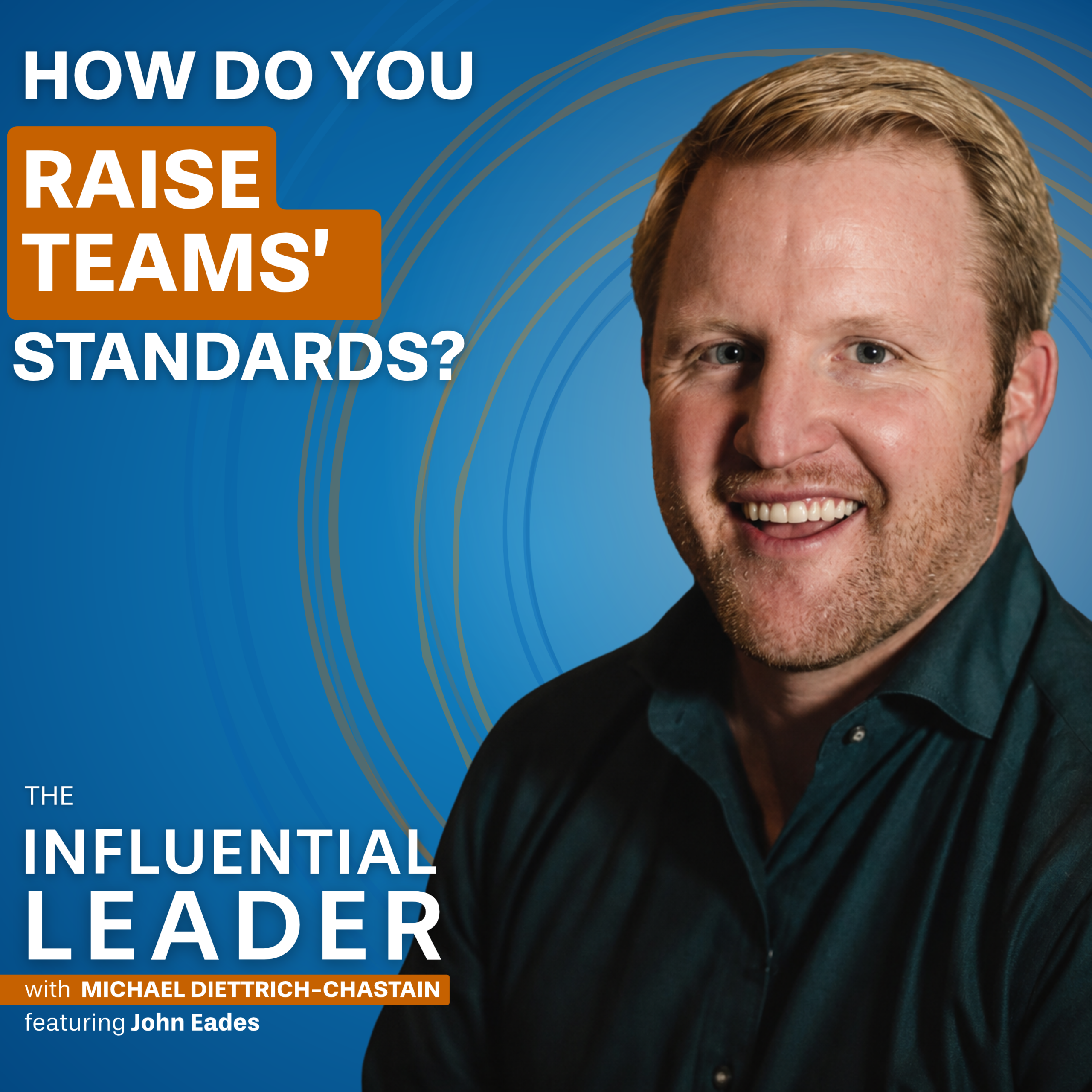
How do you help people grow when you cannot make them change? John Eades joins Michael Diettrich-Chastain to explore the influence leaders have through mentorship, clear standards, honest feedback, and optimism grounded in reality. John shares his “double bounce” metaphor for helping others reach higher, explains why leaders need to understand their own identity, vision, and skills, and offers a practical approach to behavior change: show people why it matters, then make the first step small enough to take. They also discuss protecting focus, giving praise people can learn from, and building an impact that lasts beyond a title.
Chapters:
- 00:00:00 Meet John Eades and the value of seeking mentors
- 00:05:00 The “double bounce” and a leader’s wider impact
- 00:11:00 Why your impact can outlast your title
- 00:17:00 Developing leaders through identity, vision, and skills
- 00:22:00 Optimism that faces reality
- 00:29:00 Choosing people and setting clear team standards
- 00:35:00 Why specific, honest feedback matters
- 00:41:00 ADHD, attention, and protecting your focus
- 00:47:00 How to make behavior change easier to start
- 00:52:00 John’s books, newsletters, podcasts, and closing thoughts
Quotable Moments
- “Your title is temporary, but your impact is lasting.”
- “All improvement starts with the truth.”
- “Optimism by definition is the habit of expecting good outcomes while also dealing with the reality of the current situation.”
- “If it’s not clear upfront and it’s just in your mind, that’s a leadership problem, not a them problem.”
- “My experience is that most leaders don’t have a talent problem, they have a focus problem.”
About the Guest
John Eades is an author, speaker, executive coach, and Founder of LearnLoft and The Sales Infrastructure.
He was named one of LinkedIn’s Top Voices, where his newsletters have over 300k subscribers. He is the author of Building the Best and The Optimistic Outlook. He is also the host of The John Eades Podcast, which has been downloaded over 1 million times. His work has been highlighted on Inc.com, CNBC Money, and more.
Links and Resources:
- John Eades Website
- LearnLoft
- The Sales Infrastructure
- Building the Best by John Eades
- The Optimistic Outlook Book
- The Leadership Lens Newsletter
- The Optimistic Outlook Newsletter
- The John Eades Podcast
- The Optimistic Outlook Podcast
- Accelerate Leadership Program
- Catalyst for Growth Program
- Lead the Room Presentation Skills Program
- Good to Great by Jim Collins
- First Who, Then What by Jim Collins
- Regrets of the Dying by Bronnie Ware
- Dr. Myles Munroe / Munroe Global
- Jon Gordon
- The Bible in a Year with Father Mike Schmitz
- Hoarders
- Arc Integrated Website
- Strategy Call Page
- Podcast Page
- Michael Diettrich-Chastain in Linkedin
- Michael Diettrich-Chastain in Instagram
- Michael Diettrich-Chastain in Facebook
- Arc Integrated in Linkedin
Transcript
Click here to show transcript
John: [00:00:00] Your title is temporary, but your impact is lasting. So while you have it, you have this unbelievable opportunity to impact someone that’s gonna last, and then they’re gonna take it and do it for others in the future.
Michael: Today on The Influential Leader Podcast, I sit down with John Eades, who shares a ton of strategies and ideas and helpful tips.
Michael: We cover a lot of ground, um, everything from how all improvements start with the truth to why being a realist is actually the worst kind of leader. John tells us a bit about that. He shares the principle of who then what. We talk about why standards are so important when dealing with pushback from employees, and we also share the most important leadership competency as of right now and why most leaders resist it.
Michael: And then lastly, we take a bit of a deep dive into the [00:01:00] world of ADHD and how it can be a superpower, and what you can actually do as a leader to lock in focus, and how you can teach that to those that you’re leading. If those topics sound interesting to you, I hope you’ll join us, and if you’re a leader that is asking the question, “How do I influence and maybe change the behaviors of those that I’m leading?”
Michael: I think you’ll enjoy this episode. Let’s go. Today we have with us John Eades, who is an author, a speaker, an executive coach, the founder of LearnLoft and the Sales Infrastructure. Eades’ been named one of LinkedIn’s top voices with a newsletter of over 300,000 subscribers. Amazing. He’s the author of Building the Best and the Optimistic Outlook.
Michael: He hosts the John Eades podcast. He’s down- which has been downloaded over a million times, and his work has been appeared, has been, has appeared on inc.com and CNBC Money. John, welcome to the Influential Leader Podcast. [00:02:00]
John: Michael, thank you for having me. It means a lot.
Michael: Yeah, man, it’s so good to see you again.
Michael: We were just catching up a little bit before we started here, and you and I were reflecting on, like, the direction of our careers together. We, we run similar businesses, and I, I’m curious, as a starting point, John, so you’ve got a lot of accolades we just talked about, but outside of your professional bio, what’s some, a thing or two that comes to mind that would let our listeners know about who John is as a human?
John: I genuinely love seeing other people get more out of themselves than they think they can. And that could come in the form of coaching middle school football. It could come in the form of helping someone in a workshop. See, most of us, whether we know it or not, are only gonna go until the point in which we get uncomfortable, and then we’re gonna stop.
John: And it often requires somebody else to challenge us to go a little bit higher, to give us feedback, [00:03:00] maybe even critical feedback that might be tough to hear, that helps you go a little bit higher. Sometimes it’s just praise and recognition that, that somebody sees your effort or the things that you’re putting in that helps you persevere when it gets difficult.
John: We all have people like that in our– that have come across like that in our lives, and I, I genuinely, I get excited by seeing people achieve things that they want. And I, as, as I like achieving things too. So that’s a little bit into my, I guess you could say my heart of wanting to see other people be successful.
Michael: Yeah. Love it. Love it. When I listen to that, what the word that comes to mind is mentorship or mentor, and it makes me wonder, has that been a, a significant force for you in your life and career, meaning having a core mentor or a series of mentors? And if so, is there anybody that comes to mind that’s been particularly influential in your life?
John: You know, I, I’ve sought them out. I’ve, I have four or five people [00:04:00] in my life that have be- definitely mentored me in different ways, including my dad, which has been a great, a gift to me. But I don’t think enough people seek out others to help them. They kind of hope it comes along, or when it comes along, they might…
John: But this idea of being intentional, of seeking out the people that you wanna emulate or that you wanna model or you wanna learn from. There’s an old saying that I love. It says, “Closed mouths don’t get fed.” And so sometimes seeing someone that you wanna emulate, and then having the courage to say, “Hey, can I buy you breakfast?”
John: Or, “Hey, can I buy you a cup of coffee?” Or, “Hey, I wanna… I have three really specific questions I wanna ask you. I’ve been watching, and I would love to get 15 minutes of your time to ask these specific questions, and in return I’ll do X.” There’s not enough people that do that because they’re afraid of being turned down or being told no.
John: And if you don’t ask, you don’t receive. So I, I lo- I think there’s been multiple [00:05:00] men and women in my life that have done that for me, and a lot of it has come just because I’ve asked. So maybe that’s a, a good reminder for everybody listening, is if there’s somebody that you look up to in any capacity, whether it be financial, whether it be relational, whether it be spiritual, have the courage to say, “Hey, I wanna get y- buy you a coffee and chat with you.”
John: You’ll be amazed at what people are willing to share and help because most people that have had success have built that success on the shoulders of other people, or someone that else– somebody else lifted them up at a critical moment of need. You might not always know that until you ask.
Michael: Yeah, absolutely.
Michael: Absolutely. I very much resonate with that. I was thinking about this idea just a few days ago. I was with– Last week I was with a community that’s been a, an influential mentoring community to me and our business for the last few years, and I was reflecting on, you know, what, what have been the things that have ushered our company along into its success over the years, and I [00:06:00] think there’s a direct relationship between the amount of mentorship I’ve gone after and the success of our business, and it sounds like you’ve had a similar experience.
John: Yeah, and I, I would even go a step further. If you can- Seek out people that are a little ahead of where you wanna be, that have, that think a little bit bigger than you, that have experienced bigger or more significant things than you. It has this magnifying effect. I mean, we’ve all heard the quote, “You become the five people you spend the most amount of time with,” and there’s a lot of truth to it.
John: But if you can, even in small doses, surround yourself with people that have achieved more or think bigger, there’s this rubbing off effect that happens that just by being in the presence or the proximity of people like that, it grows your vision. It expands what you believe is possible. And my experience is that people often think too [00:07:00] small because of what they’ve experienced in life or who they’ve been around, and just simply by being around others that think bigger or broader than you, it just has this…
John: I call it the double bounce effect. You have youn- you have young kids, but during COVID, we got… My kids, they just, they could not, they wanted a trampoline, and we wanted them to have a trampoline, okay? We needed them out of the house. And so it was the most popular time in the world to get a trampoline. So it, we got, like, a 12-week runway.
John: It, it was like one of these things. You needed someone to help put it together, too. I had booked someone to put it together after it was gonna arrive, and this trampoline came four weeks early in this huge box. Well, now imagine a six-year-old k- kid looking at a trampoline. “Dad, you can do it. Just watch the YouTube video.
John: Just watch the YouTube video.” And so finally, I, my wife and I got out there. We watched the YouTube video. We almost got divorced. She went [00:08:00] in. It was just a painful experience, but we finally got this trampoline. And the first day we get on this trampoline, Michael, and immediately I know what the double bounce is.
John: Because when he jumps and I jump, I can send him higher with my weight, and he loved it. And I like that visual of a double bounce because i- if you get around rooms with people that think bigger or you get a coach or you get a mentor, they can provide this double bounce for you where you can go higher than you can on your own, and I think leaders and coaches and mentors have that ability to do that.
John: Now, they also can have the inverse effect, so but keep that in mind. But that’s a good visual for all of us listening, is do I have people in my life that can provide the double bounce, or do I not? And then maybe most importantly, can I be that double bounce for somebody else?
Michael: Excellent. Yeah, I love the, love the visual.
Michael: I love the metaphor. Maybe as a segue over to working with leaders, so you have an [00:09:00] organization that’s been working with leaders for more than a decade now. Is that right? Yeah. Yeah. So I wanna ask you about the double bounce and leadership. But before we get there, why work with leaders, John? Like you, you’ve been doing this a long time.
Michael: Why is it important to you?
John: Well, leaders have this unbelievable opportunity to impact more than one person at a time. And so you have this, instead of one-to-one, you have this one-to-many effect, and anytime you get to work with one leader, it’s really like working with 10 or 20 people or 50 people or 100 people or 1,000 people.
John: So you have this expanding effect with leaders and their influence. A, a manager of a team might have 10 direct reports. Well, by helping that one manager go from manager to leader, you now are positively [00:10:00] impacting 10 lives versus just one. And so much of life, not just sports, not just a company, I’m talking families, I’m talking parents, a leaderless team is a dark place to be.
John: It’s a dark organization to be a part of. The performance of any organization can almost directly always be tied back to the quality of the leadership on it. And so that’s why I care so much about leadership because it impacts performance and engagement, and of course, it has this double bounce effect that goes not just to one person, but all the people that they interact with.
Michael: Yeah. Love it. Resonate with that. That’s definitely my belief as someone that works with leaders, and our team’s belief too. So I’m gonna continue down a dog leg here. We’re gonna come back to the double bounce, but we’re gonna go on an- another direction for a second. And as a, as a path to get us there, I’ll share that one of the things that we do on this podcast that’s unique is, with all of our guests that come on, [00:11:00] we ask, “Who are people in your life that can really speak to who you are as a leader, who you are as an individual?”
Michael: And give us a little inside baseball into John in this case. And then we collect that data, and it’s a way of kinda doing a little market research on our guests. So you shared a number of emails with us, and they filled out a form for us, and I’m gonna share with you, John, one of the themes that came back from that insight, and it’s related to something you just said.
Michael: So one of the things that came through as a common thread was that you are someone that really likes to dig into the why. That’s really important, and it’s a bit of a superpower. And so, so I wa- I actually wanna do that with you right now. So you… I asked you why is leadership important, and the answer you gave was amazing, and I totally agree with it.
Michael: So if I take that a step further and we try to go deeper into that question, why? Why is it important to make an ex- exponential impact on a company? Why is it important to make an exponential impact on what other leaders can do [00:12:00] outside of their organization? So wh- so why, again? Take us a step further.
Michael: And put my John hat on in the moment.
John: I like it. I, I think it’s really a simple answer though because- Your title is temporary, but your impact is lasting. So that, I think that’s why it’s really so critical, because you’re only gonna have this title of dad for, for so long. You’re only gonna have the title of president of this company for so long, or manager of this team, or head coach of X.
John: E- eventually, somebody else is gonna have that title. Somebody else is gonna have the title of Pope. Someone else is gonna have the title of president. So while you have it, you have this unbelievable opportunity to impact someone that’s gonna last, and then they’re gonna take it and do it for others in the future.
John: So if, if we’re using an analogy of, of a fraternity, if in that, the, the culture of that fraternity is hazing, well, guess what those brothers are gonna do when they’re juniors or seniors? They’re [00:13:00] gonna haze, and they’re gonna give back what they got. The opposite is also true then, is if they experience great leadership, they’re gonna then go give great leadership, and it’s gonna have this cyclical effect in the future.
John: And so when I think about why, like deep down why it’s so important, my 14-year-old’s gonna lead people in his life, and he’s gonna model that based on what he saw from his mom and his dad, or from the experiences that we provide him as a young person. The people that I’ve interacted with in leading organizations or teams or workshops, they’re gonna get those opportunities to go do that themselves in the future.
John: So I think it’s your title is temporary, your impact is lasting, and when you keep that lens on that what I’m doing now matters, and it’s also gonna impact the future when I’m not there, that, that makes it real, and it makes your actions that you take each day matter more than you even think about in the moment.[00:14:00]
Michael: Yeah. Yeah, I love that. The, you know, your question or the, or the thing that your people said your question is, is, is the why, the constant why. One of the things I appreciate about that question is I think it, for all of us, it reveals our values. And what I hear you saying as we continue to ask why, the values I hear you saying, and I don’t, you didn’t use these words, but legacy and lasting impact you talked about a little bit.
Michael: Do those values seem to resonate with you?
John: Yeah, I, I don’t think too much about my legacy only because I’ll be gone , you know? But I do think about it in terms of when you’re on your deathbed and you think about life, you’re probably gonna think m- mostly about the experiences that you had and the people that you impacted and the, the thing…
John: You’re not gonna think too much about the job or the, the project. Maybe you will. Maybe those provide fond opportunities for leadership and for impact, and I don’t mean to minimize that. I, I want people to achieve things in the short [00:15:00] term absolutely. But- I, I think your character counts. And a mentor of mine said, “You can always have a preference for better character.”
John: And I’ve, I think about that a lot because I’ve made plenty of mistakes in my life. I still do. But I think a lot about the, my own character development and my… And when I say character, the mental and moral qualities distinctive to me as an individual. My dad can’t do that for me. I have to do that for myself.
John: My son, I can’t do that for him. He’s gotta do that for himself. My teammates, they have to do that. I can’t… Can you do what’s right when no one’s there? And can you… There’s no ch- there’s no cheat code for that. That has to be developed by you and me and the people, each person individually, and I, I think if, when I look back on it, if someone said, “Man, he’s a high character guy, that’s what I’m after, and he builds me up.
John: He does [00:16:00] things to help me be, get more out of myself, and he’s curious,” those are good attributes that I hope people see in me that when I’m not there.
Michael: Yeah. Love it. Love it. Reminds me of a, of a study. You may have seen this. Have you ever read the, the study around the five regrets of the dying?
John: I think it’s wr- in Harvard Business Review or something, wasn’t it?
John: Yeah.
Michael: Yeah. For tho- for those listening, that this is a, I think it’s a must read, and it speaks exactly to what you’re describing. You know, it’s… Essentially, the study looks at the, someone interviewed, I think it was hundreds of folks that were on their deathbed, weeks to live, asking them what are their biggest regrets, and through that, very clearly five themes emerged.
Michael: And it’s… I’ll, I’ll leave it at that for, for those to go check it out.
John: No, you gotta tell us now. No, no. I don’t wanna shortchange this because I do believe the future of leadership is grounded in delivering short-term results while also being rooted in having long-term belief. [00:17:00] Because if we don’t deliver results now, if we don’t perform in the short term, we’re not gonna get the opportunity to develop people in the long term or to provide this great vision of what’s possible.
John: So we have to be really know that if we don’t deliver short-term results, we’re missing the boat. So w- I don’t wanna go too far into this future state and these, these great things in life. They are important, but we have to deliver short-term results or we don’t get to continue to lead. And I, I want everybody to make sure you hear me say that, is too many leaders either only focus on the short term or only focus on the long term, and we really need both.
John: We need both sides of the coin or else we get out of balance and we don’t get to do what we wanna do for a long time anyways.
Michael: Yeah. But well said. Well said. And I totally agree. Let’s, let’s come back to that. And as a way back to that, tell, tell our listeners about, you know, what does work look like for you and your team?
Michael: What are [00:18:00] typical interventions, workshops, keynotes? Well, whatever it is, tell us about how you work with leaders.
John: Each organization’s a little bit different. They have different goals, dreams, aspirations. We always like to start with the what problem are we solving? What, what is going on in the organization right now, or in the leader that they wanna solve for?
John: And then we look through that lens of, well, how do we best solve this in the shortest amount of time with the least amount of effort and the best investment that an organization can make? And that often comes about in the d- like an accelerate leadership program or a catalyst for growth program or, you know, all these programs that we’ve now developed over 11 years to help leaders develop those skills and be able to most importantly apply them when they get back to work.
John: So that’s a… It’s often a workshop or a keynote or a coaching program, one-on-one coaching program, or an assessment, all the tools that you might need to help someone get to their next level of performance and/or [00:19:00] leadership.
Michael: Yeah. Love it. Okay, so back to the double bounce. So tell us, tell us about how does your work with leaders, how does that, how does the double bounce connect to what you just mentioned a minute ago, which is kind of immediate wins and performance?
Michael: Like whether it’s an example you wanna share or, or an instance that comes to mind, anything you wanna do to connect those two concepts, anything come to mind?
John: All improvement starts with the truth. So th- this is why if you wanna provide the double bounce, if you wanna be an effective leader, we must get a clear picture of where you are today.
John: Because unfortunately or fortunately, depending on how you look at it, we tend to overestimate our current level of leadership or how advanced our skills are, and they’re not always to that level. We like to have pretty high attributes of ourselves or thoughts of ourselves, and there are a lot of leaders that have great skills and attributes.
John: So I always like to [00:20:00] start with what is the reality of the current situation so then we can focus on what we need to do to improve. And so you can always kinda look at those three buckets of any leader of… I- if you’re really gonna help someone give a better double bounce, you have to first look at their identity.
John: Do they believe that they’re good enough and worthy enough to provide the double bounce? Do they believe they’re worthy or good enough to be a leader, that they’re, that they, they value themselves in that way to then go help others? So you first have to start with their identity, and then you move into the second bucket, which is do they have the vision to see beyond what their eyes can currently see?
John: Dr. Myles Munroe says, “Your eyes are the enemy of a great vision.” So you, sometimes you have to help someone see something bigger than they see in themselves or in their [00:21:00] organization or their team. So we gotta id- identify what their vision are. That is sometimes can be their goals, their dreams, their aspirations.
John: What’s possible for themselves or their team? And then the last part is their skills. Leadership is made up of lots of 16, 18, 20 different skills, so oftentimes you gotta pull a different lever or improve a certain skill in order for the performance of the team or themselves to go up. And so those are the three buckets we like to look at of identity, vision, skills.
John: Those would be ways that things that I would look through as a coach or as a, as a teacher to help someone give a better double bounce.
Michael: Yeah. Love it. So skills, I wanna spend a little time there One of, again, as a segue, the one, one of the things that came through in our interviews with others that know you well is they pretty overarchingly identified you as someone that is very [00:22:00] positive.
Michael: Would you agree?
John: I would. I would. I would agree.
Michael: Yeah. So tell us, tell us about how positivity, is it important for leaders to have? If so, why? How does it relate to this question you and I are talking about around short-term wins or gains? Walk us through any of that.
John: Optimism, by definition, is the habit of expecting good outcomes while also dealing with the reality of the current situation.
John: So just let’s break it down. The habit of expecting good outcomes while acknowledging the reality of the current situation. I’m not talking about toxic positivity. I’m not ex- I’m not talking about just not acknowledging where you are right now or what’s happening, but it is a habit, something that you do so often it becomes the very essence of your being.
John: That… A habit, that thin rope that over time becomes a strong thread [00:23:00] and then a rope, it, and it gets so tight and so strong. That’s what our habits do in our life, Michael. So if optimism or positivity is the habit of expecting good outcomes, it’s you can train your brain to have those habits to expect good outcomes.
John: Almost to a, this is gonna sound crazy, but to a delusional sense. Because life is hard, and the outcomes, the, the, the, there are a lot of things out of your control or my control or out of control for leaders, so can you train your brain to have a habit of looking at every situation and expecting good outcomes?
John: Because… Okay, think of, think of now what we’re talking about, about the future and knowing that leaders are looking at both sides of the coin. If you have a leader that isn’t positive or optimistic or is only looking at the [00:24:00] bad things that could happen, why would you get excited about being hopeful about a brighter future?
John: You wouldn’t. You would be in negative town all the time. It would be brutal to work with because if you look at organizations and teams that go achieve amazing things, they’re often trying to create something that does not yet exist yet. It’s never happened before. So by default, you need a leader that is delusionally optimistic about this thing that’s never happened before even being possible to start with.
John: Now, it doesn’t mean we ignore the f- the challenges of the current situation, but we’re still gonna choose that habit of expecting good outcomes even though the current situation is tough.
Michael: Yeah. So John, totally agree. Very much resonate and have been a, I would say, a, like a stakeholder for this, for this movement.
John: [00:25:00] You’re carrying the mantle. I like it.
Michael: I am. I am. And so, it- wh- while I resonate with it, I’m gonna put on the devil’s advocate hat. And the hat comes, actually, I can think of many, many examples of clients saying what I’m about to say, and I’m guessing you’ve heard this a lot as well. So something to the effect, John, of, “Hey, that all sounds great.
Michael: It sounds good to be optimistic, but the reality is that’s not the world we live in, and we have to protect what we have, and we have to guard against the risks of the future. And if we don’t spend our time there, we’re in trouble.” So my question, John, for you is, h- I’m sure you’ve heard a version of that before.
John: I, I, I’ve heard it many times. In fact, a lot of people will say, “Well, I’m not a negative… I’m not a pos- I’m not pessimistic or optimistic, I’m a realist.” Have you ever heard that? There you
Michael: go. Yeah.
John: Okay. Yeah, of
Michael: course.
John: Of course. I’m a realist. Yeah. Well, research says that being a realist is actually the worst kind of leader.
Michael: Ooh, okay. Tell us about
that.
John: Because it’s just [00:26:00] grounded in the current realities of the situation, and it’s not looking forward to improving it from there. Now, again, optimism is not blind positivity. It’s not… It- I told you, it is literally rooted in the, the reality of the situation and then choosing intentionally to look for and expecting good outcomes.
John: So I would say to someone like that, “I’m not asking you at all. I actually respect the fact that you wanna be rooted in the realistic situation. But if you’re gonna be a leader, it’s gonna then require you to expect good outcomes regardless of the current situation, and for you to act in alignment with it, then making those things happen.”
John: So I would look at your coaching client and say, “I am so proud of [00:27:00] you for looking at the reality of the current situation. In fact, if you didn’t, I would be concerned. And at the same time, if you don’t choose to be optimistic and expect good outcomes in the future, why should your team keep persevering?
John: Why should they keep going, bumping up against the same problem? Why would they not just stop? Because if it’s only gonna get worse from here, how exciting is that life?” That’s that… The, the… We need hope as human beings. It’s one of our… It’s a gift that, that leaders can give to people, is a hope of a brighter future than exists today.
John: And so, yeah, I’m sorry to get jack- like jacked up about that question, but I’m not, I’m… I wanna be crystal clear here. We were finishing a football game last year and we were losing by 20 points, and I had a player come up and be like, “Oh, we got this.” And I, uh, I would be not doing my job as a leader by telling him, “Yeah, we got this.”
John: There’s a minute left in the [00:28:00] game. We- the game was decided. I did not… I looked, I had to look him in the eyes and say, “Reality is we are not gonna win this game.” hopeful. Let’s give this last minute everything we’ve got to build for our next game or our next opportunity in the future.” Do you see the difference in that?
John: I’m not ignoring reality. I am not saying we’re not in a tough spot, but I am choosing to be hopeful about the future, to paint a picture of why your continued effort and vigor of choosing excellence still matters even though we’re gonna lose this game.
Michael: Yeah. Well, and I would also call back something you said earlier is, you know, how do we like building our character.
Michael: I think what you just described is a character building strategy, you know, versus just throwing our hands up and saying, “Well, guess we lost. we’ll just hang out this last 60 seconds.” You know? That’s, doesn’t build much har- much character around us, so.
Michael: You ever wondered [00:29:00] what your leadership style really says about you?
Michael: Are you leading in a way that drives engagement, builds trust, and maximizes your influence? Well, we’ve got a resource for you. You can take our Leadership Influence Quiz, which is a quick three-minute assessment that gives you a personalized insight and roadmap and actionable strategies to improve your leadership effectiveness and ability to actually change behavior.
Michael: The best part is that you’re gonna get immediate feedback with recommendations you can use right away to elevate your leadership game. Just go to leadershipinfluencepodcast.com to get your free report today. Yeah. So John, to, to take it s- this a little bit more granular and a little bit more outcome oriented, and, and again, I’m sure you have examples for this, but say a leader is asking themselves the question of, you know, okay, optimism sounds like a good thing.
Michael: I love the quote, “Being a realist is the worst kind of leader,” and there’s research to back that up. So say we’ve won them over [00:30:00] in this perspective, but they’re asking the question, okay, how do, how do I influence those that I’m leading who aren’t positive and it’s not really their natural inclination?
Michael: What do I as a leader, what do I need to do to influence their perspective or dis- disposition?
John: Well, we gotta go two places on this one. The first is, and maybe the most important leadership principle I’ve ever learned, is first who, then what. First who, then what, and it is a good to great Jim Collins special.
John: If leadership is easier when you have the right talent and the right people around you, it’s already hard enough, and then if you surround yourself with the wrong people and the wrong tribe, it makes it all the more difficult. So I think this is where we gotta go to Jim Collins’ principle, first who, then what, which is you have to select and ensure you get the right people around [00:31:00] you that are gonna allow that optimism and the belief of a brighter future to be possible versus someone that only looks at what’s wrong and what’s bad or what’s the problems with the situation versus the opportunities of the situation.
John: First who, then what. Once we identify who tho- those people are on our bus, when that often requires making some really tough decisions about people that have been on the bus for a long time. But then when you hear negativity, when you hear that someone on the team that is not behind it, it is your job to root out that negativity, because negativity spreads like a wildfire.
John: Jo- John Gordon calls them energy vampires. They just suck the energy right out of the room, and he is 100% right So part of your job is to [00:32:00] call it out when you see it. “Hey, I get you could look at it like that, but that’s not the way we’re gonna look at it. And if it’s gonna continue, it’s not gonna be here.”
John: See, what that does is it, it sets a standard, a standard of defining what good looks like. Good leaders define what good looks like. Great leaders define what great looks like. So if you don’t set a standard of what great looks like with positivity and optimism on your team, trust me, you’re gonna get behavior that doesn’t meet that standard, and then you have a gap.
John: And if you don’t set the standard correctly earlier, you’re always gonna be having this expectation up here, and it was your fault to begin with.
Michael: Yeah.
John: First two, then what? Then get clarity on what the standard of behavior or expectation is around positivity and optimism, and never get upset when someone defines reality.
John: But then you have to get them focused on the future of what’s required for us to get where we’re trying to go.
Michael: Yeah. Yeah, it reminds me, we [00:33:00] were… We have a leadership group coaching community, and we were talking with our, with our clients in a group coaching se- session just, it was like two weeks ago, and we were talking about this concept.
Michael: The, we, the way we phrased it was a little differently, but I think it’s the same thing. We talked about what is our floor of expectation as a leader? What’s that minimum? And if it gets crossed, what’s the accountability or consequence? And so, yeah, I appreciate, I appreciate that.
John: I think I, I just wanna pause here for one second.
John: So many leaders get frustrated when someone isn’t meeting their expectation, whatever that floor is, and they start to complain. They even blame. They talk to their coach about it. They talk to their friend, their spouse. They’re so frustrated that someone’s not meeting their expectation. And then you have to look them in the eye, and you get to say, “Were you really clear on what that standard of behavior [00:34:00] was in the first place?”
John: And if you say if, if you weren’t in the room and I asked your people what is the expectation, would I get the same answer? More often than not, you wouldn’t. And to me, that’s why it’s the most important first look that any leader has is of themselves. Have I been clear? Have I set a bar that is worthy of performance, that is realistic and people can get behind?
John: Have I been clear with my communication in, in, in making sure people know why that exists in the first place? And if that answer’s yes, and then someone doesn’t meet it, by all means, accountability, difficult conversations, giving them feedback, coaching them up. But if it’s not clear upfront and it’s just in your mind, that’s a leadership problem, not a them problem.
Michael: Yeah. Yeah. Well said. Well [00:35:00] said.
John: Leaders don’t like to hear that, though. They would rather blame somebody else.
Michael: Of course. Well, wouldn’t we all? Yeah. Well, well John, to, to zoom out a little bit, you know, we’ve been talking a lot about different kinds of leadership competencies. This one we’ve spent a little time on is optimism, right?
Michael: So I’m, I’m curious, when you think about, you know, the last decade plus of working with a lot of leaders, and you zoom out and you think about competencies that you’ve seen to be so, so critical, certainly optimism is one. Are there a handful of others that come to mind that you, that you in your history say, “You know, if leaders did more of this, or if they built more of this particular skill, they would see better results”?
Michael: Anything come to mind?
John: Yeah. I’ve seen something lately that it’s been a little concerning. I think too many leaders today are just saying, “Good job,” “Awesome,” kind of vague praise and recognition, not real specific, when really what they should [00:36:00] be giving is some type of critical feedback. A- and I think they do it because it’s comfortable.
John: It’s easier to say, “Good job, thank you,” versus to, to give any type of critical feedback that, that would make the situation uncomfortable or would actually provide information for someone to improve. And I’ve seen in enough patterns lately in different organizations with different kinds of leaders that I think it’s just happening too much in organizations right now.
John: And I don’t know if we’ve, we’ve just gone too far because we didn’t wanna lose people, and we were afraid of losing people, or we needed them, and that talent squeeze, or if leaders are just really uncomfortable doing it. I’m not sure the exact cause. But I was in a workshop last week, and we did this… It was c- we have this workshop called Lead the Room, which is a presentation skills program.
John: And we have this exercise where everybody at the table gives a one-minute… They open this sh- little sheet, and then they have to give a one-minute presentation on this little prompt. [00:37:00] And then the other five people at the table have one minute to c- tell them what they did well and what they could do better.
John: Almost the entire room in that extra minute was, “Great job. Pre- best presentation of the day. You did awesome.” And one leader in the back of the room at one table said, “I agree with them. However, I heard filler words, like, too much, and I thought your pace was too quick. I had a hard time following it.” And this leader looked at her and said, “Thank you.
John: I can now do something to improve.” Do you see the differ- it’s not that she didn’t do a good job, but when she got critical feedback, now when she speaks, she’s like, “What are my filler words? Am I… And am I speaking too fast?”
Michael: Yeah. Well, and I, and I see, I’m imagining you do too, the vagueness of the positive feedback too.
Michael: So like in, in your example, you know, the tendency to say something like, “Oh, you great job, and really neat [00:38:00] presentation, and really inspiring,” versus, “Oh, you spoke with your hands very well. You- your motioning across the room was good. You did very good eye contact. You know, you smiled.” Like these are very specific elements of positive feedback, and I think that, in my experience, that’s also something that sometimes needs a little nurturing.
Michael: Would you agree with that?
John: 100%. We’re way too vague in our praise and recognition.
Michael: But at the same time, just to underscore your, your point here, ’cause I, I believe it’s really important as well, and I also see it as a big trend, is this hesitancy to give critical feedback. So yeah, it’s, I think it’s a great point.
John: I think it’s a safety thing. I really believe people don’t know that they’re skilled enough to do it, or that someone’s gonna respond or take it personally. I, I hear that a lot. Whether they take everything personal, so I can’t do it, or I… And it’s like fair, but if we don’t get in the habit of telling people the truth, how are…
John: Remember, all [00:39:00] improvement starts with the truth. So if we don’t share the truth, and we don’t give them the perspective that they can’t see on their own, how are they going to improve? How are they going to meet their potential? They’re simply not. So I hope more leaders will take this today to say, “A significant part of my job is to be the truth teller on my team.”
John: To be like, “Hey, I love you enough, I care about you enough to tell you that this behavior, this effort, this report,” whatever insert the thing is, “was not up to the level that I expect of you or that you’re capable of. And let’s go to work on how we’re gonna go about improving it.” Not like, “You’re bad and you’re never gonna get there,” but boy, people I’m amazed at how many people looking back on it respect those voices more and remember those voices more [00:40:00] than the ones that just give blind, vague po- praise and recognition.
Michael: And I hope listeners hear what you just mentioned c- ’cause it’s, I think, a critical component, which is the frame in which you give it. So I love how you phrased that. You said, “I care about you enough to give you this information, and I hope you, you know, hope you hear it.” That, that simple adjustment of the framing before giving something that could be critical, I’ve, I’ve seen that to be extremely influential, so thank you for framing that up for us.
John: I just wanna highlight one more thing. Most leaders that they rise higher in an organization, they so rarely hear the truth. The- they’re surrounded by tr- by just yes people that don’t wanna ruffle their feathers, that tell everything that they’re so great and good job, but it doesn’t actually help them improve.
John: It… They’re, they’re left with a void, and that’s why having a coach is so [00:41:00] important. It’s why recording your calls and giving it to AI is so important. It’s… So every leader needs truth tellers in their life, and if you don’t have one right now, you’ve gotta go find one. It could be a spouse. It could be a, a friend.
John: It could be a, a, a colleague at work that’s across a dotted line to you. But if you don’t have someone in your life that’s willing and able to tell you the truth about how you’re really doing, how you’re really communicating, how you’re really showing up, I can promise you, you will never hit the ceiling of your potential.
Michael: Yeah. Yeah. Agreed. Agreed. John, we got a few more questions for you, and if you’re okay to pivot a little bit and go a little personal for a minute, would that be okay? Yeah? So as a, as a context set for this next question, one of the things we learned as well through our research with those you identified that know you well, is someone wrote back and said, “John has ADHD, and it is a [00:42:00] superpower.”
Michael: And so as, as someone that I have not been diagnosed with ADHD but probably could’ve been, and for a lot of us listening, you know, whether you have ADHD or not, the reality is we are all distracted, and we have a thousand things coming at us at once vying for our attention, and our attention is actually being pulled in a lot of directions.
Michael: And so walk us through how can ADHD be used as a superpower, or what comes up for you when you hear that?
John: Well, I’ve probably brainwashed myself and that person into believing that. No. I- It can absolutely be an easy distractor, and then it also can be a superpower because when you’re locked in on something, you are completely locked in on it, almost to a place where someone will say something to you and you do not hear it.
John: It served me really well playing college golf and p- playing at a high level of golf. You just… When you get in the moment of competition, you just are so in a zone that i- y- the distractions [00:43:00] are endless. Now, it can, it can have the inverse effect, which is when distractions are everywhere, it’s so easy to get distracted, which is why so many kids struggle with it in school, because they get bored and then it’s easy to get distracted.
John: I believe ADH is a sup- ADHD is a superpower ’cause when you’re doing what you’re meant to do, you can go longer, harder, with more velocity than you can had you not had this gi- this gift. And it also can be very frustrating to be married to someone with ADHD, so I, I get both sides of the coin. But I, I think it’s an important discussion because if you’re a leader of a team, you absolutely have someone on your team that has ADHD.
John: It’s, it’s almost a guaranteed. So then figuring out how to, whether you have it or not, how you can channel that to get the best performance out of each person becomes really critical.
Michael: You bring up something im- important here, and I love how you frame it as a superpower. It makes total sense that being able to lock into [00:44:00] something without distraction and that be your sole focus, that sounds like a superpower to me and I’m sure to a lot of listeners.
Michael: Because that is something that so many people struggle with, is being able to lock in, and I’m only gonna do this thing for the next 30 min- shoot, the next 10 minutes. You know can I go 10 minutes without checking my phone or checking email or something? And so, so I’m curious, what have you seen, whether for yourself or those that you’ve worked with, be helpful interventions to help people lock in and only focus on one thing at a time?
Michael: Does, does anything come to mind as a, as a strategy?
John: Absolutely. Absolutely. I learned this from Father Mike Schmitz. He did the Bible In A Year podcast, and he said something I’ve never forgotten. He said, “You must be ruthless with your environment.” Ruthless. Th- that’s a strong word, right? But if you’re gonna really be focused on something, if you really want to achieve your goals, you must be ruthless with your environment.
John: And that means, hey, if I’m [00:45:00] in writing period, the phone cannot be near me. It can’t even be in my office. The email cannot be open because once I look at it, I’m five minutes, 10 minutes, I look at a video or LinkedIn or something, it’s like, oh, there’s 20 minutes that go by, and then it takes me that much longer to get back completely focused on what I was doing before.
John: So if you, if you wanna be great at being focused, and my experience is that most leaders don’t have a talent problem, they have a focus problem. So if you wanna be really focused, you must be ruthless with your environment. You must make a decision, which means to cut off. You must cut off something in order to be focused, and when the timer goes off, then you can be as unfocused as you want.
John: Am I perfect at this? No. But it is a great example of where whether you have ADD or not, if you want yourself or your team to be completely focused, you must be ruthless with your environment in order to get that outcome that you want. [00:46:00]
Michael: Yeah. What a wonderful question maybe that leaders could take and give to their team members or those that they’re leading.
Michael: W- how are you being ruthless with your environment?
John: And when they pause and hesitate, that means you know they’re not. Okay?
Michael: Yeah. Yeah. That’s awesome, John. That’s really, really good. Really good quote, and again, a good practice and question for those listening to take to their teams. So a couple last questions here, and I’ll, I’ll zoom out again and say, and I’m curious if you resonate with this.
Michael: Over the years of working with many, many leaders, I think they’re all asking one question essentially. It’s a meta question, which is, is, is the purpose of this podcast. I haven’t told you this yet, but when I think about all the questions we’ve gotten over the years, how do I get my team member to be more communicative?
Michael: How do I get my team member to manage time more effectively or be more emotionally intelligent or set boundaries or hold people accountable or be more delegating in nature? All these questions that I know you’ve heard all of those as well. [00:47:00] I think the meta question that all leaders are asking about their people at least, is: How do I as a leader influence and maybe change the behavior of those that I’m leading?
Michael: I think that’s the meta question. So my question for you is, what do you think is a really strong tip or tips that comes to mind that leaders could take away to influence the behavior of those that they’re leading, leading?
John: I agree with you. I agree with you. It’s really a critical question
John: There’s a quote I came across last week when writing the optimistic outlook that really made a big impact on me is, “If more people looked at how hard it was to change themselves, they would realize how almost impossible it is to change others.”
John: I think to the research for patients that have an- [00:48:00] angioplasty, a, a surgery that cleans out your arteries, there are 2 million done in the United States alone each year, and 90% of them don’t change their behavior after the surgery. They go back to what they were doing that caused it in the first place.
John: So if, if change is hard even when your life is on the line, it’s gonna be really hard to change yourself and then ultimately to change others. It doesn’t mean there aren’t techniques and strategies that you can do to do it. I just… It’s important that we start by knowing that change is hard, and it’s really hard when you’re gonna go change somebody else, because they ultimately have to make the decision in themselves to make the change.
John: Now, there are things that you can do as a leader to help accelerate that change, to help activate that change, and we can talk through what those strategies are. But we first must have to know that changing behavior is hard. It’s really hard. Because we [00:49:00] get these habits of patterns of behavior, and by definition, if anyone’s writing notes out there, I want you to write this down.
John: Change is anything that disrupts the way things are. Change is anything that disrupts the way things are. And the tricky part here is whatever you do right now is something that you’ve been doing a lot, and you would have to change it ’cause it would disrupt the way things are, and you as a human being are comfortable in it So what can leaders do?
John: What can leaders do knowing that change is hard, knowing that change is anything that disrupts the way things are? Uh, there are two things that I think the best leaders do that I’ve studied that do this really well. The first thing that they do is they tell people why this change is so important in the first place.
John: What, what pain or gain is someone going to experience [00:50:00] by adopting or activating this change in themselves or others? If they don’t know what’s at stake, why would they change in the first place? That’s number one. And number two is the best leaders know that they must shrink the change. They must shorten the shift.
John: They, instead of it being this thing that we have to do forever, we’re gonna get it to the smallest possible place where someone could say, “That’s not that bad. I could do that for that amount of time.” There’s this show called Hoarders Don’t watch it, it’s disturbing. But there’s a coach on Hoarders that I learned a lot from.
John: She calls it the five-minute rule, and she sets a timer for five minutes, and she asks this hoarder… For those that haven’t seen it, these rooms are a mess. Like, not kind of a mess, like a pigsty. And it says, “We’re gonna set a timer for five minutes, and we’re just gonna clean this little corner of this one room that is a disaster.[00:51:00]
John: And when five minutes goes off, we stop cleaning.” Everybody can say yes to five minutes. So they say yes to five minutes, and the timer goes off, and then what happens? The person’s like, “How’s it already over?” Like, “Set it for five more minutes, and let’s just, let’s just clean a little bit more, ’cause I just got started.”
John: And all of a sudden, 30 minutes goes by. Now, if you said, “Hey, we’re gonna clean the room for 30 minutes,” you might’ve gotten a hard no. But because it’s only five minutes, it’s only five reps, it’s only one rep, it’s easy to say yes. So I would say those two things. If you’re gonna help change someone’s behavior or activate the change in somebody else, Michael, I would lean into those two areas, which are why does the change matter, and how can you shorten the shift or shrink the change so someone can get started and they can see progress so they wanna continue making it?
Michael: Yeah, John. Shrink the change. What a wonderful quote. Totally agree, and see that in action every week. So thank you for those two tips.
John: [00:52:00] Oh, absolutely.
Michael: Yeah. Well, as, as we begin to wrap here, how can people find you? Like, this has been so fun. I took a ton of notes.
John: Oh, good.
Michael: I’m sure there’s a lot of nuggets that people are taking away from this.
Michael: If someone wants to know more about you or get connected to you, and feel free if there’s any resources you wanna share, we’re happy to promote those as well. I think you wouldn’t mind.
John: Yeah. I mean, the easiest place is learnloft.com or johnedes.com. I do write a two weekly newsletters. One is called The Leadership Lens.
John: It comes out every Thursday. If you care about leadership specifically and growing in your leadership, just search The Leadership Lens, John Edes. And then I started a new podca- a new newsletter, and then since a podcast called The Optimistic Outlook. I was driving my kids to school, and I wanted to frame their brain with a short daily message, and my, my 10-year-old at the time was like, “Well, Dad, you should just write it.”
John: So I started it, and I’ve been about a year and a half of writing a daily newsletter called The Optimistic Outlook. So those would be two great r- free [00:53:00] resources for anybody out there who wants to grow in their optimism and/or their leadership in those two newsletters.
Michael: Amazing. How do we, how do we find Optimistic Outlook?
Michael: Where’s that one at?
John: I’ll, I’ll drop a link, link to you, but yeah, just… It’s, I think it’s Optimistic Outl- If you just search Optimistic Outlook John Edes, I’m sure it’ll pop up
Michael: Awesome. And we’ll put all these notes, uh, all these links in the show notes. And yeah, that’s it. John, thank you so much for your time, and your wisdom, and the work that you do in working with leaders and, and teams, and organizations.
Michael: And leaders, if you’re listening to this, you’re probably asking some common questions. Questions like how do you retain top talent? How do you improve engagement? How do you build a culture that people are actually attracted to and want to stay in? And you’re not alone in this. Most leaders are asking similar questions.
Michael: There’s a lot of pressure around this. The good news is, is that there are clear solutions around how to do these things well and what to avoid. So for that reason, we are offering [00:54:00] a free strategy call. This is a no-strings-attached conversation where we take a deep dive into your business, your culture, your employee challenges, and ultimately identify opportunities that you can take and immediately apply into your business to see results.
Michael: In addition to that, I’m also happy to share some of the lessons I’ve learned over the course of a decade plus working with all sorts of businesses, from family-owned companies to Fortune 100 organizations, and share some of the strategies that I’ve seen be really effective in moving the needle on employee engagement, attraction to talent, and ultimately how to create a peak performing workplace.
Michael: If that sounds interesting to you, just go to leadershipstrategycall.com/podcast to book your free call today. Look forward to talking with you soon. Thanks so much. Man, it’s good to see you and, and awesome to connect. I look forward to our next visit.
John: Well, thank you so much for having me, Michael.
Michael: Yeah, my pleasure.
Michael: All right, everybody, that’s it for this [00:55:00] episode of the Influential Leader Podcast. If you got a nugget out of today, the encouragement is share it out with a, with another leader that needs to hear these words, and it’s much appreciated. Until next time, we’ll see you next week. Be good, be well. Talk to you soon.