Watch the Interview
Listen to the Episode
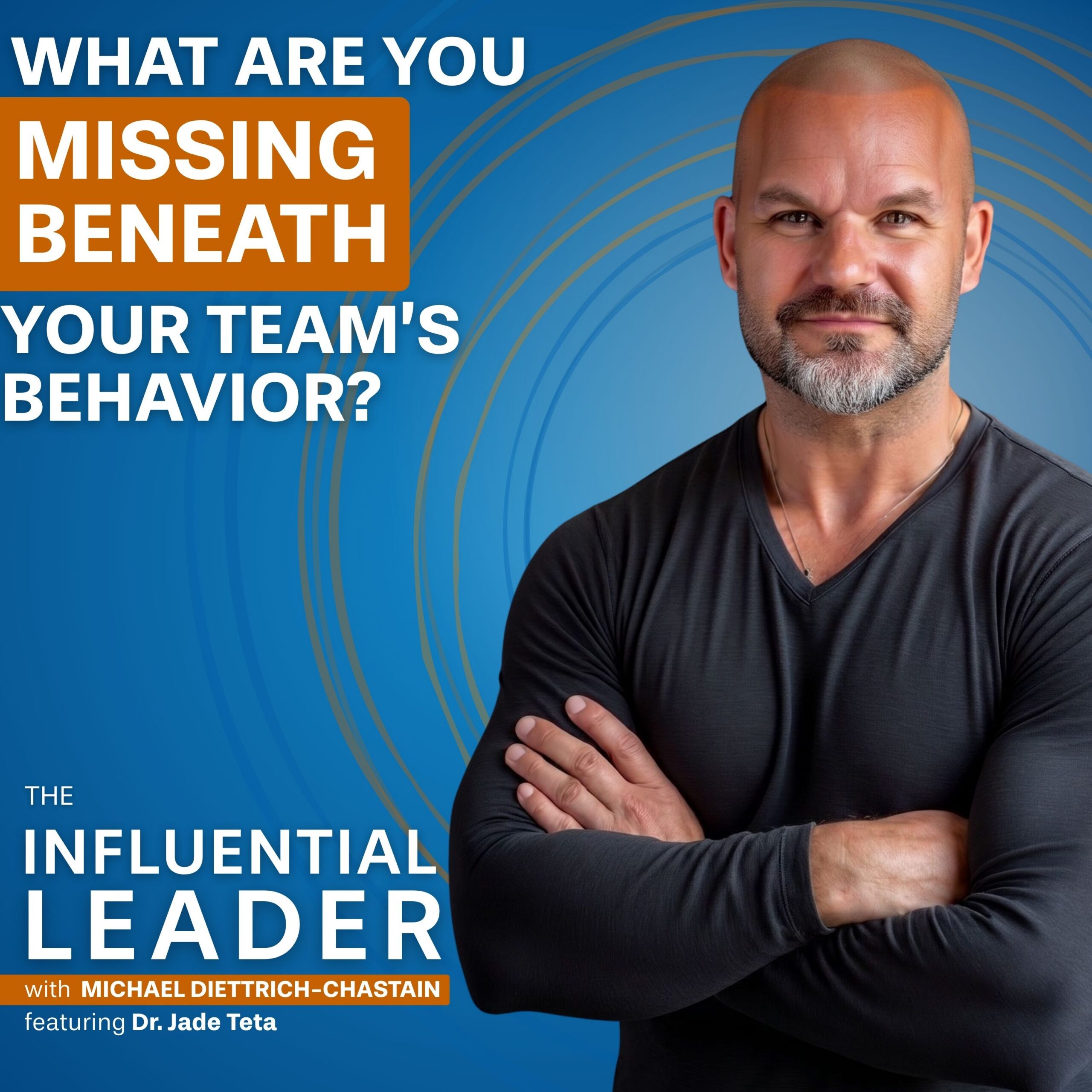
Why does a behavior keep showing up even after coaching, training, and clear expectations? Dr. Jade Teta joins Michael Dietrich-Chastain to explore the stories and identities that may sit beneath what leaders see at work. He shares a three part approach to difficult conversations that begins with recognizing someone’s humanity, showing empathy, and asking a question that helps them speak honestly. Jade also explains why he puts connection before correction, how to care deeply while holding someone accountable, and what it means to believe in a person without taking responsibility for their choices. Later, he describes using AI to challenge his ideas and spot his own patterns. The conversation gives leaders a way to look more closely at what is driving behavior before deciding what to do next.
Chapters:
- (00:00:00) – Dr. Jade Teta on Identity, Leadership, and Essentia
- (00:10:37) – Unconscious Patterns and the Identity Beneath Behavior
- (00:21:25) – Three Rules for Difficult Employee Conversations
- (00:31:37) – Connection Through Service and Leading Through Struggle
- (00:42:33) – Extreme Ownership and Three Responses to Suffering
- (00:52:24) – Fulfillment, Purpose, and Movement Beyond Mission Statements
- (01:03:23) – Rewrite, Rewire, Retrain: Changing Identity and Behavior
- (01:09:08) – The Morpheus Effect and Confident Detachment
- (01:17:43) – How to Use AI to Think With You, Not for You
- (01:27:59) – The Story You Live and the Story Your Team Follows
Quotable Moments
- “I am more interested in connection first and accuracy later.”
- “Self awareness is the true measure of maturity.”
- “If the identity does not match the behavior, then you’re not gonna be able to change and you’re not going to get anyone to change.”
- “I am more interested in connection first and accuracy later.”
- “Treat people according to their best selves.”
- “What is the story I am telling about this that is keeping me stuck?”
About the Guest
Dr. Jade Teta is a clinician, coach, and educator with more than 30 years of experience in integrative health and behavior change. He’s the founder of Next Level Human, a coaching and philosophy platform built around understanding the unconscious patterns that shape how we live. His work blends clinical science, psychology, and philosophy into practical frameworks for personal transformation. He’s the author of nine books and is currently completing a PhD in Transpersonal Psychology. At the heart of his work is a single conviction: each of us has unique work that only we can do, in the way only we can do it.
Links and Resources:
- Johari Window
- Internal Family Systems (IFS)
- The Charisma Myth
- Rewrite, Rewire, Retrain
- Pygmalion Effect
- Golem Effect Research
- Wispr Flow
- Next Level Human
- Dr. Jade Teta on Substack
- Dr. Jade Teta
- Arc Integrated Website
- Strategy Call Page
- Podcast Page
- Michael Diettrich-Chastain in Linkedin
- Michael Diettrich-Chastain in Instagram
- Michael Diettrich-Chastain in Facebook
- Arc Integrated in Linkedin
Transcript
Click here to show transcript
Dr. Jade: [00:00:00] I am more interested in connection first and accuracy later. Mm. I would even say, and this is controversial, but I’d even say I don’t need to be the smartest person in the room. I’d rather just connect with this person. I don’t need to be the most fit person in the room. I’d rather just connect with this person.
Dr. Jade: Yeah. I don’t need to be the most powerful person in the room. I would rather just connect with this person.
Michael: Today on The Influential Leader Podcast, I got to sit down with my friend Dr. Jade Teta, and every time I’ve sat down with him, uh, I always learn something. This podcast was no exception. Uh, we spoke for quite a while.
Michael: This is a longer episode. I took a ton of notes, and Dr. Jade is one of these guys that just has so much experience and research and data he can point to. He’s very scientifically oriented. Um, and, uh, we also take a deep dive into a lot of other topics that may, may seem a little bit more esoteric but are also backed by a lot of research.
Michael: And so some of the topics we [00:01:00] cover are things like his three-rule process for influencing behavior change as a leader, why connection should be considered before accuracy with employees, why incentive structures fail sometimes, why happiness is not something to chase and what should we be chasing, the three identity choices we have and how that choice directs everything else in our life And then lastly, how to use AI to think with you, not for you, and the consequence of choosing otherwise.
Michael: We talk about all these things and many other, uh, many other topics. So, um, buckle up, take notes, grab a pen. Uh, lastly, special thanks to our partner Amplified Media,
Speaker 8: where this podcast was recorded. It’s a studio inside Asheville, North Carolina, so many thanks to them. And with that, please enjoy this episode with Dr. Jade Teta. Welcome to The Influential Leader Podcast. I’m your host, Michael Dietrich Chastain, and today I have my friend Jade, Dr. Jade Teta with us, who is a clinician, a coach, [00:02:00] an educator.
Speaker 8: He has more than 30 years of experience in integrative health and behavior change, which we’re gonna talk a lot about. He’s the founder of Next Level Human, a coaching and philosophy platform built around understanding the unconscious patterns that shape how we live. His work blends clinical science, psychology, philosophy into practical frameworks for personal transformation
Michael: He’s the author of nine books and is currently completing a PhD in transpersonal psychology.
Michael: At the heart of his work is a single conviction: Each of us has a unique work that only we can do in the way only we can do it. Jade, welcome to the show, my friend.
Dr. Jade: Michael, it’s good to see you, man. Happy to be here.
Michael: Yeah, man. You too. You too. I wanna actually take a step from your bio and ask you a question.
Dr. Jade: Yeah.
Michael: This last sentence, “The unique work that only we can do in the way only we can do it.” Yeah. Tell us more about what you mean by that.
Dr. Jade: You know, there’s this interesting thing in culture, right? Uh, people say, you know, “You’re special,” right? I don’t believe [00:03:00] anyone’s special, but what we are is unique. Mm.
Dr. Jade: And because we’re unique… Like, there’s never been another Michael in the history of mankind. There never will be again.
Dr. Jade: There’s never been another Jade. There never will be again. And that uniqueness doesn’t make us special, but it does allow us to do something special, right? Mm. Like, you have your essential nature, and you have your earned wisdom, and then you have your ability, your free will, to point all of that experience in a particular direction, which means you and I could be teaching the exact same thing, maybe even using the exact same words, but some people are just gonna resonate with Michael and not Jade.
Dr. Jade: So that’s what I mean by there’s work that only you can do- Mm … in only the way that you can do it. There’s a audience for you that is not gonna be for me, even when we’re teaching the exact same thing. Yeah. And I, and I love that idea ’cause it means we all have, uh, a role to play. I also think- Culture kind of gets in the way of this for us because it tries to box us in and says, “Hey, here’s the way [00:04:00] you do the thing.”
Michael: Hmm.
Dr. Jade: And I think that’s a problem. Yeah. So I think it, I think this, this idea frees us.
Michael: I love it. I love it. It’s, it’s almost, it sounds like the way you’re describing it is like a, an essence-
Dr. Jade: Mm-hmm …
Michael: or an energy, and I know we’re gonna take a deep dive into a number of those topics around, uh, essence and subconscious- Mm-hmm
Michael: and change around those things.
Dr. Jade: Well, you actually tapped into it right away- Yeah, yeah … ’cause I have a term I use when you say essence. Yeah. I call this essentia. Okay. Your essentia. Tell me. So it’s, A, your earned wisdom-
Michael: Uh-huh …
Dr. Jade: B, your essential nature, and then your purpose potential, your free will to point that in a direction.
Dr. Jade: I call that essentia, and I feel like the reason we need a term for that is because it’s kinda purpose but not really. Mm-hmm. It’s sort of meaning but not really.
Michael: Yeah.
Dr. Jade: We need a new term for that. So to me, your essentia is the, that three-part process that allows you to do the work that only you can do in the way that you can do it.
Michael: Okay. I love it. Well, I wanna come back to essentia. Before we do, curious to get to know [00:05:00] you a little bit more. Yeah. Um, and some of these que- we know each other a little bit, but some of these questions I’m, I’m definitely excited about ’cause h- I don’t know the answer to these. And for our listeners, we, you have a very impressive bio, and it continues to grow it sounds like.
Michael: You’re working on another PhD. It’s tr- tremendous. Yeah. But the question is, outside of your professional role and experience and accolades, what would be three things that you could tell us about who Jade is to get to know you as a human?
Dr. Jade: Yeah. Well, I think on the inside, I, uh, this might surprise people, but on the inside, we all have inside stories, right, that we grow up with.
Dr. Jade: On the inside, I’m kind of, I kind of operate from the dumb jock perspective. Okay. Right? Now, I know that might seem funny, but that’s my early story. Hmm. Right? Like, my, I had a older brother. He was the smart one. I had a second brother. He was the good-looking one. I had a sister. She was the kind, caring one, right?
Dr. Jade: Mm-hmm. And I think as humans, we look to find what our story is gonna be, so I gravitated towards athletics- Mm-hmm … and did not do very [00:06:00] well in school. And- Yeah … because that’s early programming for me, to be honest with you, that sticks with me. So despite the accolades- Uh-huh … and despite the fact that a lot of people go, “Oh, Jade, you’re, you’ve done all these things,” I still on the inside kinda feel like a little bit of a dumb jock.
Dr. Jade: That’s the story that I come from. But it’s also interesting ’cause that’s the work that I do. The very first story that I deconstructed for myself- Mm … was the dumb jock-
Michael: Mm …
Dr. Jade: story.
Michael: Okay.
Dr. Jade: Okay. So, so that’s definitely one- So that’s
Michael: one
Dr. Jade: of them. Okay … that surprises, uh, people. Yeah. And you said what? What, it was three of them.
Dr. Jade: Three if,
Michael: if you have them, yeah.
Dr. Jade: I think the other one is, um, that for me, um, I definitely believe in… Like, if you meet me here and where you and I have met, it’s like I have a professorial side of me.
Michael: Definitely.
Dr. Jade: But I also have sort of the, the goofball side of me, right? Uh-huh. So the, the, the humorous side of me and the five-year-old humor side of me, and this gets into this conversation a little bit as well because I work on identities, right?
Dr. Jade: Yeah, yeah. That’s what I do with people. And so I do have [00:07:00] this sort of dumb jock identity, this professorial identity, but I also have this sort of goofy, you know, irreverent humor. Like in other words- Yeah … don’t hot mic me. You know what I mean? Sure, sure. Like, I, I would definitely get myself, uh, in trouble.
Dr. Jade: Yeah. That’s, that’s a- another thing. And then I think the final thing is probably what people would expect from someone like me, that above everything else, I am interested in growth. And, um- Hmm … and so for me, what that means is I’m deeply interested in people, because I do believe people are practice.
Michael: Hmm.
Dr. Jade: And, um, I love these kinda conversations. I think people, you know, really teach us the most, but I also am human, and so this back and forth of me and my convictions, but also wanting to learn from other people’s experiences. Yeah. And so that’s a big part of, you know, sort of who I am, perhaps the biggest part of who I am now.
Dr. Jade: Which is why- Hmm … you know, I’m going back to school. Uh, you know, because to me- Yeah … it’s all about, uh, growth.
Michael: Yeah, yeah. I wanna ask you a question about how you got into choosing a transpersonal psychology degree. Hmm. But before, before that, you [00:08:00] mentioned family as your first thing- Mm … and that’s a great segue to this next question.
Michael: And as a tee up to this question, one of the things we do that, that you know on this show is we… You identify a handful of people we can go out and survey to basi- Yeah, I
Dr. Jade: forgot about
Michael: this. To basically get to know you a little bit and bring in some interesting and, and I think fun questions. Hmm. And so one of the pieces of feedback we got from someone that we surveyed was t- was a request to ask you about something.
Michael: And the request is, “Ask him about his father, the koala, and mother, the crow.” So I don’t know what that means, but I’m excited to hear about it. Uh,
Dr. Jade: yeah. So th- well, this is the, this is the childish humor in me. Yeah, yeah. So I have this game that I play with everybody wi- that I basically can look at you and go, “I know what animal you’re descended from.”
Dr. Jade: Right?
Michael: Okay.
Dr. Jade: And it, it started with my father, who’s this little Italian hobbit-looking dude- … who has, you know, curly gray hair- Yeah … and a big gray bushy beard. And he looks- Okay … and he’s got these brown, adorable brown eyes. So, so to me, he looks exactly like a [00:09:00] koala. Okay. And my mother, my dad loves birds.
Dr. Jade: Okay. And my mom has, like, this sort of… She’s like a crow, like, this sort of regal stance- … and, like, kind of always looking around and checking things out and- Yeah … yelling from her perch, and just a- Oh, I love it … I, it was a joke in our family that I called them the koala and crow. So now when a lot of people meet me, they’re just like- Yeah
Dr. Jade: “Tell me what animal clan that, that I am.” Yeah, yeah. You know? And I’m always like, “I can’t.” I, ’cause I wrote this in one of my books, and I’m like, “I can’t do that unless I get to know your essence.” But-
Michael: Yeah
Dr. Jade: Yeah, but that gives you a little bit about how I am. That’s funny. And, and honestly, it’s funny ’cause it does go into psychology and what you and I are interested in.
Dr. Jade: Yeah, yeah. ‘Cause it, ’cause it is kind of a, it’s, it’s a way of a personality-
Michael: Absolutely …
Dr. Jade: test, right?
Michael: Absolutely, right. Yeah. All, all, you know, all these different tests often put you in the context of some kinda avatar, right? Yeah. Uh, uh, you know, an icon of, of a model, an animal. Yeah. So yeah, no, that resonates.
Michael: That’s funny. And if you
Dr. Jade: play this game with people, you have to like, you gotta be like, “Look, you c- you can’t be offended by this because- Right, right … almost all humans are like rodents and birds. Yeah. They all look like rodents and birds. [00:10:00] So if you can’t… You play this game, people are gonna get offended for sure.
Michael: Yeah, yeah. It reminds me of, I’m sure everybody that’s listened has seen this too, the, like the memes about people that look just like their dogs. Yeah, 100%. That’s, that’s uncanny sometimes. Yeah, 100%. Oh, that’s funny. Well, so going, going in the… And, and I love, one of the notes I took as I was listening to you, Jade, is the, the goofy professor-
Michael: as, as your second thing that is about your, you know- … who are you as a human. And that’s been my experience of you, man. Yeah. Like, you’re super fun to hang out with. Sure. And, and I’ve really enjoyed our visits, and you have this intense intellect and ability to communicate and, and talk about really deep ideas, and I’m excited to jump into that.
Michael: So as a, as a segue into the depth, you know, you talk a lot about the subconscious and the conscious mind. So as a starting point, you know, this show is, is about leadership, right? Yeah. It’s for leaders that wanna create behavior change and those that are leading. And we’re gonna translate some of this into why it’s applicable for them.
Michael: But as a starting point, walk us through w- how do you differentiate the conscious and the subconscious?
Dr. Jade: Yeah. [00:11:00] Well, there’s things that we’re aware of that we do.
Michael: Yeah.
Dr. Jade: And there’s things that we’re unaware of- Mm-hmm … that we do.
Michael: Yeah.
Dr. Jade: And part of the curse of being a human is that as I become close friends with Michael- Yeah
Dr. Jade: I can see a lot of his stuff that he can’t see.
Michael: Yeah, yeah.
Dr. Jade: And he can see a lot of my stuff that I can’t see.
Michael: Mm-hmm.
Dr. Jade: And this is the thing, and so when I think consciousness and unconscious, people think of Carl Jung, and they think of dreaming, and they think of all this stuff. I just go, there’s certain things that you are aware that you do.
Michael: Mm-hmm.
Dr. Jade: And then there’s things that you’re unaware. And to give you an example of this, it’s a, it’s a humorous example, but I’ll use this example. It’s like bad breath, right? Sure. Like, if, like if you have terrible breath as a human- Yeah … you are not gonna know. I mean, I know people go, “Oh, you can blow in your hand and do this.”
Dr. Jade: I don’t think that works. Yeah. How you’re gonna know is you haven’t been kissed in years. Mm-hmm. People are offering you gum all the time. Yeah. And people keep five feet distance from you. Sure. And here’s the problem. Those patterns are showing up in our lives all the time.
Michael: Mm.
Dr. Jade: And we are not aware of them.
Dr. Jade: So the only way we become aware of the [00:12:00] unconscious is the patterns that follow us around. The problem with us humans is what do we typically do? Oh. Oh, that’s them. Of course. They’re the ones with the bad breath. Yeah. Or they’re the ones that have the problem. But I just go, look, if it’s happening to you-
Michael: Mm-hmm
Dr. Jade: again and again, if you’re the one that has the repeated patterns, the recurrent obstacles, the stuck emotions-
Michael: Yeah …
Dr. Jade: then it’s you. Yeah. Then you are the one with bad breath. Right. And to me, this is where it starts because to me, self-awareness is the true measure of maturity. This is how we move out of the conditioning phases of our lives- Mm
Dr. Jade: into the awakened phase of a mature human who can actually lead, who can actually create. To me, it’s about awareness. So it doesn’t have to be this esoteric- Mm … unconscious versus conscious. It’s just that are you aware of your patterns?
Michael: Yeah.
Dr. Jade: Or are they haunting you? Yeah. Like a little, like a little computer virus.
Dr. Jade: And I think that for most of us, they are haunting us. Mm-hmm. And this is where developmental psychology comes in.
Michael: Absolutely. Absolutely. Yeah, agreed, agreed. It [00:13:00] reminds me of, there’s a model called the Johari window. Are you familiar with that?
Dr. Jade: Mm. Remind me. It’s- I’ve heard that term.
Michael: It’s, it’s, it’s similar…
Michael: It re- what, how you just, just made that description reminds me of it, ’cause it’s these, it’s a four-quadrant model- Mm … and it’s about, you know, the things that you can see that I can see, the things that you can see that I can’t see, right? Mm. Like bad breath, right? Mm. The things that I can’t see and you can’t see, right?
Michael: Mm. So it’s this matrix of different, uh, ways of, of really bringing to light the fact that we aren’t aware of all things at all times, because others- Yes … are, you know, they have, they have observations to give us. But what I hear you saying that’s different than that, of course, is that sometimes these subconscious elements, you know, they, they can’t be…
Michael: Or you correct me if I’m wrong. They can’t be revealed simply through feedback from others, which is kind of a bridge to the next question. Like, how do we move from subconscious to conscious?
Dr. Jade: Yeah. Yeah, I, I actually agree with you 100%. Mm-hmm. Um, they’re very difficult to get to through behaviors alone. And by the way, this is why, and this is my, [00:14:00] uh, pet peeve where I might get in trouble for this, but to me, I think the entire, let’s call it the coaching industry- Sure
Dr. Jade: let’s call it the leadership industry- Yeah … what we do is we focus on behaviors. Mm-hmm. And we focus on, um, information, right? So in my mind, there’s been three waves of this world of leadership and coaching. Mm. The first wave is like, “Hey, here’s some information.” Yeah. Like, take what this person did. They’ve written a book on it.
Dr. Jade: Read it. Now you’ve got the information, you should be able to change, right? Mm. The next piece is behavior. Hey, here’s the things they did. Just copy what they did or, and I’ll keep you accountable, and that’s gonna make a difference. The problem is that misses what’s underneath. And what’s- Mm-hmm … underneath information and behavior, the reason why those don’t transform us, is that underneath that is identity.
Dr. Jade: Mm. And if the identity does not match the behavior then you’re not gonna be able to change and you’re not gonna get anyone to change. And just to give you a simple idea from my old world in health and fitness- Yeah … if I [00:15:00] have somebody who’s struggling to, you know, let’s say change their nighttime binge eating- Mm
Dr. Jade: right? And I tell them, “Hey, look, that’s not healthy for you and that’s gonna cause heart disease, and we have all these stats, and why don’t you try, you know, every night, uh, you know, uh, before you go to bed, making a salad and grilling some chicken breast so tomorrow when you come home, you can eat those things?”
Michael: There you go.
Dr. Jade: The problem is this person sees food not as fuel and not as a longevity tactic, they see it as love- Mm … and connection. Their identity is attached to food as love and connection and relaxation from stress. Mm-hmm. So no amount of behavior change and no amount of tools and tips and tricks- Yeah
Dr. Jade: and no amount of information and books is gonna change that. And I would argue coaches and leaders do not get trained in how to do that. They’re- Definitely … they, they kind of throw up their arms and just go, “I… That makes sense- Mm-hmm … but how [00:16:00] do we even begin to do that?”
Michael: Yeah. Yeah. W- what it, what comes to mind for me, I think about, you know, we’ve worked with thousands of leaders at this point from all sorts of industries and, and sizes of companies, and very often there are times in which, you know, we’ll get, we’ll get approached about a particular employee, and that employee has had all sorts of interventions been done.
Michael: You know, they’ve, maybe they’ve tried coaching, they’ve tried training, they’ve tried holding, you know, accountability really strongly and, and it just doesn’t seem to move the needle. And so it makes me, makes me wonder, you know, about is this, in those particular situations, is it the identity piece that’s, that’s the real challenge?
Michael: And, and I’m gonna put, I’m gonna put a hat on for a minute and, and I’m thinking about our clients right now- Mm … right? I’m gonna put the h- I’m gonna put the kind of, uh, what’s, what’s the, what’s the word? Like, the, the skeptical hat on, right? So I’m a leader. I’m leading a team of 12, right? I’ve got a company that’s, you know, 1,500 employees.
Michael: I’ve got a bunch of other l- my team’s leading other people. [00:17:00] So big, big responsibilities. I need some behaviors to shift in the teams that I’m in charge of. I don’t, you know, me, Michael, doesn’t agree, does, does absolutely agree with you about this identity thing, but I can hear the voices of these leaders saying like, “I don’t have time to do this all c- this kind of work.”
Michael: And to your point, Jade, I don’t know how to do the work ’cause I’m not trained in identity change. You know, I can talk about behavior change. So what, what would you say to them? What tips or strategies or support might you suggest?
Dr. Jade: Yeah. Well, let me tell you a story first. We all- Yeah … have you ever been on an airplane and you see the guy who doesn’t get his right seat and is, has the wrong ticket- Oh, yeah.
Dr. Jade: and throws, throws a fit- Oh, yeah … in the, in the middle of the airport?
Michael: Totally. Yep.
Dr. Jade: What we think is we go, “This guy’s an asshole,” right? Yeah. That’s what we think. Yeah. What I think when I see that guy is I go, “He’s a four-year-old.”
Michael: Yeah.
Dr. Jade: Okay? Right. And once you do that as a leader- Mm … when you can go, “Okay, I’m not operating…
Dr. Jade: This, this person in my team is not operating from their [00:18:00] professional self.” Mm. “They’re operating from their seven-year-old identity now,” because they did not get the accolades, or they did not get the recognition, or I don’t know, they didn’t eat lunch or whatever it is, but it’s just basically to go, “They’re not in the identity needed to move the team forward.”
Dr. Jade: So that first recognition to be like, “This guy who’s throwing this temper tantrum- Yeah … is actually a five-year-old.” Mm. And, and here’s the thing. I wouldn’t expect the leader to understand that, but as soon as I say it, people start going, “Okay, I can understand they switched modes somehow.” Yeah, yeah. What, what is happening there?
Dr. Jade: If we understand how humans develop, what we see is that literally like a tattoo on your nervous system. Yeah. You literally are seared in different historical parts of yourself.
Michael: Mm.
Dr. Jade: Right? And so there is a Michael who can switch into a five-year-old. Oh yeah, there sure is. There’s a Jay who can switch into a 15-year-old.
Dr. Jade: Sure. There’s a, there, there’s a Jay that can switch into his 20-year-old self. Yeah. We as [00:19:00] leaders need to understand what identity are these people reacting to- Mm … and why. And once I understand those incentives, I can essentially say, “Okay, now that I see that I’m not dealing with my professional manager, they’re not in the managerial identity right now.”
Dr. Jade: Yeah. “They’re in a, a different identity. Why?” Mm. “And how do I get them back into this identity?” Okay. And, and what’s really interesting about this, this is very well worked out in a field. Yeah, yeah. It’s the field of psychotherapy- Sure … and child development.
Michael: Yeah,
Dr. Jade: absolutely. Um, if you’ve heard of parts work- Yeah
Dr. Jade: if you’ve heard, heard of internal family systems in some of these systems, this stuff is very well worked out and is used in therapy. Yeah. But we don’t need to make it therapeutic. It’s, there’s- Yeah … actually a way of just basically going, “Hey, now I need to speak to this identity.” And a good leader will be able to do that instead of saying, “Hey, you need to jump back into your managerial identity, and I need you to do that now.”
Dr. Jade: Mm. A good leader is gonna go, “What is, what is going on with them that they keep flipping [00:20:00] into this particular identity- Mm … all of the time? And how do I speak to that identity and get it integrated with more of their professional identity?” Yeah. And, and really all it is is good communication skills and good observational skills.
Michael: Mm-hmm.
Dr. Jade: Once we see that, that this person’s operating from a story that’s different than the one we need them to be operating from, it changes the dynamic. ‘Cause otherwise we just go, we just throw up our arms, we just go, “They’re They’re just a problem. They can’t do what we need them to do. Yeah. Instead we go, “Oh, I get it.
Dr. Jade: They’re switching into a different identity.” We just talked about me, right? Yeah. And I said, “Look, I’ve got my professional identity, I’ve got my dumb jock identity, I’ve got my goofy humor, irreverent identity, I’ve got my professorial identity.” We have all these different identities that we switch in and out of.
Dr. Jade: Mm. If you and I go after this podcast and we go to a nice bar, cocktail, party-
Yeah …
Dr. Jade: we’re gonna dress a certain way, we’re gonna talk- Yeah … a certain way, we’re gonna drink certain drinks. If we instead go to a toga party- … we’re gonna be behaving completely different. [00:21:00] Sure. Two different identities. Leaders need to understand- Mm
Dr. Jade: that individuals don’t come to work with that managerial identity all the time, and it’s up to us, the leaders, to go, “Okay, now, through incentive structures, through other things, through me inspiring and getting you on board and- Mm-hmm … getting you involved with the movement, I can adjust you back into the right identity.”
Dr. Jade: Yeah. And I do think that’s on us-
Michael: Yeah …
Dr. Jade: as leaders.
Michael: Yeah. I love it. I’m, I’m taking notes as we go. I think that the, the phases, and you didn’t use this language, but I’m thinking about, you know, I’m thinking about our listeners and trying to frame this up. So, you know, the opening that you mentioned of persons having a, some kind of drama, right?
Michael: They’re having a, an mel- meltdown of some sort, and they’re, they’re embodying their four-year-old identity. Like, what I heard you say in that is first it’s about observing the fact that identities can shift. Mm-hmm. And then maybe the, the benefit of that is that it builds empathy- Mm-hmm … in the leader’s stance perhaps, and that maybe through that empathy it would allow them, the leader, [00:22:00] to ask this employee various questions about- Mm
Michael: you know, what’s, what’s truly going on, can you… And I don’t know, I’m curious here about, about this, would you suggest that they, that they use language like, you know, “Hey, I, you know, I need you to shift back to your professional identity,” or is it more like, “Hey, you know, seems like something’s really bothering you right now and, you know, I wonder what you might need to shift back to being in a state of thinking strategically?”
Michael: Yeah. So is it… What, what would you suggest?
Dr. Jade: I’ll give you a three-part move here. Okay, okay. So the, the first one is the human rule.
Michael: So- Say it again.
Dr. Jade: The human rule. The human rule. Okay, yeah. And the human rule goes like this. The human rule goes like, “You know what, Michael? You’re just human. Everyone makes mistakes.”
Dr. Jade: Yeah. You know, “Everyone struggles with certain things.” Sure. Right? And it’s basically to say, “You’re not different,” right? Mm. So the way that might work is like, “Look, I see you’re having a tough time. I have a tough time. We all, we’re all dealing with… Like, we’re all stressed here.” Mm. Like, “It, it, it’s been pretty stressful.
Dr. Jade: I can see that.” Yeah. And, you know, “And, and that’s okay.” The next rule is the empathy rule. Mm. And the empathy rule goes, “And I can see [00:23:00] that this has been hard for you. Like, I get it. Like, you know, it’s, it’s been rough. Like, I-” I don’t know how you’re doing it, honestly- Yeah … with all the stuff going on at home and all this kind of stuff.
Dr. Jade: Yeah. And then the next move is the move that is called the Columbo Effect.
Michael: Okay.
Dr. Jade: So the Columbo move is the move… You ever see that, uh, the detective Columbo? It’s an old movie, right? Yeah, back in the day,
Michael: yeah.
Dr. Jade: So, so the detective Columbo, he’s a detective, and he’s kind of this bumbling, stumbling, you know, sort of person, but he’s super sharp underneath, but he makes the person who did the crime let their guard down because he’s like, “You know, I could be completely wrong here.
Dr. Jade: I could be completely off, but it seems like, you know, I don’t know, it seems like you got a little bit ruffled or maybe your ego got involved. Now, I could be completely wrong about this. I’m curious, what happened?”
Michael: Yeah.
Dr. Jade: Right? And what happens when you do the human rule- Mm … and the empathy rule and the Columbo Effect- That’s good
Dr. Jade: all in a row is the gatekeeper identity. Uh-huh. Because we have all these identities, but then we have the gatekeeper or the saving face identity that goes, “I’m not [00:24:00] gonna let you see what’s going on with me. I’m gonna…” It’s the ego that’s there. Mm-hmm. These three moves stand down the gatekeeper. That’s so good.
Dr. Jade: Now, all of a sudden, the identity that you actually want to talk to shows his face. Yeah. Because now it feels safe. And any leader can learn to do these. It’s literally- Mm-hmm … this three-part move. Human rule, empathy rule, Columbo Effect. Now the person speaks from that identity. Mm. Now what do you do with that?
Dr. Jade: Now you have a lot of information about what motivated them, what triggered them, and all of that kind of stuff. Yeah. And then you can make, you know, the intervention that you would need to make. But without that information, what are you gonna do? And without this understanding about this identity level switch that people make, you’re not gonna be able to reach that identity.
Dr. Jade: And by the way, it’s like psychological black ops, right? Yeah, yeah. They have no idea that you are doing this.
Michael: Of course. Of course. I love it. Yeah, for those listening, this is a really good section to save ’cause it’s a super actionable- Mm … [00:25:00] human rule, empathy rule, Columbo Effect. Love it. Yeah. Very good. Very good.
Michael: Yeah. Okay. Cool, man. Well, hey, let’s, uh, let’s move on to some more info from the folks that we s- that was, uh, quoted from one of the folks we surveyed is, “Jade has this ability to make complex issues dummy-proof.” Now, what you just did for us, that three rule, super actionable, tactical strategy, I think is a good example of taking something that is very complex, like identity shifting- Mm
Michael: and giving a real clear, like, “Here’s a way you can play with it.” Mm. So my question is, this, this ability to take complex, make it dummy-proof, how have you been able to harness that as a superpower?
Dr. Jade: You know, that is interesting and I appreciate that, that perspective on me. I, I, you know, so when you said it, I’m like, “Well, I think that’s ’cause that dumb jock.”
Dr. Jade: I really think the dumb jock comes through. Okay. Like, for me, I look at it like I need to make sense of this for myself, and I need to be able to [00:26:00] explain it to myself. And so because of that, I like to think in analogies, and I like to think- Mm … in metaphors, and I like to think in frameworks, and I oftentimes speak in alliteration so I can remember what I’m going to say.
Dr. Jade: Yeah. And so I think maybe just trying to make it make sense for me- Mm … um, because of the way my brain works, um, m- m- maybe that’s why people think it’s, it’s easy to do, because I feel like I can get easily confused by this material. Um, so I teach it to myself, and then I teach it to others. So that’s interesting.
Michael: It’s such a, it is such a superpower, man. Like, you know, st- I’m also a lifelong student- Mm … and, you know, studied really complex material, and it’s often taught in a complicated way. But to take it and make it digestible is, is a real, a real talent. And, um- Also, it’s kind of a segue to the next question. I think it’s also a way to connect with people.
Michael: Mm. I’m just thinking of this in real time, because I, oftentimes when having conversations about complicated ideas, [00:27:00] if they’re not being given in a way that’s digestible, it almost creates a wall. Mm. You know? And that wall could just be confusion, it could be judgment, it could be, you know, insecurity. That, you know, “I don’t get, I don’t get what Jade’s talking about, so I feel less than.”
Dr. Jade: Yeah.
Michael: And, um, so it’s a nice way to, to connect with folks. And w- again, one of the pieces of feedback we got from someone is that they said, “Every day, Jade has a way of making people feel seen and heard, even in the shortest interactions.” And I have felt this from you, uh, d- many times at this point. And so g- again, the question is, how have you been able to cultivate this…
Michael: I know, what I’ve, this is my own language, but I would call it a deep presence, and curious how you’ve been able to cultivate that.
Dr. Jade: You know, it’s easy when you… It, it’s, it’s in- interesting, not easy. It’s interesting when you hear people say things like that about you, ’cause I feel like, uh, maybe that’s true.
Dr. Jade: I w- I hope that’s true.
Michael: Sure.
Dr. Jade: Certainly, I don’t feel like it’s been true lately, as I’ve been, you know, in a pretty stressful place.
Michael: Sure.
Dr. Jade: But [00:28:00] I think it does go back to, like for me, uh, being, you know, my mother is someone who just really loves and adores people, and like- Mm … wants to connect. And so I think for me, uh, as I’ve matured, I no longer need to be the smartest person in the room, and I, I want to connect- Mm
Dr. Jade: with people. And there’s this interesting thing, um, that I find that I really adore about people. It’s the ones who just let other people have it, right? Mm. Like, there’s something that happens, like you and I are talking, and you’re, you know, let’s say, let’s say you’re talking to someone and you’re the expert, but they are talking about this thing that, that you’re the true expert in, but they’re talking about it passionately.
Dr. Jade: Sure. And you see, like, there’s a slight kind of mistake in there. Yep,
Michael: yep.
Dr. Jade: Right? And you just go, “I’m not gonna jump in there. I’m gonna let them have it ’cause I don’t wanna squash that passion.” And that’s something that if they’re passionate about, they’ll get that squared away at some point anyway. And so to me, I go, I am more interested in connection first [00:29:00] and accuracy later.
Dr. Jade: Mm. I would even say, and this is controversial, but I’d even say I’m interested in utility- Over truth as well. Because I feel like what is useful is what’s most true eventually. Mm. And truth is something that is difficult to put your hands on anyway. And so to me, maybe that’s what it is. I want to connect with people.
Dr. Jade: And, and- Yeah … that makes me just go, “I don’t need to be the smartest person in the room. I’d rather just connect with this person. I don’t need to be the most fit person in the room. I’d rather just connect with this person.” Yeah. “I don’t need to be the most powerful person in the room. I would rather just connect with this person.”
Dr. Jade: And I think it’s, isn’t it interesting when we meet people, you’ll see really quickly- Yeah … who’s trying to peacock and who’s- Mm-hmm … trying to posture and who’s trying to be the most popular versus who’s the most present.
Michael: Yeah.
Dr. Jade: And I would hope… I’m working on that. That’s really sweet that they say that, but I am- Yeah
Dr. Jade: I am working on that as a human.
Michael: Yeah. Well, it’s, it’s interesting, you know. I think there’s a real paradox. I wonder if you agree with this, that ironically, you know, all the things you said, I was [00:30:00] taking notes, like letting other people have it, you know, no, no gotchas, right? Mm-hmm. Like, that’s such a great piece of wisdom.
Michael: Again, all this stuff is so relevant to leadership, you know? Letting, letting employees run with it and actually focusing on your relationship- Mm-hmm … over the accuracy perhaps is, is more beneficial. Connection first, accur- accuracy later. I love that. Th- this notion of, you know, wanting to be the smartest person in the room or the most powerful, whatever, it’s, it’s…
Michael: You might translate that, or in my mind, I translate it to wanting to have influence. Yeah. But, but it ironically, this presence we’re talking about- I think, and I think the people would agree, that that’s actually the superior path to influence, is this deep presence, ’cause people do not forget that. Mm-hmm.
Michael: Just like we heard from these folks we surveyed, you made a real, real impact just from being present.
Dr. Jade: Yeah, and if, and when you take presence and then add in, like, deep compassion- Hmm … I think it’s, um, is it Calbane who wrote the book Charisma Myth?
Michael: Oh,
Dr. Jade: I’m not sure. Uh, and the, the, she has a formula for charisma, which is power, presence, and warmth.
Michael: Oh, okay.
Dr. Jade: Right? And so it’s [00:31:00] really interesting ’cause you, you know, a lot of, a lot of men will fall for this, where they’re like, “It’s just power.”
Michael: Yeah,
Dr. Jade: yeah. Right? And a lot of women might be like, “It’s just warmth,” right? Mm-hmm. And it’s really combining these, you know, two things or these three things together, power, presence, and warmth, and, or the masculine, feminine, you know, dynamic.
Dr. Jade: Yeah. It’s the balance between the two. So I would like to think that I, um, am power, presence, and warmth. Although I had to, if I had to choose one-
Michael: Yeah …
Dr. Jade: it would be presence.
Michael: Yeah. Okay.
Dr. Jade: It would be presence.
Michael: I, I’m, I’m with you, man. I, I think it’s, it’s super powerful, and it’s just such a, it’s such like a breath of fresh air.
Michael: You know, not only is it, is it a powerful stance to have because it does create influence, but it also just, it, it creates a, you know, a connectivity, a respect, an appreciation, a, a lightness, you know, for others, and I think that’s a nice way to operate in the world. I wanna come back. You mentioned masculine, feminine.
Michael: There’s a question I wanna come back to with that, but there’s a longer quote I’d like to read, again, from folks we surveyed that is, [00:32:00] is very, very sweet, and it, it has to do with care for others. So it’s a good, good segue. So here, here it is. This person said, “I now have a business that is sustainable and that I’m proud of.
Michael: I can directly tie that to Jade’s mentorship and help. Jade is the center of the ripple for people I now help and serve. More generally, though, I witnessed Jade feeling down, so he went to an ATM, grabbed a few hundred dollars, walked around his town, and gave $20 bills away to random people.” And, you know, if they were, if they looked like they were having a, a bad day or a string of bad luck.
Michael: Such an awesome act of service that my question for you is how did you land on that kind of selfless act of service, and leaders, what, what might, might they learn from that approach?
Dr. Jade: It, it’s funny ’cause it was really a selfish act of service- Okay, okay. … at first, yeah, when you think about it. So I, I had just moved out to Los Angeles, just gone through a divorce, and of course I’m a student of psychology like you, and I was miserable, right?
Dr. Jade: Okay. Just, I was, you know, just miserable. And I was like, “You know what? Action. I’m just gonna [00:33:00] take action. I wanna connect. How can I connect?” Mm-hmm. So I went to the ATM, then I, you know, basically got a bunch of money out, I think it was like $200, then I went to an ExxonMobil station and had them change that, and then I walked around, you know, handing out money to homeless people and different- Yeah
Dr. Jade: people. And really it was just a way to, for me to connect- Mm … and hear people’s stories, and I heard crazy stories. Uh, you, you do that… And I did that all day. I was walking around Santa Monica, like literally all day long doing that. Oh, wow. And I was just… By the time I got back to my apartment in Santa Monica, the money was not the point.
Dr. Jade: It was the idea that, oh my God, like, we all are suffering.
Michael: Mm.
Dr. Jade: Like, all of us humans, like it’s- it’s like the, we, we suffer so much. Yeah. And like, you know, all these people and all these stories and all the wisdom that came out of the suffering. And so I think two things fell on me from that, is that one, I will never forget, and I still do this to this day, where when I’m feeling a particular way, I go out and try to look for somebody who I also think is feeling that way-
Michael: Mm
Dr. Jade: and try to solve that within them- Mm … [00:34:00] give them any lessons I have. And an example of this would be like when I was going through a breakup, right? I knew my, uh, my good friend was also going through a breakup, so I called him and checked on him.
Michael: Yeah.
Dr. Jade: Right? And checked on him again, and checked on him again.
Dr. Jade: That was for me-
Michael: Mm-hmm …
Dr. Jade: and him.
Michael: Sure.
Dr. Jade: Right? Sure. And so it was sort of selfish- Mm-hmm … but also serving at the same time. Yeah. And it actually helped me come up with a rule that I have in life now, where I go, “When I take actions, I want it to be useful for me and others simultaneously.” Mm. Like, to me, what is useful is useful for Jade and Michael simultaneously.
Dr. Jade: Yeah. It at least can’t hurt you-
Michael: Right …
Dr. Jade: but, and ideally it would be great if it’s useful for me, you, and everyone else.
Michael: Great.
Dr. Jade: And if we wanna get woo woo- … the universe. Sure, sure. But I do check my actions through this now. Yeah. I go, “What is, what is helpful for me?” That won’t be harmful to anyone else, but also will be useful to other people.
Dr. Jade: Mm-hmm. And I think this, that kind of experiment, and I, I know who, uh, I know who wrote that- Oh, [00:35:00] good. Okay … however, so I know who that was. Yeah, yeah. That’s cool. But that experiment was a real-life experiment in doing that. And by the way, when I work with people one-on-one, one of the things I’m famous for in my work is having them do stuff like this.
Dr. Jade: Yeah. Like, one of my favorite things I did with a, a, a high-performance CEO in Los Angeles is I had him go out on, uh… We built up to this, but the final, his final thing was to go and live on the street for two nights.
Michael: Oh, nice. Okay.
Dr. Jade: And he completely… Because this kind of action, it takes you completely out of who you think you are- Yeah
Dr. Jade: and completely can, um, deconstruct your identity so that you can build it back up. Great
Michael: exercise. Yeah.
Dr. Jade: And, and, and it just put him in a whole different perspective. So now imagine as a leader, when he goes back to his management team and his employees- Mm … the perspective that he had.
Michael: Yeah. I love it. I love it.
Michael: Well, and that’s, and part of the reason I wanted to highlight this, one, it’s just, it’s such a wonderful act. Mm. But two, I think there’s a, there’s a deep l- leadership lesson in here, and I, and I say that [00:36:00] because, you know, we often hear from, from clients all the time how to deal with either their own struggles, right?
Michael: Their struggles around, you know, a, a loss, a depression, a transition. Like, we all have them, right? We all have times where we’re, we’re in, we’re in the depth of pain. And then similarly, we get questions a lot about, what do we do when there is an employee that’s super stressed or anxious or depressed or whatever?
Michael: And, you know, not that, not that leaders should take on the role as psychologist or, or anything, but there are things that we can do or ask, and I think this is one of those things. Like, as a leader, we could say, “Hey,” you know, to this employee, “What have you done as an act of service or an act of connection to someone else?”
Dr. Jade: Yeah.
Michael: Because, uh, like, like your story says, and like so many stories like these, that is a path to feeling better, is connection and service. And so, yeah, man, it’s a, it’s a great story. Yeah.
Dr. Jade: And can I say this, Michael? I, you actually said, uh, you know, I know leaders, uh, are not psychologists.
Michael: Yeah,
Dr. Jade: yeah. And I’ll say something controversial here.
Dr. Jade: Yeah, yeah. I think, I think they should be.
Michael: Well,
Dr. Jade: yeah. Yeah. [00:37:00] You know? I think, I think a good leader should be a, a psychologist and care about psychology and be deep- Oh, yeah … into that, um, that work. And I’ll give you a two-part thing that I do with people who are going through suffering that I think, um, I think the research shows this is true, and I’ve found it to be an amazing thing to do.
Dr. Jade: Number one, get them to tell their authentic story of struggle. Mm. And even in teams, this becomes… It’s kind of one of the things I do in my programs is something called a conversation circle, and it comes out of the 12-step research.
Michael: Oh, yeah.
Dr. Jade: But if someone shares their authentic story of struggle, it changes that story in their mind.
Dr. Jade: And here’s how to run these classes if you ever wanna do this. I’ll, I’ll just give it to you. The, the trick that’s different than 12-step is at the end, say Okay, what can you give us if someone is just starting with this problem? What can you coach us of how to deal with this? Hmm. And it does two things, ’cause it teaches everyone in the room who [00:38:00] might have that problem coming or who are dealing with that problem, it solves it for them or gives them a place to go.
Dr. Jade: Mm-hmm. But it also pre-coaches the person without them knowing it. Yeah. So it puts them in problem-solving solutions. So that’s the first thing, get people to talk about their authentic story of struggle. Mm-hmm. Have them say it out loud in a room. Mm-hmm. The other thing is, is tell them to find someone who is struggling with the same thing and seek to soothe that person.
Dr. Jade: Hmm. In so doing, they are also healing themselves. Love it. And these are very easy things to do that a leader can do as, let’s say, the lead psychologist on the team. Yeah. That’s what I think a leader should do. Sure. And so to me, it’s like, “Hey, let’s make sure you have a place to tell this story-
Michael: Yeah …
Dr. Jade: and let’s make sure you have a place to share the lessons you’re learning and practice the lessons that you will learn.”
Dr. Jade: Because ultimately, every struggle that we go through, if we can’t make meaning out of it, it becomes a trauma or a drama.
Michael: Yeah. Yeah, yeah, yeah. No, I totally, totally agree, and it’s funny, it’s funny you say that. Like, [00:39:00] one of the things that I’ve heard a lot from our clients over the years is, you know, we’ll be having a coaching conversation and they’ll, they’ll kinda pause and they’ll be like, “You know, being a leader is kinda like being a psychologist.”
Michael: Or, or they’ll say, “Michael, you, you feel like I gotta be a psychologist to do this stuff well.” And, and I think you’re right, Jad, that, you know, to understand behavior change, which I think is ultimately what leaders are after, right? How do I influence the behavior of others? Gotta understand, you know, some of this stuff around conscious and unconscious.
Michael: Gotta understand emotional intelligence, communication practices, motivational issues. Like, these are all kinda tenets in psychology, and so I think, uh, I think you’re right. You know, thankfully I think it’s moving in that direction. Yeah. I think that, you know, leadership identity is changing from what it used to be years ago, and, and I think employees are also expecting more out of the workplace and expecting more from, from their leaders.
Michael: And I, I think that’s a good thing.
Dr. Jade: I’m curious, uh, uh, curious what you see, because, you know, there’s this idea of identity- Yeah … which is the work that I do.
Michael: Yeah,
Dr. Jade: yeah. We can call it identity coaching or we can call it belief coaching. Mm-hmm. [00:40:00] Do you feel, ’cause you’re more in this world than I am, do you feel that it- that is the work that’s being done, or do you feel they’re m- we’re moving in that direction?
Dr. Jade: Do you feel like that’s the direction it needs to be done? Mm. ‘Cause what I see, at least in the coaches that I teach, which is more in the realm of therapists and clinicians and- Yeah … health coaches, they’re not really schooled… Even the therapists, believe it or not, are not necessarily schooled the way they should be in identity-level change and memory reconsolidation and some of these things.
Dr. Jade: Yeah. But I’m curious, in the leadership space, do you feel like this is a, a gap, or do you feel like they’ve largely got this figured out?
Michael: No, no, definitely not figured out- Okay … at least in my experience. I, I can absolutely see it going in that direction. Yeah. But no, I would say, you know, right now it’s very much at the level of kind of behavior change.
Michael: Like-
Dr. Jade: Information- Yeah … behavior change, motivational accountability.
Michael: Yeah, whole… Accountability. Yeah. You know, and I think, you know, in my experience, there’s absolutely a place for that, like it, it can work. Mm. And I also, to your point, have s- have s- come up with many examples I can think of where that wasn’t enough.
Dr. Jade: Yeah.
Michael: You know, and that person is stuck. [00:41:00] And u- unfortunately, the result of that is often they, you know, that employee, I’ve, I’ve, you know, I’ve seen them quit, I’ve seen them get fired, I’ve seen them get demoted, et cetera, et cetera. And I think it’s… I could, I could point to what you’re describing as the culprit- Yeah
Michael: ultimately.
Dr. Jade: Interesting.
Michael: And yeah. And so I think, you know, I, I’m excited for the world of change to head in this direction more so. And I think with all the research that exists about how we change as human beings, you know, like you and I are agreeing on, leaders are gonna be required to ask more of themselves as far as understanding human change-making.
Dr. Jade: Yeah.
Michael: But one of the things I’m feeling grateful for now, and I hope listeners are too, is like you’re offering, again, like we said in the beginning, you’re offering a lot of really complicated concepts, but very easily digestible frameworks to action them.
Dr. Jade: Yes.
Michael: And I think that’s a great bridge to this stuff, so thank you for that.
Midroll
Speaker 3: You ever wondered what your leadership style really says about you? Are you leading in a way that drives engagement, builds trust, and maximizes your influence? [00:42:00] Well, we’ve got a resource for you. You can take our Leadership Influence Quiz, which is a quick three-minute assessment that gives you a personalized insight and roadmap and actionable strategies to improve your leadership effectiveness and ability to actually change behavior.
Speaker 3: The best part is that you’re gonna get immediate feedback with recommendations you can use right away to elevate your leadership game. Just go to leadershipinfluencepodcast.com to get your free report today
Dr. Jade: Yeah. I hope I’m, I hope that’s what I’m doing, so thank you for-
Michael: Yeah …
Dr. Jade: for saying it’s- Yeah … it’s, it’s seeping in.
Michael: Yeah, yeah, for sure. For sure. There’s, um, you know, there’s another… We’re talking a bit about paradox, so maybe this is a rough segue, but I wanna, I wanna get your perspectives on a two-part question about paradox.
Michael: And so, uh, here’s, here’s another quote from those that we surveyed, which I think you’ll like. Uh, the quote says, “I guess that’s what I would say about Jade. He’s a paradox. He’s a bald guy who squats 600 pounds, but also tells his male friends that he loves them and is [00:43:00] emo- very emotionally intelligent.” So, like I said, wonderful compliment, first of all.
Michael: And, um-
Dr. Jade: I wish I could still squat 600 pounds
Michael: Yeah. That’s, that’s, that’s impressive. So, so my question, and for, again, two-parter. Part one is how have you built, and this gets back to something you said earlier, how have you built the ability to embrace these qualities of masculine and feminine so effectively?
Dr. Jade: Yeah, I mean, I can’t take credit for that at all. I mean, we, we, sometimes we get lucky in life, and I got lucky with a, a mother and a father. Mm. A father who was a very strong masculine presence and, uh, loved me unconditionally and had my back financially. And, uh, a mother who loves everybody. Mm. You know?
Dr. Jade: So, you know, take this old school Italian man who’s like, “I got your back, and I got the family, and you’re safe here,” and take this hippie mom- … you know, who, like, loves everybody, and you kinda have a sense of what happened for me. And this does bring me back to that masculine, feminine- Yeah … archetypal dynamic.
Dr. Jade: Yeah. I feel like I [00:44:00] got modeled a very strong masculine presence, and I got modeled a very strong feminine presence. And I think the final piece to that is, um, just getting over my ego. And that part, uh- Mm … was the part that I was dragged kicking and screaming, you know? Um, and that’s just, like, getting beat down in life, going through a divorce, not getting into college at first.
Dr. Jade: You know, I got turned down from all my colleges. Mm. Almost failing out of high school. Um, you know, having fin- uh, financial failures and, uh, business collapses and, uh, health struggles. I’ve literally had a collapse in every single area that- Mm … the four jobs that we humans have to do, health and relationships, purpose and meaning, finance, and, um, career.
Dr. Jade: You know, this kind of thing. Yeah. And for me, that stuff gave me an opportunity to remake, um, myself.
Michael: Mm.
Dr. Jade: Uh, and I would say maybe i- if I could take credit for any [00:45:00] of that, maybe it’s the, the desire to grow. I don’t know where I got that, but I did go back and look at myself and go, “Am I the one with bad breath here?”
Dr. Jade: Mm. Like, am, am I the one? Yeah. Like, I haven’t been flossing and brushing my teeth. Like, I’m the, I’m the guy. I’m the problem. Sure. You know? It’s always landing on me, so I gotta do something about it. I think, I think it’s that. My mother, my father- Yeah … and then just having an extreme ownership principle in my- Mm
Dr. Jade: psyche. You know, we talk about essentia, your essential nature and your earned wisdom. I think there’s something in my essential nature that was like, “It’s on me. I’m gonna take responsibility.” Maybe my dad taught, taught me that.
Michael: Yeah.
Dr. Jade: But I think that might answer it.
Michael: Well, and yeah, you know, the, uh, for all of us, right, we’ve all had really intense challenges in various ways, ri- various life domains, and it is a choice, though, what you’re describing, right?
Michael: This extreme ownership. No matter what kind of background we had- You know, even the best background can be broken down by the pains of life, right? And then people choose not to take ownership over, and it’s a blame game, and [00:46:00] it’s a victim game. So I, I wonder, you know, this disposition of ownership, how… And I’m sure you do this in your work, like, how do you coach others, or what would you suggest to leaders listening around taking more ownership for all their stuff?
Michael: Like, uh, what, what, what thoughts come to mind?
Dr. Jade: Well, you know, I think, I think leaders want results, right? Yeah, yeah. And so to me, there’s three different ways to orient to this- Hmm … and only one of them gives you results. Yeah. The, the, the first way is the villain way, right? Yeah, yeah. The, the villain is the hurt person who hurts people-
Michael: Mm-hmm
Dr. Jade: and copes by, you know, seeking power and control, right? And we see a lot of those types.
Michael: Oh, yeah.
Dr. Jade: The, so that’s the hurt person who hurts others. And then there’s the, what I call the victim. We, we all know this one, the hurt person who overly identifies with their suffering, and therefore continues to hurt themselves.
Michael: Mm-hmm.
Dr. Jade: And the final one, I think, is the one that you’re talking about. This is the extreme ownership one. This is the victor- Mm-hmm … or the hero, and all that is, is the hurt person who helps people. And I’ll give you, you know, a, a, a little bit of [00:47:00] a, you know, a metaphor or proverb here. The way I like to talk about this when I’m teaching is I go, “You know, we all get a backpack filled with, of painful bricks.”
Dr. Jade: Mm. And, and here’s the thing that people think. They think, “When I get over my suffering, or I get over this divorce, or I get over this health thing, or I get over this financial collapse, I get to take the backpack off.” And I go, “No, you do not.” Yeah. This is just, you do not get to take the backpack off. No human gets to take the backpack off.
Dr. Jade: Yeah. That backpack is there- and you have to carry those bricks. It’s on you, whatever you have to deal with as a human. So now you have a choice of how to carry them. Yeah. Do you take them out and throw them at other people and smash them- Yeah … over other people’s heads? Do you take them out, set them on the ground, and sit there and whimper and whine, and be like, “Oh my God, look at these-“
Dr. Jade: look at the bricks in my backpack”? They’re
Michael: so heavy.
Dr. Jade: Or do you look in the backpack and go, “I have to carry these bricks anyway Maybe I can build something with these bricks. There you
Michael: go.
Dr. Jade: That’s the ownership principle. So I don’t think it’s like being the soldier just to be the soldier, right? Mm-hmm. Like I’m just gonna do the work, you know?
Dr. Jade: Mm-hmm. It’s basically going, I’ve been give, I’ve been given paints [00:48:00] and a canvas- Mm-hmm … and watercolor paints, and I can paint something, or I’ve been given clay and rocks, and I wanted the paints, but I’ve been given rocks and, and, and clay, so I have to sculpt something. It’s gon- Yeah … right? And it’s just understanding that, and then also, you know, coming up with, you know, just mottos and figuring stuff out.
Dr. Jade: Like, to me, I have a few that I, I use all the time. Fault is irrelevant. Mm. Doesn’t matter whose fault it is. Yeah. Right? Um, stop waiting for apologies, right? Yeah. Like, so I, you know, I’m human too, so when I get in these, these moments where I’m like, “They should apologize,” I’m like, “For what?” I, I don’t need…
Dr. Jade: They don’t need to apologize. I can forgive and move on by myself. Mm-hmm. And then whoever’s fault it is is irrelevant. It’s getting the stuff done. Yeah. And, you know, this is some of the stoic philosophy- Sure … some of the Daoist philosophy that- Yeah … I like to live. Yeah. But to me, I go, that I think is how I see ownership.
Dr. Jade: It’s like, what do I wanna build? Mm-hmm. You know what I love the most, Mike?
Michael: What’s
Dr. Jade: that? Here’s the thing that I just love the most. [00:49:00] Somebody who you know- Yeah … is going through the worst time.
Michael: Mm.
Dr. Jade: Right? You know they’re having a rough time.
Michael: Yeah, yeah.
Dr. Jade: And yet they show up, and they do not put that off on you.
Dr. Jade: Yeah.
Michael: Yeah.
Dr. Jade: They still show up the same way, and you’re like, “How are they doing it? They’re so amazing.” Mm. My mom recently has been dealing with a lot of blood pressure stuff, and, you know, s- I’m 52. She’s getting up in age. You know, we know we’re gonna lose our… You know, we’re gonna lose, uh, the people we love, and she’s in the hospital, and I’m watching her, and she’s suffering.
Dr. Jade: She’s not comfortable. Mm. Every person that comes into her room, “Thank you so much. You’re so beautiful. Oh my gosh, look at…” You know, and she’s turning this thing, and it’s helping her and helping them- Mm … at the same time versus I was at the hospital, and this, this, you know, man yelling and screaming. Now, by the way, no judgment.
Dr. Jade: Yeah. Like yelling and screaming at all the staff. No judgment there, but it is perhaps some people’s minds are going, so it’s not always- Sure … a choice. Sure. But there is a choice there. Yeah. What are you gonna do? Mm. Throw the bricks, cry over the bricks, or build with the bricks?
Michael: Yeah, it’s beautiful. It’s [00:50:00] so inspirational to see that kind of, uh, bravery.
Dr. Jade: Mm.
Michael: Right? Yeah. Yeah. It is. It’s, it’s really… And, and it’s, it’s interesting, so this notion of kinda showing up the same way regardless. This was another piece of feedback we got from, uh, from folks that we, we surveyed, so I’m gonna read another quote to you. Mm. This is very nice. It says, “I’ve seen Jad in public and in private.
Michael: He’s the same person. He lives in line with his values. He genuinely cares about his fellow human beings. He loves you in a way that you can feel it and will always be there for you So it’s awesome, man. It, it, it reminds me of… The question is, it reminds me of a challenge that I’ve seen in the business world, and I guess you’ve seen this too, and it’s, you know, it’s this idea that people wear all sorts of different hats and personas, right?
Michael: They might show up at the board meeting differently than at the conference or the bar afterwards or at, you know, their team meeting different. And I see a lot of that i- you know, again, identity, like identity sh- shifting and m- moving around in various workplace environments. So the question for you is: how do you cultivate this [00:51:00] consistent alignment, and what suggestions would you have for others that are wrestling with this kind of like, “What hat do I wear in what environment?
Michael: How can I just be myself?”
Dr. Jade: Yeah.
Michael: You know, and there, there’s obvious- you know, there’s boundaries around certain ways to show up, but, you know, I think that’s, that’s a lot of what leaders are looking for. Like, how do I just be myself- Mm … and cons- consistently across environments? Yeah. What would you say?
Dr. Jade: Well, to me, when someone shows up, there is an energy they bring, right?
Dr. Jade: There’s an experience that you kinda feel off them, and there’s an example they can set.
Michael: Mm.
Dr. Jade: And so to me, I go, “What is the energy, what is the example, and what is the experience that I want-” Okay … “to bring into a room?” And I look at that from the perspective of my deathbed, and I go- Mm … “At the end,” and I really do do this.
Dr. Jade: On my chest, I have tattooed memento mori- Oh, yeah … which is a stoic saying, says, “Remember death.”
Michael: Yeah, yeah.
Dr. Jade: Part of the reason for that is I, I love philosophy and I love the [00:52:00] thinking about what matters most to us humans. But I don’t think it’s happiness, by the way. Okay. I, I don’t think what we’re chasing is happiness.
Dr. Jade: I think what we’re chasing is fulfillment. I think we’re chasing the work that only we can do in the way that we can do it, and I think culture gets us off track ’cause they’re like, “Well, you know, you should do it like Steve Jobs did it,” or, “You should do it like so-and-so did,” or, “You should do it like Michael does it or Jade does it.”
Dr. Jade: Instead, I go, “You need to do it the exact way you do it. You have your essential nature, your earned wisdom, your free will. You have your paints- Mm … or your, or your clay or whatever it is you’re trying to build, and you have to build it that way.” Yeah. And then you sit down and you go, “What experience do I want people to have?
Dr. Jade: What energy do I want to bring? What example do I want to set?” Mm. “And at the end of my life, will I feel fulfilled?” Like to me, I go… And I’ve, I’ve done this. At one point, I was all about like look at my six-pack, walking around Santa Monica Beach being like, “You know, let me take my shirt off so I can look good.”
Dr. Jade: N- on my deathbed, am I gonna be like, “Oh my God, Jade, you had s- great [00:53:00] six-pack”?
Michael: Right,
Dr. Jade: right. Right? Yeah. Or i- you know, am I gonna be like, “Oh my God, man, I can’t believe I have millions of dollars in, in my bank account- Mm … and I have an amazing car”? Yeah, yeah. Right? Yeah. Like I’m gonna go, “How did I matter?”
Michael: Yeah.
Dr. Jade: “How did I make a difference? Did I do what I said I was gonna do? Did I set out to do something?”
Michael: Mm. “
Dr. Jade: Maybe I didn’t complete it, but did I set out to do something that matters for people?” Mm. “So that my ripples continue on in some way. And not legacy in the sense of, “Look what I built.” Yeah. Legacy in the sense of, “Look how I contributed to what other people can continue building.”
Michael: Yeah.
Dr. Jade: That, to me, is what a true leader is. And to me, I think too many leaders go, “What am I gonna build?” Mm. And, and I just go, “Honestly, you have a very limited time, Jade. You’re not here for long, and you never know when you’re gonna go. And so if you really wanna matter and make a difference, the only way that you truly do that is through other people.”
Dr. Jade: Like-
Michael: Right …
Dr. Jade: like literally me touching you and you touching me- Yeah … is what moves the world. It’s [00:54:00] not- Yeah … me just trying to be like, “Look at all the things I’ve accomplished.” And this would be my complaint about how incentive structures-
Michael: Mm …
Dr. Jade: influence us. Yeah. So from my perspective, the incentive structure of a business, like if you’re working in a business and it’s not a next level human business, how can you be a next level human?
Dr. Jade: And this is another thing I think next that, uh, leaders miss. They go, “Hey, here’s the mission statement.” Mm. And then they actually don’t show up and act as the next level embodiment of that. For sure. Yeah. That’s why I don’t like mission statements. I’d like- Mm-hmm … no, it’s a movement. Yeah. And a, and a movement means energy, and that energy comes from you.
Dr. Jade: A movement means the energy, the experience, the example. So then you go, if it’s, if you talk about movement statements instead of mission statements- Ah … you go, “Okay, now I’m going to- That’s good … move people forward. How do I move people? With my energy, not with my memo.”
Michael: Right. Right. I’m making a note about that movement state- movement statements versus mission statement.
Dr. Jade: I think so.
Michael: Yeah. I love that. Well, and I think, [00:55:00] um- Uh, there is… We, I was just talking to a friend, uh, who was on this podcast the other day, and we were talking about movement making. Mm-hmm. And how, you know, that’s, that naming, uh, is not often associated in the workplace culture world, but I think it’s absolutely appropriate, right?
Michael: ‘Cause that’s what leaders want, right? They wanna, they wanna have a movement behind them. They want people that’s gonna, that are gonna, you know, show up excited to be at work and, and be inspired and energized and- Yeah,
Dr. Jade: and let me give you an example of this, because I think, uh… I had a business, two, two business partners, um, metabolic.com.
Michael: Okay.
Dr. Jade: Hundred million dollar company. They built it. Wow. I was, uh, I was the architect of the program. Yeah. So I, I just wanna point that out- … ’cause I’ve, I’ve built million dollar companies, but not hundred million dollar companies. Hey,
Michael: that’s great.
Dr. Jade: But these two, uh, guys, Mark Stockman and Jeff Radice, sh- shout out to my boys.
Michael: Yeah.
Dr. Jade: That business ended up, uh, falling apart, right? Okay. And this is what happens, but they built a movement in that business. Everybody felt a part of this thing. Mm. And [00:56:00] they… We all still love each other, and watching the way that everything has happened after that, right? Mm. So this is the thing. Imagine your business collapses.
Dr. Jade: Yeah. Do you want all these people mad and fragmented and d- you know, disgruntled or this and that, or do you want them to go… That experience in that business, I could not be doing what I am doing now the way that I am doing it at the level that I am doing it without the love that I put in there and without- Yeah
Dr. Jade: the community and team that we built, and the movement continues. See what I mean? Yeah, absolutely. Such a mean movement lives after businesses, but if you’re just about, “This is the mission of the business-” Mm-hmm … then once again, you’re not worried about connecting with your people.
Michael: Yeah.
Dr. Jade: Right,
Michael: right.
Dr. Jade: Right?
Dr. Jade: You’re asking them to connect to this inanimate thing, and that’s not what motivates us.
Michael: Yeah, absolutely. Well, and it, and it is, and again, I think that’s ultimately what leaders want. They wanna, they wanna feel a movement.
Dr. Jade: Yes.
Michael: Which is ultimately the, the biggest way to create engagement, right? A movement speaks [00:57:00] to all people are engaged.
Michael: A mission and vision and values is a, is a maybe, you know?
Dr. Jade: Well, yeah, and, and if that’s the case, then it’s about community and your people- Yeah. Right … versus, you know, versus the, the, uh… You know, of course, we have to make money and we have to do all those things. Yeah. But, like, I hear that if, if you want a movement, then you’ve gotta learn to get people to move their, them- themselves energetically, and you have to be the leader in doing that.
Dr. Jade: So when- Yeah … a good leader walks into the room, it’s just like what we talked about, that power, that presence, that warmth.
Michael: Yeah,
Dr. Jade: yeah. People go, “Whatever that is, I want I want to model myself- Mm … after that. I, I want to, I want to do that and fall in lockstep with that. It, it is an ener- it’s a resonance-
Michael: Yeah
Dr. Jade: is what it is.
Michael: Yeah, yeah. For sure, for sure. Well, we’re, we’re asking… I think we’re asking a l- we’re covering a lot of territory, asking a lot of- Yeah … of leaders, right, at th- at this point in, in this conversation, which I think is awesome. And it, it reminds me of this notion of kind of paradox. Like, right, we’re asking them to, you know, understand the ident- identity stuff, be the psychologist, be the leader, [00:58:00] hold people accountable.
Michael: You know, we’re asking a lot, and I think in this current time, that is generally what leaders are being asked of. They’re asked– They’re being asked to hold paradox. Complicated by the fact that there’s so much uncertainty with, you know, technology advancing in the way it is, culture moving the way it is.
Michael: Complicated by the fact that, you know, all, all the external factors that exist, economy and change moving rapidly, and the amount of, like, decis- di- uh, divisiveness that’s going on, right? Yeah. Polarized views about everything. It’s just an intense tension. So my… All that is a tee up to, to ask you, how, how would you recommend leaders tackle this notion of holding paradox or holding, you know, multiple truths at the same time?
Michael: What, what thoughts do you have there?
Dr. Jade: Yeah. I, I’ll give an, I’ll give an example of this that I just had this conversation and just posted some content on, and it comes up a lot in my work.
Michael: Mm-hmm.
Dr. Jade: And it’s the concept of I love you and fuck you. Right? Okay. It’s this, it’s this [00:59:00] idea that when lo- and let’s just do it on a personal level first.
Dr. Jade: Uh-huh. Okay? So you have a good friend, uh, or you have a spouse. Yeah. And they’re doing something that is absolutely just not okay with you, period. Yeah. And what we think is we go, “I have to go to battle, and I have to put aside-” Mm “… the part of me that loves them.” Right? Mm. And so we flip out of this place, but both are true.
Dr. Jade: You do love them, and you’re also like, “I will not tolerate this thing.”
Michael: Yeah.
Dr. Jade: And to me, leaders need to hold that concept, right? Yeah. They need to basically be like, “You’re not rising to the occasion, and I’m gonna tell you that-” Mm-hmm “… because we’re, we’re not playing games here, and I deeply am committed to you on a personal level.”
Michael: Mm-hmm.
Dr. Jade: And I don’t think it works any other way. So to me, if you have to ask yourself, “Am I committed to this person?”
Michael: Yeah. “
Dr. Jade: And am I committed to the work?” Yeah. Versus I’m not committed to any of these people, I’m just committed to the work, and anyone can slot in here.
Michael: Yeah.
Dr. Jade: And this is how I think a lot of, of, of leaders think becau- and, [01:00:00] and to me, I understand, but if you go, “Anyone can slot in here,” you may end up getting the same thing.
Dr. Jade: But imagine you have a difficult person here. Mm-hmm. And, and they are, uh, troublesome for the team, and they may have to go, by the way.
Michael: Sure, sure.
Dr. Jade: But Looking at it like they’re just a peg in a, in a round hole and I can put someone else in there without you going, “Am I really deeply invested in both simultaneously?”
Dr. Jade: Yeah. ‘Cause if I’m not, they can’t be. Right. And so I always ask myself, “Look, I’m gonna tell you straight to your face, I care deeply.” I think, uh, you know, the, again, one of the other human rules is treat… You know, there’s this whole idea of like treat people how you wanna be treated, the golden rule.
Michael: Right.
Dr. Jade: I think that’s completely wrong.
Dr. Jade: Yeah. Treat people according to their best selves.
Michael: Yeah,
Dr. Jade: yeah. This is the way you do that. So you go, “I know that this person can, you know, I’m gonna take them as far as they can go, and then if they can’t get there, I’m gonna tell them flat out, ‘You got to go.'” Mm-hmm. But you gotta hold both of these things.
Dr. Jade: And to me, the way you hold paradox-
Michael: Yeah …
Dr. Jade: right, is you just go [01:01:00] I can do that- Mm-hmm … and I can do this. Yeah, yeah. But as soon as you find yourself being like, “No, it’s only this,” to me, that is gonna cause problems with you down the line. Mm-hmm. And so it, it really is interesting. Sometimes when I do trainings, I have, uh, people, and I know you’ve probably done this and many people have done this before, but it’s take the different perspective, argue from that perspective.
Dr. Jade: Yeah. Right? Yeah. Now argue from… Zoom out a little bit more and argue from a third person, uh, perspective.
Michael: Mm-hmm.
Dr. Jade: Now argue from God perspective or- Yeah … universal perspective. And to me, that, this is how you deal with a paradox. You basically start going, “Can I think laterally-
Michael: Mm …
Dr. Jade: about these processes?” Yeah.
Dr. Jade: And a lot of people can’t. Like this cup, just in, you know, I know I’m probably talking to people who know lateral thinking, but like this cup, I have water in it.
Michael: Yeah.
Dr. Jade: I can also use it as a ho- a holder for a pen. I can flip it upside down and drum on it. I can put soil in it and plant something in it. [01:02:00] And the more you get good at sort of seeing something and going, “That could work this way”-
Michael: Yeah
Dr. Jade: the more you’re flexible in that lateral thinking, the better you get with paradox. Yep. In psychology, by the way, the more rigid somebody is, the less healthy their psychology and brain is. Yeah. And so this is really about the openness trait. Right. Right. And, and there’s a lot that you can do. Yeah. And openness is one of the major traits that can change- Yeah
Dr. Jade: in psychology. So to me- Yeah … openness is one of the big ones. Like, you literally could give your team a personality, the big five are now big six personality traits. Uh-huh. Look at openness, and there are things that we can do to change openness immediately-
Michael: Yeah …
Dr. Jade: in people. I, yeah. And, and a lot of people don’t know that.
Michael: Yeah. It’s, uh, it’s, I love that you’re bringing this up. I, I also believe that that particular trait is gonna be much more important in the next, you know, five years, 10 years, and beyond, right? Because we as a, as a species, right, are gonna be forced to deal with rapid change of unce- rapid, [01:03:00] uh, rapid change, but also increased uncertainty and chaos, right?
Michael: Mm-hmm. So if that’s the case, our, our rigidity is, it flies in the face of that. So our openness is the thing that will support our ability to manage that change. 100%. And so I think, yeah, I think of those six traits, that one’s gonna be critical.
Dr. Jade: Yeah. Openness and conscientiousness are two really big ones for me- Mm-hmm
Dr. Jade: when I look at, uh, good leaders.
Michael: Absolutely. Absolutely. Well, shifting gears a little bit, I wanna talk… There’s another f- uh, framework that you have that I wanted to bring up, and, um, it’s a- also about behavior change, of course. So rewrite, rewire, retrain. Um,
Michael: talk to us a- about that in any way you want. Oh,
Dr. Jade: I’m glad we’re, we’re bringing this up ’cause this is, this is my big pet peeve in- Okay … in my world.
Michael: Yeah,
Dr. Jade: yeah. Um, you know, and, you know, I’m leadership space adjacent, but most of my world is clinicians, counselors, and coaches. So we’re dealing with people who are…
Dr. Jade: They want deeply to change- Mm-hmm … on the level of money mindset, or on the level of relationship, or on the level of health and [01:04:00] fitness.
Michael: Yeah.
Dr. Jade: The problem with this is, is that most people come at this from the retrain perspective, right? So they go, “You need good quality information. You need behavior. You need to regulate your nervous system.”
Dr. Jade: It’s all physical stuff.
Michael: Okay.
Dr. Jade: We talked before about identity being where the magic is.
Michael: Mm-hmm.
Dr. Jade: Now, identity has essentially two parts, and I have to deconstruct this from everyone. Sure. There’s t- Each identity has a story that they believe and an emotion that fuses to that story. Mm-hmm. And, and to let you know how this happens, let’s just walk through this real quick.
Dr. Jade: Let- let’s imagine, you know, you have a newborn, right? Mm-hmm. So, your, your child begins to walk.
Michael: Yeah.
Dr. Jade: It’s just learning to walk, and runs out in front of you and falls and hits its knee.
Michael: Yeah.
Dr. Jade: And okay, now there’s… Child’s feeling pain. Mm-hmm. They’re feeling warmth on their leg. They reach down. There’s this sticky substance.
Dr. Jade: They see red. Mm-hmm. Right now it’s all just information. Yeah. The, “What is [01:05:00] going on here?” The child will normally look back at you and do what? “Am I okay?”
Michael: Sure,
Dr. Jade: sure. Now, what happens there is this… If you watch it, it happens fast, but a story is being written. Now, what happens with the, the parents? Maybe the parents- Yeah
Dr. Jade: start yelling and screaming at each other. “Who… Why’d you let them out of your sight?” Yeah. “This, this, and this.” Yeah. That writes a different story.
Michael: Yeah.
Dr. Jade: Now, that story combines with an emotion.
Michael: Yeah.
Dr. Jade: This is where the power happens. Think of the story as liquid cement and the emotion as rebar, steel rebar.
Dr. Jade: That’s good, yeah. And so when the cement and the rebar combine together, they form this belief structure. Mm-hmm. So story plus emotion creates a belief.
Michael: Yeah.
Dr. Jade: A set of beliefs create an identity.
Michael: Yeah.
Dr. Jade: A set of identities create a personality.
Michael: Mm-hmm.
Dr. Jade: And that personality, and this is where it gets magic, that personality creates a gating structure, because what we now know about the brain is the brain is not a controller.
Dr. Jade: The brain is a predictor and a responder. So it is a prediction machine, and it responds to predictions. [01:06:00] “I expect the world to go this way, and I know myself to be this way.” Hmm. That all comes from these stories and these emotional architectures.
Michael: Yeah, yeah.
Dr. Jade: So the retrain piece only deals with the after effects, the prediction that the brain makes.
Michael: Hmm.
Dr. Jade: So there’s three components to this thing, and we’ve only been dealing with one. So imagine you’re trying to solve a problem and help someone change, and you need 100% buy-in, but you’re only at 30% ’cause you’re dealing with retrain, which is behaviors, information, nervous system regulation. Meanwhile, you have not touched the story, you have not touched the emotion, you have not touched the beliefs, you have not touched the identity, and you’ve not touched the personality.
Michael: Right. Right.
Dr. Jade: So rewrite and rewire. Rewrite the story.
Michael: Hmm.
Dr. Jade: Rewire the emotion, decouple the mud and the rebar, and then what happens? The brain’s predictions begin to change, and the behaviors almost [01:07:00] always flow out of that. Hmm. And so from my perspective, what we have missed is we have decided, oh, it’s all retrain.
Dr. Jade: It’s all behavior. It’s all nervous system. It’s all brain stuff. Right. It’s all physical stuff. Mm-hmm. We have not understood how to rewrite people’s stories or rewire their emotional states. And by the way, neuroscience has shown and proven, like this is not, this is not Jade’s woo. Yeah, yeah. This is in the research that you can rewrite, rewrite and rewire, uh, emotional learnings.
Dr. Jade: Hmm. And when you do that, you automatically change the way the brain predicts things. So we were talking about openness.
Michael: Right, right.
Dr. Jade: Right? So imagine I take you in and I can rewrite and rewire an old story that you told. Mm-hmm. Maybe your pain in the ass attitude at work has nothing to do… And by the way, this is normally how, it has nothing to do with the boss.
Dr. Jade: It has nothing to do with the team. It has nothing to do with the work. Sure. It has to do with the fact that your wife cheated on you and left you.
Michael: Yeah, yeah.
Dr. Jade: Totally. And that story [01:08:00] architecture makes you feel Like you’re not worthy- Mm-hmm … on some level. Mm-hmm. And that’s familiar to you. And then you show up in work, and the prediction error is everyone sees me as not worthy, so then I have to have a coping mechanism of acting this particular way.
Dr. Jade: Yeah. And all of this is unconscious.
Michael: Yeah.
Dr. Jade: And so to me, when I do this work, I go, the frustration for me is I’m like, it’s sitting right here, everybody. We have the rewrite and rewire. We have the technologies to do this.
Michael: Yeah.
Dr. Jade: And yet we keep banging on the door of retrain, retrain, retrain. Mm-hmm. Now, does that mean that every once in a while it won’t seep in?
Dr. Jade: It, it does go both directions, right?
Michael: Sure.
Dr. Jade: Rewrite, rewire, retrain. It does go retrain, re- rewire, rewrite.
Michael: Okay.
Dr. Jade: But going back that other direction is very, very difficult to do. Yeah, yeah. Makes sense. So yes, someone could do the behaviors- Yeah … and act as if, and let’s just behavior change our way in it. It happens every once in a while.
Michael: Yep.
Dr. Jade: It happens much more easily when we combine these methods.
Michael: Makes sense. Yeah. The visual I- came to mind is like you’re swimming against [01:09:00] the water, right? 100%. Against upstream, right? So you can maybe get a little bit of direction, but it’s certainly easier to swim with the direction of the water, yeah.
Dr. Jade: 100%.
Michael: So o- one of the concepts that you talk about, Chade, is this Morpheus effect- Mm … which my understanding of that is, like, belief in others. Yeah. So I’m, I’m gonna tie this into what you’re talking about. Where does Or, or does it? The belief in others apply to what we were just talking about. Is that a, a steroid, right?
Michael: Mm-hmm. A ga- gas to pour on the fire? Ta- talk, talk to us about that.
Dr. Jade: Yeah. It’s kind of like, uh, you know, a, a good quality ankle brace for somebody who can’t get there yet and do the workouts. Okay. Okay. Right? So first you support them. But, um, in, in, uh… I call it the Morpheus Effect, but you also are very good with psychology, and some of you might know.
Dr. Jade: Mm. It’s in the research, it’s called the Pygmalion effect. Okay.
Michael: Okay?
Dr. Jade: Say,
Michael: say that again.
Dr. Jade: Pygmalion.
Michael: Pygmalion.
Dr. Jade: Pygmalion
Michael: effect. Oh, write this down. Okay. I actually don’t know that term.
Dr. Jade: Okay. O- okay. So the Pygmalion effect, I call it the Morpheus Effect because it’s more modern. So- Sounds
Michael: cooler …
Dr. Jade: anyone seen The Matrix?
Dr. Jade: You’ve seen The Matrix, right? Yeah, of [01:10:00] course. Of course. Yeah, yeah. We’ve all seen The Matrix.
Michael: Yeah,
Dr. Jade: love it. So in The Matrix, Neo, the main character, for those of you who haven’t seen it, I’ll just break it down for you real quick. Neo is the main character, and he’s basically the one. Yeah. He’s the savior of the world.
Dr. Jade: Yeah. Only problem is he doesn’t know it- Mm … and is completely unsure about it. Mm. So Morpheus is the figure who believes so strongly in Neo that he basically uses what I call the next level human rule, which is he sees Neo as the one. Yeah. And he sees Neo as the one so strongly that he starts dropping breadcrumbs for Neo to discover it himself.
Michael: Yeah.
Dr. Jade: And there comes a moment where Morpheus basically gives up his life ’cause he believes so strongly in Neo, which is what causes Neo to start believing in him- Mm … which is what triggers the whole thing off. And so for me, what I wanna be in my life, I don’t wanna be Neo. Yeah, yeah. I wanna be Morpheus.
Dr. Jade: Yeah. Yeah. I wanna be the, I wanna be the guy that believes so strongly in you-
Michael: Yeah …
Dr. Jade: that you completely change and go and change the world. Love it. That’s called the Pygmalion effect. Now, by the way, in research, there’s an opposite. It’s called the Golem [01:11:00] effect. Oh, in- And, and-
Michael: Oh, interesting …
Dr. Jade: and the Golem effect- Okay
Dr. Jade: is if you treat people like they can’t do it, like they suck, like they’re not worth much, they also are more likely to Rise to that Yeah To, to fall to that occasion. Yeah, yeah. So the Pygmalion effect, by the way, the original research on the Pygmalion effect was, you probably heard some of this research, but it’s basically like they took a group of students and they said, “This one’s gonna be the smart one, this one’s gonna be a smart one, and this one’s gonna be a smart one.”
Dr. Jade: Hmm. Of course, they were all the same. Right. No one took any tests. And then they told the teachers, “Hey, these three kids-
Michael: Yeah …
Dr. Jade: are special.”
Michael: Yeah, yeah.
Dr. Jade: Right? This work was done back in the 1960s, I believe. Uh-huh. “These three kids are special.” Then they looked at what happened to the, those three kids over the year.
Michael: Yeah, yeah.
Dr. Jade: And those three kids excelled. The only difference was that the researchers told the, the, gave the, those teachers the expectations that these were special kids. There was nothing special about them at all.
Michael: Mm-hmm.
Dr. Jade: The same thing goes backwards. If you have an expectation- Yeah … that someone is horrible- Yeah
Dr. Jade: and they’re no good, energetically you will behave and bring in a particular [01:12:00] energy, a particular experience, and a particular example to that person- Yeah … that will most likely cause them to be that way. By the way, think about this as radical ownership, ’cause now all of a sudden you’re not taking radical ownership for yourself.
Michael: Mm-hmm.
Dr. Jade: You’re taking radical ownership over the idea that this person that I lead, am I causing a Gollum effect on them- Yeah … or am I a Morpheus figure?
Michael: Oh, it’s such a, such a g- really, really applicable question you’re asking. ‘Cause I hear this all the time, particularly when it comes to kinda holding employees accountable.
Michael: Mm. It’s like, like, you know, how, how much should I believe in this person? ‘Cause they’ve, they’ve either shown me that, you know, they’re not stepping up to my expectations or dropping the ball consistently. It’s like, and I’m, and I, and I didn’t know this term, the Gollum effect, until just now. Mm. But I’m, I am certainly familiar with this idea- Mm
Michael: and I’ve seen it play out. So I, I always tell them, it’s like, “Well, if you’re gonna go into a position of having complete doubt in their ability, then you need to figure out another option because that’s gonna totally degradate the, the whole process.” I love that. You’re gonna degrade it. 100%. Right? And so, um, the, the [01:13:00] phrase that I often use is like, you know, the a- encouraging them to act with, you know, full expectation and encouragement around the success that this person can have While being neutral.
Michael: Yeah. And so I’m gonna ask you a question about this, ’cause I, I wonder, I wonder what you think about this approach. In my experience, the, the neutrality allows for the employee to kinda be the master of their own destiny, right? Yeah. Like, holding neutral that I believe in you fully, but ultimately you gotta make the decisions to, you know, achieve or not achieve.
Michael: Yeah. So my curiosity for you is that, is that a appropriate way to apply the Pygmalion effect?
Dr. Jade: Yeah.
Michael: Full belief, but held with a neutral energy?
Dr. Jade: Yes, I think so. I think… And it goes to the movement. Yeah. Like to me, in this particular case, I’d be like, “Look, I believe you can do it.”
Michael: Yeah.
Dr. Jade: But, and then here’s where the, you know, the I love you, I fuck you thing- Yeah, yeah
Dr. Jade: but here’s the part where I would go, “Do you believe it?” Because in the end-
Michael: Yeah …
Dr. Jade: I will, I will hold this, you know, I, I have to hold you accountable the same way I hold myself accountable. I believe you can do [01:14:00] this. Do you believe it?
Michael: Yeah.
Dr. Jade: You know? Yeah, yeah. This is good. And you’re gonna have to make that, that change, otherwise we’re gonna have to make a change.
Dr. Jade: So it’s not that you- Yeah … it’s not that you don’t get to say the realistic thing, but I like the, the term I would use is confident detachment, right? Oh, yeah, yeah. I am confident. That’s good. I am super confident- Confident detachment … that you can do this, and I’m gonna show you my confidence. But I’m also detached from the, the, the thing that you will do it.
Dr. Jade: Like, that’s on you. Yeah. That part’s on you. I’m not detached from you as a human.
Michael: Yeah.
Dr. Jade: I’m detached from you being the one, because this- Yeah … might not be the place for you.
Michael: That’s it.
Dr. Jade: This, you know That’s it … but I’m gonna believe in you, and even when I send you out the door, I’m gonna treat you that exact same way.
Dr. Jade: Yeah. I’m gonna be like, “I believe in you.” Yeah. “This is not the end for you, but in this particular case, you know, you, you weren’t able to make it work, and it’s okay, and, you know, love you to death.” Yeah. “And also, there’s consequences of not doing your work.”
Michael: That’s it.
Dr. Jade: But that’s sort of the way I look at it.
Dr. Jade: And to me, again, there’s, you don’t, you can love people while you’re sending them home.
Michael: Mm-hmm. Yeah, yeah. So good, so good. Confident [01:15:00] detachment. I wrote that down. That’s really, really powerful.
Dr. Jade: That one’s a good one for relationships, right? It sure is. Like, I, I do a lot of co- Sure … I do a lot of coaching with young men who are like- Uh-huh
Dr. Jade: you know, looking to have relationships. Yeah. And they’re like, “How do I approach this girl?” And I’m like, “Confident detachment.”
Michael: Yeah.
Dr. Jade: You basically show up, tell her exactly what you want, what you’re interested in, “Hey, I dig you.”
Michael: Yeah,
Dr. Jade: yeah. And then you detach completely from whether she calls you back, does anything, and there’s something sexy as hell about that.
Dr. Jade: Yeah. But it also works here, too. Really does. Confident detachment makes people rise to the occasion. They’re like, “Well, they believe in me, and you know, but they’re leaving it to me. They’re not gonna do the work for me.” Yeah. “They’re not gonna give me a free ride.” They’re, you know, it’s like, “I’m, hey, I believe in you.
Dr. Jade: You can do it, but I’m detached from the outcome.” Yeah. “If it’s not you, it will be someone else.”
Michael: Yeah, this is so good. I hope, I hope those that, y’all that are listening, you take, take this to practice, ’cause this is such a good tool. Awesome, man. Well, hey, uh, there is a question that we ask everybody, and I’m gonna ask you in a few minutes, but the, the question is, what’s a question we should ask the next guest?
Dr. Jade: Ah. [01:16:00]
Michael: And so the last guest gave a really good question I would like your perspective on, and it is, what is one thing life is teaching you right now about leadership?
Dr. Jade: Ah, this is a good one.
Michael: Mm-hmm
Dr. Jade: I, I think, uh, what it’s teaching me right now is that I constantly am thinking about leading other people-
Michael: Uh-huh
Dr. Jade: uh, you know, and, and how I, uh, lead other people, and I’ve lost sight of leading myself through some of the difficult- Hmm … things that I’m, uh, going through in life, like with some health stuff and, and other things like that. And I think we always have to find that balance, right? Like, we, we have to kinda come back and go, “Okay,” like, it’s that thing that I said, you know, sort of in the beginning.
Dr. Jade: It’s like I have to do what’s useful for me and others simultaneously. I can tend to put other people first-
Michael: Hmm …
Dr. Jade: all the time, and I can tend to not ask for what I need. So there’s still a little bit of that, you know, male thing in me where I have to do it alone, and I constantly have to remind myself.
Dr. Jade: And of [01:17:00] course, it’s, it’s interesting, right? Because we… We’re never complete. We’re always, uh, sort of in, in process.
Michael: Absolutely, man. Yeah. I always think about the onion metaphor, right? Mm-hmm. Like, there’s always another layer to peel and- Always … the work is, is indefinite. Well, that’s good. Okay. The, the last kinda few questions categorically, I, I wonder if you’re open to having a little chat about AI.
Dr. Jade: Yeah. Oh, I’d
Michael: love it. C- can we go there?
Dr. Jade: Yeah. I love it. Yeah.
Michael: Yeah. I… You know, we’ve spent a lot of time talking about psychology and- Mm-hmm … and really some deep topics here, and, and my first question is, how does AI make its way into your thinking a- as an expert in human change-making? Like, what… H- how are you feeling about it?
Michael: How are you thinking about it?
Dr. Jade: Well, first of all, I am not a doomsday guy. Okay. And, and I love, uh, AI- Yeah … for lots and lots of reasons, but here’s the way I think about it. To me, AI should think with you- Okay … not, not think for you. And it… You know, some of the… I’ll say some of the downsides first. If you- y- you’re using AI to be like, “Hey, [01:18:00] teach me about psychology,” or, “Teach me about, teach me about, uh, leadership”- Mm-hmm
Dr. Jade: right? It’s gonna spit out what? Information-
Michael: Yeah …
Dr. Jade: for you.
Michael: Yeah.
Dr. Jade: Uh, and by the way, this is a, this is a really interesting con- uh, conversation for coaches because AI can give you the information that the coaches used to give people for free-
Michael: Totally …
Dr. Jade: uh, with no problem.
Michael: Yeah.
Dr. Jade: Uh, it also can do behavior change.
Dr. Jade: Yeah. And, and it can do accountability, right?
Michael: Yeah.
Dr. Jade: The problem, though, that AI can’t do is it can’t reach into the things that we were talking about. Yeah. It can’t reach into belief and identity work. Right. It can do the behavior work, and it can do the information work. Partly how I use it, though, is I go, “Okay.
Dr. Jade: Well, I’ll use it for the information then, and I’ll use it for the behavior stuff then. But how am I gonna use it for the identity change?” Hmm. And for the identity change stuff, remember we talked about patterns- Right … and spotting your own patterns and awareness. So to me, I have gone out of my way to train my AI to find and spot my patterns.
Dr. Jade: In fact- Oh, cool … I’ve built an AI [01:19:00] for Next Level Human- Ah … that instead of agreeing with you all the time, “Oh, yeah- Yeah … Jade, you look beautiful today.” Right. Or, you know, “You’re, you’re so smart”- Yeah … “and that was the best idea ever.”
Michael: Sure.
Dr. Jade: I’ve trained the AI to be like, “Hey, you know, Jade, you’ve brought this up several times.”
Dr. Jade: And you have not done it. Yeah. And I’m not gonna be your accountability coach, but I am gonna ask, where are you operating from? Mm. Like, what, why do you keep doing this? You, uh, it seems to me that you’re operating from an identity of freedom and wanting all the possibilities in the world instead of getting shit done.
Dr. Jade: Ah. Right? And so to me, you can use AI to point these things out, uh, for you.
Michael: Yeah, yeah.
Dr. Jade: I write on Substack. Okay. Um, and it’s really interesting ’cause I use ma- my AI, uh, to do this, and I use WhisperFlow to dictate the article.
Michael: Mm.
Dr. Jade: And I come up with the metaphors, and I come up with the, the, all of that kind of stuff, but then I let AI battle test it for me.
Michael: Okay.
Dr. Jade: And I tell it, I’m like, “Hey, I want you to, to, to act as a debater.” And then I go on a walk with it, and it just debates me and, and, like, literally I’m like, “Just come at me with [01:20:00] every possible angle of how this could be wrong.” Huh. And it forces me to think better, versus me saying, “Hey, I’ve got this idea.
Dr. Jade: Tell me how great it is.” Mm-hmm. And this is like what I think a lot of people are doing with AI. To me, I go like this: “Look, I got this idea, and I want you to just tear it apart.”
Michael: Right.
Dr. Jade: Right. “I, I want you to just come at me like you are, you know, you hate every a-,” and I literally do, “You hate every aspect of this.
Dr. Jade: I want you to find every hole in this argument.”
Michael: Yeah, yeah, yeah. That’s good.
Dr. Jade: And what it does is it allows me, and I just go on a walk and I’m talking. I use Claude. I know everyone use different thing. And I’m talking to this thing, and it’s just You know, constantly being like, “You missed this, you missed that.”
Dr. Jade: And now my AI is trained this way. Even when I want it to agree with me, it, it can’t. Yeah, yeah. It’s good. It, it still comes, comes at me. Yeah. So I think learning, teaching it to think with you-
Michael: Yep …
Dr. Jade: not for you, is the first rule. And then the other thing is, is using it to do the stuff that is the pain in the ass stuff.
Michael: Mm-hmm.
Dr. Jade: What I also did was create a brain for myself. So [01:21:00] I am lucky, ’cause I’ve got nine books, and so I basically- Yeah … go, “Look, here’s the way I sound, here’s the way I write, here are my frameworks. I want you to operate from this, this sort of piece.”
Michael: Mm-hmm.
Dr. Jade: Um, the downsides of it, I do feel… I wonder what you think about this.
Dr. Jade: Sure. I ask, and, and the leaders who are hiring young folk, and I almost feel like, you know, maybe it’s, um, maybe it’s the millennials that suffer from this the most. Gen Z, those are my nieces and nephews, they seem to be a little bit better, but maybe that’s a biased sample size. But, but millennials to me seem like they maybe didn’t get…
Dr. Jade: Like, when I talk to you, right?
Michael: Yeah.
Dr. Jade: I go, “Damn, I just wanna sit and learn from him,” ’cause he’s got such a depth of knowledge and understanding, and real-life experience-
Michael: Hmm …
Dr. Jade: that you can bring to the AI. So when the AI says to you- Yeah … “Hey, this, this, and this,” you’re going, “Um, no. Sorry, buddy.” Yeah. “Not exactly.
Dr. Jade: You need to rethink that.”
Michael: Yeah.
Dr. Jade: It’s cool. I do wonder about these millennials who don’t have that depth of experience- Yeah. Yeah,
Michael: yeah …
Dr. Jade: who then go, “Hey, what about this?” And can’t correct it.
Michael: Totally.
Dr. Jade: Right? Yeah. And, and so that’s the [01:22:00] downside there. But I do think- Yeah … if you come in with a particular way of looking at it, and this goes openness again.
Dr. Jade: Am I someone who’s like, “Hey, I wanna prove my point”? Mm-hmm. Then AI is not a good thing for you. No,
Michael: it’s
Dr. Jade: not. But if it’s something where you’re like, “Hey, I want to work through this from every angle, and I want this to be the best possible idea-
Michael: Yeah …
Dr. Jade: let me have AI, you know, rip into this.”
Michael: Definitely.
Dr. Jade: I- Then it becomes something different.
Michael: Yeah. I think that’s a totally underutilized, um, application for it. Mm-hmm. And I, and I, and I think generally pe- People generally think that or, um, maybe put too much trust in it because of its overwhelmingly positive bias, like you said. Yeah. You know, if you d- unless you train it to think differently, it’ll it’ll blow smoke all day about how wonderful everything is about whatever you give it.
Dr. Jade: Yeah, and you know what? And so By the way, it’s funny about that. Like, people com- I, I actually like that because, you know, one of my big complaints about humanity, I am Team Human. I love humans. Yeah, yeah, yeah,
Michael: same. Yeah.
Dr. Jade: I, I’m, I definitely am Team Human. I love us. Thank you, humans. Sure. But one of the things I wish we would do differently is stop [01:23:00] attacking each other constantly and stop tearing- Yeah
Dr. Jade: each other down constantly. Of course. So it is refreshing- It is. It is. … that we can go somewhere- Yeah … that AI does that. Yeah. However, it misses… You know, it’s that integration thing again. Yeah, yeah. Like, we, we need it to be honest, not agreeable.
Michael: Yeah, that’s right. That’s right. And, and absolutely, there is absolutely space for that encouragement, right?
Michael: Yeah. Like, we were… And that belief, you know? Mm-hmm. That’s a AI has a lot of belief in its users- Yes … which is good.
Dr. Jade: Yes, it
Michael: does. Um, I wondered just kind of some tactical questions. So you said you use Claude for the debating tool. Yes. I’ve done that a lot, too, on, on ChatGPT. I love doing the walk and talk with it- Mm
Michael: and having it just, you know, challenge. For the next level human that you created, was that also built on Claude or something else?
Dr. Jade: That’s actually built through the ChatGPT API.
Michael: Okay. Okay, cool. Yeah, just curious ’cause I think, you know, one of the things I notice in organizations right now that’s really interesting is the variability of AI usage- Mm
Michael: and expertise.
Dr. Jade: Yeah.
Michael: So meaning usage, like some of them are barely using it. Others have it embedded in every process. Yeah. [01:24:00] And then expertise or, you know, or fear even, some– you’ve got some users inside an organization that are, like, super, super high experts. Others just want nothing to do with it. Yeah. So it’s really, it’s an interesting time.
Dr. Jade: I’ve seen the same thing. Yeah? And you’re seeing it even in when people… Like, on my Substack, I definitely believe… I’m, like, love transparency, so I put every one of my articles.
Michael: Yeah.
Dr. Jade: Um, the, “This is written with the help of AI.” Oh, there you go. And you’ll s- and you’ll see some people just, like, some people are like, “Hey, thanks for saying that,” and I’ll even get- Yeah
Dr. Jade: messages, “How are you using it?” Which I’m glad to share. Yeah, yeah. And then other people are like, “You’re a complete fraud. You’re using AI.” So it’s, it’s really is- I know … it really is interesting. I do- It is … I will say this, Michael, I feel bad for the people who have, you know, who have been the Luddites.
Dr. Jade: Sure. You know, the, you know, the Luddites- Sure … if you guys don’t know that term, those are the people back in the Industrial Revolution- … that were smashing typewriters and stuff like that- Yeah … ’cause they thought it was gonna ruin the world. Of
Michael: course.
Dr. Jade: AI is here. It’s not going anywhere. I don’t think it’s very smart to run away from it.
Michael: No, agreed, agreed. Yeah, I mean, you know, it’s like the… If you think about holding out on the internet, you know, how f- how far did [01:25:00] that get folks? Yeah. I think it’s gon- This is, this is that times 1,000, right? Times 1,000. So yeah, it’s… I’m with you. Related to, you know, skill sets, I guess you could say, thinking about the changes in technology, who knows where they’re all gonna go, right?
Michael: Mm-hmm. But what would you say are the skill sets that you think leaders need to hold onto and maybe teach-
Dr. Jade: Yeah …
Michael: in this kind of tech revolution that we’re in?
Dr. Jade: Yeah. It, it’s connection and communication. So th- Okay … it’s, to me, it’s really interesting that all… Again, it goes back to this whole retrain, rewire, rewrite kind of thing.
Dr. Jade: Like, the AI can do the retrain piece, and it’s gonna get better and better and better at the retrain piece. Mm-hmm. Right? You can basically be like, “Hey, go and do this. Learn this information. You know, here’s your accountability plan. Here’s your behavior. Here’s your habits.” AI is gonna be able to do all that.
Dr. Jade: People are going to need real humans that connect and communicate all the C’s. Yeah. Compassion- Yeah, yeah. … connection- Right … communication, collaboration. Right. Like, it’s that, that heart… And, and I think it’s gonna become more important. Yeah. People are gonna want it more [01:26:00] and more. So from my perspective, leaders really have to love people- Mm-hmm
Dr. Jade: which is why, which goes back to what you and I were talking about, where it’s like I love psychology-
Michael: Yeah …
Dr. Jade: because I love people. Same. Well, I love and hate people, but I love people. Sure, sure. Right? Like, of course- Sure … when you love someone, you hate them too. Sure, sure. But like, you know, people are hard.
Michael: Yeah.
Dr. Jade: But I think that’s where the real magic comes for leaders, and people feel that, right? Yeah. They feel that. Otherwise, if it’s just machine, machine, machine, machine, you’re gonna get more machine-like interactions.
Michael: Yeah. Totally, man. I love, I love all the C’s. The o- the other C I would add in there is, is critical thinking- Oh
Michael: which I think you are emphasizing today in, in spades. 100%. Yeah. Yeah, 100%. Such, such good tips. I think your, your tip about using AI as a, as a challenge bot so to speak, right? That’s a great way to express critical thinking, so thank you for that.
Dr. Jade: Yeah, I mean, I had it push on me all the different ways.
Michael: Yeah, it’s so good.
Dr. Jade: And it does get annoying ’cause like sometimes you do just wanna be like, “Can you tell me my idea is good?” Right, right, right. “Stop tearing it apart.” But, but it comes out better.
Michael: No, that’s cool. That’s [01:27:00] cool. Well, Jade, we’re gonna move into… I’ve got a handful of rapid-fire questions. We’re gonna be- begin to wrap in a little while.
Michael: But before we do, is there anything else that I didn’t ask you that you wanted to talk about?
Dr. Jade: No, not at all. I’m like, well, I, I mean, I love this. Yeah. This is like one of those conversations that I could… you and I could have over wine or coffee- Totally … and just keep going, keep going. So I’ve loved every second of it.
Michael: Me too, man. Yeah. I really appreciate it. Yeah. Well, good. Well, last, last couple questions. So one of the, um, I’m gonna ask your perspective on this. So the reason, one of the reasons we launched this podcast is I wanted to test something. Mm. So the, the thing that, that I think most leaders are asking as it relates to their people, as we’ve talked about today, is, you know, a question: how do I as a leader influence and change the behavior of those that I’m leading?
Michael: Mm. I think that’s the meta question over the years that I’ve seen again and again. My hypothesis around the answer to that question is that we as leaders, our best path to effective change-making is actually through the questions that we ask ourselves and others. Mm-hmm. So my curiosity is what do you think about that as a hypothesis?
Dr. Jade: I [01:28:00] love it, and I might just add to it- Yeah, yeah … in one way. And I would probably say rather than question, I would say story.
Michael: Oh, yeah.
Dr. Jade: So like- That’s good. Okay … so, so if you put in like, um, you know, if you take that exact sentence and go story, and the reason why I say story is ’cause story to me wraps emotion in the question.
Michael: Mm.
Dr. Jade: Because a question without an emotional charge oftentimes does not get people to where they could actually go with the question.
Michael: And create.
Dr. Jade: Yeah, that’s really good. This is why stories are so, to me, powerful. So to me, I go, if I’m talking to a leader, I go, “What story are you living from?”
Michael: Mm. “
Dr. Jade: And what story do you want the people you lead to live from?”
Michael: Mm. That’s
Dr. Jade: good.
Michael: Right?
Dr. Jade: That to me is… Because then it’s not just a simple question. It’s like, I really gotta think about what it all means. Yeah.
Michael: Yeah.
Dr. Jade: You know, when I live my story, and at the end of my life when I tell my story and when I tell the story of this business, what is that story? And now you gotta go much deeper than just answering a question in, in my opinion.
Dr. Jade: Yeah.
Michael: No, that’s really good. I’m taking, I’m taking notes. I love [01:29:00] that as an, as an edit. That’s really good. Okay. Excellent. Well, I asked you one of these questions, but now for the next guest that we’ve, we have on, what question should we ask the next guest?
Dr. Jade: Yeah. This one comes to me almost immediately. Okay.
Dr. Jade: And, and you might not love this question- No, no, it’s great … but to me, this is the most important question that any human should be asked, and I don’t think they ever think about it.
Michael: Okay.
Dr. Jade: So, so I don’t want it to be a gotcha question- Okay … but the question is, and we don’t have to make it so woo, but it goes like this: What are you on the planet for?
Michael: Mm.
Dr. Jade: Why did you come here? And by the way, this is not… I don’t actually believe what I’m gonna tell you, but I think it’s- … I, I think it actually is the most useful question you can ask a person.
Michael: Okay.
Dr. Jade: If you just take for a minute, imagine before you came down, you were a spirit, and they basically said to you, “You’re going down, and you’re gonna learn this thing, and you’re gonna do this thing, and you’re gonna teach this thing.”
Dr. Jade: Mm. Learn, teach, and love. Those are the three things.
Michael: Mm.
Dr. Jade: What are you gonna [01:30:00] learn, what are you gonna teach, and how are you gonna love?
Michael: That’s good ‘
Dr. Jade: Cause to me, those are the things that humans never think about. Like, you’re here to learn, in my mind, you’re here to learn, teach, and love. So I wanna go, “Why are you here?”
Michael: Yeah. “
Dr. Jade: Why are you on the planet?” Yeah. And by the way, you get to choose that.
Michael: Yeah.
Dr. Jade: Like, you know, you get to choose why you’re here. Yeah. With all the stuff and all the suffering and all the chaos and all the crazy and all that- Mm … you get to choose how to learn, teach, and love.
Michael: Yeah.
Dr. Jade: And I just go, if you’re not here to help, then why the hell are you here?
Michael: Love it.
Dr. Jade: But get clear on that.
Michael: Yeah, yeah. That’s really good. Really good question. Awesome. What would you say, any kind of final tips for leaders out there that are, that listen to this, this podcast about, you know, we talked a lot about identity, certainly about behavior change. Is there, like, a c- an action you would suggest, a final action for them to take?
Michael: I,
Dr. Jade: I would just say, uh, you know, go- going back to story, I would say when you’re frustrated with what’s going on, when you’re frustrated from, with a, a person, when you’re frustrated with business, when you’re frustrated direction things are going through, go back to [01:31:00] story and go- Mm … “What story am I telling myself?”
Dr. Jade: You, this works on a personal level, too. If you are emotionally charged up, if you’re anxious, if you’re depressed, you go, “What, what was the story I was just telling myself before I felt that?” Oh, yeah. And if you feel frustrated in any area, in personal relationships, in, uh, you know, finance and career, in health and fitness, you have to go, “What is the story I am telling about this that is keeping me stuck?”
Endroll
Speaker 4: Leaders, if you’re listening to this, you’re probably asking some common questions. Questions like, how do you retain top talent? How do you improve engagement? How do you build a culture that people are actually attracted to and want to stay in? And you’re not alone in this. Most leaders are asking similar questions.
Speaker 4: There’s a lot of pressure around this. The good news is, is that there are clear solutions around how to do these things well and what to avoid. So for that reason, we are offering a free strategy call. This is a [01:32:00] no-strings-attached conversation where we take a deep dive into your business, your culture, your employee challenges, and ultimately identify opportunities that you can take and immediately apply into your business to see results.
Speaker 4: In addition to that, I’m also happy to share some of the lessons I’ve learned over the course of a decade plus working with all sorts of businesses from family-owned companies to Fortune 100 organizations, and share some of the strategies that I’ve seen be really effective in moving the needle on employee engagement, attraction to talent, and ultimately how to create a peak performing workplace.
Speaker 4: If that sounds interesting to you, just go to leadershipstrategycall.com/podcast to book your free call today. Look forward to talking with you soon. Thanks so much
Michael: Mm. That’s really good. Okay. Man, amazing. Well, my friend, where, uh, where would you like to direct people to, to find you, to learn more about what you’re up to? Any- anything, or, and it can [01:33:00] be multiple things.
Dr. Jade: Yeah. Uh, well, I appreciate the opportunity to send people to, my website is nextlevelhuman.com. And, uh, the major training probably for your individuals is a training where we essentially teach coaches, clinicians, counselors, you know, leadership individuals- Mm-hmm
Dr. Jade: how to do the work of rewrite, rewire, and retrain. Mm. So anyone who’s interested in that, nextlevelhuman.com. If you’re just interested in, in, uh, my philosophies, my thoughts, and things like that, uh, Substack is where to find me, @jadetita, and I’m @jadetita on all the social medias.
Michael: Amazing.
Dr. Jade: Yeah.
Michael: Amazing, man.
Michael: Awesome. Well, we’ll put all those links in the notes as well, and this has been a ton of fun. I took a ton of notes. I learned a lot. Yeah. And, uh, my guess is those listeners learned a lot, too. Thank you so much, man. I’m really excited for our next connection, whenever that might be.
Dr. Jade: Yeah, and you know what, uh, Michael, thank you for the work that you do.
Michael: Yeah.
Dr. Jade: Thank you for the work that you do for this podcast, this creation. And thank you for all of you for listening, yeah, and I really appreciate it.
Michael: Oh, thank you, man. That is it for this episode [01:34:00] of the Influential Leader Podcast. I will repeat what Jade said, which I think is such strong wisdom, which is consider your story, ’cause it may be taking you down a direction that you may or may not like.
Michael: So ask yourself, what is that story you’re telling? Thank you for listening. We’ll see you in about a week. Take good care.