Watch the Interview
Listen to the Episode
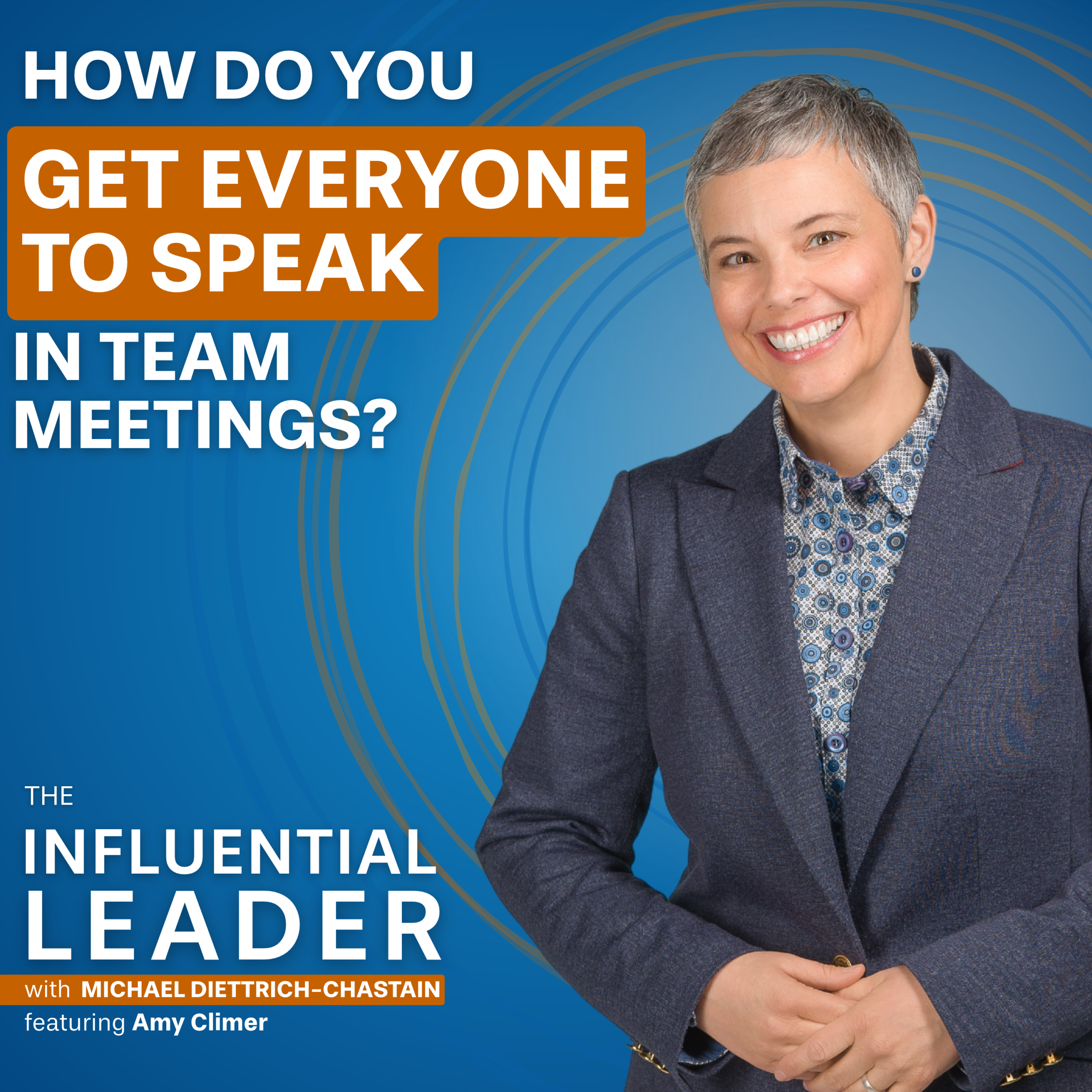
Why do smart people stay quiet in team meetings? Dr. Amy Climer joins The Influential Leader to show how leaders can make creativity more deliberate. She explains why innovative thinking matters during change, how to hold competing truths, and how systems can create space for better work. Amy shares a simple way to get everyone speaking early in a meeting, when to listen instead of offering solutions, and how a card can help people express a difficult thought. They also explore where AI helps and hinders creativity, and the three elements of an innovative team: clear purpose, healthy dynamics, and a creative process.
Chapters:
- 00:00:00 Why leadership teams need creativity amid change
- 00:06:00 Reading, empathy, and a better feedback habit
- 00:12:00 Use systems to handle complexity and opposing truths
- 00:18:00 When analog thinking helps teams create
- 00:24:00 Facilitate meetings so every voice is heard
- 00:30:00 Model authenticity and understand your audience
- 00:36:00 Fix team friction with structure and Climer Cards
- 00:42:00 What AI can and cannot do for team creativity
- 00:48:00 AI literacy, influence, and better questions
- 00:53:00 Deliberate Creative Teams and Amy’s three part model
Quotable Moments
- “Advice is one of those things that nobody wants unless they ask for it.”
- “Change the structure of your meetings so that it invites more conversation from everybody.”
- “It’s hard to influence if you’re not willing to share.”
- “Our ability to ask better questions changes the conversation, which changes everything.”
- “What I see is a lotta teams wanting to be creative, but they have no methodology.”
About the Guest
Dr. Amy Climer is an award-winning author and expert on innovation in teams. She facilitates innovation with organizations such as Mayo Clinic, FOX Sports, and the University of Wisconsin. With a PhD in Leadership and Change from Antioch University and over 25 years of experience working with leaders and teams, she is widely regarded as an asset in helping teams and organizations lead for innovation. She is the award-winning author of Deliberate Creative Teams: How to Lead for Innovative Results, designer of Climer Cards, and a TEDx speaker. You can learn more about Amy and her work at climerconsulting.com and at climercards.com.
–CTA: Deliberate Creative Teams: How to Lead for Innovative Results: climerconsulting.com/
Links and Resources:
- Amy Climer Website
- Deliberate Creative Teams: How to Lead for Innovative Results
- Climer Cards
- Climer Cards Free eBook: 50+ Prompts
- The House in the Cerulean Sea by TJ Klune
- Don’t Shoot the Dog by Karen Pryor
- The Tim Ferriss Show
- Google Docs
- Asana
- QuickBooks
- Amy Climer on LinkedIn
- Amy Climer on Instagram
- Climer Consulting on Facebook
- Amy Climer on YouTube
- Arc Integrated Website
- Strategy Call Page
- Podcast Page
- Michael Diettrich-Chastain in Linkedin
- Michael Diettrich-Chastain in Instagram
- Michael Diettrich-Chastain in Facebook
- Arc Integrated in Linkedin
Transcript
Click here to show transcript
Michael: [00:00:00] Today on the Influential Leader Podcast, I have with me my good friend Dr. Amy Climer who is an expert in innovation and creativity. And we talk a lot about innovation and creativity of course, but we also talk a lot about facilitation team dynamics, a little bit about AI and a number of other things.
Michael: A handful of highlights for me in this episode were her points around why innovative thinking as leadership teams is perhaps more important now than it ever has been,how to manage polarities as leader. This is something that we talked a, a strong bit about and it’s certainly a question that we get from our clients all the time.
Michael: in addition to that, Amy gave us some wonderful tips around how to facilitate better meetings. We talked about the importance of systems and structures when managing team dynamics. And lastly, the most important question leaders need to ask as it relates to AI, and this question is
Michael: not what you think it [00:01:00] is.
Michael: So with that, I hope you enjoy this episode with my dear friend Dr. Amy Climer.
Michael: Welcome to the Influential Leader podcast. I’m your host Michael Dietrich-Chastain and today I have with me my dear friend Dr. Amy Climer. She is an award winning author/expert on innovation in teams facilitating innovation with organizations like m- the Mayo Clinic, Fox Sports and The University of Wisconsin.
Michael: With a PhD In Leadership and Change from Antioch University and over 25 years of experience she is the author of Deliberate Creative Teams: How To Lead For Innovative Results and the designer of Climber Cards which if you’re watching this on video, we have both her book and the cards here. We’ll probably dive into both.
Michael: Amy welcome.
Amy: Thank you. It’s so good to be here. Yeah.
Michael: It’s good to be with you too. Yeah we’ve, we’ve been friends for a long time. We’re both in Asheville and, but we’ve never sat down like this before.
Amy: No. This is cool.
Michael: Great. I know I’m excited. I’m excited. I’ve got a number of fun questions for ya.
Michael: I’m excited for listeners [00:02:00] to hear more about your expertise in creativity and a lot of other things about you. But I start with creativity because it seems like maybe right now that’s a more critical skill than ever.
Amy: Mm. I think so. Do
Michael: y-, d- do you agree?
Amy: Yeah.
Michael: Yeah? T- Talk us through like why is it maybe m- a little more relevant.
Amy: Okay, going back a few years I feel like the… When COVID hit- Mm-hmm … we had this just beautiful example of what happens when organizations or companies aren’t willing to innovate.
Michael: Yeah.
Amy: And they just wither away and go out of business- Yeah … or become irrelevant.
Michael: Mm-hmm.
Amy: And I feel like now we’re in this new era with AI coming so strong and, and it’s everywhere now.
Michael: Mm-hmm.
Amy: And it… There’s still something really unique about human thought- Yeah … that AI can’t replicate. I
Michael: hope so.
Amy: I know, right? So…. yeah, so I feel like the, our, our ability to foster that within ourselves- Hmm … our ability to work in a team in [00:03:00] this collaborative creative way-
Michael: Yeah …
Amy: is so critical.
Michael: Yeah, yeah. I appreciate the notion of like innovation and finding creative solutions amidst change- Yes … and uncertainty and chaos which it seems like all signs point to we’re gonna have a lot more of that.
Amy: Yep.
Michael: A lot more chaos, a lot more uncertainty. So perhaps being innovative, like you’re saying, is- That’s it … more and more critical.
Amy: Yeah, I feel like creativity really follows some sort of need.
Michael: Hm.
Amy: Like, oh, I… I mean even something as simple as like, oh, this invention of this microphone I’m talking on. Uh-huh.
Amy: Like some-… There was this need of like, “Oh wait, we need to hear people from a distance.” Ah. And so someone comes up with this idea.
Michael: Yeah, yeah.
Amy: And it’s like if everything is perfect and going fine why… You don’t actually need to be creative.
Michael: Ah, that’s an interesting point. Yeah. yeah, yeah, which is not the case right now.
Michael: Right. Yeah. amazing. Well, we’re gonna talk a lot about AI today, about technology, about creativity. But maybe before we go there, you’ve got a tremendous bio, and you’re a really awesome human, so I wanna start with the human part.
Amy: All right.
Michael: What are three things you can tell us about who Amy is that [00:04:00] maybe don’t show up on your bio?
Amy: I love reading
Michael: Okay
Amy: I w- I think it was 2020 actually, I, started tracking how many books I read.
Michael: Oh, okay, cool.
Amy: And I only read 12 that year.
Michael: That’s pretty good.
Amy: I thought that was really bad.
Michael: Oh wow, okay. Okay.
Amy: So now I read about 50 books a year.
Michael: Fifty, wow.
Michael: You’re gonna have listeners feeling really bad about their reading.
Amy: Well, when I was 49, which I’m now 51, when I was 49- Okay … I read, I was trying to get to 50 and I only read 49 books. Oh, wow. Then I was just like, “Okay, maybe I just read as many books as my age.”
Michael: That’s amazing. So. That’s am-… Okay, that’s… I wanna hear your other two s- answers to this question, but I want to come back to that.
Michael: That’s- Okay … okay. So go ahead. Wait.
Amy: What was the rest of the question?
Michael: So the three things to tell us about you that aren’t on our bio.
Amy: Let’s see. I have a new puppy.
Amy: actually he’ll be a year next week- Okay … so s- s- puppy-ish, but I’ve been having- Love it … a lot of fun training him.
Michael: Okay.
Amy: Yeah. We, we’ve [00:05:00] been, I’ve been working one-on-one with this trainer and- … this dog is kind of amazing. He just… W- We actually got him when he was about six months and we thought, “Oh no, this dog is a disaster.” I mean, like, he just bit everybody. Oh. It was really bad. And then we started working with his trainer, and now he just, he follows us around.
Amy: Interesting. He doesn’t run away. Great. He just … I took him standup paddle boarding.
Michael: Oh sweet. Okay. Okay. Awesome. Okay, that’s number two, so new puppy. I wanna ask you a question about that too, but what’s number three?
Amy: Number three. well this, yeah, definitely may be a human side. So my wife and I, we have a daughter who’s adopted.
Michael: Okay.
Amy: She’s 25-
Michael: Yeah …
Amy: but we met her when she was 18.
Michael: Mm.
Amy: She moved in with, u- You al- you know this already but- Yeah, yeah … she moved in with us as a foster kid- Yep … and then when she was 20 we adopted her.
Michael: Yeah.
Amy: And, I have not met anyone else who’s done that.
Michael: Yeah, that’s so special.
Amy: Yeah, it was really unusual and-
Michael: Yeah
Amy: Yeah.
Michael: No, so cool. I think it s- it’s, it speaks to the big hearts you and Julie have. Yeah.
Amy: It’s hard.
Michael: Yeah. [00:06:00] We’re trying. No, no doubt. Wow, no doubt. Yeah, we have two little ones and, yeah, parenting is no joke. Yeah. Not for the faint of heart. Yeah.
Speaker 2: You ever wondered what your leadership style really says about you? Are you leading in a way that drives engagement, builds trust, and maximizes your influence? Well, we’ve got a resource for you. You can take our Leadership Influence Quiz, which is a quick three-minute assessment that gives you a personalized insight and roadmap and actionable strategies to improve your leadership effectiveness and ability to actually change behavior.
Speaker 2: The best part is that you’re gonna get immediate feedback with recommendations you can use right away to elevate your leadership game. Just go to leadershipinfluencepodcast.com to get your free report today
Michael: cool. Well, this show, as is about leadership.
Michael: The two things you started with actually I think have a good tie to leadership. So I’m sure you hear this all the time ’cause I know you work with a lot of leaders, but time constraint is always against us, right? Yes. Like there’s no time for this or that. [00:07:00] So I wanna ask you a time question about the reading.
Michael: 50 books a year is impressive. How do you, what are your strategies to make time for that?
Amy: Generally I always have an audiobook- Okay … and, either a e-book or a physical book that I have.
Michael: Okay.
Amy: And now that I have a puppy- … I go on a lot of walks. Uh-huh. And so often have an audio book.
Michael: Okay, cool.
Amy: But I also find that I kinda go in waves.
Amy: Like sometimes I’m reading, like, two or three books at the same time. Ah, okay. And other times, like actually at this moment I’m not reading a book I think I- Oh … like, I just get, oh, too much and I need to, like, have more space in my brain. See?
Michael: Yeah. Yeah, yeah.
Amy: That’s cool … and about 75% of those books are fiction-
Michael: which I find just easier to read.
Michael: Mm.
Amy: Yeah, it’s sort of like this escapism.
Michael: Okay.
Amy: And so that makes it not … I mean, it’s not work, At least to me.
Michael: Totally. I’m writ- I’m taking notes as we go. One of the… This is a quick story, and then a question follow up to that. So my dad and I, he’s a voracious reader, and he’s [00:08:00] 99% fiction, and we oft- I’m off- I’m often trying to convince him to read nonfiction, right?
Michael: ‘Cause all these great lessons. He’s often doing the same to me because his stance is always like, “There’s so many great lessons in fiction.” And so we have this kind of funny banter. So my question for you is, 75% fiction, what is a book recently that taught you an interesting leadership lesson or reminded you of an interesting leadership lesson?
Amy: Oh, I just, like I just got turned on to this, author T.J. Klune
Michael: Okay …
Amy: K-L-U-N-E. And I read this book called The House in the Cerulean Sea, I think that’s what it’s called
Michael: sci-fi?
Amy: No, but it was like- Okay … fantasy-ish Okay.
Michael: Yeah, cool
Amy: Yeah.
Michael: Yeah.
Amy: And actually, and then, and it’s a series of three books and,it, it is sort of like Harry Potter-ish type- Ah
Amy: of genre right now. Love it. Yep. There’s like these people with magical abilities and- Yeah … and, unlike Harry Potter the s- the quote unquote muggles, you know they don’t . Right … non-magical people- Yep … know about the magical people-
Michael: Yeah …
Amy: and they’re [00:09:00] just trying to prosecute or persecute them.
Michael: Oh yeah,
Amy: okay.
Amy: And, really- Mm … the way he wrote the book, i- kind of loosely, very loosely parallels like right now what’s happening to transgender people.
Michael: Oh interesting yeah, okay.
Amy: And it was just beautiful. The- Yeah … the book was so beautifully written and- Hm … th- character depth and it made me feel, the importance of empathy.
Michael: Hmm. Yeah of course. Mm.
Amy: And like you never know what people are going through and what they’re dealing with. Totally. And-
Michael: Yeah …
Amy: I think as a leader it’s so easy to quickly judge and just say, this person did this so they must be a jerk.”
Michael: Oh yeah, yep.
Amy: But maybe ask some questions. Mm-hmm. There may something behind that that- Yeah
Amy: chances are high they actually had good intentions.
Michael: Yeah. Yeah. Yeah assume good intent, right? Yeah. Yeah love that. That’s a great leadership lesson. Yeah. So in the theme of leadership lessons I want to go to the puppy for a minute.
Amy: Okay .
Michael: So you’re training the puppy. It reminds me the when you were telling that story it reminds me of a book that I think [00:10:00] heard first on the Tim Ferriss podcast years ago and I think it and ’cause references it as it relates to training people and I think it’s called Don’t Shoot the Dog.
Michael: Do you know this book? Oh I don’t
Amy: know that book
Michael: I think that’s what it is. But my, my curiosity is training this puppy what parallels do you see to training people?
Michael: Because you’ve done a lot of that. You know we’ve both done a lot of that. Yeah. So any, any parallels come to mind
Amy: I think one of the parallels is the importance of positive feedback
Michael: Mm-hmm
Amy: And, that’s kind of the big premise in dog training.
Amy: although with this dog I’m learning you need the positive and the negative- Uh-huh … so we have a technique for both.
Michael: Yep.
Amy: And, but I think if you only focus on one and point out all the problems- Yeah … then your dog will become neurotic and like always be like on edge, nervous- Hmm … and oh my gosh, what, what am I doing wrong?
Amy: Yeah. And so it has to know, “Hey, this works. This is what you’re looking for.” Yeah. “This is what, how I’m gonna get more fun if I do this.”
Michael: Yeah. Yeah, yeah.
Amy: And- It’s
Michael: great …
Amy: I think it’s the same thing with people that-
Michael: [00:11:00] Absolutely … y-
Amy: and I, I don’t remember the stat, I’m sure you’ve heard it before where, we n- we need to hear seven times more positive than negative in order- Yeah
Amy: for it to really sink in.
Michael: Yup.
Amy: And I don’t know if that ratio i- is so important, but just it needs to be something. Like- Yeah … there has to be some positive feedback.
Michael: Yeah, absolutely. Yeah. R- it makes me think about like a potential call to action for people that are listening. If you’re a leader trying to evaluate where are you putting the emphasis, is it overly on positive feedback or is it ovaly- overly on consequence to negative feedback?
Michael: ‘Cause you’re, like you’re saying ideally it’s a balance.
Amy: Yeah. Yeah. Yeah. Like maybe the call to action is count it.
Michael: Love that, yeah.
Amy: Like for now for the next three, four days- Mm-hmm … just count how many times you give either positive or negative feedback to, to- Yeah … people you work with.
Michael: Love it.
Michael: Love it. Yeah. Cool. we’re gonna go into leadership some more, but before we do, there is a unique thing about this podcast which you know about this and if … Yes, it’s the first time you’re listening to this [00:12:00] listener, you might not know this which is part of what we do to research the guests is that we give co- You have the opportunity to identify people that we’ll survey, which you did.
Michael: You gave us a few names. We surveyed them, asked them questions about your awesomeness, and we heard something back that was really cool and I got a number of questions about some of the things we heard back As a tee up to this question, you and I have talked about this notion that we are in a unique stage of life where we’re caring for parents that are elderly and challenged in a number of ways.
Michael: And, and then there’s… Like we talked about, there’s kids too. Like, we’re in this middle stage. A lot of the leaders you and I talk to are also in this stage. And actually, there’s a name for this as I was reading it, it’s called the sandwich generation- Yes … which I hadn’t heard of until recently. The sandwich generation of you’re forced or you’re, you’re positioned, right?
Michael: Mm-hmm. Care for the little ones or adult children, and you’re caring for elderly ch- parents as well. And so, there was a compliment that was given to you by someone that filled out this survey, and it says, related to family, challenges: “Amy did…” The quote is, “Amy did [00:13:00] this without shutting down, becoming cold, or ignoring the complexities of a huge family full of big personalities.”
Michael: So a really s- sweet compliment around, handling challenges. So the question for you is, what strategies have you applied to being so good at managing this stage of life? Because so many leaders, I think, are also in the same stage of life you and I are in.
Amy: I don’t know that I would say I’m so good at it.
Michael: Okay.
Amy: It’s been a lot of, trial and error.
Michael: Yeah.
Amy: And,I think this person was referring to last year, we– my mom moved into assisted living and that whole experience. Okay.
Michael: Yeah.
Amy: And I, I did a lot of the legwork- Hm … and organizing of that. one of the things that I did that I found really helpful is I tried to apply kind of the systems approach.
Michael: Okay.
Amy: Where I literally had like Google Docs-
Michael: Okay …
Amy: of like, okay, here’s the conversation I had with so and so, and here’s … I took notes in them, and they were, available. I was working a lot with my brother. And, um [00:14:00] You know, we, we could all see all of the information
Amy: And I was trying to be, as collaborative as I could with,i- in all the decisions that were coming up.
Amy: And, it… And also I think just trying to be patient and recognize this is complicated. Mm-hmm. And I’ve, I’ve never done it before. Sure. And most people who are doing it have never done it before. Yeah. You usually do it once or twice in your life, depending on how many parents you have-
Michael: Right,
Amy: right … and situations.
Amy: And-
Michael: Yeah …
Amy: yeah, so I think that, that was, trying to apply the systems approach.
Michael: Yeah.
Amy: And then I think the other thing I tried to think a lot about was that we as humans are complex people.
Amy: And that we might have, these dualities at the same time that are showing up.
Amy: yeah. Like, I don’t know.
Amy: The one that comes to mind is we might be both organized and messy, or-
Michael: Hmm ….
Amy: we might be both compassionate and gruff. And trying to recognize this is how people are and having grace an- and- Yeah … hoping people had grace with [00:15:00] me.
Michael: Totally. Yeah. That’s powerful. It, it reminds me of a, a different question, which is, I’m sure you see this too, like we’re in this time where one of the most maybe challenging things for all of us to manage, leaders I think especially, is managing polarity, right?
Michael: Like multiple truths at the same time, like you’re talking about, and then also the, the polarities of like, conflict that exists and ideologies there and, people just in… there’s a lot of tension around all sorts of topics. And so I’m curious, in your work, how have you seen leaders effectively manage polarity?
Michael: Or is there a best practice that you’ve seen work well?
Michael: yeah. we can take a quick, quick break. Yeah, we’ll just cut that, cut this part out.
Amy: Okay. All right, polarities.
Michael: Yeah, yeah
Amy: I think one of the best things leaders can do with polarities is just, [00:16:00] one, recognize they exist-
Michael: Mm …
Amy: and recognize that, that like I said, we’re all complex. We, we can move across a system. We’re not just one way. We might be this one way at one point for some reason, but then we might be able to shift and adapt in a different situation.
Michael: Yeah.
Amy: And I think recognizing that-
Amy: and, and also just recognizing, yeah, somebody can be both kind and assertive- Mm … at the same time, or something that we think are opposites, but they don’t necessarily have to be.
Michael: Yeah, agreed. Yeah.
Amy: yeah, I feel like just being able to recognize that is one of the most powerful things I’ve seen.
Amy: I love it. And, and saying it out loud sometimes-
Michael: Yeah, yeah …
Amy: can be really helpful.
Michael: I think that’s a great way f- to, embrace it as a value for others too, right? You’re normi- normalizing it- Yeah … and perhaps that, extends to the team or the culture hopefully of the company, right?
Amy: Yeah, exactly.
Michael: Yeah, yeah. So you mentioned systems, you brought up a couple times. Related to this feedback we got from others that we surveyed, there’s a, there’s a comment about systems I wanna ask you about. So here’s the quote that we got. It says, “Amy is a tools [00:17:00] and systems person.” Not surprisingly. “She responds to complicated situations with written organization.
Michael: I think for her it’s a way of focusing attention and creating order. You can only write one word at a time, so your attention is automatically focused when writing things down.” So makes a lot of sense. Does that resonate with you before I give you the question?
Amy: Sure, yeah. Yeah? Okay. I haven’t thought about that, but…
Michael: Okay, good, good. So my curiosity is in this time, we, we’ve talked about this already, like constant change, technological revolution, optimizing for efficiency always, right? When is it worth slowing down and being analog, and how do you know?
Amy: Yeah, I think… interestingly, I think for me having systems helps me slow down and be more analog- Mm
Amy: than I need to be.
Michael: That’s good, yeah.
Amy: because the systems for, like I have systems in place for things that are like repetitive, Okay, yep. I’m like, “Oh, okay, I gotta…” I don’t personally do this, I have an assistant now, but like oh, we got to enter stuff into [00:18:00] QuickBooks every month or, y- like send clients an invoice, right?
Amy: Mm-hmm. This is like repetitive stuff that-
Michael: Sure …
Amy: w- we don’t need to be thinking about too deeply. Yeah. Yeah, of course. So it’s like all right, we got this step by step written down. Just don’t even think about it until the time comes and just follow the steps, right?
Michael: Yeah, yeah.
Amy: what I find for me can be really helpful to get off the computer.
Amy: Like I know I need to do that if I’m stuck.
Michael: Okay.
Amy: So actually, this week was a great example. There’s this, new product that I’m working on, and I’ve not had my, this in my head for a very long time.
Amy: And I’ve made some progress, but I’m… there’s a bit more to go. I forgot what day it was this week, but all of the west side of town where I live lost pow- or lost internet.
Michael: Oh, right. Yeah, yeah. Did you hear about this? I remember, I remember this. Yeah, yeah. Yeah. It was those storms we had, right?
Amy: No,
Michael: actually- Oh, it wasn’t?
Amy: Well according to the, to Spectrum, it was a vandal cut the line.
Michael: Oh, no way. Okay.
Amy: So like I don’t know, 100,000 people lost
Michael: their internet. Oh, I did not hear about this.
Michael: Okay. Yep.
Amy: And so about four, by 4:00 it was back on. Yeah. And fortunately I didn’t [00:19:00] have a lot of meetings, but-
Michael: Okay, good …
Amy: it forced me to, I, I was actually typing on the computer, but I couldn’t get distracted and go anywhere else. Mm-hmm. And it was super helpful. I was incredibly productive.
Michael: That’s cool, okay.
Amy: But I find when I’m procrastinating on something, it usually means I need to get out pen and paper.
Amy: And usually it’s, for me, i- it’s usually where I’m trying to like develop something. Yeah. And that is, like I always have a lot of ideas, but developing them is where I get a little hung up.
Amy: Yeah. And so when I just get out pen and paper, sometimes it’s 15 minutes. Uh-huh. That’s it.
Michael: Yeah, yeah.
Amy: And then all of sudden I’m good to go.
Michael: Yeah, so interesting. It makes me think about, you and I have done a lot of workshops, right?- Mm … with teams. You’ve done a lot around creativity, that’s your specialty.
Michael: You got a PhD in it. I know that, and I think, correct me if I’m wrong, I, in your workshops it’s a lot of analog work, right? For sure. A lot of flip charting, a lot of, ideation work and- Yeah … and creative analog. Is there anything in the research that supports the idea that when teams are being creative and innovative in this way, [00:20:00] that they really should lean on analog processes versus digital?
Amy: I don’t know if I’ve seen that specific research.
Michael: Okay.
Amy: It might exist. Yeah, yeah. I, I don’t know.
Michael: Okay. Yeah, I’m curious.
Amy: I mean, I can certainly say from observation- Yeah … and personal experience, like watching teams-
Michael: Yeah …
Amy: that, if you have a team sitting around a table-
Michael: Mm-hmm …
Amy: and everyone has their laptop open-
Michael: Yeah
Amy: and say you give them a task to do collaboratively with their laptop.
Michael: Yeah.
Amy: Just they’re … And then you said that’s one view.
Amy: And then you have another scene where it’s like no laptops, markers, Post-Its, and you give them a task. Their body language is so different.
Michael: Totally agree.
Amy: I mean, they’re leaned in.
Amy: Some of those people are standing up and, like, pulling things across the table, just-
Michael: Yeah …
Amy: this energy shifts.
Amy: And y- yeah, I think, I don’t know. There’s something about computers. Like, I love them, they’re amazing, and then they can really get in our way.
Michael: Agreed. Yeah. And I’ve… I mean, I don’t know if the research exists on this either, but I’ve certainly witnessed this for many years- Yeah
Michael: that there is a, there is a radically different [00:21:00] presence when, we’re using analog together. And so, eh, presence is also something that we heard from those we surveyed I wanna ask you about. So I’m gonna read you another quote and give you a question. The question is, “What I think is unique that, what I s-…
Michael: Was, “What I think is unique that Amy knows that sometimes the solution is to do nothing, listen, and simply be present.” Beautiful compliment. My question is: How do we know when to ask, when to listen, and when to give feedback?
Amy: Yeah, I struggle with this Okay You… I, that- that’s amazing that person said that ’cause- Yeah,
Michael: yeah
Amy: this is sometimes a, a point of contention with my wife and I.
Michael: Okay. Yeah, yeah
Amy: Because I, both my parents give a lot of advice.
Michael: Okay.
Amy: And it has seeped into me.
Michael: Yeah,
Amy: sure, sure And, and so I have to work really hard to, to … Co- ‘Cause, I also am an idea person. Yeah, yeah I have lots of ideas. I’m like, “Oh, I have an idea what, how you could solve that problem.”
Michael: Yeah
Amy: When actually it’s not really a solvable problem.
Michael: Mm. Yeah, yeah.
Amy: And so one of the things [00:22:00] that I do, is I just sometimes ask.
Michael: Okay.
Amy: Mm-hmm And just say, “Are you looking for-”
Michael: Mm “…
Amy: ideas and solutions or do you just, are you just wanting me to listen?”
Michael: Yeah.
Amy: And-
Michael: That’s good …
Amy: sometimes they don’t know, but usually they do.
Michael: Yep
Amy: And then… And it also is like if they do say, “Oh, no, no, I want your ideas,” that’s really helpful to me because then I’ve just been given permission- Mm-hmm … and I don’t have to feel like, okay, do they want this? Do they not?
Michael: Yeah
Amy: And then if they don’t, I’m like, oh, okay, cool. I’m just gonna hang out and like- Take it in
Amy: I’m here for you. Yeah. Yeah, yeah. and I don’t always ask. Sometimes I, I try to feel it out- Uh-huh …. And- Yeah … and I don’t know, it just feels sort of intuitive at this point. Hmm Maybe because I’ve thought about it for so, likes for years just-
Michael: Yeah …
Amy: knowing that advice is one of those things that nobody wants unless they ask for it.
Amy: But it is, it can be fun to give.
Michael: Yeah, yeah.
Amy: But what’s the point of giving it if they don’t want it, Totally.
Michael: Yeah, yeah. Well, I, I appreciate this as a, a possible action for [00:23:00] those listening, right? Or for all of us, right? It’s like if we wanna flex this muscle of being good at intuiting the answer, we have to spend a lotta time considering it, right?
Michael: Like, and it sounds like you have. And I, part of the reason why I wanted to ask this question is ’cause I, we get this question a lot from clients. Like, “How do I know when to, give feedback or what kind of feedback or do I just listen or do I, direct,” Direct versus being inquisitive.
Michael: Ah. And so I think it’s a, it’s an important question and I appreciate your suggestion around maybe we just, it’s something to sit with more- Mm-hmm … to build the ability to be intuitive.
Amy: Yeah.
Michael: Yeah, yeah.
Amy: And I feel like in a lotta cases there’s not a right or wrong.
Amy: And yeah, I don’t know. I just err on the side of asking.
Amy: I think the other thing that goes along with this is that I have been trained as a facilitator.
Michael: Yeah, yeah.
Amy: And in facilitation you learn to just let there be silence.
Michael: Yeah, that’s right. You
Amy: know? That’s right. And just listen, so. Yeah,
Michael: yeah. Love that. Yeah, facil- on facilitation, what do you think about the idea that [00:24:00] at…
Michael: Like, facilitation should be a leadership competency? Like, do, do you think of it that way and, and, and if so, like, yeah, what come, what comes to mind when I say that?
Amy: I actually more and more think that.
Michael: Okay.
Amy: Because, I guess maybe depend- Like, when I think of facilitation I think of, at least in this context- Yeah
Amy: I’m thinking of, a leader leading a team meeting.
Michael: right. Which- That, that was my ima- image as well. Okay, cool. Yeah.
Amy: the number of team meetings I’ve seen or heard about that were not well done-
Amy: yeah … is very high.
Michael: Same, yeah. Totally.
Amy: Yeah. And so… And, and so often too I listen to, to issues from teams and I’m thinking, “All you gotta do is change how you do your team meetings-” Right
Amy: and this problem will be solved.”
Michael: Yep.
Amy: So I actually think facilitation’s really important- Yeah …. for leaders to understand how to do that.
Michael: Yeah. Agreed. Yeah.
Amy: And most team meetings are the leader comes in and says, “Okay, marketing, how’s it going?”
Michael: Uh-huh. “
Amy: Finance, what’s new?” and everyone’s just reporting
Michael: out.
Michael: Status update, yeah.
Amy: And-
Michael: Yeah …
Amy: like, you got some smart people at this table.
Michael: Yeah.
Amy: And this is what you’re gonna do for an hour?
Michael: yeah. Totally …
Amy: it just [00:25:00] seems like a waste of time. Yep. When it could be this collaborative, brain trust basically.
Michael: Yeah. Yeah. What’s one, what’s one fun facilitation tip that comes to mind?
Michael: Like, if someone were, l- leader’s listening and they’re like, “Okay, what’s one thing I can do differently?”
Amy: Well, one of the most common, problems I hear about- Yeah … our most frequently asked question is I have a team of 10 people, and in my team meetings only three or four people talk.
Michael: Hmm. Yep.
Amy: And have you heard this?
Michael: Of, of course, yep. Definitely.
Amy: Yeah. It’s like… Yeah.
Michael: And- How do we bring the others forward, or how do we get, how do we get the loud ones to be quiet?
Amy: Right, right. And there’s a number of approaches, but I think one thing that can be really helpful for a leader to do is at the very beginning of the meeting-
Michael: Yeah
Amy: some question or something where every single person has to answer.
Michael: Mm-hmm.
Amy: And there’s something about when everyone has said something early on-
Michael: Yeah …
Amy: they’re more likely to say things 10 minutes later, 15 minutes later, whatever.
Michael: Yeah. Yeah, yeah. Yep.
Amy: But if, if they’re, if a lot of time passes and they haven’t said [00:26:00] anything, they’re more likely to not say anything.
Michael: Yeah. That’s a great tip. Yeah, so have, like,… The way I, I would f-… The way I’m thinking about that is, like, get everyone to be vocal quickly so that it gets them practiced in speaking up.
Amy: Yeah.
Michael: Yeah.
Amy: And ideally something related to your topic.
Amy: if you’re like, “Oh, hey, everyone. Let’s go around and share our favorite color.”
Michael: Right. People get
Amy: really annoyed
Michael: about that. Yeah, nobody cares about that stuff- No. Exactly …. those icebreakers, right. Yeah. Yeah, yeah. Yeah. That’s cool. Okay. Okay. Interesting. Well, there’s a, there’s a question about, about authenticity I wanna ask you, and again, just the feedback that we got that was overwhelmingly, th- like, three themes came up about you: loving, generous, authentic, right?
Michael: Really- Wow … really nice things. The question is, what do you think are the best practices to being authentic, and why is it important in leadership? And, and the reason I’m going here related to what we were just saying is, like, there… And I think the risk in all facilitation is, like, the risk of it being contrived.
Michael: Right? The risk of it [00:27:00] feeling inauthentic or like we’re doing a schtick, right? And so it’s, and I know you know this, like, making it feel authentic. And so, yeah, so the question is, what are best practices in being authentic, and how should leaders be thinking about that?
Amy: That’s, yeah, that’s a hard one.
Michael: Yeah.
Amy: thinking about what I just said where you invite people to go around and share something-
Michael: Mm-hmm. Yeah, yeah …
Amy: I didn’t think this early in my career, but now I, I see the value of a leader going first.
Michael: yeah.
Amy: And that’s a great … I mean, you could, as the leader, you can craft the question to be a question that’s, a little vulnerable.
Amy: The first time you do this, ta- keep it lighter. Mm-hmm. And then maybe over time you ask questions that are inviting people to go a little deeper.
Michael: Yep.
Amy: But as a leader, you have to … if you model that, people are more likely to follow.
Michael: Sure.
Amy: yeah. and that could get into the contrivedness- Mm-hmm
Amy: in a way, but if you’re doing it over and over and you’ve created this environment-
Michael: Yeah …
Amy: then it’ll feel genuine.
Michael: Agree. [00:28:00] Yeah.
Amy: I think if you walk in and say, “Hey, we’re, we’re, we’ve never, … We need to change some things around here, so I wanna know like what’s a secret you have?”
Michael: Mm-hmm.
Amy: Something just like, “Whoa, what?”
Amy: No, no, no. Don’t start there. Right. You gotta k- keep the risk low.
Michael: Yeah, yeah.
Amy: so I think that is, it’s, it’s the role modeling and being willing to-
Michael: …
Amy: to do that.
Michael: The other thing I hear you saying is it’s im- m- maybe authenticity comes after regular practice.
Michael: Right? It’s like we have to almost like, not d- not to prove it to people, but certainly the more consistent we are, right?
Michael: Yeah. The more trust we build. And, and I th- I like, I love the idea of like you’re saying, like you gotta do it more than a few times for it to really … For people to believe in it perhaps. Yeah.
Amy: Yeah, and I think there’s this element of risk-
Michael: Mm-hmm …
Amy: where, when you’re, when you start off and you’re doing something new, it
Amy: You want the risk to be low.
Michael: Yeah.
Amy: And then the more, the more comfortable you get, you can start amping up the risk.
Michael: Hmm. Yeah, yeah.
Amy: But if you go in at really high risk, it’s gonna be a disaster.
Michael: Yeah. Yeah, yeah. So. Yeah, [00:29:00] it’s tricky balance, right?
Amy: Yeah. And so as a leader, you can set up those conditions so that, hey, I’m gonna invite you all to do something low risk to start.
Michael: Mm-hmm.
Amy: And then over time as we get more practice and we’re more comfortable, we amp up that risk.
Michael: Yeah, yeah. ‘
Amy: Cause I think being authentic can be risky.
Michael: Oh, yeah.
Amy: Because what if the person’s like, “Okay, what’s wrong with you?”
Michael: Yeah, yeah, yeah. Yeah. And I, and I also … I think, I think you’re also saying, or are you saying that when there is a, an interesting or maybe a little bit of depth in the question that the leader’s vulnerability modeled first, maybe that’s the time for them to be a little more vulnerable so that it models others to come forward?
Amy: Yeah.
Michael: Yeah? Okay. cool. Well, we’ve got a s- leadership skills. We’re gonna s- kind of continue to go on that track. So I’m gonna shift gears a l- a little bit into your experience. It’s gonna, it’s gonna point us toward another leadership skill, and for those that don’t know, they may not know this about you.
Michael: I don’t think this was hit in your bio, but I know this about you. You are an exceptional emcee. You’ve done this a lot, and my [00:30:00] curiosity is what can you tell us about the principles of holding attention in a room? And what leadership lessons, leaders could apply to employee engagement?
Amy: Okay.
Michael: So if you think about holding- Yeah
Michael: attention in a room, what, what principles could leaders take and then reapply to employee engagement? Ooh,
Amy: that’s a good question.
Amy: Yeah, I have emceed a number of different types of events. Right. Mostly sort of conferency, conference style events- Yeah … but ranging from, 100 people to 1,000 people.
Michael: Awesome.
Amy: And all sorts of different types of groups.
Michael: Uh-huh.
Amy: And so I think one of the first things that I find is super helpful is to know the audience.
Michael: Okay.
Amy: To just understand who they are as much as you can.
Michael: Yeah.
Amy: Yeah, yeah. Like one, one group that I ph- I emceed was … Oh gosh, I’m gonna forget the name of the association, but it
Amy: was, That’s okay … outdoor, outdoor leaders, outdoor recreation leaders. Oh, okay. Uh-huh. Right? Like these folks are up for anything. these are like the summer camp [00:31:00] professionals. Yeah. They’re leading rock climbing trips- Yeah … backpacking trips, that kind of thing. Yeah. And, so I knew going in I could be a little goofier.
Amy: Yeah. I could throw a game at them and they were gonna … if I said, “Hey, stand up and clap and then touch your head,” they’re gonna do it.
Michael: Totally, yeah.
Amy: But then this other group that I’ve emcee’d several times th- They’re, professionals that work in the, the hospitality industry.
Amy: And they’re amazing, but I was certainly not gonna do that on day one.
Amy: I have- Yeah … If I was gonna do that with something kinda silly with them, I would need to lead up to it. Kind of the same thing we were just talking about with risk.
Michael: Yeah, yeah. Definitely.
Amy: The, the… With employee engagement, it’s knowing your employees. Like- Hmm … who are they? What do they want? What do they need? when I’m em- gonna MC a conference, I spend a lot of time before the event talking with the staff and tell, you know- Sure … we go through everything together. We have a script, and it’s, it’s actually way [00:32:00] more work than keynoting a conference.
Michael: yeah, oh yeah, for sure. Mm-hmm.
Amy: but I think, yeah, really understanding em- the group- Yep … and the employees and the individuals, and that does take a lot of work.
Michael: It does. Yeah. It does, yeah. I w- I was, I was on a call today with a new client. We’re preparing for an event with them, and we were talking about this idea and saying that, like, one of the, one of the most important things we have to kinda plan for in gathering large people is that f- to the best of our ability, everyone in the room, whether it’s, 50 or 1,000, have to feel like they have a voice.
Michael: And that’s … and si- similarly in an employ- employee population, right? that’s the thing that’s gonna have people lean in, is if they feel like they’re seen, and they’re heard, and that their voice matters. And so- Yeah … that’s good. That’s a, that’s a really good lesson. And to your point, lots of work.
Amy: Yeah. I mean- Yeah, yeah … yeah, it’s interesting. I just was thinking about, someone who I’m gonna be intentionally vague about th-who they are, but- Yeah … someone I know and, and the context she works in, she recently just this week got some [00:33:00] feedback that- Mm … it wasn’t really, like, feedback. It was just a in-the-moment like, “Hey, that’s not up to standard.
Amy: You’re not doing that right.”
Michael: Mm-hmm. Okay.
Amy: And she was kind of taken aback because she’d seen all these other employees do the same thing.
Michael: Sure.
Amy: She’s like, “Okay, I don’t understand.”
Michael: Yeah.
Amy: And when she tried to push back to the manager, he just was like, “I don’t wanna hear your excuses.”
Michael: Oh, gosh. Yeah.
Amy: I know this person really well, and she’s very receptive to feedback when it’s delivered well.
Michael: Yeah, very good. Yeah.
Amy: And to me, that’s, that’s employee engagement. Like, this manager could have… It would have taken just as long, maybe less time- Mm-hmm … to just say, “Hey, look, I noticed this thing. let me just explain to you why this isn’t, doesn’t work here,” and just to the patience to Adjust your approach
Amy: can, I mean she is a, she can be very loyal
Michael: Yeah
Amy: And she’s also now considering a new job, not just from that one incident, but from a few.
Michael: Sure, there’s a few, right.
Amy: Right.
Michael: Right. Yeah. [00:34:00]
Amy: And-
Michael: Makes sense …
Amy: yeah, it’s like people don’t leave their jobs, they leave their managers.
Michael: Yeah, absolutely. Absolutely, yeah
Amy: Or their leaders.
Michael: Yeah, whether we’re talking about, engaging employees, surveying employees, putting in feedback mechanisms, and c- it comes back to, I think, in a lot of ways, like your comments about structures and systems.
Michael: Like this allows us to kinda amplify and create ease in which we’re working. And so I’m, I’m curious when you think about the biggest opportunity for leaders and teams to leverage more systems or structures, what, what comes to mind? Like, a- and, and it could be totally unrelated to what we’re talking about regaring- regarding feedback.
Michael: but systems and structures, what’s something that you see teams have an opportunity with that maybe they aren’t leveraging as much?
Amy: I think it… You know what? Think about in your team whatever, where- wherever there’s like a sticky point, a struggle- Okay … something that is not going well.
Michael: Mm-hmm.
Amy: And look at the systems or the structures that either are or are not in place- Hmm
Amy: that might be contributing to that.
Michael: [00:35:00] Okay.
Amy: I have talked with an inordinate number of teams who I ask them, I say, “Tell me about your, h- how do you track the tasks that you all have?” Yeah, right. Like, do, do you have like a shared… are you using a tool like Asana or some sort of shared tracking tool?
Amy: And they look at me like I’m nuts.
Michael: Uh-huh. Yeah. They’re
Amy: like, “What do you mean?” I’m like, “Well, like a shared to-do list-” Right, right … “or a, a project management tool.” Uh-huh. No, they’ve never- Yeah … they don’t use anything like that. It’s oh. But then one of the problems they’re having is that people aren’t doing the task they said they were gonna do.
Michael: Yeah.
Amy: Like, of course, because people are forgetting and there’s no way to track it and they’ve got 100 things going on in their mind and-
Michael: Yeah,
Amy: yeah … so I think if you can look at whatever, wherever your, your challenge is, what might you do to change the structure?
Michael: Hm. Okay.
Amy: That was good.
Amy: Kind of like when I said earlier where if you have only four people on the team talking, change the structure of your meetings so that it invites more conversation from [00:36:00] everybody.
Michael: Love it. Love it. Yeah, that’s good. That makes sense. I think, there’s an interesting bridge to your cards here, so if you’re watching this on video, I’m, I’m holding The Climber Cards, which are a tool…
Michael: Well, you c-… Amy, you could, you could tell us about it. What are climber cards?
Amy: Well, you’ve used them.
Michael: Ha, I have. They’re great. I love ’em.
Amy: Climber Cards are this deck of cards that I created. They are the size of playing cards.
Amy: And on one… There’s two different decks. one, on one side of both of, on both of the decks are these images.
Amy: Mm-hmm. There are like these watercolor paintings that I did.
Michael: Oh, y- and you did these? I love that.
Amy: Yes, I painted all of these.
Michael: So, so, so cool.
Amy: And so the way it works is you lay them all out on the table-
Michael: Uh-huh …
Amy: and then you ask a question. Yep. And you say to the group, pick a card that represents blah, blah, blah.
Amy: Mm-hmm. So maybe you’re starting off your team meeting and you’re about to do, have a conversation about your budget- Mm-hmm … so you might say, “Pick a card that represents where you hope we get with our budget”- Hm … or a concern you have about [00:37:00] this conversation we’re about to have with our budget.
Michael: Yup.
Amy: And, everyone picks a card and- I
Michael: got one.
Amy: Each person can share, they go around and share like, “Oh, well, I picked these bears because, I’m really concerned that we’re not gonna have team unity after this budget conversation.” Yeah. Yeah, yeah, yeah. Or w- whatever they say, it doesn’t matter.
Michael: Yup.
Amy: But there’s something about Answering the question while pointing at this object- Yes …
Michael: this
Amy: card, Yes. And what happens is people tend to go deeper, they get more specific. Yeah. the conversation’s more focused.
Michael: Yeah.
Amy: And yeah, they’re kinda surprisingly powerful.
Michael: Absolutely. And, and I … I mean, I’ve used these a lot.
Michael: I agree, super powerful. and the reason I’m talking about this we- as it relates to structures, what we were just talking about, I like thinking about tools like this as a technology.
Amy: Yeah.
Michael: Because this is- Yeah … right? This is a structure that will optimize crea- I think creativity- … conversation, communication, all the things.
Michael: And, and the, the [00:38:00] thing that you, that you highlighted about what, what makes possible, one of the things that I think allows for that is the de-centering of- Hm … using a card. It’s like you’re using a third party to tell a point that makes it more comfortable ’cause it’s not coming from you, right?
Michael: It’s coming from the card. has that been your experience? Like, people’s comfort level goes up- Yeah … in revealing truth. Would you say that that’s true? Yeah.
Amy: Yeah. Actually, in the world of facilitation, it’s ca-… This is called a third point.
Michael: Oh, I- So- Oh, that’s so interesting … yeah. I had not heard it called that before.
Michael: Yeah. A third point.
Amy: Yeah, which is basically what you said.
Michael: Yeah, yeah, yeah. That’s so funny. That’s so funny. Okay. Huh, I c- … Yeah, awesome. But
Amy: I don’t know why … I mean, I guess it’s a third ’cause it’s like maybe we are one and two- Y- yep …. and this is, like, this other thing over here.
Michael: Yeah.
Amy: But yeah, I … Yeah, there is something about I don’t know, it’s like, like we’re all looking at the card instead of-
Michael: Yeah
Amy: like you’re looking at my card instead of me so I can open up a little bit more.
Michael: Yeah, right, Yeah. Yeah. Well for th-… For those listening highly recommend you check this [00:39:00] out Climber Cards and we’ll put links to that in the show notes but yeah, I would, for anybody that may have doubts about this I would invite them to experiment, And there’s all sorts of ways to use these. I think those are also in the card deck, right?
Amy: Yeah. Okay. And there’s like a free download on the website,- Okay cool … called an e-book. Cool. And if you are listening CLIMBER is spelled without a B .
Michael: Ah yeah C-L-I-M,… C-L-I-M-E-R.Yep.
Amy: Yeah, yeah climbercards.com.
Michael: very cool.
Michael: Well good well uh we’re gonna go in a fun direction. I’m going to ask you the same question that you’re going to get which is one of the fun things we do on the show is we ask the guest to give us a question for the next guest. Right? So the, the question that we got from the last guest is when you look back on your career what’s the best decision you’ve made as leader or a best decision that you’ve made?
Michael: What comes to mind?
Amy: Probably marrying my wife. All
Michael: right. Good. That came up. Good. Hope she’s listening.
Amy: Yeah right. yeah [00:40:00] I… Well i f I was to think, I mean it’s funny ’cause that’s like one of the best decisions I made in my life.-
Michael: Yeah, yeah, yeah.
Amy: Right?. For sure. Mm-hmm. And so and it has had such a big impact on my career-
Michael: because she has just been so incredibly supportive. Yeah. I’ve been able to start this business in part because of her support.
Michael: Yeah.
Amy: Especially y-you know I started back in 2009 and, yeah I don’t know. It’d be really- That’s a great answer … yeah it’d be weird- It’s a great answer ….to t-try to imagine this without her.
Michael: Well and I think, and I, and I’m sure you’ve heard others talk about this idea that like the partners we choose have o-some of biggest impact on all things right? Yeah. And so I think it is a, a great leadership lesson- Yeah … to be mindful of who we’re choosing as partners and, and I think to be mindful of who we’re surrounding ourselves with in general, right?-
Michael: Mm-hmm … right? But partner specifically so- Yeah …yeah that’s cool.
Amy: Absolutely.
Michael: That’s cool. Well we’re gonna kinda te-… head toward ending the plane but before we do, I want to talk about AI. So we were talking- Hm …about technology with these cards, right? A technology, a tool for up-upgrading experience but we’re also [00:41:00] in this like technological shift as a species you could say.
Michael: So I wanna get your insight into a few AI questions if that’s all right. Sure. Yeah? So first one is, in your work currently with leaders and teams how are you generally seeing AI impact the clients that you work with? And take that in any direction you want
Amy: I think, sometimes I see kind of a riff-
Michael: …
Amy: where, within the organization where some are just like, “This is so cool.”
Michael: Mm-hmm. And
Amy: then some are like, “Oh my gosh, this is the worst thing ever,” Okay.
Michael: Oh yeah, yeah.
Amy: like there’s
Michael: s- Pol- another polarity, right?
Amy: Exactly, right?
Michael: Yeah,
Amy: yeah.
Amy: And we probably really need both.
Michael: Sure.
Amy: You know- Agreed … going back to the
Michael: polarity. Agreed.
Amy: but I do think that can make be a challenge.
Michael: Mm-hmm.
Amy: and I think the,… I, I probably tend to fall more towards the, “Oh, this is really cool” side . Yeah, yeah. I, I think AI is, is fascinating.
Amy: Uh-huh. I certainly have some reservations, right? Yep. Hopefully we all do.
Michael: Yeah, yeah.
Amy: but sometimes when I watch anything new and there’s like this resistance to change, I [00:42:00] think it’s worth looking at what’s that really about?
Michael: Great question.
Amy: I think it’s not about the technology.
Michael: Great question.
Amy: There’s something else going on.
Michael: I love that. I’m taking a note of that question, what is resistance to change really about? So speaking of change what do you think or do you have any predictions about risks and benefits that AI poses to teams and their creativity specifically?
Amy: I think that AI has the potential to help teams be creative in the sense that it can help speed up those tasks that-
Michael: Sure The menial stuff
Amy: Yeah Yeah It’s like, just some of…
Amy: I mean, even one of the things that I hate in my own work- … is writing proposals.
Michael: Sure, sure. Yeah
Amy: As we’ve talked about.
Michael: Sure. Fast tracks that. Yeah,
Amy: exactly.
Michael: Yeah.
Amy: and it does lead me,my mind is now open to do more creative work.
Michael: Mm-hmm.
Amy: My concern with AI, and something that I’ve seen teams do, is like, “Oh, we need a new idea.
Amy: Let’s [00:43:00] ask AI.”
Michael: Ooh, yeah.
Amy: But the problem is AI is built only on all of past human history.
Michael: Right.
Amy: So AI is just pulling from what’s already been done. It’s … our brains are the ones that are particularly good at imagination and inventing- Mm-hmm … new things. And the few times that I have asked AI for help with ideas, I have been…
Amy: it just felt kind of blah.
Michael: Yeah, yeah, yeah. Yep.
Amy: Agreed. and I’ve had people say, “Well, you just weren’t asking it the right way.” I’m like- Mm-hmm … maybe. Yeah. I don’t know.
Michael: Yeah.
Amy: but when you were really trying to generate something new, I think that’s where we need the human brains.
Amy: And in a team, our ability to collaborate is now those brains can just be, like, exponential.
Amy: And but then we need s- the collaboration skills in order to get there.
Michael: Yeah, I love it. I love it. An- another, guest recently was talking about this idea. His quote was, “Have A- have AI think with you, not for you.”
Michael: Yeah. And his recommendation w- similar to what we’re talking about, was [00:44:00] around giving AI the, the s- the instruction to push back and kinda deconstruct, an idea rather than- Hm … just be, like, a blanket supporter of it. which I think is kinda fun. but I really love what you’re saying, that e- the way I’m thinking about it, is that, like, yeah, their AI has a…
Michael: It’s almost like it has a, a limited data set, right? Right. It does. It does have a limited data set, but we don’t.
Amy: Yeah.
Michael: And we never will, right? No. We… And, and this, yeah, this gets into some, some interesting territory-
Amy: Yeah.
Michael: … of, of possibility.
Amy: And AI has a data set that we don’t have.
Michael: Mm-hmm.
Amy: Mm-hmm. Right? Like, I mean, I don’t know all of human history.
Amy: Right, right … so yeah, I do think that. I like that i- the idea of looking at, like, how AI worked with you, not for you.
Michael: Yeah. Yeah, yeah. Yeah. Cool. Well, n- we don’t have a crystal ball, but do you have any opinions or predictions about what may happen in the next 10 years as a result of AI, particularly in regards to, like, team dynamics, leadership, the workplace?
Michael: Anything [00:45:00] you wanna say? And this will be on record.
Amy: See how good I am
Michael: tomorrow. No, no, no pressure. No pressure.
Amy: I do think that one of the things that’s going to happen is that if p- the people who are not willing and able to at least learn AI to some degree-
Michael: Mm-hmm …
Amy: they’re gonna be left behind.
Michael: yeah.
Michael: I’m worried about that too. Yeah. Yeah.
Amy: And I actually, as a, as a parallel, I think about, My, my wife and I, we each have two parents- Mm-hmm … and so of the four of them, like watching how they either embraced or didn’t embrace technology in their lifetime-
Michael: Yeah …
Amy: and all of them are, like my dad’s the youngest who’s maybe 78, 79.
Amy: Mm-hmm. And her mom’s the oldest of 91.
Michael: Okay.
Amy: And those, of the four that embraced technology earlier, like in their 40s, 50s, have had an easier time in their aging years.
Michael: Yeah, makes sense. Right? Makes sense.
Amy: Like my mom literally had the first iPhone.
Michael: Yeah. Okay. There you go. There you go.
Michael: She’s like
Amy: had every iteration of iPhone, right?
Michael: Sure.
Amy: and it just [00:46:00] enabled her to do more later.
Michael: Yep.
Amy: whereas my father-in-law, I don’t even know if he ever really used a computer. Mm-hmm. Maybe a little bit at work early- Yeah … in the ’80s.
Michael: Yeah, yeah.
Amy: But I, so I think AI’s gonna be the same.
Michael: Mm-hmm.
Amy: And that those who aren’t willing to learn it, you don’t, maybe you don’t need to be an expert, but if you’re so against it-
Michael: Yeah …
Amy: it’s just inevitable at this point.
Michael: Great points. Yeah. Yeah. Great points. Yeah. And I’m, I’m im- I’m imagining and I’m picturing like the last bunch of years, last couple decades let’s say with, with technology and how it’s changed and knowing how fast things are moving now.
Michael: It’s almost like the risk you pose maybe has sped up in risk-
Amy: Yeah,
Michael: I think so … versus things like cell phones and internet and et cetera. Yeah.
Amy: yeah. I think it’s gonna, I think it’ll h- hurt teams or impact teams because, like if somebody on the team isn’t able to use th- the tools-
Michael: Yup …
Amy: then it’s going to be really hard to keep them in the team.
Michael: Yeah. Yeah, yeah.
Amy: Because the rest of the [00:47:00] team will be like moving forward and-
Michael: Mm-hmm.
Amy: Yeah … yeah, it’s kind of like trying to have a teammate that won’t use Google Docs.
Michael: Yeah. Right, right, right. Yeah. To, yeah, t- It’s like I
Amy: can’t keep sending you a PDF- … every time we edit this.
Michael: That’s a great point.
Michael: Yeah. Yeah, that’s a good… I hadn’t thought of that. That’s good. That’s good. Awesome. Well Amy, this has been super fun. I hope it’s been fun for you too. No, this has
Amy: been great.
Michael: Thanks. Yeah, yeah. Cool. handful of questions that are kinda rapid fire we ask every guest. First one is do you have… the, the show is obviously Influential Leaders, so we talk about influence and how leaders can do their best to influence and hopefully change the behavior of those they’re leading.
Michael: I think that’s the meta question that are at, that they’re asking. Do you have a best tip for how leaders could influence those they’re leading, or a tip that comes to mind?
Amy: But I think one thing is, like you have to be willing to share
Michael: Okay
Amy: I, sometimes feel like I l- I’ve talked to leaders who are like, “Well, that’s, that’s my… I don’t wanna share that because I don’t wanna…” [00:48:00] I mean, for who– For all sorts of reasons. Either they don’t want to sound too, like grandiose or something.
Amy: Yeah Or also they’re like, “Oh, well, that’s personal and I, I think we should keep a separation of personal and professional.” And- Mm-hmm … certainly to a degree that is true. But, I just feel like be willing to like open up and share- Hm … who you are and-
Michael: Yeah …
Amy: it’s hard to influence if you’re not willing to share.
Michael: Yeah. Yeah. Love it. Makes sense. Okay. next question is: When you think about asking better questions of self and others, what relationship do you think that plays with influencing behavior change for a leader?
Amy: Like our ability to ask better questions?
Michael: Of ourselves and others, yeah. Do you think that there’s a connection between that and influencing behavior of others?
Amy: Absolutely.
Michael: Yeah.
Amy: Yeah.
Michael: Any thoughts about it?
Amy: I mean, I think that S- often we, maybe this goes to what I was talking about the very beginning of those- Mm … the fiction books that I was [00:49:00] reading and how- Oh
Michael: yeah, yeah …
Amy: when we can, not make assumptions about other people but instead ask questions.
Amy: Yeah. Come from a place of curiosity, I think that’s huge. Mm-hmm. I think it can have a really big impact on our ability to lead and connect, which connection’s a big part of leadership certainly.
Michael: 100%, yeah. Yeah, that’s, that’s my belief. That’s, it’s a little bit of a, I don’t think I’ve told you this, a little bit of theory for the show that, this show is essentially a testing ground for a hypothesis, and that’s my belief.
Michael: The hypothesis is our ability to ask better questions of self and others is our best path to influence. And so, yeah, we’ll see. I’m curious to see what all experts like yourself have to say about that as we get into a lot of episodes here. So we’ll see.
Amy: Yeah, one other thing just-
Michael: Yeah,
Amy: yeah … in, in context of the podcast.
Amy: Yeah. And I’ve been on a lot of podcasts.
Michael: Okay.
Amy: And you’re asking really good questions.
Michael: Okay.
Amy: And for one they’re, they’re not the same old questions that-
Michael: Yeah, yeah. Good …
Amy: And I can [00:50:00] tell how I show up on a show.
Amy: I, pretty early on in the first few minutes, especially if I don’t know the person, like I’ve figured out have they done any homework?
Michael: Hm.
Amy: And any prep, and are they showing up from a place of curiosity or are they showing up from like, “Yep, it’s episode 421.” “I have to get this done.” Right,
Michael: right. Yeah.
Amy: and I feel like I show up different.
Michael: Sure. I’m like, oh- Yeah, yeah …
Amy: Like you’re,- Mm … I’m like, oh yeah, we’ve, I mean we’ve known each other for over 10 years.
Amy: Yeah, yeah. Here we are just having a good time.
Michael: Love it.
Amy: But I feel like, yeah, our ability to ask better questions changes the conversation- Mm … which changes everything.
Michael: Yeah, yeah. That’s such an interesting feedback, and thank you. Oh my goodness. Yeah, thank you. It’s a total pleasure to hang with you and- Oh,
Amy: likewise
Michael: yeah, that’s cool. That’s cool. Okay. Well, speaking of questions, what question should we ask the next guest?
Amy: Oh my gosh. Maybe what’s a, what’s a creative idea that you have seen come to [00:51:00] fruition that made you really happy?
Michael: That’s great. I’m taking notes here Okay I like the ending that made you really happy. . Excellent. Well, Amy, what, whether it’s a resource or a, a direction to connect with you on social, like, what can we tell listeners about how to do more with you?
Amy: yeah, you can certainly find me on social media- Okay … I’m Amy Climer, C-L-I-M-E-R.
Michael: Yeah.
Amy: I also have a book. We didn’t talk a whole lot about it, but some of the concepts- Yeah … we talked about are in the book.
Michael: Do you wanna take a couple minutes and say anything, anything about it? We can.
Amy: Sure.
Michael: Yeah, yeah.
Amy: this
Michael: is- It’s a great book.
Amy: Yeah, it’s called Deliberate Creative Teams: How To Lead For Innovative Results.
Michael: Yeah.
Amy: And some of the concepts in … That we talked about are in here. Mm-hmm. But it’s really about how to help your team be more innovative.
Michael: Yeah.
Amy: And it’s called Deliberate Creative Teams because what I see is a lotta teams wanting to be [00:52:00] creative, but they have no methodology.
Amy: Hmm. No approach, no system, and it’s really a, a system of how to be more creative
Michael: when you get into it. Back to systems, yeah.
Amy: Yeah.
Michael: Systems and structures. Yeah, yeah. Is there, just to highlight it for a second ’cause I really do, I, I mean, you’re my friend, but I also, I’ve given this book to a lotta clients before.
Michael: It’s, it’s a great book. Thanks. Is there a system, a tool, a, a, a call-out model from this that you wanna highlight real quick?
Amy: Sure. Yeah. Yeah. Yeah, there’s a model in there. it’s based on research I did where I was looking at, … I, look, I have had the experience, and you probably have too, where I’ve been on teams that were highly creative.
Michael: Mm-hmm.
Amy: And then other teams that weren’t.
Michael: Yeah.
Amy: And I’m like, “Okay, what’s the difference between these two teams?” And what I found were these three elements that creative teams have which are, and I have them in a three circle Venn diagram.
Michael: Okay.
Amy: So clear team purpose. Mm-hmm. So team purpose is one. Team dynamics and team creative process.
Michael: Okay.
Amy: So team dynamics are, like, those behaviors, interactions between the team members.
Michael: Yep.
Amy: And [00:53:00] then team creative process is the how. Like, how are you- Hmm … what’s your methodology for being creative?
Michael: Yup.
Amy: And most teams have never thought about that. Yeah. They don’t know that there could be a process. And so a big part of the book is on that.
Michael: That’s cool. Okay. Excellent. Excellent. Well, we’ll put a link to the book. We’ll put a link to the, to the cards, which is cool. I’m holding this up if you’re watching this on video. And link to your socials and anything else before we wrap?
Amy: That’s it. Thank you so much, Michael.
Michael: Yeah. This was
Amy: fun.
Michael: Super fun.
Michael: Super fun. Excellent. Well, thank you.
Speaker: Leaders, if you’re listening to this, you’re probably asking some common questions. Questions like, how do you retain top talent? How do you improve engagement? How do you build a culture that people are actually attracted to and want to stay in? And you’re not alone in this. Most leaders are asking similar questions.
Speaker: There’s a lot of pressure around this. The good news is, is that there are clear solutions around how to do these things well and what to avoid. So for that reason, we are offering a free [00:54:00] strategy call. This is a no-strings-attached conversation where we take a deep dive into your business, your culture, your employee challenges, and ultimately identify opportunities that you can take and immediately apply into your business to see results.
Speaker: In addition to that, I’m also happy to share some of the lessons I’ve learned over the course of a decade plus working with all sorts of businesses from family-owned companies to Fortune 100 organizations, and share some of the strategies that I’ve seen be really effective in moving the needle on employee engagement, attraction to talent, and ultimately how to create a peak performing workplace.
Speaker: If that sounds interesting to you, just go to leadershipstrategycall.com/podcast to book your free call today. Look forward to talking with you soon. Thanks so much
Michael: All right everyone, that’s it for this episode of The Influential Leader Podcast. And as Amy mentioned, perhaps one of the most important things we can do right now in the midst of all the [00:55:00] change and uncertainty and chaos in the world is be more creative and innovative as leaders and as team members.
Michael: So with that, thanks for listening. We’ll see you next time. Take care